



 下载:
下载:

-
青藏高原的隆升是印度—欧亚板块碰撞引起地球内部动力学过程的直观体现(Yin and Harrison,2000;Wang et al.,2014;Ding et al.,2022),并对浅表圈层产生了重要影响,一直是地球科学领域的研究热点。青藏高原的隆升驱动了亚洲季风的形成和演化(Molnar et al.,1993;An et al.,2001;Guo et al.,2002,2008;Boos and Kuang,2010;Wu et al.,2022)、加强了岩石圈的风化和剥蚀(Raymo et al.,1988;Raymo,1991;Raymo and Ruddiman,1992;Fang et al.,2019)、引起了区域大型水系的重组(Clark et al.,2004;Zheng et al.,2013;Zhang et al.,2022)、促进了生物多样性的演化(Deng et al.,2011,2020;Spicer,2017;邓涛等,2019;Ding et al.,2020;Feijó et al.,2022)。因此,研究青藏高原的隆升历史不仅对理解大陆岩石圈的变形机制至关重要,也是认识地球多圈层相互作用的核心科学问题。
尽管对青藏高原的隆升和扩展已有广泛的研究,但关于其隆升时代、幅度和方式仍然存在激烈的争论(李吉均等,1979;中国科学院青藏高原综合科学考察队,1981)。为解释新生代青藏高原的隆升和扩展,至少存在两种主要模型:(1)青藏高原北部的隆升在印度—欧亚板块碰撞不久后便开始发展(Yin and Harrison,2000;Yin et al.,2002;Clark et al.,2010;Duvall et al.,2011;Zhuang et al.,2011;An et al.,2020;He et al.,2021);(2)青藏高原中部率先隆起,南北两侧直到中新世才被卷入(Wang et al.,2008,2014;Fang et al.,2020;Ding et al.,2022)。这些截然不同的模型大多以青藏高原北部新生代沉积盆地或造山带隆升的起始时间作为依据。由此可见,高原北部的隆升时间是检验现有隆升和扩展模式的关键。
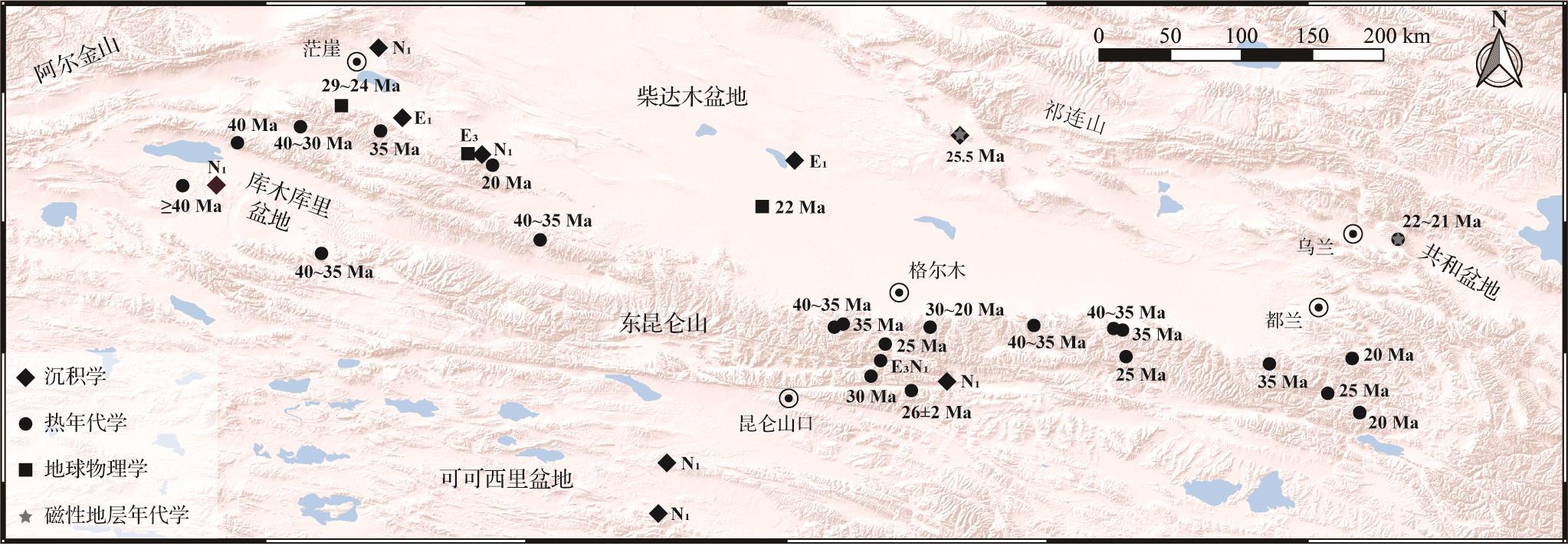
东昆仑山作为青藏高原北部显著的地貌分界带,构成了高原北部的南部边界,是印度—欧亚板块碰撞应力向北传播过程中的关键通道,可作为研究青藏高原北部隆升过程的理想区域。它与柴达木、可可西里和库木库里盆地紧密相连,构成典型的“盆山耦合”体系,为揭示高原北部隆升过程提供了多层次的研究视角。“盆—山耦合”强调了盆地沉积物与物源区构造活动之间的紧密联系,可为山体隆升和古地形演化提供重要信息。柴达木、可可西里和库木库里盆地的沉积物已通过沉积学、地球物理学和磁性地层学分析,为东昆仑山的初始隆升时间提供了间接证据(图1)。然而,已有的研究对东昆仑山初始隆升时间提出了不同的观点,包括古新世(Jolivet et al.,2001;Bush et al.,2016;Cheng et al.,2016,2019b)、渐新世(Yin et al.,2007,2008b;Wang et al.,2017b)和中新世(Meng and Fang,2008;Lu et al.,2012;Mao et al.,2014;Wang et al.,2017b;McRivette et al.,2019;Wu et al.,2019;Jiang et al.,2024)。此外,前人通过热年代学方法对东昆仑山体进行了广泛研究,为山脉的隆升提供了直接证据(图1)。例如,祁漫塔格山地区的研究表明,东昆仑山的初始隆升发生在大约40~30 Ma(Liu et al.,2017;Wang et al.,2017a;魏岩岩,2017)。相比之下,香日德地区的研究提出了一个稍晚的观点,即35~20 Ma(Yuan et al.,2006;Wu et al.,2019b;Li et al.,2023b),而格尔木—诺木洪地区的结果则包含了上述两个时间范围(Mock et al.,1999;Wu et al.,2009;Clark et al.,2010;Wang et al.,2016,2020;McRivette et al.,2019;Staisch et al.,2020;Li et al.,2023a)。这些热构造事件通常被解释为与东昆仑山新生代隆升密切相关。然而,不论是来自盆地沉积物的间接证据还是山体基岩热年代学的直接证据,它们对东昆仑山初始隆升时间的约束存在显著分歧。上述差异的存在可能归因于以下因素:(1)大多数研究集中于局部地区,而造山带复杂的地质结构和显著的区域差异可能会影响从局部构造事件推断整体演化过程的有效性;(2)低温热年代学数据的时空分布特征通常用于揭示区域平面上的构造差异,但缺乏对不同海拔岩石热年代学信息的联合,限制了从垂向上对岩石柱体的热历史进行综合评估;(3)如果岩石通过封闭温度等温面没有单调冷却,则热年代学年龄代表复合冷却路径的成分,没有实际的地质意义,难以直接准确地指示冷却事件。因为热年代学年龄和闭合温度的概念仅适用于从高温到低温单调冷却的情况(Dodson,1973;Villa,1998)。

图 1 东昆仑山新生代初始隆升研究(据Mock et al.,1999;Wang et al.,2004;Yuan et al.,2006;Yin et al.,2007;Meng and Fang,2008;Yin et al.,2008;Wu et al.,2009;Clark et al.,2010;Lu et al.,2012;Mao et al.,2014;Cheng et al.,2016;Wang et al.,2016;Liu et al.,2017;Wang et al.,2017a;Wang et al.,2017b;魏岩岩,2017;Shi et al.,2018;Cheng et al.,2019a;McRivette etal.,2019;Wu et al.,2019;Wang et al.,2020;Li et al.,2021;Li et al.,2023a;Li et al.,2023b;Jiang et al.,2024修改)
Figure 1. Study on the uplift history of the Eastern Kunlun Mountains in the Cenozoic (modified from Mock et al., 1999; Wang et al., 2004; Yuan et al., 2006; Yin et al., 2007; Meng and Fang, 2008; Yin et al., 2008; Wu et al., 2009; Clark et al., 2010; Lu et al., 2012; Mao et al., 2014; Cheng et al., 2016; Wang et al., 2016; Liu et al., 2017; Wang et al., 2017a; Wang et al., 2017b; Wei, 2017; Shi et al., 2018; Cheng et al., 2019a; McRivette etal., 2019; Wu et al., 2019; Wang et al., 2020; Li et al., 2021; Li et al., 2023a; Li et al., 2023b; Jiang et al., 2024)
为揭示东昆仑山新生代隆升历史,本研究汇编了来自造山带内不同地区和不同海拔的磷灰石(U-Th)/He和磷灰石裂变径迹数据,并使用多种分析方法,构建地表岩石的低温热年代学信息序列。这一研究旨在约束东昆仑山新生代初始广泛隆升的时间,为进一步深入理解青藏高原北部演化过程提供新的低温热年代学依据。
-
东昆仑山位于青藏高原北部,北临柴达木盆地,南临可可西里盆地,东西两端分别被温泉走滑断裂和阿尔金走滑断裂所截切,呈近北西—南东走向,全长约1 500 km,平均海拔5 500~6 000 m,构成了青藏高原内部显著的地貌分界带。中生代早期,随着古特提斯洋的闭合,柴达木地块与羌塘或巴颜喀拉地体发生碰撞作用,形成了古昆仑增生型造山带(Yin and Harrison,2000;Song et al.,2014;Dong et al.,2018)。新生代时期,印度—欧亚板块碰撞的远程效应触发了区域构造活化,并被解释为先存弱点(即古构造薄弱带)的重新激活(Yin,2010;Zuza et al.,2017;Wu et al.,2019a),从而引发构造隆升,最终塑造了现今的高海拔地貌。
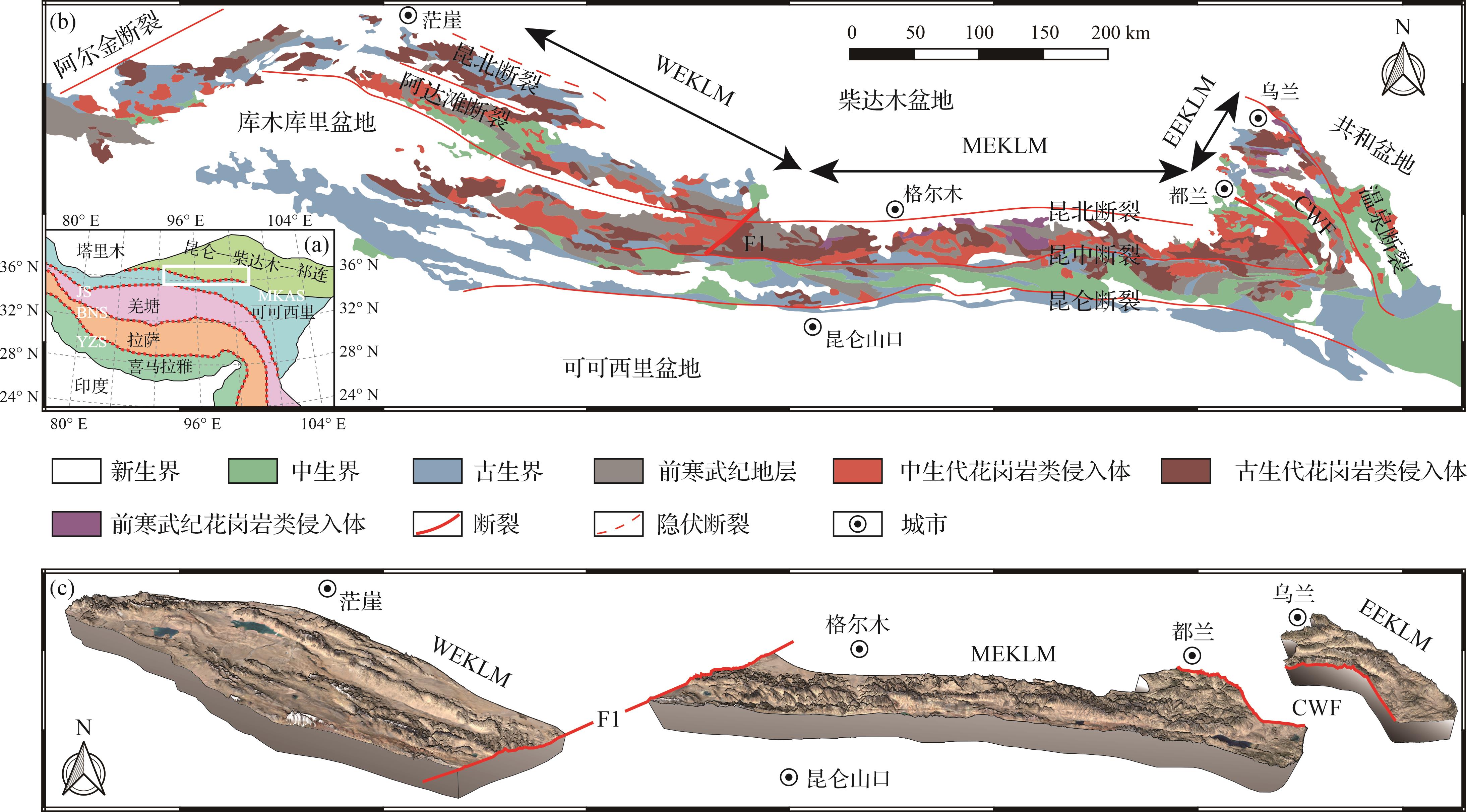
东昆仑山广泛发育早古生代和二叠纪—三叠纪的花岗岩类侵入体(Cheng et al.,2017;Dong et al.,2018),整体呈反S形弧形造山带。山脉西端和东端分别发育新生代山间盆地(库木库里盆地)和复杂的逆冲断裂系(鄂拉山断裂系)(图2b)。造山带内部受昆北逆冲断裂、昆中逆冲断裂和东昆仑走滑断裂的控制。值得注意的是,在格尔木和都兰地区,还分别发育斜截山体基岩的未命名断裂(F1)和察汗乌苏断裂(CWF),这些断裂的位置与山脉弯曲形态基本一致。结合这些断裂的分布及已有的热年代学研究对东昆仑山初始隆升时间约束的时空差异,东昆仑山被划分为三个段落:东昆仑山西段、东昆仑山中段和东昆仑山东段(图2c),以进一步探讨其构造演化特征。

图 2 东昆仑区域地质图(据庞健峰等,2017修改)
Figure 2. Geological map of the Eastern Kunlun (modified from Pang et al., 2017)
东昆仑山西段以祁漫塔格山为主体,呈北西—南东走向,并以阿达滩断裂为界分为北峰和南峰,分别发育晚古生代和中生代花岗岩类侵入体(Li et al.,2013)。地球化学研究发现祁漫塔格北峰形成于早古生代活动大陆边缘,而祁漫塔格南峰形成于早古生代洋内岛弧环境(Yu et al.,2017)。祁漫塔格地区的基底由新太古代—中元古代金水口群和新元古代冰沟群组成(庞健峰等,2017),覆盖前中生代及新生代沉积盖层。东昆仑山中段位于格尔木与都兰之间,呈东西走向,出露晚古生代—早中生代花岗岩类侵入体。基底主要包括新太古代—中元古代金水口群、古元古代—中元古代万宝沟群和苦海岩群(庞健峰等,2017)。二叠纪—三叠纪沉积物主要分布在山脉南部,而新生代沉积物主要覆盖于山区,共同构成区域的沉积盖层。东昆仑山东段位于都兰和乌兰之间,以鄂拉山为主体,发育一系列北西—南东向的复杂逆冲断裂系统。该地区受温泉右行走滑断裂和东昆仑左行走滑断裂共同控制,广泛出露晚古生代—早中生代的花岗岩类侵入体(庞健峰等,2017)。基底岩系主要为新太古代—中元古代金水口群。三叠纪和新生代沉积物主要分布在山区,构成区域性的沉积盖层。
-
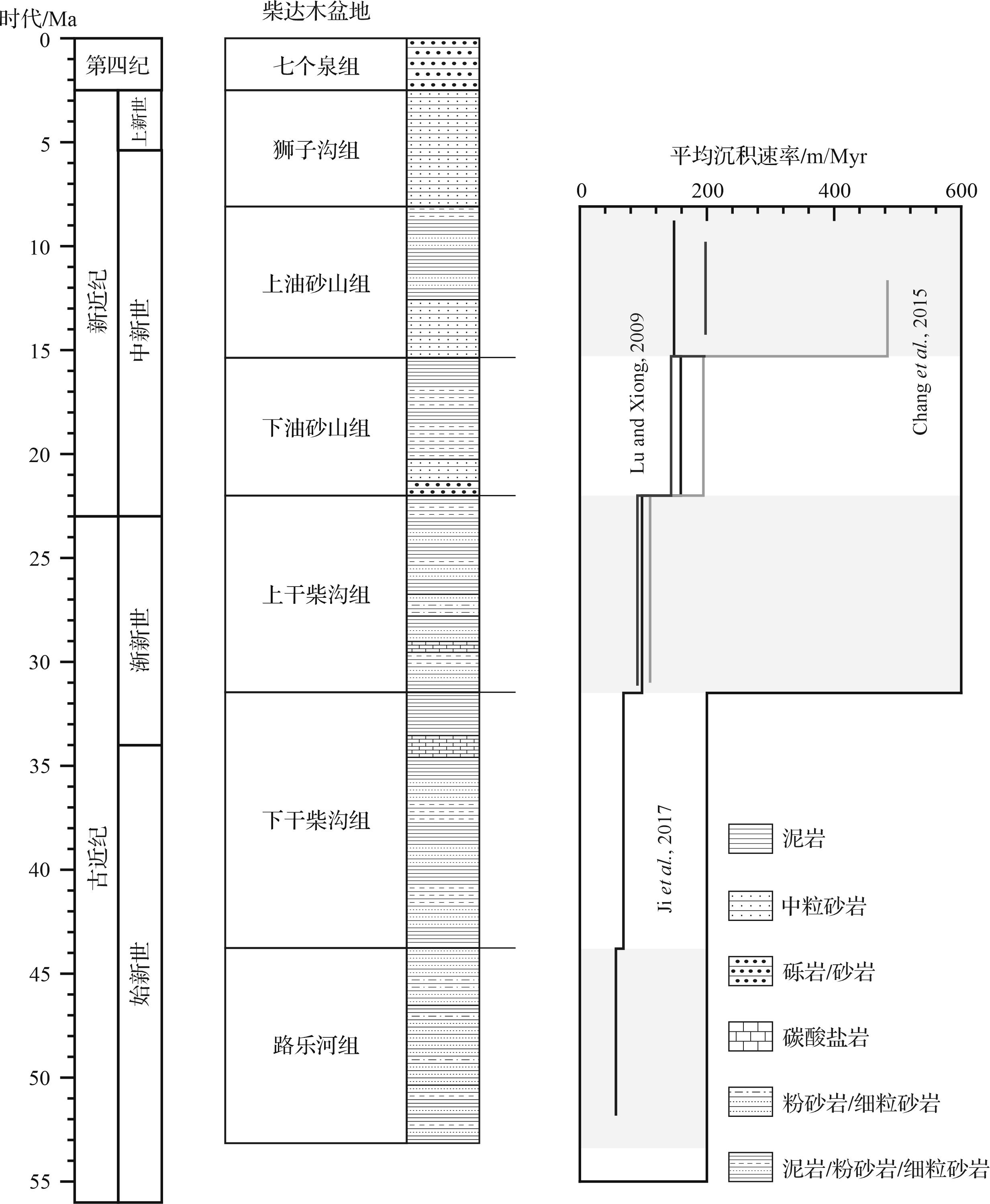
柴达木盆地位于东昆仑山北部,其基底由花岗岩和变质结晶基底构成,被相对较薄且不连续的中生代沉积层序和厚度可达10 km的巨大新生代沉积层序所覆盖(Zhou et al.,2006;Liu et al.,2007;Meng and Fang,2008;Yin et al.,2008a,2008b)。中生代地层为侏罗系和白垩系(Ritts and Biffi,2000;Meng et al.,2001;Wu et al.,2011;Cheng et al.,2019b),主要分布在柴达木盆地东北部的阿尔金山和祁连山东南缘的小型次盆地(Wu et al.,2011;Cheng et al.,2019b)。相反,新生代地层广泛分布于整个盆地,主要由冲积、河流和湖泊相沉积物组成,显示出明显的时空变化(Wang and Coward,1990),其主要沉积中心位于盆地的几何中心(Xia et al.,2001;Meng and Fang,2008)。根据岩性和地层学,盆地沉积物被划分为七个地层单元,从下到上依次为:路乐河组(53.4~43.8 Ma)(张伟林,2006;Fang et al.,2019)、下干柴沟组(43.8~31.5 Ma)(张伟林,2006;Fang et al.,2019)、上干柴沟组(31.5~22 Ma)(张伟林,2006;Fang et al.,2019)、下油砂山组(22~15.3 Ma)(张伟林,2006;Fang et al.,2019)、上油砂山组(15.3~8.1 Ma)(Fang et al.,2007;Zhuang et al.,2011)、狮子沟组(8.1~2.5 Ma)(Fang et al.,2007;Zhuang et al.,2011)和七个泉组(2.5~0 Ma)(Fang et al.,2007;Zhuang et al.,2011)。柴达木盆地南缘的地震剖面显示,始新世—渐新世地层厚度相对均匀,或向东昆仑山方向增厚,而中新世—上新世地层向南楔状减薄(Mao et al.,2014)或超覆(杜忠明等,2016)。
-
库木库里盆地位于东昆仑山西段以南,是一个巨型新生代山间盆地。盆地主要沉积始新世—上新世地层,并受后期构造变形作用形成了北西—南东背斜。根据古生物化石和区域地层关系(张云翔等,1996;Meng and Fang,2008),盆地新生代地层自下而上可划分为:花条山组(E2-3)、红石梁组(N
-
可可西里盆地位于东昆仑山南部,发育于松潘—甘孜地块及羌塘地块北缘之上,平均海拔为4 800 m。前新生代沉积基底包括石炭系、二叠系和三叠系的板岩、千枚岩和变砂岩,其中石炭系和二叠系分布较为零散(张以茀和郑健康,1994)。新生代地层可划分为三个单元:风火山群(85~51 Ma)(Staisch et al.,2014)、雅西错组(36~31 Ma)(Liu et al.,2003)、五道梁组(23~16 Ma)(Wu et al.,2008)。雅西错组沉积时期,古流向以向北为主,但沉积晚期则向东流(Yi et al.,2008)。该地层发生不同程度的变形,特别是在唐古拉、风火山和可可西里逆冲断裂带附近褶皱作用强烈(Li et al.,2012;Staisch et al.,2016;Li et al.,2018)。然而,逆冲和褶皱作用应该在晚渐新世已经结束,因为变形的雅西错组被约27 Ma未变形的玄武岩席所覆盖(Staisch et al.,2014)。五道梁组主要由湖相碳酸盐岩组成,与下伏的雅西错组呈角度不整合接触(Liu and Wang,2001;Liu et al.,2001,2003;Wang et al.,2002;段志明等,2007;Li et al.,2012;Li et al.,2018),其底部记录了向南的古流向(刘志飞等,2005)。
-
地表侵蚀和构造作用会使岩石从地壳深处剥露至地表。由于地温梯度的存在,这种相对地表发生位移的过程会伴随着矿物的冷却。低温热年代学,如磷灰石(U⁃Th)/He(封闭温度(Stockli et al.,2000):80 ℃~40 ℃)和磷灰石裂变径迹(封闭温度(Reiners and Brandon,2006):120 ℃~60 ℃),可以敏感地记录岩石经过封闭深度(即与封闭温度相对应的地壳深度)的时间(Reiners and Brandon,2006)。结合封闭温度和地温梯度,磷灰石(U-Th)/He和磷灰石裂变径迹技术可以用于揭示地壳浅部1~5 km的岩石冷却历史,被广泛用于约束与深部构造、地球动力学、地貌演化和自然资源形成过程相关的岩石和矿物的热演化(Boone et al.,2023)。
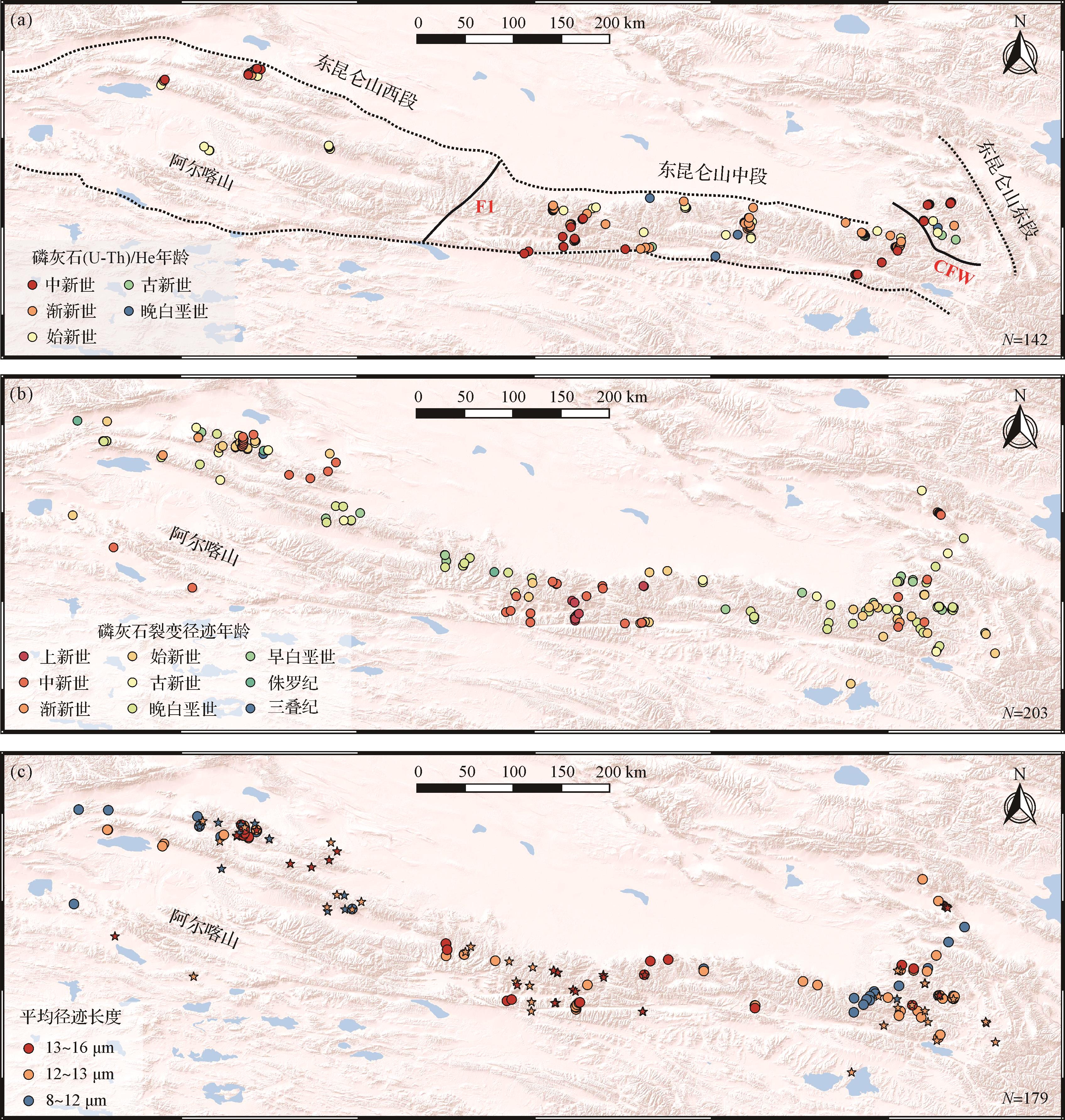
近年来,通过构建直观的低温热年代学信息框架用于区域性研究的做法被越来越多的学者支持和采用。这种方法被用于量化山脉和大陆隆升—剥露的时间和规模(Gleadow et al.,2002;Kohn et al.,2002;Vernon et al.,2008;Lanari et al.,2023;Wang et al.,2023),同时用于探究气候、构造和山脉剥露之间的相互联系(Herman et al.,2013;Glorie and de Grave,2016;Schildgen et al.,2018;Jepson et al.,2021)。东昆仑山已被广泛采样用于低温热年代学研究。本研究整合了34篇学术论文和3篇学位论文的低温热年代学数据,共包含142个磷灰石(U-Th)/He和203个磷灰石裂变径迹样本(附件S1,图3)。在数据集的整理阶段,为确保数据的准确性和可靠性,本研究严格遵循低温热年代学对样品选择的标准(Gleadow and Lovering,1974;Arne et al.,1989;Kohn et al.,2019),并结合前人的研究范例(Gleadow et al.,2002;Kohn et al.,2002;Vernon et al.,2008;Lanari et al.,2023;Wang et al.,2023),制定了一系列严格的数据筛选策略。这些策略包括:(1)仅关注地表基岩样品,明确排除碎屑岩样品,以减少其复杂热历史带来的不确定性;(2)保留高级变质岩样品(如片麻岩),排除低级变质岩样品(如千枚岩),因为不完全的退火会引入复杂的热历史。此外,这些低级变质岩样品不适合裂变径迹测试,通常也不适用于严谨分析;(3)排除了碳酸盐岩、糜棱岩、石英岩脉、断层泥以及高度蚀变或矿化的岩石样本,因为这些岩石可能具有特殊的物理化学性质会干扰热年代学分析;(4)排除多重测年技术结果矛盾的样品,例如锆石(U⁃Th)/He年龄显著小于磷灰石(U⁃Th)/He年龄(Dai et al.,2013);(5)排除不同研究中重复发表的数据,以确保数据的唯一性,防止计算冗余。这些策略旨在最大程度地降低由实验误差、样品特性以及复杂热历史带来的干扰,从而提高数据集的准确性和可靠性。

图 3 低温热年代学数据分布图
Figure 3. Distribution map of Low⁃temperature thermochronological data
早期发表的论文通常未能规范地提供完整的样品信息,例如地理坐标或海拔(Jolivet et al.,2001,2003;Wang et al.,2004;Wang et al.,2006;Yuan et al.,2013),限制了数据透明性和后续研究的可重复性。因此,尽可能联系这些论文的作者,或通过审阅原文中的插图和文字描述补充缺失的样品信息。作为补充措施,本研究根据美国国家航空航天局提供的SRTM 30 m数字高程模型(https://www.earthdata.nasa.gov/),使用QGIS对文献中的相关图件进行地理配准,从而确定样品的经纬度和/或海拔,并在附件
S1 中做了详细的注释。 -
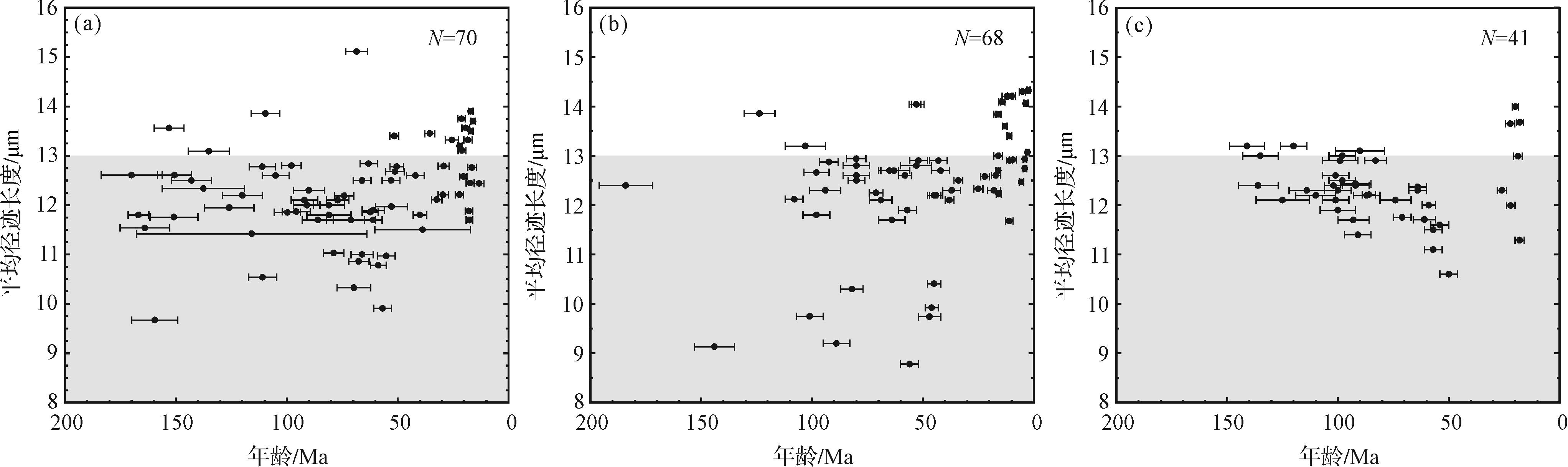
为揭示东昆仑山的新生代隆升历史,本研究采用三种方法对低温热年代学数据集进行组织和综合分析。具体包括:可视化磷灰石(U-Th)/He和磷灰石裂变径迹年龄的概率密度分布(图4,5),建立平均径迹长度与年龄关系(图6),以及汇编热历史模拟结果(图7)。

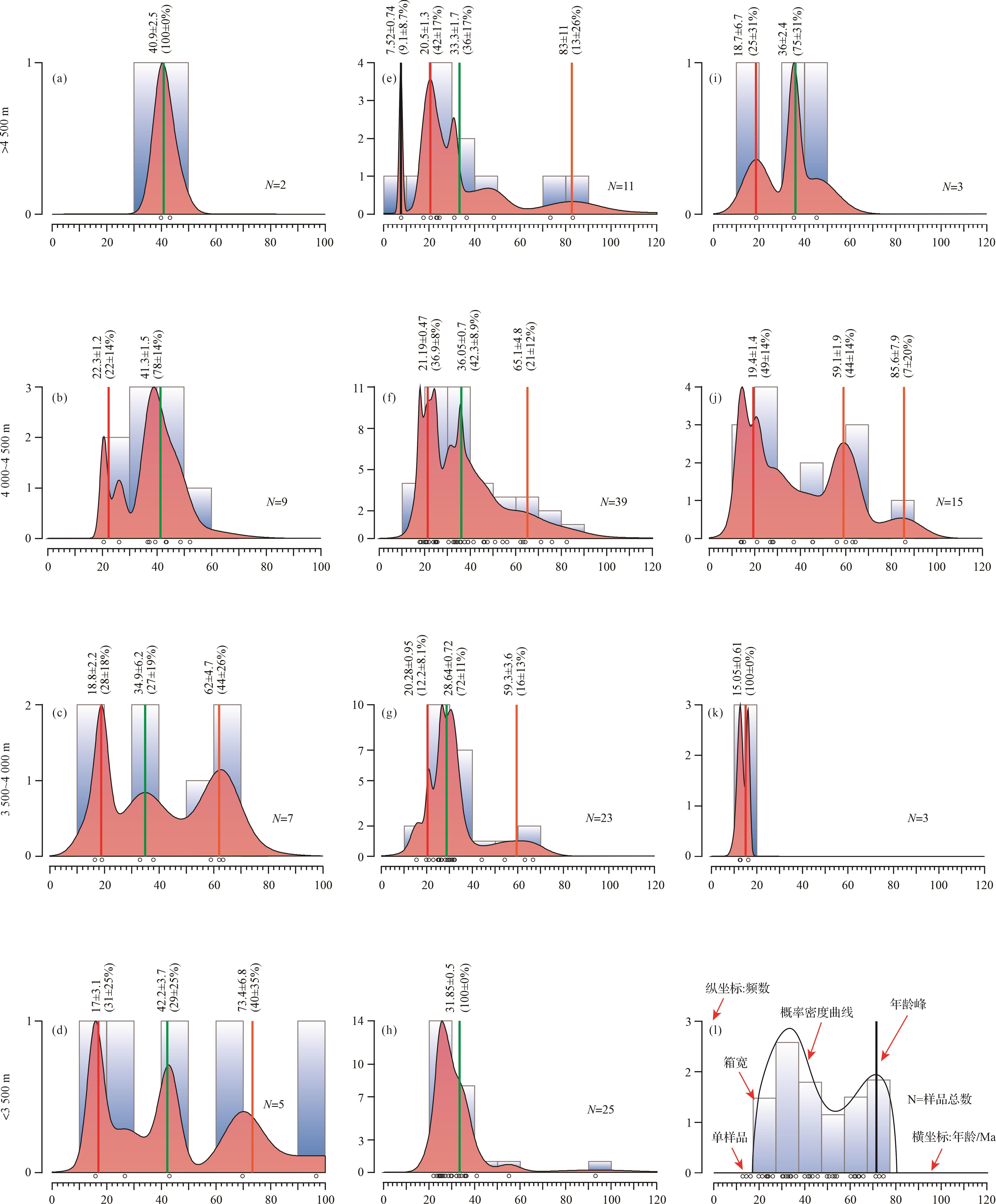
图 4 磷灰石(U⁃Th)/He年龄概率密度图
Figure 4. Probability density plot of apatite (U⁃Th)/He age

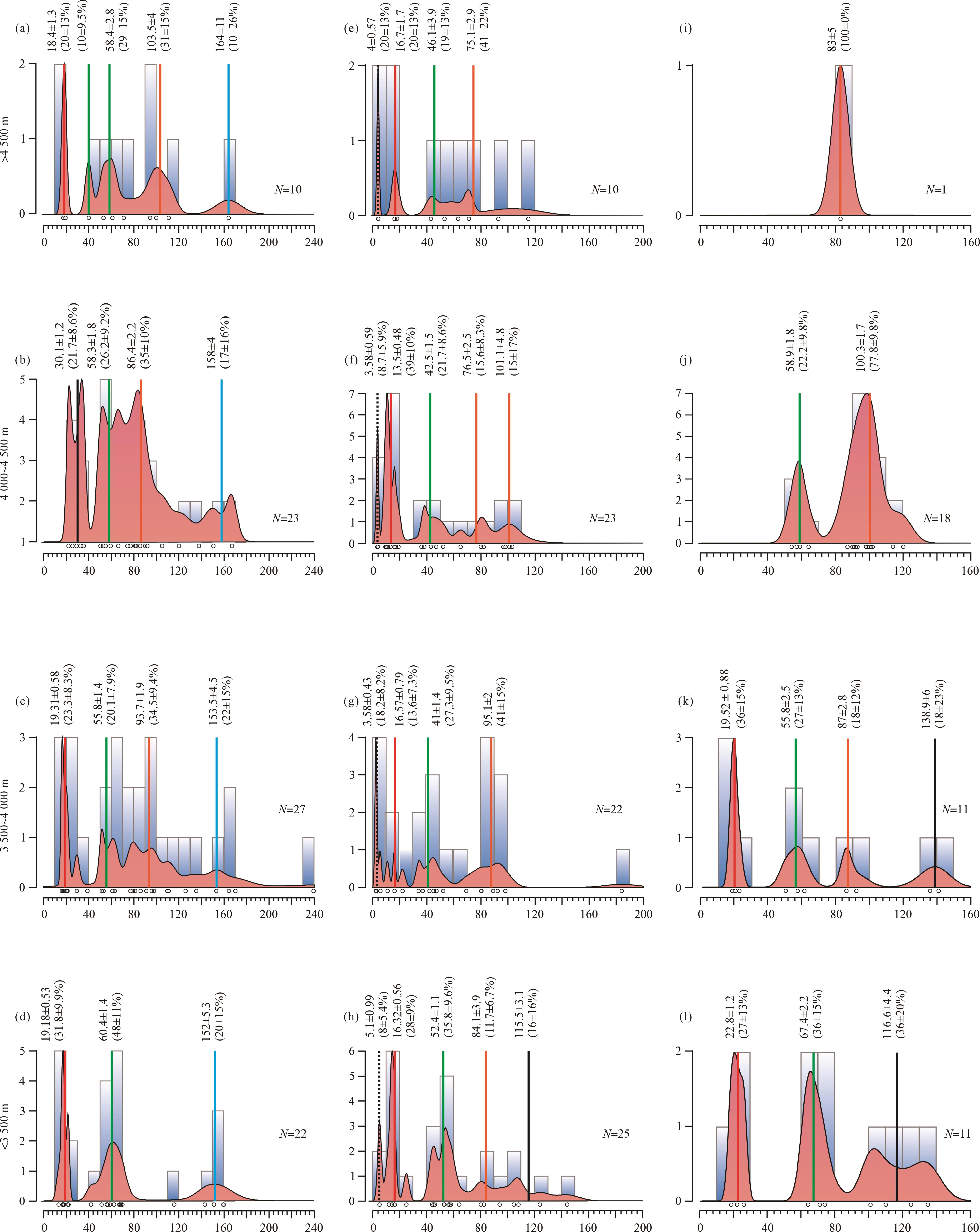
图 5 磷灰石裂变径迹年龄概率密度图
Figure 5. Probability density plot of apatite fission track age

图 6 平均径迹长度与年龄关系
Figure 6. Relationship between mean track length and age

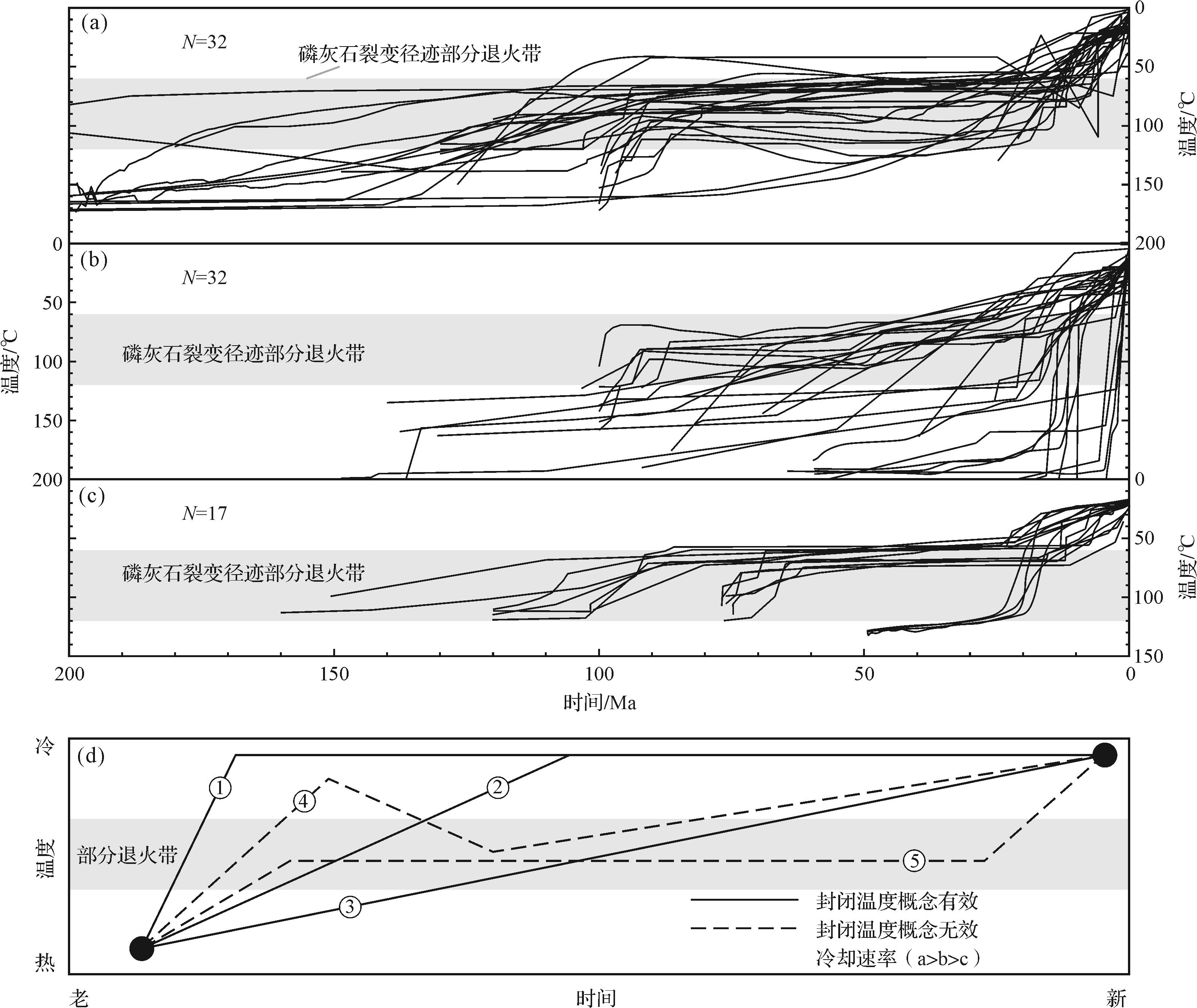
图 7 热历史模拟结果汇编图
Figure 7. Compilation of thermal history modeling results
-
低温热年代学年龄分布模式是地表过程和构造活动相互作用导致近地表环境冷却的结果(Gallagher et al.,1998;Hill and Kohn,1999;Gleadow and Brown,2000),能够用于初步了解区域地表岩石的冷却特征和方式。根据地理位置和海拔(以500 m为间隔),将数据划分至东昆仑山不同段落,并采用DensityPlotter(Vermeesch,2012),对磷灰石(U-Th)/He和磷灰石裂变径迹数据的年龄分布进行可视化,分析不同区域和不同海拔之间的数据差异(图4,5)。这种方法不仅揭示了低温热年代年龄的空间平面分布特征,还能联合不同海拔岩石的热年代学信息,构建东昆仑山现今地表岩石柱体(约2 km)的低温热年代学信息序列,从而有助于整体评估岩石隆升与冷却事件之间的关系和判断简单或复杂的温度—时间路径。
Vermeesch(2012)建议分析师使用核密度算法代替概率密度算法拟合年龄分布特征,因为当数据量(分析数量)或数据质量(精度)较高时,概率密度算法可能会产生一些违反直觉的结果。然而,核密度算法同样存在局限性。它无法对小型数据集实现收敛拟合,并且会生成过于平滑、信息量很少的核密度曲线。在实际操作中,当数据集被切片后,每个子集的样本量通常较小(2<N<39),并且238U原子的裂变属于泊松过程,这会导致基于单颗粒年龄计算的样品年龄存在较大的不确定性(Galbraith,1988,1990;Galbraith et al.,1999)。因此,本研究采用概率密度算法对年龄分布进行拟合,以避免核密度算法在小数据集上的局限性。
-
尽管低温热年代学年龄分布为了解岩石冷却特征提供了初步线索,但无法反映冷却速率随时间的变化。理论上,裂变径迹初始形成时的长度可达20 μm(Paul and Fitzgerald,1992)。在自然条件下,由于矿物经历不同的温度—时间路径,受到不同程度的退火影响,从而影响最终保留的平均径迹长度。通常,快速冷却的岩石能够保留较长的平均径迹长度(大于13 μm),而缓慢冷却或具有复杂热历史的岩石则表现为较短的平均径迹长度(小于13 μm)。因此,本研究建立了平均径迹长度与年龄的关系(图6),揭示冷却速率随时间的变化趋势,识别潜在的部分退火或重置。这一方法还用于评估热年代学年龄是否能够真实反映岩石通过封闭温度等温面所对应的时间,从而为区域热历史的定性分析提供依据(Gleadow et al.,2002)。
-
虽然基岩的低温热年代学年龄分布特征和平均径迹长度与年龄关系能够分别用于揭示地表岩石的冷却特征和方式,以及冷却速率随时间的变化趋势。但是,其无法提供详细的热演化路径,尤其是对于经历过复杂构造—热作用的岩体。通过结合热年代学年龄、裂变径迹长度和Dpar值,并运用退火模型,进行热历史模拟,能够重建样品可能经历过的最合理的温度—时间路径(Ketcham,2005;Ketcham et al.,2007;Gallagher,2012;Guenthner et al.,2013;Vermeesch and Tian,2014)。本研究汇总了已发表的81条温度—时间曲线(均由HeFTy软件生成)(图7),并根据样品地理位置划分至东昆仑山的不同区域,以利于直观地理解和对比区域时空演化模式。此外,热历史模拟结果还可以进一步验证和补充上述两种方法得出的热历史结论。
需要注意的是,热历史模拟仅适用于解释磷灰石裂变径迹样品在120 ℃~60 ℃范围内的温度—时间演化路径,以区分自然事件与模拟过程中可能产生的伪影(Jolivet et al.,2001;Ketcham et al.,2009)。在高于120 ℃或低于60 ℃的温度条件下,磷灰石裂变径迹系统分别处于开放系统和完全封闭系统,此时无法记录热信息。因此,当温度超过120 ℃或低于60 ℃时,如果温度—时间曲线的斜率显著偏离预期的单调冷却趋势,则被视为异常,这种现象源于模拟过程引入的伪影。这类温度—时间曲线应予以排除,因为它们并未真实反映实际的热事件。
-
通过对磷灰石(U-Th)/He和磷灰石裂变径迹年龄峰值的梳理,得到以下结果:磷灰石(U-Th)/He年龄分布显示三个主要组分,分别为85~55 Ma、40~30 Ma和22~17 Ma(图4)。磷灰石裂变径迹分布表现出四个主要组分,分别为165~150 Ma、105~80 Ma、60~40 Ma和23~15 Ma(图5)。此外,尽管概率密度年龄谱中还出现了小于10 Ma的年龄峰,但由于涉及样品数量太少(1~2个),不具有统计意义,因此未将该年龄峰纳入本文分析。
总体来说,除较老的磷灰石裂变径迹年龄组分(165~150 Ma)出现在东昆仑山西段外,其他组分均表现为磷灰石(U-Th)/He与磷灰石裂变径迹年龄组分接续或包含。尤其是最年轻的磷灰石(U-Th)/He年龄组分(22~17 Ma)与磷灰石裂变径迹年龄组分(23~15 Ma)明显重叠(图4,5)。这些年龄组分并不随海拔发生变化,且在不同高程区段中普遍共存。这一现象与典型的年龄—海拔关系相矛盾,因为通常情况下,不同热年代学系统的年龄会随海拔的增加而增加。
-
平均径迹长度与年龄关系(图6)显示:前中新世样品的平均径迹长度以小于13 μm为特征,而中新世以来的样品普遍具有大于13 μm的平均径迹长度。此外,少数年龄较老的样品(前中新世)仍显示出较长的平均径迹长度(大于13 μm)。这一现象可能归因于这些样品具有较强的抗退火能力,因此尽管它们年龄很大,但仍能保留较长的裂变径迹长度。
-
东昆仑山不同区域的岩石热历史模拟结果呈现出一个共同特征(图7):晚白垩世期间,东昆仑山地表岩石普遍经历了广泛的快速冷却,进入磷灰石裂变径迹的部分退火带。此后,这些岩石在部分退火带内保持相对稳定或缓慢冷却,直至约20 Ma,区域内再次经历了一次大范围的快速冷却事件,将其剥露至地表。
-
热历史模拟结果显示,东昆仑山现今地表岩石普遍在晚白垩世进入磷灰石裂变径迹的部分退火带,并以相对稳定或缓慢冷却的状态长期滞留在磷灰石裂变径迹的部分退火带和磷灰石(U-Th)/He的部分保留带(否则不能同时记录两种低温热年代学年龄),直到约20 Ma才快速冷却至地表(图7)。该结果和平均径迹长度与年龄关系(图6),以及磷灰石(U-Th)/He和磷灰石裂变径迹年龄分布特征(图4,5)相匹配。然而,已有的研究认为,东昆仑山在始新世—早渐新世期间发生的快速剥露与山脉初始隆升密切相关(王国灿等,2007;Clark et al.,2010;Wang et al.,2016,2017a;Liu et al.,2017;Jiang et al.,2024)。这一观点可能并不恰当。首先,东昆仑山现今地表岩石普遍在20 Ma之前并未离开磷灰石裂变径迹的部分退火带(图7)。由于冷却年龄和封闭温度概念仅适用于岩石从高温到低温单调冷却的情况(Dodson,1973;Villa,1998)(图7d)。因此,经历缓慢冷却或复杂热作用影响的岩石的热年代学年龄并不具有实际地质意义,只能被视为表观年龄。这些年龄无法准确地反映新生代早期山脉快速剥露事件。其次,格尔木(Clark et al.,2010;Wang,2017a)、诺木洪(Clark et al.,2010;Wang et al.,2016)和香日德(王国灿等,2007;Clark et al.,2010;Wang et al.,2016,2017a)地区已发表的磷灰石(U-Th)/He和磷灰石裂变径迹年龄—高程/深度剖面,均为没有明显拐点的低斜率直线,表明岩石的热状态基本没有发生显著改变。此外,新生代早期的平均径迹长度普遍以小于13 μm为特征(图6),表明岩石在该时期经历了缓慢冷却或复杂的热历史(Vernon et al.,2008;Wang et al.,2023),未发生显著的广泛隆升或冷却剥露事件。不仅如此,相邻盆地的沉积记录对东昆仑新生代早期初始广泛隆升的认识构成了挑战。
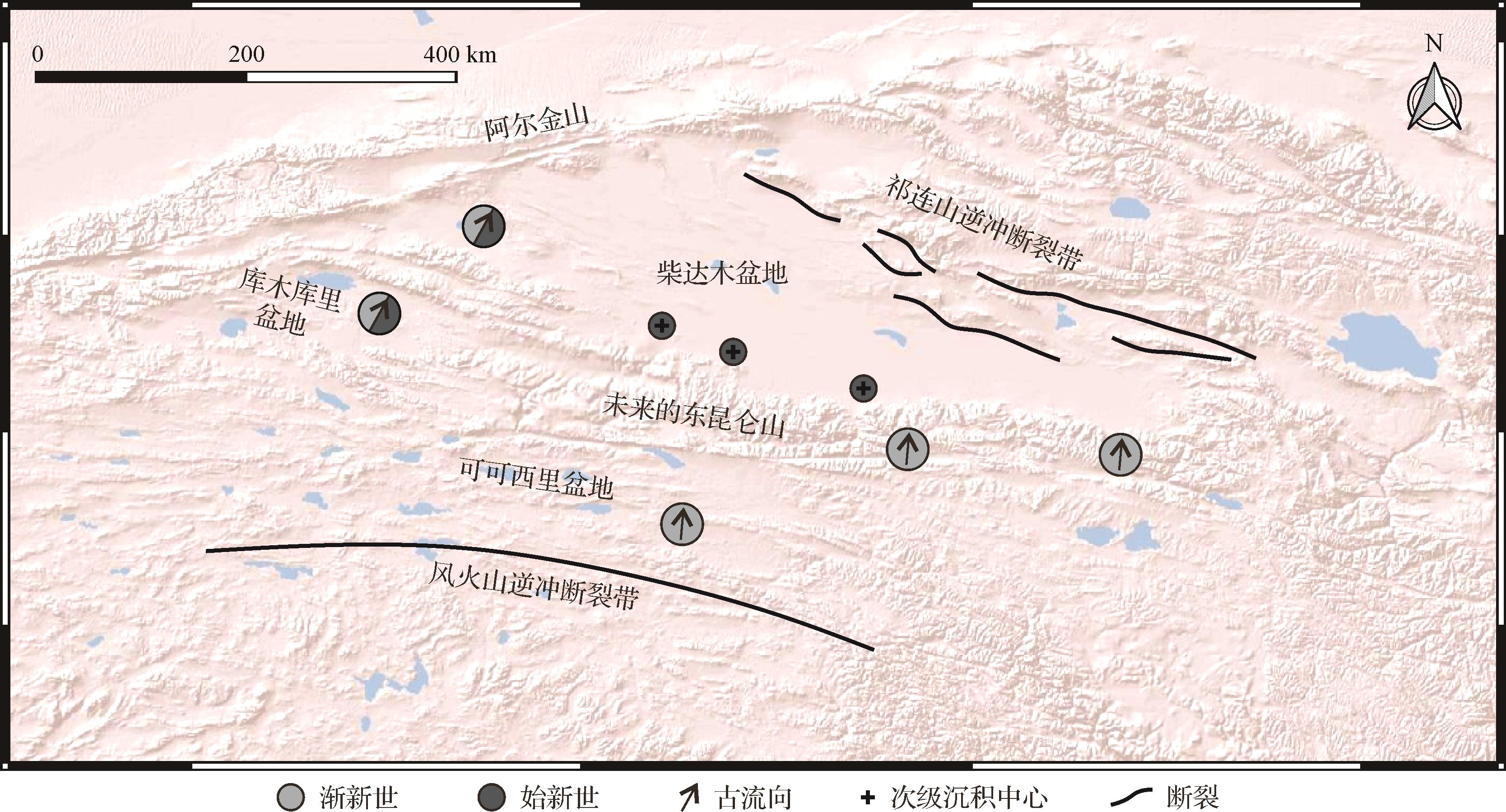
沉积相分析表明,库木库里盆地北部的花条山组主要由细粒湖相沉积组成,可与柴达木盆地西南部的路乐河组和下干柴沟组对比(Meng and Fang,2008)。古生物学研究表明,可可西里盆地的雅西错组与柴达木盆地下干柴沟组具有高度相似的孢粉组合(Miao et al.,2016)。古流向研究显示,柴达木盆地西南缘(Xia et al.,2021)、库木库里盆地(肖爱芳等,2005;Meng and Fang,2008)及东昆仑山中段南缘和北缘(Li et al.,2023a,2023b)的始新世—渐新世地层中,记录了一致向北的古流向(图8)。此外,柴达木盆地古近纪时期是一个逐步发展的简单向斜洼地(Meng and Fang,2008),路乐河组和下干柴沟组沉积期间柴达木盆地的次级沉积中心分布在东昆仑山北缘山前(Yin et al.,2008b;Cheng et al.,2019a)(图8),因此该时期次级沉积中心的边缘应向南跨越现今东昆仑山的地理位置。并且,可可西里盆地北缘的古流向研究表明,在始新世时期,古水流向北流动,具有单向扩散模式(图8),表明东昆仑山地区没有明显广泛的正地形(Yi et al.,2008)。此外,晚白垩世—古近纪期间,东昆仑山现今地表岩石普遍以相对稳定或缓慢冷却的状态长期滞留在磷灰石(U-Th)/He的部分保留带和磷灰石裂变径迹的部分退火带(图7,9)。这些证据表明当时东昆仑山并未形成广泛的地形屏障,其相邻盆地之间的河流系统可能局部是相互连通的(图9b)。并且印度—亚洲碰撞初期的应力通过阿尔金断裂的走滑运动得以释放(Yue et al.,2004),最大程度减少了青藏高原北部内部所需的地壳增厚量(Zhuang et al.,2018),从而能够合理地解释东昆仑山在古近纪的大规模埋藏。因此,新生代早期的热事件与山脉的初始广泛隆升无关。

图 8 柴达木盆地和可可西里盆地始新世—渐新世古流向和沉积格局(据肖爱芳等,2005;Meng and Fang,2008;Yi et al.,2008;Yin et al.,2008b;Cheng et al.,2019a;Xia et al.,2021;Li et al. 2023a,2023b修改)
Figure 8. Paleocurrent and sedimentary configuration of the Qaidam Basin and Hoh Xil Basin during Eocene⁃Oligocene (modified from Xiao et al., 2005; Meng and Fang, 2008; Yi et al., 2008; Yin et al., 2008b; Cheng et al., 2019a; Xia et al., 2021; Li et al., 2023a, 2023b)

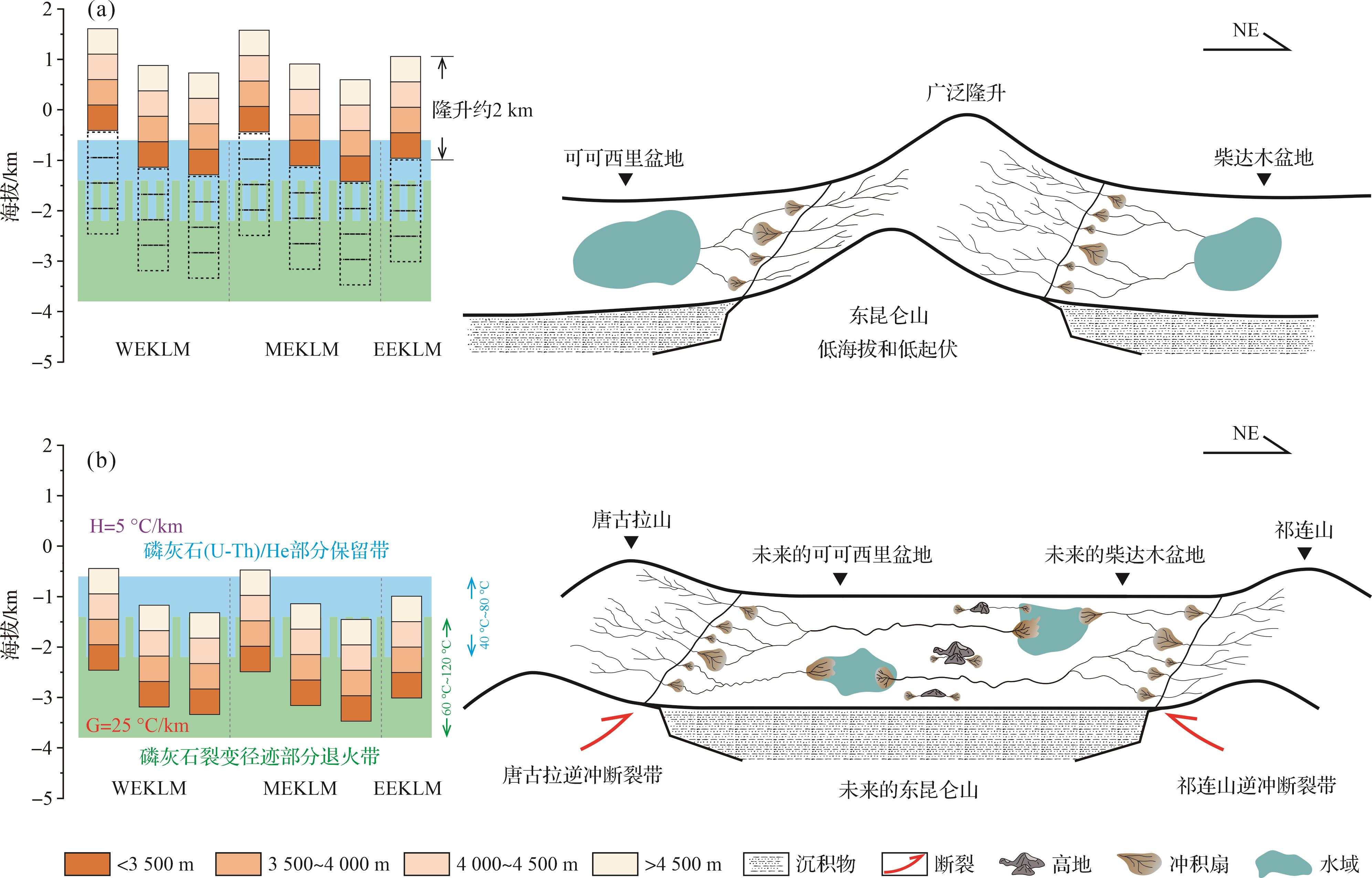
图 9 东昆仑山新生代隆升模式图
Figure 9. Cenozoic uplift pattern of the Eastern Kunlun Mountains
白垩纪以来的冷却事件(图7)以及响应印度—欧亚板块碰撞(Yin,2010;Zuza et al.,2017;Wu et al.,2019a),导致东昆仑山古近纪期间可能存在零星的高地,为周缘盆地提供物源(Li et al.,2015;Cheng et al.,2016;Xia et al.,2021;Jian et al.,2024)(图9b),并与南部唐古拉山(Wang et al.,2008;Dai et al.,2012;Li et al.,2012)、北部祁连山(Jian et al.,2013;Lu et al.,2019;Song et al.,2019;Li et al.,2023a)以及阿尔金山(Li et al.,2015;Jian et al.,2024)共同构成泛盆地的物源体系(图9b)。由于东昆仑山局部地区缺乏足够的热年代学数据,无法对数据覆盖不足的地区(如阿尔喀山地区)作出准确的评估。因此,本研究不能完全排除东昆仑山脉在古近纪期间存在零星高地的可能性,但对低温热年代学数据集进行多方法联合分析表明,东昆仑山的初始广泛隆升发生在约20 Ma。热历史模拟显示,东昆仑山现今地表岩石普遍在约20 Ma发生快速冷却,从磷灰石裂变径迹的部分退火带快速冷却至地表(图7),并保留了较长的平均径迹长度(大于13 μm)(图6)。由于岩石在这过程中经历了单调冷却路径,其热年代学年龄可以用于反映岩石通过封闭温度等温面对应的时间(Gleadow et al.,1986)。进一步分析显示,最年轻的早中新世磷灰石(U-Th)/He(22~17 Ma)和磷灰石裂变径迹(23~15 Ma)年龄组分重叠,且不随海拔发生变化(图4,5)。这一现象表明,东昆仑山岩石柱体(约2 km)在早中新世迅速且连续地穿过磷灰石裂变径迹的部分退火带和磷灰石(U-Th)/He的部分保留带,岩石相对地表发生的位移量应不少于记录了该年龄组分的岩石柱体长度,即约2 km(图9a)。不仅如此,早中新世山脉的初始广泛隆升也被来自相邻盆地的证据所支持。
柴达木盆地中南缘和东南缘的地震剖面显示,始新世—渐新世地层厚度基本一致,而中新世—上新世生长地层向南楔状减薄(Mao et al.,2014),或以超覆形式出现(杜忠明等,2016),表明东昆仑山的隆升开始于中新世(Mao et al.,2014)。柴达木盆地西南缘还发现一处与东昆仑山初始广泛隆升同期的不整合面(Wang et al.,2015)。沉积相研究显示,柴达木盆地南部边缘下油砂山组的粗粒沉积相较于上干柴沟组更加普遍,并且存在砾岩层(Meng and Fang,2008)。柴达木盆地西南缘中新世地层的ZTR指数相比古近纪地层显著降低,重矿物组合也发生了明显变化(Li et al.,2015;Zhu et al.,2017)。柴达木盆地东部及共和盆地的磁性地层学研究发现,盆地底部的沉积始于22~21 Ma(Lu et al.,2012)。本研究还从柴达木盆地收集了3个具有代表性的地层厚度—磁性地层学年龄图,将其进一步转化为沉积年龄—平均沉积速率曲线(图10),结果显示柴达木盆地上干柴沟组沉积期间的平均沉积速率为90~110 m/Myr,而下油砂山组沉积期间的平均沉积速率倍增至140~200 m/Myr。类似地,与上干柴沟组沉积时期相比,下油砂山组沉积期间,柴达木盆地的沉积通量和平均缩短率也呈倍增趋势(Bao et al.,2017)。此外,可可西里盆地和柴达木盆地的碎屑锆石年代学研究表明,古近纪地层均含有来自松潘—甘孜地体的1 800 Ma和2 500 Ma独特年龄峰,而柴达木盆地新近纪地层缺少该年龄组分的碎屑锆石(McRivette et al.,2019;Wu et al.,2019b)。可可西里盆地北缘的地层等厚线表明,五道梁组湖相碳酸盐岩地层向东昆仑山方向增厚,体现出山脉隆升的负载效应引起了盆地的构造沉降(Liu and Wang,2001;Zhu et al.,2006)。不仅如此,库木库里盆地的沉积相和古水流证据表明,红石梁组沉积期间盆地开始演化为一个孤立的山间盆地,开始发育独立的沉积中心,并被近端冲积河流粗粒岩相所环绕,且在风尘口组和碱土梁组沉积期间开始出现自北向南的古流向(张云翔等,1996;肖爱芳等,2005;Meng and Fang,2008)。以上证据表明,东昆仑山的广泛隆升始于早中新世,并显著影响了相邻盆地的沉积演化,同时调整了区域的源—汇关系。

图 10 柴达木盆地新生代地层平均沉积速率垂向分布图(据Lu and Xiong,2009;Chang et al.,2015;Ji et al.,2017修改)
Figure 10. Vertical distribution of average sedimentation rates in Cenozoic strata of the Qaidam Basin(modified from Lu and Xiong, 2009; Chang et al., 2015; Ji et al., 2017)
-
本研究约束了东昆仑山初始广泛隆升的时间和幅度,对理解青藏高原北部的构造、地貌、隆升过程和机制等问题具有重要意义。
首先,柴达木盆地与可可西里盆地新生代早期地层在沉积、古生物和构造等特征方面表现出的相似性(Yin et al.,2008b;蔡雄飞等,2009;Li et al.,2021),以及东昆仑山新生代早期的埋藏(图7、图9b),意味着Yin et al.(2008b)提出的古柴达木盆地模型可能是合理的。古柴达木盆地的解体时间应同步或滞后于东昆仑山的初始广泛隆升,而不是之前研究所认为的新生代早期(Cheng et al.,2016,2019a,2021;Liu et al.,2017;Jiang et al.,2024)。
其次,先前的研究认为柴达木盆地及其以北地区在早—中中新世处于较低海拔(Miao et al.,2022),与可可西里盆地的高海拔(Polissar et al.,2009;Sun et al.,2015)形成鲜明对比。本研究结果表明,东昆仑山初始广泛隆升的位移量应不少于记录了早中新世磷灰石(U-Th)/He(22~17 Ma)和磷灰石裂变径迹(23~15 Ma)年龄组分的岩石柱体长度,即约2 km,并在地表形成较低的地形起伏,可能只有1 000±500 m(图9a)。由于对东昆仑山发生初始广泛隆升之前的地貌状态缺乏数据约束,因此对初始隆升后地表起伏幅度的估计可能不完整,但对山脉初始广泛隆升所形成的地形起伏的估计与青藏高原北部盆地(Hui et al.,2018;Chen et al.,2019a;Miao et al.,2022)和山脉(Saylor et al.,2018;Zhuang et al.,2019)的古海拔和地形起伏非常接近。因此,本研究认为早—中中新世青藏高原北部的低海拔和低起伏区应向南延伸至东昆仑山。
这些约束对评估青藏高原北部隆升过程及其相关的动力学机制至关重要。第一,尽管青藏高原北部的变形在印度—亚洲碰撞后不久便已形成(Yin and Harrison,2000;Clark et al.,2010;Duvall et al.,2011;Zhuang et al.,2011),但作为青藏高原北部块体的南、北边界,东昆仑山和祁连山(Zhao et al.,2024)初始广泛正地形的形成却有所延迟,表明青藏高原北部山脉的广泛隆升显著滞后于印度—亚洲板块碰撞的发生(Wang et al.,2008,2014;Fang et al.,2020;Ding et al.,2022),并非与之同步(Yin and Harrison,2000;Yin et al.,2002;Clark et al.,2010;Duvall et al.,2011;Zhuang et al.,2011;An et al.,2020;He et al.,2021)。并且,青藏高原北部的高海拔格局直到晚中新世才得以确立(Miao et al.,2022)。第二,印度—欧亚板块汇聚引起的地壳缩短常被用来解释青藏高原北部早中新世的地表快速隆升(Yin et al.,2008b;Lease et al.,2011;Duvall et al.,2013;Staisch et al.,2020;Miao et al.,2022)。然而,可可西里盆地的地壳缩短已在约27 Ma停止(Staisch et al.,2014),并在24~14 Ma期间发育了一个巨大的未变形湖盆(Wu et al.,2008)。此外,早中新世期间,柴达木盆地、可可西里盆地和西秦岭地区广泛发育细粒碎屑沉积和碳酸盐沉积(张伟林,2006;Meng and Fang,2008;Wu et al.,2008;Wei et al.,2023)。不仅如此,东昆仑断裂的高角度倾角(50°~85°)的存在(青海省地震局和中国地震局地壳应力研究所,1999),及东昆仑山早中新世约2 km的岩体垂直隆升,同样暗示地壳缩短可能并不是造成青藏高原北部早中新世地表隆升的主要原因,而需要地球内部动力驱动(Staisch et al.,2016)。因此,在已有的驱动地表隆升的动力学机制中,Wei et al.(2023)提出的边缘驱动对流模型似乎是解释青藏高原北部早中新世岩石大规模垂直隆升的合理机制,同时协调了区域构造、沉积和火山活动等突出现象。
-
(1) 东昆仑山现今地表岩石普遍在晚白垩世进入磷灰石(U-Th)/He部分保留带和磷灰石裂变径迹部分退火带,并以相对稳定或缓慢冷却的状态滞留。新生代早期热事件与山脉的广泛隆升无关,并未形成广泛的正地形。
(2) 东昆仑山初始广泛隆升发生在约20 Ma,岩石相对地表发生的位移量应不少于记录了早中新世磷灰石(U-Th)/He(22~17 Ma)和磷灰石裂变径迹(23~15 Ma)年龄组分的岩石柱体长度估计约为2 km。
Cenozoic Initial Widespread Uplift of the Eastern Kunlun Mountains Onset at Approximately 20 Ma: Evidence from low-temperature thermochronology
-
摘要: 目的 东昆仑山作为青藏高原北部显著的地貌分界带,其山脉初始隆升的时间问题,仍存在较大争议。 方法 整合东昆仑地区37项低温热年代学研究成果,包括203个磷灰石裂变径迹数据和142个磷灰石(U-Th)/He数据,通过可视化低温热年代学年龄分布、建立平均径迹长度与年龄关系以及汇编热历史模拟结果,综合分析东昆仑新生代隆升历史。 结果 晚白垩世以来,东昆仑山地表岩石普遍呈相对稳定或缓慢冷却的状态,滞留在磷灰石裂变径迹部分退火带和磷灰石(U-Th)/He部分保留带,未形成广泛的正地形。直到约20 Ma,东昆仑山发生初始广泛隆升,伴随着岩石相对地表约2 km的位移。 结论 这一认识为理解古柴达木盆地解体时间、青藏高原北部早中新世古海拔历史、隆升过程和动力学机制提供了新的证据。Abstract: Objective The uplift of the Tibetan Plateau is a direct expression of the Earth’s interior geodynamic processes caused by the impact of the collision of the India-Eurasia Plates. Investigating the uplift history is essential to clarify the deformation mechanisms of the continental lithosphere, and remains a central scientific issue in deciphering interactions of the Earth’s multiple spheres. Despite extensive studies, intense debate continues regarding the plateau uplift and expansion. The timing of the uplift in the northern Tibetan Plateau is pivotal for resolving these questions; the Eastern Kunlun Mountains are a crucial geomorphic boundary, since they form the southern margin of the northern plateau and were a critical conduit for the northward propagation of collision-related stresses. The Eastern Kunlun range is an ideal area for studying the uplift processes of the northern Tibetan Plateau, but the timing of their initial uplift remains highly debated. Methods A comprehensive low-temperature thermochronological analysis of the bedrock in the Eastern Kunlun Mountains was conducted to constrain the Cenozoic uplift history. It included integrating the results of 37 low-temperature studies in the region comprising 203 apatite fission track data points and 142 apatite (U-Th)/He data points. Sample selection criteria for low-temperature thermochronology were strictly followed during dataset compilation, and a series of rigorous data-screening strategies were established to minimise disturbances from experimental errors, sample characteristics and complex thermal histories to enhance the accuracy and reliability of the dataset. The analysis involved three steps: (1) the low-temperature thermochronological age distribution was visualised; (2) the relationship between mean track length and age was established; and (3) thermal history modelling results were compiled. Integrating these enabled a detailed, comprehensive low-temperature thermochronology framework to assess the uplift history of the Eastern Kunlun Mountains in the Cenozoic. [Results and Conclusions] Since the Upper Cretaceous, the surface rocks of the Eastern Kunlun Mountains have generally remained in a relatively stable or slowly cooling state within the apatite fission track partial annealing zone and the apatite (U-Th)/He partial retention zone. The Eastern Kunlun Mountains did not form a significant topographic barrier during the Paleogene, and the drainage systems of adjacent basins were likely interconnected. Although the possibility cannot be entirely excluded that sporadic highlands in local areas of the Eastern Kunlun Mountains provided sediment sources for adjacent basins, the data indicates that widespread uplift of the Eastern Kunlun Mountains did not begin to occur until about 20 Ma, when rapid uplift took place causing an estimated rock displacement not less than approximately 2 km relative to the surface, corresponding to the length of the rock column recording Early Miocene apatite (U-Th)/He (22-17 Ma) and apatite fission track (23-15 Ma) age components. This finding provides new evidence for understanding the timing of the paleo-Qaidam Basin disintegration, the paleo-elevation history of the northern Tibetan Plateau in the Early Miocene, and the uplift processes and dynamic mechanisms involved.
-
图 1 东昆仑山新生代初始隆升研究(据Mock et al.,1999;Wang et al.,2004;Yuan et al.,2006;Yin et al.,2007;Meng and Fang,2008;Yin et al.,2008;Wu et al.,2009;Clark et al.,2010;Lu et al.,2012;Mao et al.,2014;Cheng et al.,2016;Wang et al.,2016;Liu et al.,2017;Wang et al.,2017a;Wang et al.,2017b;魏岩岩,2017;Shi et al.,2018;Cheng et al.,2019a;McRivette etal.,2019;Wu et al.,2019;Wang et al.,2020;Li et al.,2021;Li et al.,2023a;Li et al.,2023b;Jiang et al.,2024修改)
Figure 1. Study on the uplift history of the Eastern Kunlun Mountains in the Cenozoic (modified from Mock et al., 1999; Wang et al., 2004; Yuan et al., 2006; Yin et al., 2007; Meng and Fang, 2008; Yin et al., 2008; Wu et al., 2009; Clark et al., 2010; Lu et al., 2012; Mao et al., 2014; Cheng et al., 2016; Wang et al., 2016; Liu et al., 2017; Wang et al., 2017a; Wang et al., 2017b; Wei, 2017; Shi et al., 2018; Cheng et al., 2019a; McRivette etal., 2019; Wu et al., 2019; Wang et al., 2020; Li et al., 2021; Li et al., 2023a; Li et al., 2023b; Jiang et al., 2024)
图 2 东昆仑区域地质图(据庞健峰等,2017修改)
Figure 2. Geological map of the Eastern Kunlun (modified from Pang et al., 2017)
图 3 低温热年代学数据分布图
Figure 3. Distribution map of Low⁃temperature thermochronological data
图 8 柴达木盆地和可可西里盆地始新世—渐新世古流向和沉积格局(据肖爱芳等,2005;Meng and Fang,2008;Yi et al.,2008;Yin et al.,2008b;Cheng et al.,2019a;Xia et al.,2021;Li et al. 2023a,2023b修改)
Figure 8. Paleocurrent and sedimentary configuration of the Qaidam Basin and Hoh Xil Basin during Eocene⁃Oligocene (modified from Xiao et al., 2005; Meng and Fang, 2008; Yi et al., 2008; Yin et al., 2008b; Cheng et al., 2019a; Xia et al., 2021; Li et al., 2023a, 2023b)
图 10 柴达木盆地新生代地层平均沉积速率垂向分布图(据Lu and Xiong,2009;Chang et al.,2015;Ji et al.,2017修改)
Figure 10. Vertical distribution of average sedimentation rates in Cenozoic strata of the Qaidam Basin(modified from Lu and Xiong, 2009; Chang et al., 2015; Ji et al., 2017)
-
[1] 拜永山,任二峰,范桂兰,等. 2008. 青藏高原西北缘祁漫塔格山中新世快速抬升的磷灰石裂变径迹证据[J]. 地质通报,27(7):1044-1048. Bai Yongshan, Ren Erfeng, Fan Guilan, et al. 2008. Apatite fission track evidence for the Miocene rapid uplift of the Qimantag Mountains on the northwestern margin of the Qinghai-Tibet Plateau[J]. Geological Bulletin of China, 27(7): 1044-1048. [2] 蔡雄飞,刘德民,袁晏明,等. 2009. 试论柴达木和可可西里盆地古近纪—中新世地层的亲缘性[J]. 地层学杂志,33(3):276-282. Cai Xiongfei, Liu Demin, Yuan Yanming, et al. 2009. Relationship of the Paleocene-Miocene strata between the Qaidam and Kekexili Basins[J]. Journal of Stratigraphy, 33(3): 276-282. [3] 陈小宁,袁万明,张爱奎,等. 2014. 东昆仑西段巴音郭勒地区构造事件的磷灰石裂变径迹分析[J]. 核技术,37(1):54-61. Chen Xiaoning, Yuan Wanming, Zhang Aikui, et al. 2014. Apatite fission track analysis for revealing tectonic events of the Bayinguole area in the west section of Eastern Kunlun Mountains, northern Qinghai-Tibet Plateau[J]. Nuclear Techniques, 37(1): 54-61. [4] 陈宣华, Mcrivette M W,李丽,等. 2011. 东昆仑造山带多期隆升历史的地质热年代学证据[J]. 地质通报,30(11):1647-1660. Chen Xuanhua, Mcrivette M W, Li Li, et al. 2011. Thermochronological evidence for multi-phase uplifting of the East Kunlun Mountains, northern Tibetan Plateau[J]. Geological Bulletin of China, 30(11): 1647-1660. [5] 邓涛,吴飞翔,王世骐,等. 2019. 古近纪/新近纪之交青藏高原陆地生态系统的重大转折[J]. 科学通报,64(27):2894-2906. Deng Tao, Wu Feixiang, Wang Shiqi, et al. 2019. Significant shift in the terrestrial ecosystem at the Paleogene/Neogene boundary in the Tibetan Plateau[J]. Chinese Science Bulletin, 64(27): 2894-2906. [6] 杜忠明,樊龙刚,武国利,等. 2016. 柴达木盆地东部新生代盆地结构与演化[J]. 地球物理学报,59(12):4560-4569. Du Zhongming, Fan Longgang, Wu Guoli, et al. 2016. Cenozoic architecture and structural development of the eastern Qaidam Basin[J]. Chinese Journal of Geophysics, 59(12): 4560-4569. [7] 段志明,李勇,沈战武,等. 2007. 青藏高原腹地温泉地区新生代生态环境演化与高原表面隆升过程分析[J]. 中国地质,34(4):688-696. Duan Zhiming, Li Yong, Shen Zhanwu, et al. 2007. Analysis of the evolution of the Cenozoic ecological environment and process of plateau surface uplift in the Wenquan area in the interior of the Qinghai-Tibet Plateau[J]. Geology in China, 2007, 34(4): 688-696. [8] 蒋荣宝,陈宣华,党玉琪,等. 2008. 柴达木盆地东部中新生代两期逆冲断层作用的FT定年[J]. 地球物理学报,51(1):116-124. Jiang Rongbao, Chen Xuanhua, Dang Yuqi, et al. 2008. Apatite fission track evidence for two phases Mesozoic-Cenozoic thrust faulting in eastern Qaidam Basin[J]. Chinese Journal of Geophysics, 51(1): 116-124. [9] 李吉均,文世宣,张青松,等. 1979. 青藏高原隆起的时代、幅度和形式的探讨[J]. 中国科学,9(6):608-616. Li Jijun, Wen Shixuan, Zhang Qingsong, et al. 1979. A discussion on the period, amplitude and type of the uplift of the Qinghai-Xizang Plateau[J]. Science Sinica, 9(6): 608-616. [10] 刘志飞,王成善,金玮,等. 2005. 青藏高原沱沱河盆地渐新—中新世沉积环境分析[J]. 沉积学报,23(2):210-217. Liu Zhifei, Wang Chengshan, Jin Wei, et al. 2005. Oligo-Miocene depositional environment of the Tuotuohe Basin, central Tibetan Plateau[J]. Acta Sedimentologica Sinica, 23(2): 210-217. [11] 罗文行. 2012. 东昆仑中段辉石岩的成因与构造—热演化史[D]. 武汉:中国地质大学:1-136. Luo Wenxing. 2012. Petrogenesis and tectono-thermal history of the plutonic pyroxenite in the middle of East Kunlun orogen, western China[D]. Beijing: China University of Geosciences: 1-136. [12] 庞健峰,丁孝忠,韩坤英,等. 2017. 1∶100 万中华人民共和国数字地质图空间数据库[J]. 中国地质,44(增刊1):8-18. Pang Jianfeng, Ding Xiaozhong, Han Kunying, et al. 2017.The national 1∶1000000 geological map spatial database[J]. Geology in China, 44(Suppl. 1): 8-18. [13] 青海省地震局,中国地震局地壳应力研究所. 1999. 东昆仑活动断裂带[M]. 北京:地震出版社:1-186. Qinghai Earthquake Administration, Institute of Crustal Stress, China Earthquake Administration. 1999. Eastern Kunlun active fault zone[M]. Beijing: Seismological Press: 1-186. [14] 孙非非,朱传宝,袁万明,等. 2016. 青海都兰县哈日扎多金属矿区构造活动的磷灰石裂变径迹分析[J]. 核技术,39(12):120501. Sun Feifei, Zhu Chuanbao, Yuan Wanming, et al. 2016. Apatite fission track analysis of tectonic activity in Harizha polymetallic ore district, Dulan county, Qinghai province[J]. Nuclear Techniques, 39(12): 120501. [15] 王国灿,向树元, Garver J I,等. 2003. 东昆仑东段哈拉郭勒—哈图一带中生代的岩石隆升剥露:锆石和磷灰石裂变径迹年代学证据[J]. 地球科学:中国地质大学学报,28(6):645-652. Wang Guocan, Xiang Shuyuan, Garver J I, et al. 2003. Uplift and exhumation during Mesozoic in Halaguole-Hatu area, east segment of Eastern Kunlun Mountains: Evidence from zircon and apatite fission-track ages[J]. Earth Science: Journal of China University of Geosciences, 28(6): 645-652. [16] 王国灿,向树元,王岸,等. 2007. 东昆仑及相邻地区中生代—新生代早期构造过程的热年代学记录[J]. 地球科学:中国地质大学学报,32(5):605-614,680. Wang Guocan, Xiang Shuyuan, Wang An, et al. 2007. Thermochronological constraint to the processes of the East Kunlun and adjacent areas in Mesozoic-Early Cenozoic[J]. Earth Science: Journal of China University of Geosciences, 32(5): 605-614, 680. [17] 魏岩岩. 2017. 柴西南新生代沉积和构造特征及其与祁漫塔格的构造耦合[D]. 杭州:浙江大学:1-130. Wei Yanyan. 2017. Cenozoic sedimentary and structural features of southwest Qaidam Basin and its coupling with Qiman tagh[D]. Hangzhou: Zhejiang University: 1-130. [18] 肖爱芳,黎敦朋,李新林,等. 2005. 新疆库木库里盆地演化[J]. 陕西地质,23(1):59-69. Xiao Aifang, Li Dunpeng, Li Xinlin, et al. 2005. Evolution of the Kumukuli Basin in Sinkiang[J]. Geology of Shaanxi, 23(1): 59-69. [19] 杨莉,袁万明,朱传宝,等. 2021. 东昆仑中生代隆升剥露历史[J]. 岩石学报,37(12):3781-3796. Yang Li, Yuan Wanming, Zhu Chuanbao, et al. 2021. Mesozoic uplift exhumation history of East Kunlun[J]. Acta Petrologica Sinica, 37(12): 3781-3796. [20] 袁二军,史立群,袁万明,等. 2022. 东昆仑东段那日马拉黑南地区构造活动的磷灰石裂变径迹新证据[J]. 原子能科学技术,56(12):2780-2790. Yuan Erjun, Shi Liqun, Yuan Wanming, et al. 2022. New evidence of tectonic event of south Narimalahei area in Eastern Kunlun Mountain constrained by apatite fission track[J]. Atomic Energy Science and Technology, 56(12): 2780-2790. [21] 张伟林. 2006. 柴达木盆地新生代高精度磁性地层与青藏高原隆升[D]. 兰州:兰州大学:1-158. Zhang Weilin. 2006. Cenozoic uplift of the Tibetan Plateau: Evidence from high resolution magnetostratigraphy of the Qaidam Basin [D]. Lanzhou: Lanzhou University: 1-158. [22] 张以茀,郑健康. 1994. 青海可可西里及邻区地质概论[M]. 北京:地震出版社:1-177. Zhang Yifu, Zheng Jiankang. 1994. Geological overview in Kokshili, Qinghai and adjacent areas[M]. Beijing: Seismological Press: 1-177. [23] 张云翔,车自成,刘良,等. 1996. 新疆库木库里盆地的第三系[J]. 中国区域地质,15(4):311-316. Zhang Yunxiang, Che Zicheng, Liu Liang, et al. 1996. Tertiary in the Kumkol Basin, Xinjiang[J]. Regional Geology of China, 15(4): 311-316. [24] 中国科学院青藏高原综合科学考察队. 1981. 青藏高原隆起的时代、幅度和形式问题[M]. 北京:科学出版社:1-175. The Comprehensive Scientific Expedition to the Qinghai-Xizang Plateau of the Chinese Academy of Sciences. 1981. Studies on the period, amplitude and type of the uplift of the Qinghai-Xizang Plateau[M]. Beijing: Science Press: 1-175. [25] 周波. 2019. 东昆仑造山带中新生代热演化史及隆升—剥露过程研究[D]. 西安:西北大学:1-171. Zhou Bo. 2019. The thermal history and uplift-exhumation process of the East Kunlun Orogenic Belt during Meso-Cenozoic time[D]. Xi’an: Northwest University: 1-171. [26] 朱传宝,孙非非,袁万明,等. 2018. 东昆仑野马泉地区磷灰石裂变径迹热年代学及构造意义[J]. 地球科学,43(6):2019-2028. Zhu Chuanbao, Sun Feifei, Yuan Wanming, et al. 2018. Apatite fission track thermochronology and tectonic significance in Yemaquan area, East Kunlun[J]. Earth Science, 43(6): 2019-2028. [27] An K X, Lin X B, Wu L, et al. 2020. An immediate response to the Indian-Eurasian collision along the northeastern Tibetan Plateau: Evidence from apatite fission track analysis in the Kuantan Shan-Hei Shan[J]. Tectonophysics, 774: 228278. [28] An Z S, Kutzbach J E, Prell W L, et al. 2001. Evolution of Asian monsoons and phased uplift of the Himalaya-Tibetan Plateau since Late Miocene times[J]. Nature, 411(6833): 62-66. [29] Arne D C, Green P F, Duddy I R, et al. 1989. Regional thermal history of the Lennard shelf, Canning Basin, from apatite fission track analysis: Implications for the formation of Pb‐Zn ore deposits[J]. Australian Journal of Earth Sciences, 36(4): 495-513. [30] Bao J, Wang Y D, Song C H, et al. 2017. Cenozoic sediment flux in the Qaidam Basin, northern Tibetan Plateau, and implications for regional tectonics and climate[J]. Global and Planetary Change, 155: 56-69. [31] Boone S C, Kohlmann F, Noble W, et al. 2023. A geospatial platform for the tectonic interpretation of low-temperature thermochronology Big Data[J]. Scientific Reports, 13(1): 8581. [32] Boos W R, Kuang Z M. 2010. Dominant control of the South Asian monsoon by orographic insulation versus plateau heating[J]. Nature, 463(7278): 218-222. [33] Bush M A, Saylor J E, Horton B K, et al. 2016. Growth of the Qaidam Basin during Cenozoic exhumation in the northern Tibetan Plateau: Inferences from depositional patterns and multiproxy detrital provenance signatures[J]. Lithosphere, 8(1): 58-82. [34] Chang H, Li L Y, Qiang X K, et al. 2015. Magnetostratigraphy of Cenozoic deposits in the western Qaidam Basin and its implication for the surface uplift of the northeastern margin of the Tibetan Plateau[J]. Earth and Planetary Science Letters, 430: 271-283. [35] Chen C H, Bai Y, Fang X M, et al. 2019a. A Late Miocene terrestrial temperature history for the northeastern Tibetan Plateau's period of tectonic expansion[J]. Geophysical Research Letters, 46(14): 8375-8386. [36] Chen X, Yuan W M, Xu J F, et al. 2019b. Tectonic activities in Dongshangen polymetallic ore district, Eastern Kunlun Mountains, Qinghai-Tibet Plateau: Evidences from fission track thermochrono-logy[J]. Ore Geology Reviews, 112: 103065. [37] Cheng F, Fu S T, Jolivet M, et al. 2016. Source to sink relation between the Eastern Kunlun range and the Qaidam Basin, northern Tibetan Plateau, during the Cenozoic[J]. GSA Bulletin, 128(1/2): 258-283. [38] Cheng F, Garzione C N, Jolivet M, et al. 2019a. Initial deformation of the northern Tibetan Plateau: Insights from deposition of the Lulehe Formation in the Qaidam Basin[J]. Tectonics, 38(2): 741-766. [39] Cheng F, Jolivet M, Guo Z J, et al. 2019b. Jurassic-Early Cenozoic tectonic inversion in the Qilian Shan and Qaidam Basin, North Tibet: New insight from seismic reflection, isopach mapping, and drill core data[J]. Journal of Geophysical Research: Solid Earth, 124(11): 12077-12098. [40] Cheng F, Jolivet M, Guo Z J, et al. 2021. Cenozoic evolution of the Qaidam Basin and implications for the growth of the northern Tibetan Plateau: A review[J]. Earth-Science Reviews, 220: 103730. [41] Cheng F, Jolivet M, Hallot E, et al. 2017. Tectono-magmatic rejuvenation of the Qaidam Craton, northern Tibet[J]. Gondwana Research, 49: 248-263. [42] Clark M K, Farley K A, Zheng D W, et al. 2010. Early Cenozoic faulting of the northern Tibetan Plateau margin from apatite (U-Th)/He ages[J]. Earth and Planetary Science Letters, 296(1/2): 78-88. [43] Clark M K, Schoenbohm L M, Royden L H, et al. 2004. Surface uplift, tectonics, and erosion of eastern Tibet from large‐scale drainage patterns[J]. Tectonics, 23(1): TC1006. [44] Dai J G, Wang C S, Hourigan J, et al. 2013. Multi-stage tectono-magmatic events of the Eastern Kunlun range, northern Tibet: Insights from U-Pb geochronology and (U-Th)/He thermochronology[J]. Tectonophysics, 599: 97-106. [45] Dai J G, Zhao X X, Wang C S, et al. 2012. The vast proto-Tibetan Plateau: New constraints from Paleogene Hoh Xil Basin[J]. Gondwana Research, 22(2): 434-446. [46] Deng T, Wang X M, Fortelius M, et al. 2011. Out of Tibet: Pliocene woolly rhino suggests high-plateau origin of ice age megaherbivores[J]. Science, 333(6047): 1285-1288. [47] Deng T, Wu F X, Zhou Z K, et al. 2020. Tibetan Plateau: An evolutionary junction for the history of modern biodiversity[J]. Science China Earth Sciences, 63(2): 172-187. [48] Ding L, Kapp P, Cai F L, et al. 2022. Timing and mechanisms of Tibetan Plateau uplift[J]. Nature Reviews Earth & Environment, 3(10): 652-667. [49] Ding W N, Ree R H, Spicer R A, et al. 2020. Ancient orogenic and monsoon-driven assembly of the world's richest temperate alpine flora[J]. Science, 369(6503): 578-581. [50] Dodson M H. 1973. Closure temperature in cooling geochronological and petrological systems[J]. Contributions to Mineralogy and Petrology, 40(3): 259-274. [51] Dong Y P, He D F, Sun S S, et al. 2018. Subduction and accretionary tectonics of the East Kunlun orogen, western segment of the Central China orogenic system[J]. Earth-Science Reviews, 186: 231-261. [52] Duvall A R, Clark M K, Kirby E, et al. 2013. Low-temperature thermochronometry along the Kunlun and Haiyuan faults, NE Tibetan Plateau: Evidence for kinematic change during late-stage orogenesis[J]. Tectonics, 32(5): 1190-1211. [53] Duvall A R, Clark M K, van der Pluijm B A, et al. 2011. Direct dating of Eocene reverse faulting in northeastern Tibet using Ar-dating of fault clays and low-temperature thermochronometry[J]. Earth and Planetary Science Letters, 304(3/4): 520-526. [54] Fang X M, Dupont-Nivet G, Wang C S, et al. 2020. Revised chronology of central Tibet uplift (Lunpola Basin)[J]. Science Advances, 6(50): eaba7298. [55] Fang X M, Galy A, Yang Y B, et al. 2019. Paleogene global cooling-induced temperature feedback on chemical weathering, as recorded in the northern Tibetan Plateau[J]. Geology, 47(10): 992-996. [56] Fang X M, Zhang W L, Meng Q Q, et al. 2007. High-resolution magnetostratigraphy of the Neogene Huaitoutala section in the eastern Qaidam Basin on the NE Tibetan Plateau, Qinghai province, China and its implication on tectonic uplift of the NE Tibetan Plateau[J]. Earth and Planetary Science Letters, 258(1/2): 293-306. [57] Feijó A, Ge D A, Wen Z X, et al. 2022. Mammalian diversification bursts and biotic turnovers are synchronous with Cenozoic geoclimatic events in Asia[J]. Proceedings of the National Academy of Sciences of the United States of America, 119(49): e2207845119. [58] Feng Y L, Yuan W M, Tian Y T, et al. 2017. Preservation and exhumation history of the Harizha-Halongxiuma mining area in the East Kunlun range, northeastern Tibetan Plateau, China[J]. Ore Ge-ology Reviews, 90: 1018-1031. [59] Galbraith R F. 1988. Graphical display of estimates having differing standard errors[J]. Technometrics, 30(3): 271-281. [60] Galbraith R F. 1990. The radial plot: Graphical assessment of spread in ages[J]. International Journal of Radiation Applications and Instrumentation. Part D. Nuclear Tracks and Radiation Measurements, 17(3): 207-214. [61] Galbraith R F, Roberts R G, Laslett G M, et al. 1999. Optical dating of single and multiple grains of quartz from Jinmium rock shelter, northern Australia: Part I, experimental design and statistical models[J]. Archaeometry, 41(2): 339-364. [62] Gallagher K. 2012. Transdimensional inverse thermal history modelling for quantitative thermochronology[J]. Journal of Geophysical Research: Solid Earth, 117(B2): B02408. [63] Gallagher K, Brown R, Johnson C. 1998. Fission track analysis and its applications to geological problems[J]. Annual Review of Earth and Planetary Sciences, 26: 519-572. [64] Gleadow A J W, Brown R W. 2000. Fission track thermochronology and the long-term denudational response to tectonics[M]//Summerfield M J. Geomorphology and global tectonics. New York: Wiley: 57-75. [65] Gleadow A J W, Duddy I R, Green P F, et al. 1986. Confined fission track lengths in apatite: A diagnostic tool for thermal history analysis[J]. Contributions to Mineralogy and Petrology, 94(4): 405-415. [66] Gleadow A J W, Kohn B P, Brown R W, et al. 2002. Fission track thermotectonic imaging of the Australian continent[J]. Tectonophysics, 349(1/2/3/4): 5-21. [67] Gleadow A J W, Lovering J F. 1974. The effect of weathering on fission track dating[J]. Earth and Planetary Science Letters, 22(2): 163-168. [68] Glorie S, de Grave J. 2016. Exhuming the Meso-Cenozoic Kyrgyz Tianshan and Siberian Altai-Sayan: A review based on low-temperature thermochronology[J]. Geoscience Frontiers, 7(2): 155-170. [69] Guenthner W R, Reiners P W, Ketcham R A, et al. 2013. Helium diffusion in natural zircon: Radiation damage, anisotropy, and the interpretation of zircon (U-Th)/He thermochronology[J]. American Journal of Science, 313(3): 145-198. [70] Guo Z T, Ruddiman W F, Hao Q Z, et al. 2002. Onset of Asian desertification by 22 Myr ago inferred from loess deposits in China[J]. Nature, 416(6877): 159-163. [71] Guo Z T, Sun B, Zhang Z S, et al. 2008. A major reorganization of Asian climate by the Early Miocene[J]. Climate of the Past, 4(3): 153-174. [72] He P J, Song C H, Wang Y D, et al. 2021. Early Cenozoic activated deformation in the Qilian Shan, northeastern Tibetan Plateau: Insights from detrital apatite fission‐track analysis[J]. Basin Research, 33(3): 1731-1748. [73] Herman F, Seward D, Valla P G, et al. 2013. Worldwide acceleration of mountain erosion under a cooling climate[J]. Nature, 504(7480): 423-426. [74] Hill S M, Kohn B P. 1999. Morphotectonic evolution of the Mundi Mundi range front, Broken Hill region, western NSW[M]//Taylor G M, Pain C F. New approaches to an old continent. Perth: CRC LEME: 319-334. [75] Hui Z C, Li X C, Ma Z H, et al. 2018. Miocene pollen assemblages from the Zeku Basin, northeastern Tibetan Plateau, and their palaeoecological and palaeoaltimetric implications[J]. Palaeogeo-graphy, Palaeoclimatology, Palaeoecology, 511: 419-432. [76] Jepson G, Carrapa B, Gillespie J, et al. 2021. Climate as the great equalizer of continental‐scale erosion[J]. Geophysical Research Letters, 48(20): e2021GL095008. [77] Ji J L, Zhang K X, Clift P D, et al. 2017. High-resolution magnetostratigraphic study of the Paleogene-Neogene strata in the northern Qaidam Basin: Implications for the growth of the northeastern Tibetan Plateau[J]. Gondwana Research, 46: 141-155. [78] Jian X, Guan P, Fu L, et al. 2024. Detrital zircon geochronology and provenance of Cenozoic deposits in the Qaidam Basin, northern Tibetan Plateau: An overview with new data, implications and perspectives[J]. Marine and Petroleum Geology, 159: 106566. [79] Jian X, Guan P, Zhang D W, et al. 2013. Provenance of Tertiary sandstone in the northern Qaidam Basin, northeastern Tibetan Plateau: Integration of framework petrography, heavy mineral analysis and mineral chemistry[J]. Sedimentary Geology, 290: 109-125. [80] Jiang L W, Liu Y J, Li W M, et al. 2024. Mesozoic-Cenozoic uplift of Qiman Tagh range in northern Tibet Plateau, western China[J]. GSA Bulletin, 136(3/4): 1050-1066. [81] Jolivet M, Brunel M, Seward D, et al. 2001. Mesozoic and Cenozoic tectonics of the northern edge of the Tibetan Plateau: Fission-track constraints[J]. Tectonophysics, 343(1/2): 111-134. [82] Jolivet M, Brunel M, Seward D, et al. 2003. Neogene extension and volcanism in the Kunlun fault zone, northern Tibet: New constraints on the age of the Kunlun fault[J]. Tectonics, 22(5): 1052. [83] Ketcham R A. 2005. Forward and inverse modelling of low-temperature thermochronometry data[J]. Reviews in Mineralogy and Geochemistry, 58(1): 275-314. [84] Ketcham R A, Carter A, Donelick R A, et al. 2007. Improved modelling of fission-track annealing in apatite[J]. American Mineralogist, 92(5/6): 799-810. [85] Ketcham R A, Donelick R A, Balestrieri M L, et al. 2009. Reproducibility of apatite fission-track length data and thermal history reconstruction[J]. Earth and Planetary Science Letters, 284(3/4): 504-515. [86] Kohn B, Chung L, Gleadow A. 2019. Fission-track analysis: Field collection, sample preparation and data acquisition[M]//Malusà M G, Fitzgerald P G. Fission-track thermochronology and its application to geology. Cham: Springer: 25-48. [87] Kohn B P, Gleadow A J W, Brown R W, et al. 2002. Shaping the Australian crust over the last 300 million years: Insights from fission track thermotectonic imaging and denudation studies of key terranes[J]. Australian Journal of Earth Sciences, 49(4): 697-717. [88] Lanari R, Boutoux A, Faccenna C, et al. 2023. Cenozoic exhumation in the Mediterranean and the Middle East[J]. Earth-Science Reviews, 237: 104328. [89] Lease R O, Burbank D W, Clark M K, et al. 2011. Middle Miocene reorganisation of deformation along the northeastern Tibetan Plateau[J]. Geology, 39(4): 359-362. [90] Li C P, Zheng D W, Yu J X, et al. 2023a. Late Oligocene orogen-scale tilting in northern Tibet: A response to northward injection of the Tibetan lower crust?[J]. Geophysical Research Letters, 50(8): e2022GL102700. [91] Li C P, Zheng D W, Yu J X, et al. 2023b. Late Oligocene mountain building of the East Kunlun Shan in northeastern Tibet: Impact on the Cenozoic climate evolution in East Asia[J]. Global and Planetary Change, 224: 104114. [92] Li C P, Zheng D W, Zhou R J, et al. 2021. Late Oligocene tectonic uplift of the East Kunlun Shan: Expansion of the northeastern Tibetan Plateau[J]. Geophysical Research Letters, 48(3): e2020GL091281. [93] Li L L, Guo Z J, Guan S W, et al. 2015. Heavy mineral assemblage characteristics and the Cenozoic paleogeographic evolution in southwestern Qaidam Basin[J]. Science China Earth Sciences, 58(6): 859-875. [94] Li L L, Wu C D, Yu X J. 2018. Cenozoic evolution of the Altyn Tagh and East Kunlun fault zones inferred from detrital garnet, tourmaline and rutile in southwestern Qaidam Basin (northern Tibetan Plateau)[J]. Basin Research, 30(1): 35-58. [95] Li W, Neubauer F, Liu Y J, et al. 2013. Paleozoic evolution of the Qimantagh magmatic arcs, Eastern Kunlun Mountains: Constraints from zircon dating of granitoids and modern river sands[J]. Journal of Asian Earth Sciences, 77: 183-202. [96] Li Y L, Wang C S, Zhao X X, et al. 2012. Cenozoic thrust system, basin evolution, and uplift of the Tanggula range in the Tuotuohe region, central Tibet[J]. Gondwana Research, 22(2): 482-492. [97] Liu D L, Li H B, Chevalier M L, et al. 2021. Activity of the Baiganhu fault of the Altyn Tagh fault system, northern Tibetan Plateau: Insights from zircon and apatite fission track analyses[J]. Palaeogeography, Palaeoclimatology, Palaeoecology, 570: 110356. [98] Liu D L, Li H B, Sun Z M, et al. 2017. AFT dating constrains the Cenozoic uplift of the Qimen Tagh Mountains, northeast Tibetan Plateau, comparison with LA-ICPMS Zircon U-Pb ages[J]. Gondwana Research, 41: 438-450. [99] Liu Y J, Neubauer F, Genser J, et al. 2007. Geochronology of the initiation and displacement of the Altyn strike-slip fault, western China[J]. Journal of Asian Earth Sciences, 29(2/3): 243-252. [100] Liu Z F, Wang C S. 2001. Facies analysis and depositional systems of Cenozoic sediments in the Hoh Xil Basin, northern Tibet[J]. Sedimentary Geology, 140(3/4): 251-270. [101] Liu Z F, Wang C S, Yi H S. 2001. Evolution and mass accumulation of the Cenozoic Hoh Xil Basin, northern Tibet[J]. Journal of Sedimentary Research, 71(6): 971-984. [102] Liu Z F, Zhao X X, Wang C S, et al. 2003. Magnetostratigraphy of Tertiary sediments from the Hoh Xil Basin: Implications for the Cenozoic tectonic history of the Tibetan Plateau[J]. Geophysical Journal International, 154(2): 233-252. [103] Lu H J, Wang E, Shi X H, et al. 2012. Cenozoic tectonic evolution of the Elashan range and its surroundings, northern Tibetan Plateau as constrained by paleomagnetism and apatite fission track analyses[J]. Tectonophysics, 580: 150-161. [104] Lu H J, Xiong S F. 2009. Magnetostratigraphy of the Dahonggou section, northern Qaidam Basin and its bearing on Cenozoic tectonic evolution of the Qilian Shan and Altyn Tagh fault[J]. Earth and Planetary Science Letters, 288(3/4): 539-550. [105] Lu H J, Ye J C, Guo L C, et al. 2019. Towards a clarification of the provenance of Cenozoic sediments in the northern Qaidam Basin[J]. Lithosphere, 11(2): 252-272. [106] Malusà M G, Fitzgerald P G. 2020. The geologic interpretation of the detrital thermochronology record within a stratigraphic framework, with examples from the European Alps, Taiwan and the Himalayas[J]. Earth-Science Reviews, 201: 103074. [107] Mao L G, Xiao A C, Wu L, et al. 2014. Cenozoic tectonic and sedimentary evolution of southern Qaidam Basin, NE Tibetan Plateau and its implication for the rejuvenation of Eastern Kunlun Mountains[J]. Science China Earth Sciences, 57(11): 2726-2739. [108] McRivette M W, Yin A, Chen X H, et al. 2019. Cenozoic basin evolution of the central Tibetan Plateau as constrained by U-Pb detrital zircon geochronology, sandstone petrology, and fission-track thermochronology[J]. Tectonophysics, 751: 150-179. [109] Meng Q R, Fang X. 2008. Cenozoic tectonic development of the Qai-dam Basin in the northeastern Tibetan Plateau[M]//Burchfiel B C, Wang E. Investigations into the tectonics of the Tibetan Plateau. Boulder: Geological Society of America: 1-24. [110] Meng Q R, Hu J M, Yang F Z. 2001. Timing and magnitude of displacement on the Altyn Tagh fault: Constraints from stratigraphic correlation of adjoining Tarim and Qaidam Basins, NW China[J]. Terra Nova, 13(2): 86-91. [111] Miao Y F, Fang X M, Sun J M, et al. 2022. A new biologic paleoaltimetry indicating Late Miocene rapid uplift of northern Tibet Plateau[J]. Science, 378(6624): 1074-1079. [112] Miao Y F, Wu F L, Chang H, et al. 2016. A Late-Eocene palynological record from the Hoh Xil Basin, northern Tibetan Plateau, and its implications for stratigraphic age, paleoclimate and paleoelevation[J]. Gondwana Research, 31: 241-252. [113] Mock C, Arnaud N O, Cantagrel J M. 1999. An early unroofing in northeastern Tibet? Constraints from 40Ar/39Ar thermochronology on granitoids from the Eastern Kunlun range (Qianghai, NW China)[J]. Earth and Planetary Science Letters, 171(1): 107-122. [114] Molnar P, England P, Martinod J. 1993. Mantle dynamics, uplift of the Tibetan Plateau, and the Indian monsoon[J]. Reviews of Geophysics, 31(4): 357-396. [115] Paul T A, Fitzgerald P G. 1992. Transmission electron microscopic investigation of fission tracks in fluorapatite[J]. American Mineralogist, 77(3/4): 336-344. [116] Polissar P J, Freeman K H, Rowley D B, et al. 2009. Paleoaltimetry of the Tibetan Plateau from D/H ratios of lipid biomarkers[J]. Earth and Planetary Science Letters, 287(1/2): 64-76. [117] Raymo M E. 1991. Geochemical evidence supporting T. C. Chamberlin's theory of glaciation[J]. Geology, 19(4): 344-347. [118] Raymo M E, Ruddiman W F. 1992. Tectonic forcing of Late Cenozoic climate[J]. Nature, 359(6391): 117-122. [119] Raymo M E, Ruddiman W F, Froelich P N. 1988. Influence of Late Cenozoic mountain building on ocean geochemical cycles[J]. Ge-ology, 16(7): 649-653. [120] Reiners P W, Brandon M T. 2006. Using thermochronology to understand orogenic erosion[J]. Annual Review of Earth and Planetary Sciences, 34: 419-466. [121] Ritts B D, Biffi U. 2000. Magnitude of post-Middle Jurassic (Bajocian) displacement on the central Altyn Tagh fault system, Northwest China[J]. GSA Bulletin, 112(1): 61-74. [122] Saylor J E, Jordan J C, Sundell K E, et al. 2018. Topographic growth of the Jishi Shan and its impact on basin and hydrology evolution, NE Tibetan Plateau[J]. Basin Research, 30(3): 544-563. [123] Schildgen T F, van der Beek P A, Sinclair H D, et al. 2018. Spatial correlation bias in Late-Cenozoic erosion histories derived from thermochronology[J]. Nature, 559(7712): 89-93. [124] Shi W B, Wang F, Wu L, et al. 2018. A prolonged Cenozoic erosional period in East Kunlun (western China): Constraints of detrital apatite (U-Th)/He ages on the onset of mountain building along the northern margin of the Tibetan Plateau[J]. Journal of Asian Earth Sciences, 151: 54-61. [125] Song B W, Zhang K X, Hou Y F, et al. 2019. New insights into the provenance of Cenozoic strata in the Qaidam Basin, northern Tibet: Constraints from combined U-Pb dating of detrital zircons in recent and ancient fluvial sediments[J]. Palaeogeography, Palaeoclimatology, Palaeoecology, 533: 109254. [126] Song S G, Niu Y L, Su L, et al. 2014. Continental orogenesis from ocean subduction, continent collision/subduction, to orogen collapse, and orogen recycling: The example of the north Qaidam UHPM belt, NW China[J]. Earth-Science Reviews, 129: 59-84. [127] Spicer R A. 2017. Tibet, the Himalaya, Asian monsoons and biodiversity: How are they related?[J]. Plant Diversity, 39(5): 233-244. [128] Staisch L M, Niemi N A, Clark M K, et al. 2016. Eocene to Late Oligocene history of crustal shortening within the Hoh Xil Basin and implications for the uplift history of the northern Tibetan Plateau[J]. Tectonics, 35(4): 862-895. [129] Staisch L M, Niemi N A, Clark M K, et al. 2020. The Cenozoic evolution of crustal shortening and left‐lateral shear in the central East Kunlun Shan: Implications for the uplift history of the Tibetan Plateau[J]. Tectonics, 39(9): e2020TC006065. [130] Staisch L M, Niemi N A, Hong C, et al. 2014. A Cretaceous-Eocene depositional age for the Fenghuoshan Group, Hoh Xil Basin: Implications for the tectonic evolution of the northern Tibet Plateau[J]. Tectonics, 33(3): 281-301. [131] Stockli D F, Farley K A, Dumitru T A. 2000. Calibration of the apatite (U-Th)/He thermochronometer on an exhumed fault block, White Mountains, California[J]. Geology, 28(11): 983-986. [132] Sun B, Wang Y F, Li C S, et al. 2015. Early Miocene elevation in northern Tibet estimated by palaeobotanical evidence[J]. Scientific Reports, 5(1): 10379. [133] Tian P F, Yuan W M, Yang X Y, et al. 2020. Multi-stage tectonic events of the Eastern Kunlun Mountains, northern Tibetan Plateau constrained by fission track thermochronology[J]. Journal of Asian Earth Sciences, 198: 104428. [134] Vermeesch P. 2012. On the visualisation of detrital age distributions[J]. Chemical Geology, 312/313: 190-194. [135] Vermeesch P, Tian Y T. 2014. Thermal history modelling: HeFTy vs. QTQt[J]. Earth-Science Reviews, 139: 279-290. [136] Vernon A J, van der Beek P A, Sinclair H D, et al. 2008. Increase in Late Neogene denudation of the European Alps confirmed by analysis of a fission-track thermochronology database[J]. Earth and Planetary Science Letters, 270(3/4): 316-329. [137] Villa I M. 1998. Isotopic closure[J]. Terra Nova, 10(1): 42-47. [138] Wang A, Wang G C, Xie D F, et al. 2006. Fission track geochronology of Xiaonanchuan pluton and the morphotectonic evolution of Eastern Kunlun since Late Miocene[J]. Journal of China University of Geosciences, 17(4): 302-309. [139] Wang C S, Dai J G, Zhao X X, et al. 2014. Outward-growth of the Tibetan Plateau during the Cenozoic: A review[J]. Tectonophysics, 621: 1-43. [140] Wang C S, Liu Z F, Yi H S, et al. 2002. Tertiary crustal shortening and peneplanation in the Hoh Xil region: Implications for the tectonic history of the northern Tibetan Plateau[J]. Journal of Asian Earth Sciences, 20(3): 211-223. [141] Wang C S, Zhao X X, Liu Z F, et al. 2008. Constraints on the early uplift history of the Tibetan Plateau[J]. Proceedings of the National Academy of Sciences of the United States of America, 105(13): 4987-4992. [142] Wang F, Feng H L, Shi W B, et al. 2016. Relief history and denudation evolution of the northern Tibet margin: Constraints from 40Ar/39Ar and (U-Th)/He dating and implications for far-field effect of rising plateau[J]. Tectonophysics, 675: 196-208. [143] Wang F, Lo C H, Li Q, et al. 2004. Onset timing of significant unroofing around Qaidam Basin, northern Tibet, China: Constraints from 40Ar/39Ar and FT thermochronology on granitoids[J]. Journal of Asian Earth Sciences, 24(1): 59-69. [144] Wang F, Shi W B, Zhang W B, et al. 2017a. Differential growth of the northern Tibetan margin: Evidence for oblique stepwise rise of the Tibetan Plateau[J]. Scientific Reports, 7(1): 41164. [145] Wang F, Shi W B, Zhang W B, et al. 2020. Multiple phases of mountain building on the northern Tibetan margin[J]. Lithosphere, 2020(1): 8829964. [146] Wang Q M, Coward M P. 1990. The Chaidam Basin (NW China): Formation and hydrocarbon potential[J]. Journal of Petroleum Ge-ology, 13(1): 93-112. [147] Wang W T, Zheng W J, Zhang P Z, et al. 2017b. Expansion of the Tibetan Plateau during the Neogene[J]. Nature Communications, 8(1): 15887. [148] Wang Y D, Zheng J J, Zheng Y W. 2018. Mesozoic-Cenozoic exhumation history of the Qimen Tagh range, northeastern margins of the Tibetan Plateau: Evidence from apatite fission track analysis[J]. Gondwana Research, 58: 16-26. [149] Wang Y D, Zheng J J, Zheng Y W, et al. 2015. Paleocene-Early Eocene uplift of the Altyn Tagh Mountain: Evidence from detrital zircon fission track analysis and seismic sections in the northwestern Qai-dam Basin[J]. Journal of Geophysical Research: Solid Earth, 120(12): 8534-8550. [150] Wang Y N, Zhang J, Huang X, et al. 2023. Cenozoic exhumation of the Tianshan as constrained by regional low-temperature thermochronology[J]. Earth-Science Reviews, 237: 104325. [151] Wei H H, Wu G L, Ding L, et al. 2023. Revisiting the mechanisms of mid-Tertiary uplift of the NE Tibetan Plateau[J]. National Science Review, 10(4): nwad008. [152] Wu C, Li J, Ding L. 2021. Low-temperature thermochronology constraints on the evolution of the Eastern Kunlun range, northern Tibetan Plateau[J]. Geosphere, 17(4): 1193-1213. [153] Wu C, Zuza A V, Chen X H, et al. 2019a. Tectonics of the Eastern Kunlun range: Cenozoic reactivation of a Paleozoic‐Early Mesozoic orogen[J]. Tectonics, 38(5): 1609-1650. [154] Wu C, Zuza A V, Zhou Z G, et al. 2019b. Mesozoic-Cenozoic evolution of the Eastern Kunlun range, central Tibet, and implications for basin evolution during the Indo-Asian collision[J]. Lithosphere, 11(4): 524-550. [155] Wu F L, Fang X M, Yang Y B, et al. 2022. Reorganization of Asian climate in relation to Tibetan Plateau uplift[J]. Nature Reviews Earth & Environment, 3(10): 684-700. [156] Wu L, Xiao A C, Wang L Q, et al. 2011. Late Jurassic-Early Cretaceous northern Qaidam Basin, NW China: Implications for the earliest Cretaceous intracontinental tectonism[J]. Cretaceous Research, 32(4): 552-564. [157] Wu Z H, Barosh P J, Wu Z H, et al. 2008. Vast Early Miocene lakes of the central Tibetan Plateau[J]. GSA Bulletin, 120(9/10): 1326-1337. [158] Wu Z H, Ye P S, Patrick B J, et al. 2009. Late Oligocene-Early Miocene thrusting in southern East Kunlun Mountains, northern Tibetan Plateau[J]. Journal of Earth Science, 20(2): 381-390. [159] Xia G Q, Wu C H, Li G J, et al. 2021. Cenozoic growth of the Eastern Kunlun range (northern Tibetan Plateau): Evidence from sedimentary records in the southwest Qaidam Basin[J]. International Geology Review, 63(6): 769-786. [160] Xia W C, Zhang N, Yuan X P, et al. 2001. Cenozoic Qaidam Basin, China: A stronger tectonic inversed, extensional rifted basin[J]. AAPG Bulletin, 85(4): 715-736. [161] Yi H S, Wang C S, Shi Z Q, et al. 2008. Early uplift history of the Tibetan Plateau: Records from paleocurrents and paleodrainage in the Hoh Xil Basin[J]. Acta Geologica Sinica (English Edition), 82(1): 206-213. [162] Yin A. 2010. Cenozoic tectonic evolution of Asia: A preliminary synthesis[J]. Tectonophysics, 488(1/2/3/4): 293-325. [163] Yin A, Dang Y Q, Wang L C, et al. 2008a. Cenozoic tectonic evolution of Qaidam Basin and its surrounding regions (Part 1): The southern Qilian Shan-Nan Shan thrust belt and northern Qaidam Basin[J]. GSA Bulletin, 120(7/8): 813-846. [164] Yin A, Dang Y Q, Zhang M, et al. 2007. Cenozoic tectonic evolution of Qaidam Basin and its surrounding regions (part 2): Wedge tectonics in southern Qaidam Basin and the Eastern Kunlun range[M]//Sears J W, Harms T A, Evenchick C A. Whence the mountains? Inquiries into the evolution of orogenic systems: A volume in honor of Raymond A. price. Boulder: Geological Society of America: 369-390. [165] Yin A, Dang Y Q, Zhang M, et al. 2008b. Cenozoic tectonic evolution of the Qaidam Basin and its surrounding regions (Part 3): Structural geology, sedimentation, and regional tectonic reconstruction[J]. GSA Bulletin, 120(7/8): 847-876. [166] Yin A, Harrison T M. 2000. Geologic evolution of the Himalayan-Tibetan orogen[J]. Annual Review of Earth and Planetary Sciences, 28: 211-280. [167] Yin A, Rumelhart P E, Butler R, et al. 2002. Tectonic history of the Altyn Tagh fault system in northern Tibet inferred from Cenozoic sedimentation[J]. GSA Bulletin, 114(10): 1257-1295. [168] Yu M, Feng C Y, Santosh M, et al. 2017. The Qiman Tagh Orogen as a window to the crustal evolution in northern Qinghai-Tibet Plateau[J]. Earth-Science Reviews, 167: 103-123. [169] Yuan W M, Dong J Q, Wang S C, et al. 2006. Apatite fission track evidence for Neogene uplift in the Eastern Kunlun Mountains, northern Qinghai–Tibet Plateau, China[J]. Journal of Asian Earth Sciences, 27(6): 847-856. [170] Yuan W M, Mo X X, Zhang A K, et al. 2013. Fission track thermochronology evidence for multiple periods of mineralization in the Wu-longgou gold deposits, Eastern Kunlun Mountains, Qinghai province[J]. Journal of Earth Science, 24(4): 471-478. [171] Yue Y J, Ritts B D, Graham S A, et al. 2004. Slowing extrusion tectonics: Lowered estimate of post-Early Miocene slip rate for the Altyn Tagh fault[J]. Earth and Planetary Science Letters, 217(1/2): 111-122. [172] Zhang Z J, Daly J S, Tian Y T, et al. 2022. Sedimentary provenance perspectives on the evolution of the major rivers draining the eastern Tibetan Plateau[J]. Earth-Science Reviews, 232: 104151. [173] Zhao Q M, Hu X F, Sun X Y, et al. 2024. Landform evolution of the Qilian Shan since 120 Ma revealed by apatite fission track data[J]. Journal of the Geological Society, 181(5): jgs2023-193. [174] Zheng H B, Clift P D, Wang P, et al. 2013. Pre-Miocene birth of the Yangtze River[J]. Proceedings of the National Academy of Sciences of the United States of America, 110(19): 7556-7561. [175] Zhou J X, Xu F Y, Wang T C, et al. 2006. Cenozoic deformation history of the Qaidam Basin, NW China: Results from cross-section restoration and implications for Qinghai-Tibet Plateau tectonics[J]. Earth and Planetary Science Letters, 243(1/2): 195-210. [176] Zhu L D, Wang C S, Zheng H B, et al. 2006. Tectonic and sedimentary evolution of basins in the northeast of Qinghai-Tibet Plateau and their implication for the northward growth of the plateau[J]. Palaeogeography, Palaeoclimatology, Palaeoecology, 241(1): 49-60. [177] Zhu W, Wu C D, Wang J L, et al. 2017. Heavy mineral compositions and zircon U-Pb ages of Cenozoic sandstones in the SW Qaidam Basin, northern Tibetan Plateau: Implications for provenance and tectonic setting[J]. Journal of Asian Earth Sciences, 146: 233-250. [178] Zhuang G S, Hourigan J K, Ritts B D, et al. 2011. Cenozoic multiple-phase tectonic evolution of the northern Tibetan Plateau: Constraints from sedimentary records from Qaidam Basin, Hexi Corridor, and Subei Basin, Northwest China[J]. American Journal of Science, 311(2): 116-152. [179] Zhuang G S, Johnstone S A, Hourigan J, et al. 2018. Understanding the geologic evolution of northern Tibetan Plateau with multiple thermochronometers[J]. Gondwana Research, 58: 195-210. [180] Zhuang G S, Zhang Y G, Hourigan J, et al. 2019. Microbial and geochronologic constraints on the Neogene paleotopography of northern Tibetan Plateau[J]. Geophysical Research Letters, 46(3): 1312-1319. [181] Zuza A V, Yin A, Lin J, et al. 2017. Spacing and strength of active continental strike-slip faults[J]. Earth and Planetary Science Letters, 457: 49-62. -

 点击查看大图
计量
- 文章访问数: 394
- HTML全文浏览量: 75
- PDF下载量: 400
- 被引次数: 0