




-
自志留纪植物登陆,火就成为地球生态系统重要组成部分,影响地球岩石圈、大气圈和生物圈演化,包括碳循环、水循环、植物分布和气候变化(Scott,2000;Zhang et al.,2022)。古野火是指发生在第四纪之前地质时期的燃烧事件(Scott,2000),当前研究主要集中在生物大灭绝时期,如二叠纪末大灭绝和白垩纪末大灭绝时期(Jasper et al.,2008)。野火通常由闪电点燃,是一种常见自然现象。木炭是植物不完全燃烧的残留物,是与火相关的以芳香碳为基础的黑色惰性固体,结构普遍保存良好,既能原地埋藏,又能经风力、流水搬运而广泛分布。木炭最早记录于晚志留世,而后在地质历史各个时期的沉积物中均有发现,能够提供几千年甚至几亿年的野火记录(Scott,2010;Wang et al.,2019)。
木炭已成为研究古野火记录的重要工具,在植物解剖结构保存良好的前提下,植物组织薄片技术和扫描电镜可以鉴定木炭燃烧前的植物种属(McGinnes et al.,1974;Cousins,1975)。傅里叶红外线光谱和随机反射率测定技术可以推测野火燃烧温度并讨论其与古氧气浓度的关系(Guo and Bustin,1998;Wang et al.,2021a)。在古野火与碳循环方面,学者普遍认为野火燃烧造成森林植被退化,同时释放大量二氧化碳,阻碍生态系统的恢复与重建,削弱陆地生态系统的碳汇能力(Liu et al.,2014;Lasslop et al.,2019;Xu et al.,2020)。在以年为尺度单位研究中,野火显著降低了陆地生态系统固碳效率,遥感数据显示,尽管2000—2019年期间全球地表总体燃烧面积显著减少,但是全球野火碳排放量仍然稳定(Zheng et al.,2021)。木炭稳定的结构和热解特性,使其成为土壤或沉积物中稳定的碳储形式,记录野火事件。野火产生的木炭持续积累在泥炭地等沉积环境中,具有高抗逆性和抗生物降解性(Santín et al.,2015;Holden et al.,2016),能够在一定程度上降低土壤有机质周转率和提高土壤碳库稳定性(Aaltonen et al.,2019;Flanagan et al.,2020)。此外,低强度野火杀死土壤微生物并增加土壤聚集体数量(Sollins et al.,1996;Pellegrini et al.,2021),能够减少土壤碳损失并支持长期碳储存(Flanagan et al.,2020;Pellegrini et al.,2021)。因此,长时间尺度下野火对于碳循环的净效应亟须进一步认识与讨论。
本文通过讨论泥炭地野火发生条件,分析木炭形成、结构特性及其支持长期碳储存的证据,对比野火驱动下的碳源与碳汇效应,系统评价古野火对碳排放和全球碳循环影响。当前,全球极端气候事件频发,亟须提高野火导致气候变化和环境演变的认识,从时间尺度上量化不同强度野火对全球碳循环的正负反馈(邵龙义等,2024),进而推动深时—现今气候变化和碳循环研究的深度融合。
-
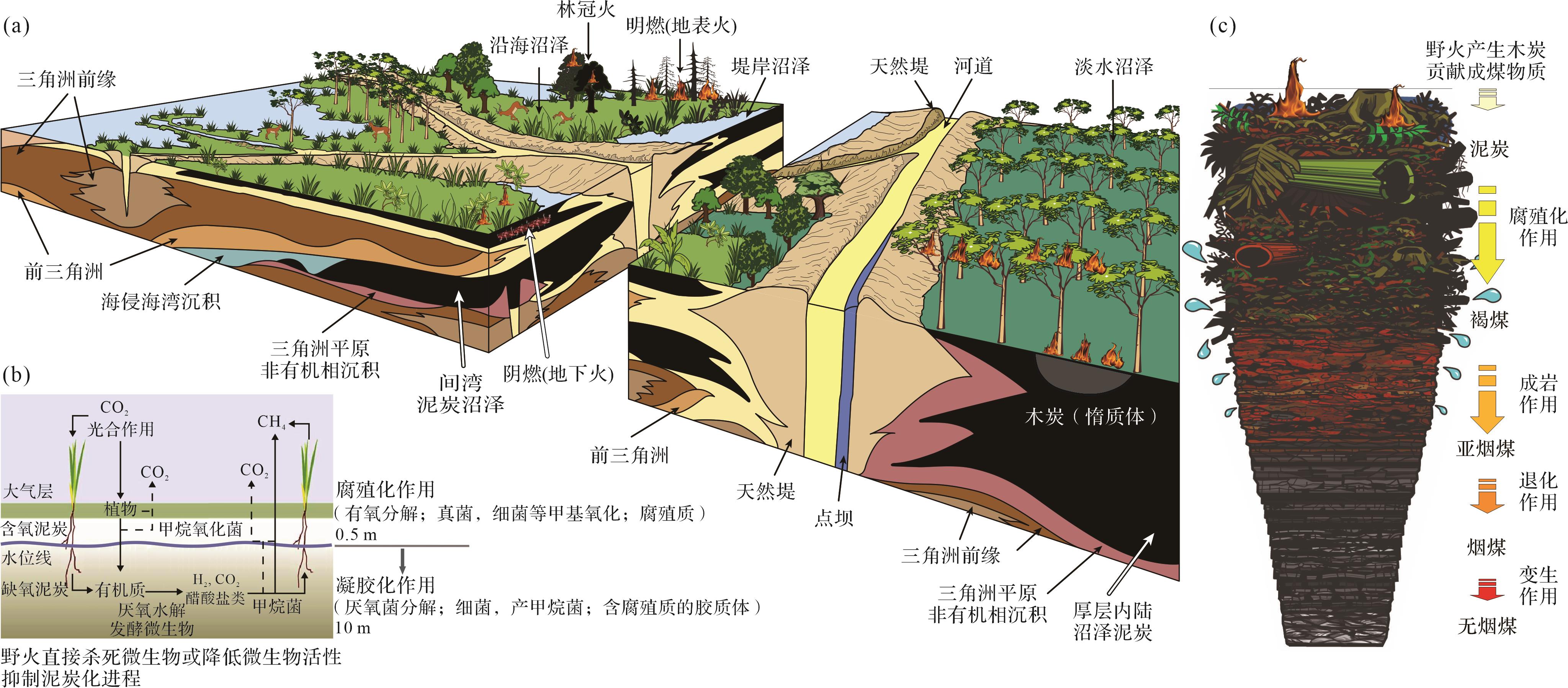
根据泥炭地野火有无火焰,可以将其分为明燃和阴燃(图1)。明燃野火持续时间较短,更接近于古泥炭地野火中的地表火,造成地表泥炭和生物质损失(Stracher et al.,2016);而阴燃野火主要发生在泥炭地下的土壤内,可以在低温、高含水量和低氧浓度下持续燃烧,更接近于古泥炭地野火中的地下火,造成泥炭地地下泥炭的损失(Belcher et al.,2010)。明燃与阴燃野火的发生往往是密切联系相互耦合的,阴燃泥炭可使燃烧范围从地下转移到地表,导致明燃火灾的发生(Belcher,2013;Stracher et al.,2016)。相比之下,阴燃火灾加热持续时间可超过1 h,达到大多数泥炭地内物种的致死温度,带来持续性热释放也是导致生物死亡率增加的重要因素(Hartford and Frandsen,1992;Stephens and Finney,2002;Rein et al.,2008),这种地下火可使超过10 000年储存于古土壤内的碳释放(Rein et al.,2008)。但是由于泥炭地土壤通常处于潮湿或淹水状态而无法支持燃烧,土壤含水率是控制泥炭地野火点燃和蔓延的最重要因素(Rein and Huang,2021),如气温升高或人为泥炭地排水都会降低土壤含水率,使泥炭地野火发生频率增加(孙龙等,2021)。关于泥炭地野火的着火方式有自然点火(例如闪电或自热点火)(Restuccia et al.,2017)和人为点火(采用计划火烧的方式减少泥炭地野火的发生,例如刀耕火种中点燃泥炭地以迅速清除植被进行种植)(Goldstein et al.,2020;Astuti,2021)。

图 1 泥炭地沉积体系及野火类型和作用(据李勇等,2022修改)
Figure 1. Peatland sedimentary systems and types and functions of wildfires (modified from Li et al., 2022)
-
在湖泊、海洋和土壤沉积物中保存的木炭(罗运利等,2001;Huang et al.,2006;Marlon et al.,2008),能够提供几千年甚至几万年野火活动的连续记录,常被地质学家用作恢复地质时期野火的工具(Scott,2010;孙楠和李小强,2016)。惰质体与木炭有着极其相似的物理化学性质,尤其是在野火产生木炭观察到反射率增加,最近研究中发现并确认惰质体和木炭,绝大多数情况下是同物异名(Uhl and Kerp,2003;Scott and Glasspool,2007;Diessel,2010;Glasspool et al.,2015)。
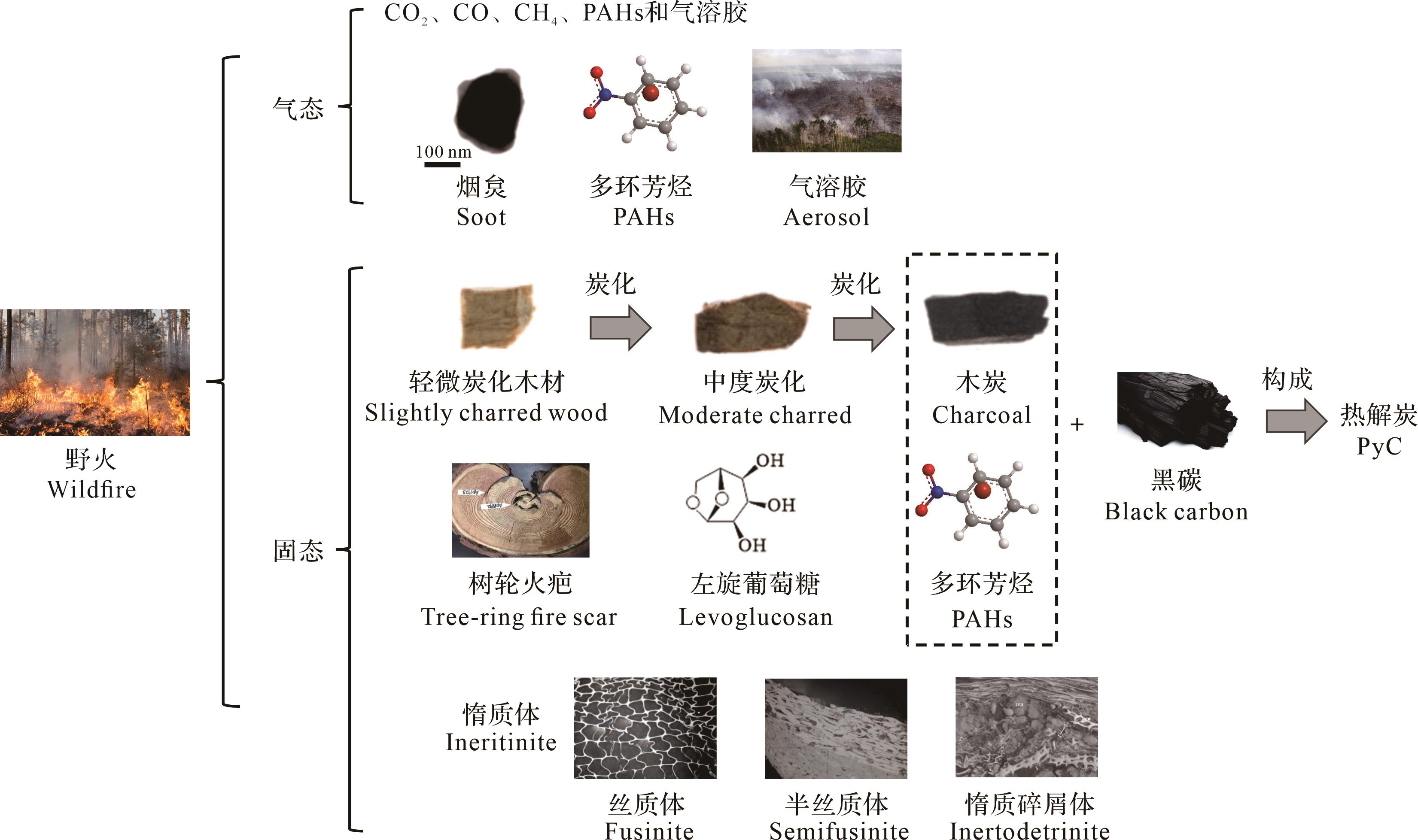
虽然木炭能够重建古野火活动和古环境演化的认识已被广泛接受,但关于木炭、黑碳、丝炭、热解炭等专业名词的区分和认识却混淆不清。基于此,本文系统阐述“炭”相关概念,以期加深“炭”相关领域学者的理解和认识,规范专业术语的准确运用(图2)。木炭(charcoal)是植物不完全燃烧产生的灰黑—黑色含碳化合物,是由植物树干、茎、树皮或叶、果实等各种植物组织在无氧或缺氧条件下不完全燃烧的残余集合体(Uhl and Kerp,2003)。不同研究领域对于木炭的定义略有不同,地理学将古炭屑(不包括煤层中)定义为有机体不完全燃烧或高温分解产生的深褐色或黑色多孔无机碳化合物,并突出强调其燃烧特征(Swain,1973;吕静等,2002;张健平和吕厚远,2006);古生物学中将化石木炭定义为植物材料经缺氧条件下不完全燃烧保存于沉积地层的古植物残留体,强调其生物降解性低于未经炭化材料(Schopf,1975);煤岩学根据煤岩显微组分的光学特征划分丝炭与半丝炭,并将它们共同称为惰质体(陈佩元等,1996;韩德馨,1996)。Scott(1989)明确提出保存于煤层中的丝炭与半丝炭是由于古森林野火事件生成的化石木炭,并阐明丝炭形成于高温火灾,半丝炭形成于低温火灾(Scott and Jones,1994)。黑碳(black carbon,BC)最早被描述为一种存在于沉积物中的碳质颗粒物,通过燃烧植物或煤、石油和天然气等工业燃料形成(Smith et al.,1973)。黑碳具有稳定的芳香结构和生物化学惰性,在土壤、湖泊、海洋等沉积物中能够稳定保存数百万年,常作为火灾活动的记录器(Schmidt and Noack,2000;Conedera et al.,2009)。关于黑碳与木炭界定模糊不清,许多研究人员将黑碳近似等同于木炭(Kuhlbusch,1998;Zhu and Pignatello,2005;Forbes et al.,2006)。但追根溯源后发现,黑碳是生物质与化石燃料不完全燃烧形成的具有高度热稳定性的连续体,其囊括范围更大,包括轻微/中度炭化的植物、烟炱、木炭和石墨碳(Goldberg,1985;Schmidt and Noack,2000;Masiello,2004)。热解炭(pyrogenic carbon,PyC)以固体炭化残留物的形式存在,是由森林火灾有机燃料不完全燃烧产生,包括木炭、耐氧化的部分黑碳、低比例的挥发性烟尘和多环芳烃(PAHs)(Preston and Schmidt,2006;Santín et al.,2015)。野火产生PyC具有抗分解性,可提供十几年乃至数千年的碳封存(Lehmann et al.,2008;Santín et al.,2015)。

图 2 木炭等相关野火产物学术术语关系
Figure 2. Relationship between academic terms related to charcoal and other wildfire products
-
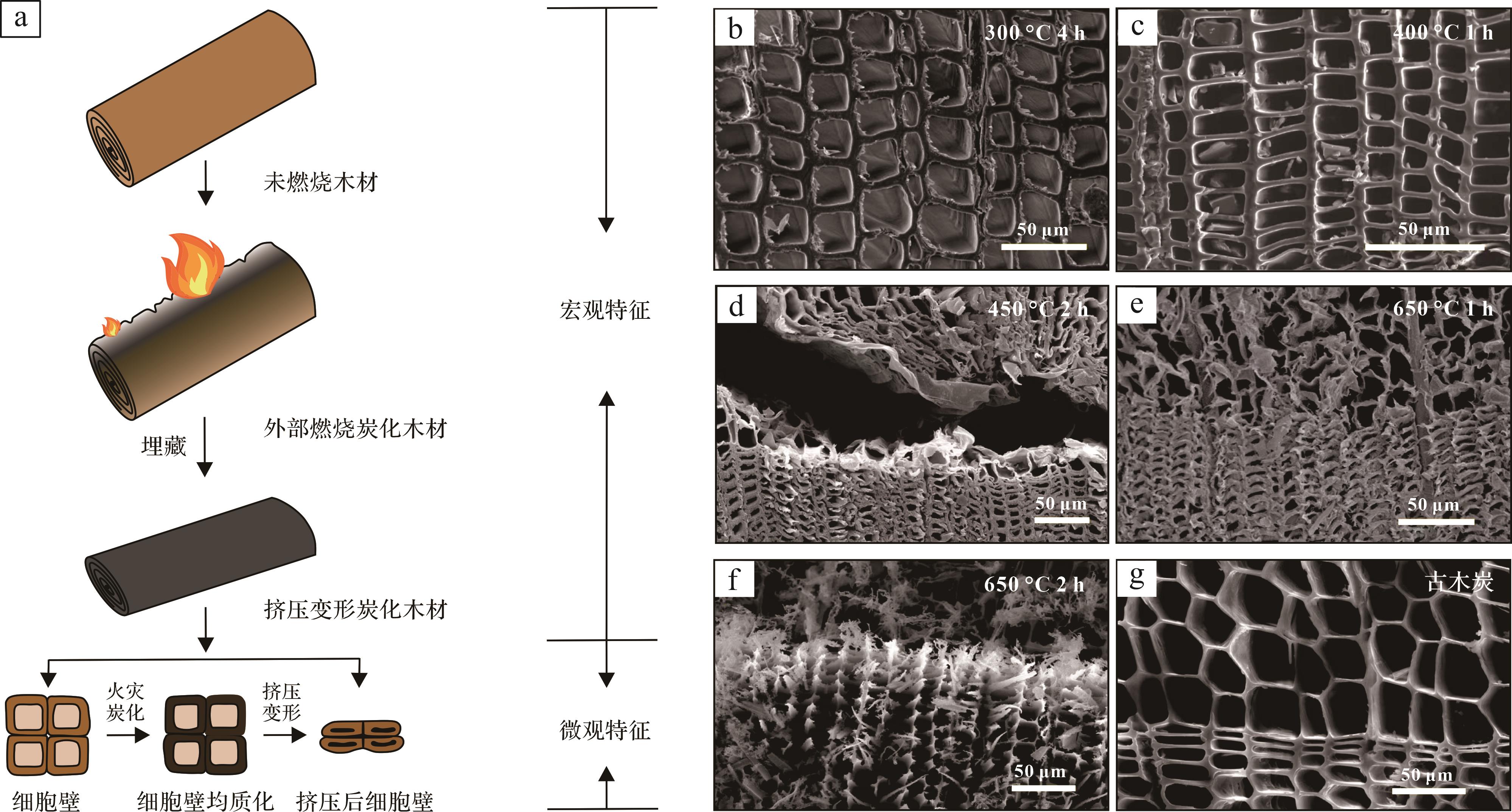
木炭是在无氧和缺氧条件下形成的,生物质表层燃烧产生的热量会渗透到组织内部,部分缺氧或无氧区域会发生高温热解反应释放出挥发性气体分子,气体分子接触到氧气会持续燃烧和高温热解,但若反应由于缺氧而停止,木炭则作为不完全燃烧产物保存下来(Scott,2000,2010)。树木外部经火烧后炭化埋藏逐渐形成木炭,内部保存完好的细胞结构会发生细胞壁均质化而后被挤压变形最终形成木炭(图3a)。在炭化过程中,细胞壁发生均质化,细胞间层消失。当木材样品炭化或几乎完全炭化时,在300 ℃下加热2 h后会发生均质化。炭化后温度升高会进一步改变丝质体微观结构,使细胞壁变形(图3b)并形成许多裂缝(图3d);当温度达到650 ℃时,木材组织完全灰化,导管结构和形态特征几乎消失(图3f)(Li et al.,2024)。

图 3 树木外部燃烧、炭化宏观过程与微观特征
Figure 3. Macroscopic process and microscopic characteristics of external combustion and carbonization of trees
目前,学术界关于惰质体成因一直存在争议(Guo and Bustin,1998;Scott,2002;Moore and Shearer,2003;Scott and Glasspool,2005),主要包括:(1)氧化成因,是由植物残骸在泥炭化作用阶段缓慢氧化形成,发生脱氧、脱氢和失水变化,碳元素逐渐富集而成(代世峰等,2021);(2)野火成因,是由植物或沼泽的木质组织经森林野火不完全焚烧而成(Scott,1989;Guo and Bustin,1998;Scott and Glasspool,2007);(3)生物降解成因,与真菌降解木质组织有关(Teichmüller,1989;Moore et al.,1996)。针对氧化成因,自然界低阶煤中丝质体和半丝质体的反射率高于镜质体,说明惰质体可能并不是氧化形成的(Jones,1994);针对生物降解成因,真菌的生物活动导致植物组织破裂或分解,使其更容易燃烧和炭化,在野火作用下真菌和成煤植物一起形成了惰质体(Guo and Bustin,1998)。
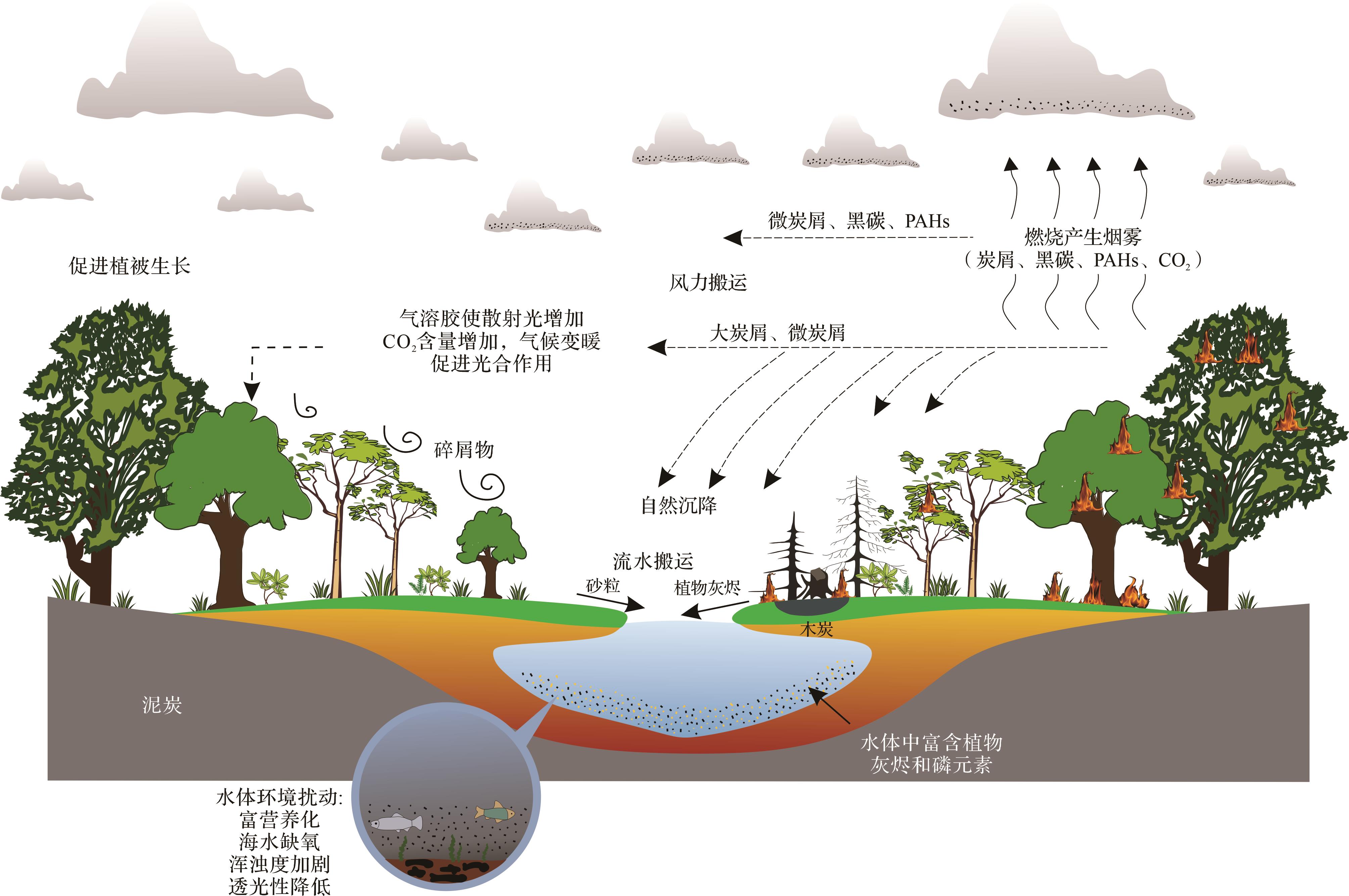
尽管惰质体可能来源于野火或有机质降解等途径,但现代木炭沉积和炭化实验观察显示,惰质体几乎完全来源于野火(Jones et al.,1991;Jones,1994;Scott and Glasspool,2007;Xu et al.,2022a)。大规模的泥炭地野火会烧焦和半烧焦植物,并在沉积物中形成由野火衍生的惰质体,包括半丝质体、丝质体、碎屑惰质体等(Cope and Chaloner,1985;Scott and Glasspool,2007)。火焚成因的惰质体质地较脆,细胞保存十分完好。但易受到成岩作用的物理性破坏,未发生侵蚀和极端热变质作用的惰质体能够指示古野火事件的发生(Lamberson et al.,1996)。这主要是由于泥炭地沉积是陆地相对连续沉积的最佳记录之一,在正常潮湿的泥炭地内,富含木质素、纤维素等植物组织的有机物质被掩埋、氧化并转化为主要的成煤物质(Lamberson et al.,1996)。倘若这一过程发生野火,植物残骸不完全燃烧形成煤中最常见的显微组分—惰质体(图4)。

图 4 泥炭地野火主要产物迁移、沉积示意图(据Glasspool and Scott,2013;Yan et al.,2019修改)
Figure 4. Schematic diagram of the migration and deposition of the main products of peatland wildfires (modified from Glasspool and Scott, 2013; Yan et al., 2019)
近年来,许多学者通过多种实验证明煤中惰质体(主要为丝质体和半丝质体)属于植物不完全燃烧的产物,等同于现今的木炭(Scott,1989;Bustin and Guo,1999;Scott and Glasspool,2007)。现今森林野火不完全燃烧形成的木炭与地质历史时期形成的木炭具有相似的性质和结构,均易形成立方体小块,沉积物中的木炭由于受到压力作用被压扁成片状,其次微观上可看到完整清晰的植物细胞结构,因此煤中惰质体相当于现今火灾产生的木炭(Scott,2000)。大多数惰质体成分是森林野火的产物,尤其是丝质体和半丝质体是植物经过不完全燃烧形成的(Bustin and Guo,1999)。Scott and Stea(2002)研究发现大气氧含量在地质时期的长期变化可以解释惰质体的全球分布特征,也支持煤中惰质体是植物不完全燃烧产生的观点。有学者认为所有的惰性体显微组分都可归因于泥炭沼泽中的野火,受温度、加热时间和原始植物材料性质的共同影响(Lamberson et al.,1996;Bustin and Guo,1999)。
-
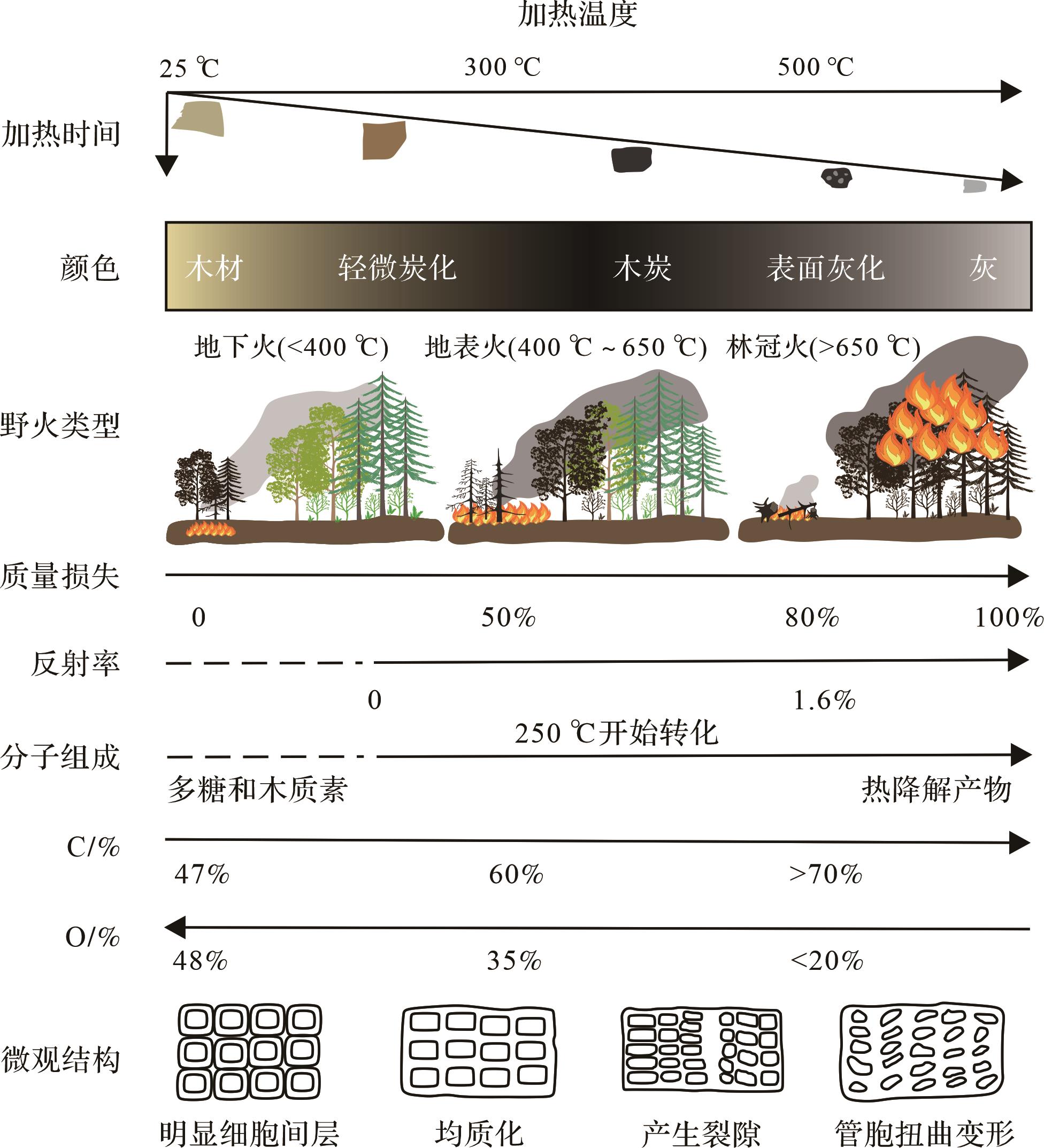
野火衍生的木炭在一系列环境变化中可存在数千年,是重建古野火的重要工具,了解野火作用下木炭结构特性的变化,有助于提高野火木炭化石记录认识。有学者通过使用锥形量热法(cone calorimetry)生产木炭并使用反射光显微镜制备用于结构研究的木炭样品(Hudspith and Belcher,2017)。结果显示,细胞壁均质化是木炭热解前早期加热阶段所特有的结构特征,随后在燃烧样品表面顶部形成木炭绝缘层(Hudspith and Belcher,2017)。木炭形成速度取决于燃烧时间、燃料水分含量和物种特异性因素,如原始木材密度和木材解剖结构等(Mikkola,1991;Tran and White,1992;White and Nordheim,1992;Harada,2001)。在燃烧过程中,木炭反射率也会由灰色到白色逐渐增加,早期细胞壁变得薄而扭曲,并随着燃烧进行沿着中间薄片开裂,在燃烧末期细胞壁会被拉开和断裂(Hudspith and Belcher,2017)。关于木材分子组成与升温变化关系,学者利用DTMS-EI光谱观察升温过程木材的分子组成,发现加热至250 ℃样品(被子植物和针叶树)与未燃烧样品相比,其分子组成仍以多糖和木质素为主;高于250 ℃时,会产生部分芳香化合物,多糖和木质素会逐渐被生物分子的热降解产物所替代(Braadbaart and Poole,2008)。木材通过火烧或加热转化为木炭这一过程可以分为三个阶段:轻微炭化、炭化和灰化。Li et al.(2024)针对青藏高原东北部地区开展了两个典型树种(油松和云杉)的木材炭化梯度加热实验(以150 ℃~650 ℃为温度梯度,1~4 h为时间梯度),通过颜色、质量损失、反射率、碳氮氧元素含量、木材微观结构等一系列理化指标定量化分析了木材炭化过程(图5)。结果表明,木材的炭化发生于300 ℃以上,木材转变为木炭至少需要在300 ℃下加热4 h,温度越高木炭化所需时间越少,直至木材完全变黑(Li et al.,2024)。随着温度升高,细胞壁也变得均质化、断裂和扭曲。炭化过程中木材失重率达到50%,碳和氧元素含量分别上升和下降至约60%和35%,反射率从0上升到0.5%(Braadbaart and Poole,2008;McParland et al.,2009;Ascough et al.,2010)。反射率能够很好地反映木炭的形成温度,大量研究显示反射率与温度具有很强的正相关关系,能够重建古野火温度(Braadbaart and Poole,2008;McParland et al.,2009;Ascough et al.,2010;Veal et al.,2016),木炭的微观结构细胞壁均质化可用于识别木炭和反映古野火温度阈值。

图 5 木炭炭化过程结构及理化性质变化图(据Li et al.,2024修改)
Figure 5. Diagram of the structural and physicochemical property changes during the carbonization process of charcoal (modified from Li et al., 2024)
木炭化过程本质是一个热降解过程,这一过程围绕纤维素、半纤维素和木质素发生了复杂的化学变化,即多糖和木质素被芳香族化合物替代释放挥发性气体的过程(Guo and Bustin,1998;Ascough et al.,2010)。纤维素占比最大,超过木材质量的50%,是木材热降解过程的主要贡献者(徐有明,2019)。在热降解过程中,首先必须蒸发水分后受热升温至100 ℃以上。由于半纤维素性质不稳定,在130 ℃开始分解并释放一氧化碳、二氧化碳、乙酸和甲醇等挥发性物质。当温度达到250 ℃时纤维素开始分解,超过300 ℃开始生成木炭,325 ℃时植物细胞结构改变发生细胞壁均质化。自然界内木炭化过程通常为大于约350 ℃下的贫氧阴燃过程(Preston and Schmidt,2006;McParland et al.,2009)。400 ℃以上纤维素会失去约91%的原始质量,转化为大量的挥发性物质和烧焦固体(Wang et al.,2007;Liu et al.,2009)。此外,热降解过程会形成缩聚芳烃增加反射率,这一过程伴随着脱氧和脱氢,最终导致碳聚集(Braadbaart and Poole,2008;Ascough et al.,2010)。当热解温度达到500 ℃时,木炭的表观密度开始增加,内部裂缝和固定碳含量也会随着热解温度的上升而增加(Dias Junior et al.,2020)。
-
煤中惰质体对于古野火的研究至关重要,现已在古野火事件研究中广泛应用。(1)确定古野火类型:Jones(1998)依据惰质体反射率Ro与古野火燃烧温度T的正相关关系,首次建立野火燃烧温度计算模型,将惰质体反射率与古野火类型建立直接联系。Scott(1989)确定了森林野火的三种类型:林冠火,地表火,地下火(图5)。地下火主要燃烧枯落物以下的土壤腐殖层,一般会产生约400 ℃的最高温度;地表火主要燃烧草本植被、低矮灌木、凋落物,温度可达600 ℃左右;树冠火通常会烧毁树木和较大灌木的树冠,产生强烈的热量,温度可达800 ℃或更高(Scott and Jones,1994;Preston and Schmidt,2006;Petersen and Lindström,2012;Wang et al.,2019)。(2)估算古大气氧含量:古大气氧含量预测主要是基于地化模型,经过不断修正与改进,现已逐步成熟(Berner,2006,2009;Mills et al.,2023)。野火燃烧很大程度上受大气氧含量的限制(邵龙义等,2024)。基于惰质体的野火成因,Glasspool and Scott(2010)收集并分析了全球不同时代的惰质体含量数据,建立了用惰质体含量计算大气氧含量模型,并计算出400 Ma以来的大气氧含量。而后多位学者利用该模型计算出成煤期大气氧含量(Shao et al.,2012;Wang et al.,2019;Liu et al.,2020;Zhang et al.,2020),并与地化模型吻合程度较高(Mills et al.,2023)。
通过分析煤层垂直剖面的显微组分,即镜质体与惰质体的相对比例,能够合理地解释泥炭地野火的历史演化过程,这一原理现已得到广泛的应用(Teichmüller,1989;Jones,1994;Wang et al.,2019)。根据沉浮和水流搬运实验可将木炭分为三类,微观木炭(<125 μm)、细粒木炭(125 μm~1 mm)、宏观木炭(>1 mm)(Scott,2010)。宏观木炭质量重,搬运距离短,沉积在野火发生地附近,指示本地野火类型。微观木炭质量轻,可被燃烧热流气体带入高空,搬运几百千米至几千千米,可指示区域性野火类型(图4)。
-
泥炭沼泽作为古野火事件和古气候信息的沉积载体,在全球碳循环中发挥着重要作用(Greb et al.,2006;Brown et al.,2012)。泥炭地野火主要通过燃烧泥炭沼泽地表植被和土壤有机质向大气中排放大量的温室气体。气候变暖和干旱导致森林野火强度和频率增加,严重威胁泥炭沼泽生态系统的碳平衡使其从净积累转变为净损失(Walker et al.,2019)。野火发生后,泥炭地燃烧层下的部分土壤可免于燃烧,导致多次火灾后泥炭沼泽中碳的净积累。此外,森林野火燃烧产生大量木炭,能够提供最稳定的碳储存。土壤微生物、聚集体和有机质的持久性变化,可以直接抵消碳损失,提高生态系统碳汇能力。野火对全球碳循环的净影响涉及除燃烧排放外的许多相互作用源和汇的过程(Girona-García et al., 2024),反映了野火干扰后泥炭沼泽中碳循环效应的不确定性。因此,古野火事件的源汇过程仍存在许多尚未解决的问题,亟须以泥炭沼泽碳循环为纽带,在总结梳理泥炭沼泽碳的损失、储存及其迁移机制基础上,探究长时间尺度下古野火事件碳循环效应。
-
野火是全球碳排放的重要组成部分,它通过直接向大气排放大量温室气体和火后多种碳源和碳汇途径(van der Werf et al.,2017;Yin et al.,2020;Bowring et al.,2022),影响全球气候变化和碳循环过程(Zheng et al.,2023)。据统计,自2000年以来,由于化石燃料和土地利用变化的CO2排放量平均每年约90 Gt(1 Gt=109 t)(Friedlingstein et al.,2022),而野火CO2年排放量约为2 Gt(Zheng et al.,2021;Loisel and Gallego-Sala,2022)。随着全球气候变暖,野火风险加剧,并严重威胁碳的稳定储存(Zheng et al.,2023)。倘若野火侵入了泥炭地等富含碳、具有较强碳汇功能的生态系统,不仅会在短时间内产生大量的碳排放,而且阻碍生态系统的恢复与重建,削弱陆地生态系统的碳汇能力(Zheng et al.,2021)。
泥炭地生态系统是由部分分解的植物残余物和有机物组成的湿地,这些残余物和有机物经过数千年的积累,形成富含碳的土壤,称为泥炭,厚度可达几米(Loisel and Gallego-Sala,2022)。泥炭沼泽对于气候调节具有重要作用,但野火燃烧和泥炭地退化能够加速泥炭地的碳释放(Wilkinson et al.,2023)。原始泥炭地生态系统被野火燃烧破坏,使其碳源效应逐渐显现(Wösten et al.,1997;Page et al.,2002;Canadell et al.,2007)。研究发现,野火可使原始泥炭地的碳吸收减少35%,使退化的泥炭地的碳排放量增加了10%。气候变化加速碳损失,预计到2100年,野火强度和频率增加可使泥炭沼泽的碳汇分别减少38%和65%(Wilkinson et al.,2023)。全球泥炭沼泽地内的土壤碳储量约为600±100 Gt(Yue et al.,2016)。但野火导致的气候变化和人为压力可能致使这些长期储存的碳迅速逸散,使得一些泥炭地成为大气中的碳源(Leifeld et al.,2019;Turetsky et al.,2020;Evans et al.,2021)。这主要是野火、气候干旱和土地退化导致的热带泥炭地碳排放和永久冻土融化影响,可能超过北部高纬度地区植物生产力提高的预期碳收益(Loisel and Gallego-Sala,2022)。
一般情况下,原始泥炭地具有水文自律功能,不会受到深层阴燃的影响,泥炭沼泽碳储量可受到保护(Dommain et al.,2010;Waddington et al.,2015)。泥炭表层的高孔隙度和储存系数能够最大限度地减少地下水位变化,维持深层泥炭的潮湿状态,使其无法支持阴燃。若表层泥炭变得干燥易燃,则深层泥炭致密的有机层可作为防火屏障(Turetsky et al.,2015)。未受干扰的泥炭地野火对大气的影响是近乎中性的,因为表面泥炭明燃释放的碳可通过植被恢复重新封存(Trumbore,2009;Turetsky et al.,2015)。然而,如果火灾向深层泥炭进一步扩展成阴燃,则可能影响到几个世纪乃至几千年来一直不是活性碳循环的部分土壤碳(Turetsky et al.,2015)。野火频率和强度的增加导致深层泥炭持续阴燃,泥炭地则可能充当碳源。例如,1997—1998年印度尼西亚广泛燃烧的深层泥炭阴燃火释放了约0.95 Gt碳,相当于当时全球化石燃料排放量的15%(van der Werf et al.,2010)。据统计,1997—2009年期间,泥炭地野火对全球碳排放量贡献从4%增加至5%(van der Werf et al.,2010)。此外,野火使得泥炭地地下水位下降,导致泥炭氧化(干燥、有氧条件促进微生物活动而加剧土壤分解)和CO2排放,泥炭地本身也会发生沉降(海拔下降)或地表变化(Loisel and Gallego-Sala,2022)。深层泥炭的阴燃火会严重损害热敏植物根部和微生物(如外生菌根和细菌)(Hart et al.,2005),这些影响将在火后泥炭长时间地持续存在。在北方和热带泥炭地,野火连续性可能使泥炭地性质由不易燃转变为更易燃的类型,增加火灾风险(Hoscilo et al.,2011)。上述火灾后的变化使泥炭地生态系统的水文调节功能丧失,导致泥炭堆积和碳储量减少。但是,这些研究并未强调时间和野火强度的重要性,或是只关注野火对泥炭地短期(年尺度)的碳源效应,野火在泥炭沼泽生态系统长期过程中的碳源或汇作用需要在未来研究中更深入的探索。
-
泥炭地是重要的陆地碳库,并在全新世的大部分时间里充当碳汇(Yu et al.,2010;Page and Hooijer,2016)。由于泥炭地中碳源相对稳定的性质,在过去的几个世纪甚至几千年里,泥炭地中储存的碳并未参与活性碳循环(Turetsky et al.,2015)。野火产物木炭,即由生物质或化石燃料不完全燃烧产生的PyC进入土壤,不仅直接影响碳储量,而且对于泥炭地恢复以及碳平衡发挥重要作用(孙龙等,2021)。煤炭形成主要经历泥炭化阶段和成煤阶段,而木炭具有大量稳定的芳香结构,对生物和非生物分解都具有抵抗力,难以被细菌、真菌等微生物分解,因此可能受泥炭化作用影响很小,或可能直接跳过该阶段,最终以泥炭、腐泥的形式储存在地下,为后来的煤炭形成奠定了基础。木炭在燃烧过程中,自身已经发生脱羟、脱羧、脱甲烷等作用,含碳量持续增加,因此煤化作用对木炭可能影响也不大。泥炭地多形成在沼泽、滨湖、海湾或潟湖等水体相关环境中,靠近原始炭化源,非常适合捕获足够数量的木炭沉积物。野火对植被覆盖的破坏也会导致径流增加多达60%,并且还会加剧侵蚀,沉积物产量增加30倍,可能携带木炭并集中在河口潮汐坝之间的缓流区中或近岸大型水体沉积物中积累,将带来的木炭掺入泥炭中(Moore,1978,1982)。考虑到5~10 m厚的植物遗体才能形成约1 m厚的泥炭,而泥炭到烟煤成煤过程受到高达约6∶1的压实比例(邵龙义等,2022)。在长时间过程中,产生大量的木炭持续积累在泥炭中,为成煤贡献足够的惰性物质(惰质体),并且植物遗体到泥炭的比例以及泥炭到成煤的比例可能会有所降低。
在森林砍伐和野火殆尽后,植被和土壤碳储量往往很难恢复到野火前的水平。这主要是由于:燃烧后的碳一部分可能流失至大气中,一部分则可能通过PyC积聚在陆地或海洋生态系统中(Santín et al.,2016)。PyC很早就被认为是野火的一种顽固副产品并支持陆地碳汇(Seiler and Crutzen,1980)。据不完全统计,虽然泥炭地只覆盖了陆地表面的3%,但可包含土壤中储存1/3的碳(Dargie et al.,2017)。例如,北极泥炭地约含500~600 Gt的碳,而90%储存在永久冻土区(Tarnocai et al.,2009);在东南亚地带,热带泥炭地可储存约100 Gt的碳(Turetsky et al.,2015;Dargie et al.,2017)。现场勘查结果显示,全球PyC年产量约为114~383 TgC·yr-1(1 Tg=106 t),这些PyC如果逐渐沉降并保存在土壤中,大约可抵消每年全球碳排放的十分之一(Seiler and Crutzen,1980)。PyC是土壤碳库的重要组成部分,全球土壤中PyC含量可占土壤有机质含量的30%以上(Reisser et al.,2016),而在中国长白山区和欧洲北方地区的泥炭地,PyC占泥炭地平均土壤有机质的10%,有时甚至达到50%(Gao et al.,2016;Leifeld et al.,2018)。虽然PyC在泥炭地碳库中占比很大,但是大部分野火干扰后碳损失的估算并不包括PyC,全球碳储量估算应更加关注野火产生的净效应。PyC是具有强热稳定性和高碳富集的多环芳烃化合物,属于泥炭地燃烧连续体的一部分(Hedges et al.,2000;孙龙等,2021)。研究表明,野火燃烧温度越高,形成PyC的碳富集度和芳香度也就越高,因此具有高抗逆性和抗生物降解性(Santín et al.,2015;Holden et al.,2016)。随着野火频率和强度的升高,土壤被输入更加稳定且保存时间更长的PyC,一定程度上降低了土壤有机质周转率和提高土壤碳库稳定性(Aaltonen et al.,2019;Flanagan et al.,2020)。此外,PyC输入对土壤微生物和土壤酶的影响,可能是改变土壤碳排放的重要原因。有学者通过在加拿大冻土区土壤内添加高温产生的PyC实验,发现PyC进入土壤后可抑制土壤微生物和酚氧化酶活性,减少土壤碳排放(Flanagan et al.,2020)。进一步研究发现,PyC作用机制可能因氧气条件不同而存在差异(孙龙等,2021)。在有氧条件下,PyC进入土壤后可通过增加酚类化合物含量,降低微生物和水解酶(酚氧化酶)活性,减少土壤碳排放;在厌氧状态下,PyC输入会促进土壤内甲烷菌产生,增加土壤CH4排放(孙龙等,2021)。
野火可使有机质生物化学结构转变,并且形成新的结构积累。植物燃烧过程中,挥发物被释放,更不稳定的纤维素被分解,木质素发生化学变化,含氧官能团减少,产生更高百分比例的耐火分子(Scott and Glasspool,2007)。野火导致土壤有机质化学成分的主要变化之一是形成顽固的结构域,这些结构域包括交联脂质化合物的耐火烷基结构,还包括严重去功能化的缩合芳烃,它们通常可以抵抗剧烈的化学水解,具有化学和生物学的顽固性。除了火引起的结构稳定外,可能导致挥发性结构的去除和不稳定化合物的转变(Almendros et al.,1988;González-Pérez et al.,2008;de la Rosa et al.,2012)。此外,真菌往往对野火更敏感,泥炭地野火可使真菌丰度降低47.6%,微生物丰度降低33.2%,完全恢复原来水平需要几十年的时间(Waldrop and Harden,2008)。真菌产生相关的外酶减少,有机质分解速率下降。细胞外酶测定表明,火可以将降解纤维素和芳香族化合物的八种细胞外酶的活性降低40%~66%,减少多种土壤有机化合物的分解,如纤维素、半纤维素、淀粉、甲壳素、有机磷和多酚(Hart et al.,2005;Pressler et al.,2019)。燃烧时土壤酶活性降低,野火降低了分解者的潜在活性,呼吸速率随野火时间下降,反复燃烧的土壤中微生物CO2呼吸速率平均降低了55±5%,进而减少了土壤碳的损失(Pellegrini et al.,2021)。
土壤聚集体(aggregates)是土壤有机质输入和输出的关键场所,其形成与稳定是土壤碳库的重要保护机制之一(胡海清等,2020)。聚集体形成受物理化学、微生物和植物等因素影响,其中许多过程会受到野火影响。聚集体通过减少微生物对底物的接近,以及通过阻碍反应物和产物的扩散,或者通过产生缺氧条件来降低细胞体外反应的速率,在稳定土壤有机质方面发挥着重要作用。野火通过加热土壤促进聚集体的形成,未烧毁的森林与被烧毁的森林相比,聚集体丰度从58%增加到84%,这可能使野火过后的土壤有机质物理稳定性增加(Sollins et al.,1996)。虽然野火燃烧有机物会破坏一部分聚集体,但可能会留下最具抵抗力的聚集体,如富含氧化铁的土壤(例如,许多氧化溶胶)和尿素土壤属于最稳定的微团聚土壤(El-Swaify,1980;Warkentin and Maeda,1980;Strickland et al.,1988)。野火强度会影响土壤团聚过程及相关特性(Mataix-Solera et al.,2011),野火干扰后土壤表面可形成疏水膜,增加土壤结构稳定性(DeBano,2000;Mataix-Solera and Doerr,2004)。在地中海地区的石灰质土壤中,野火发生区域的土壤聚集体稳定性显著增加(Arcenegui et al.,2008)。
-
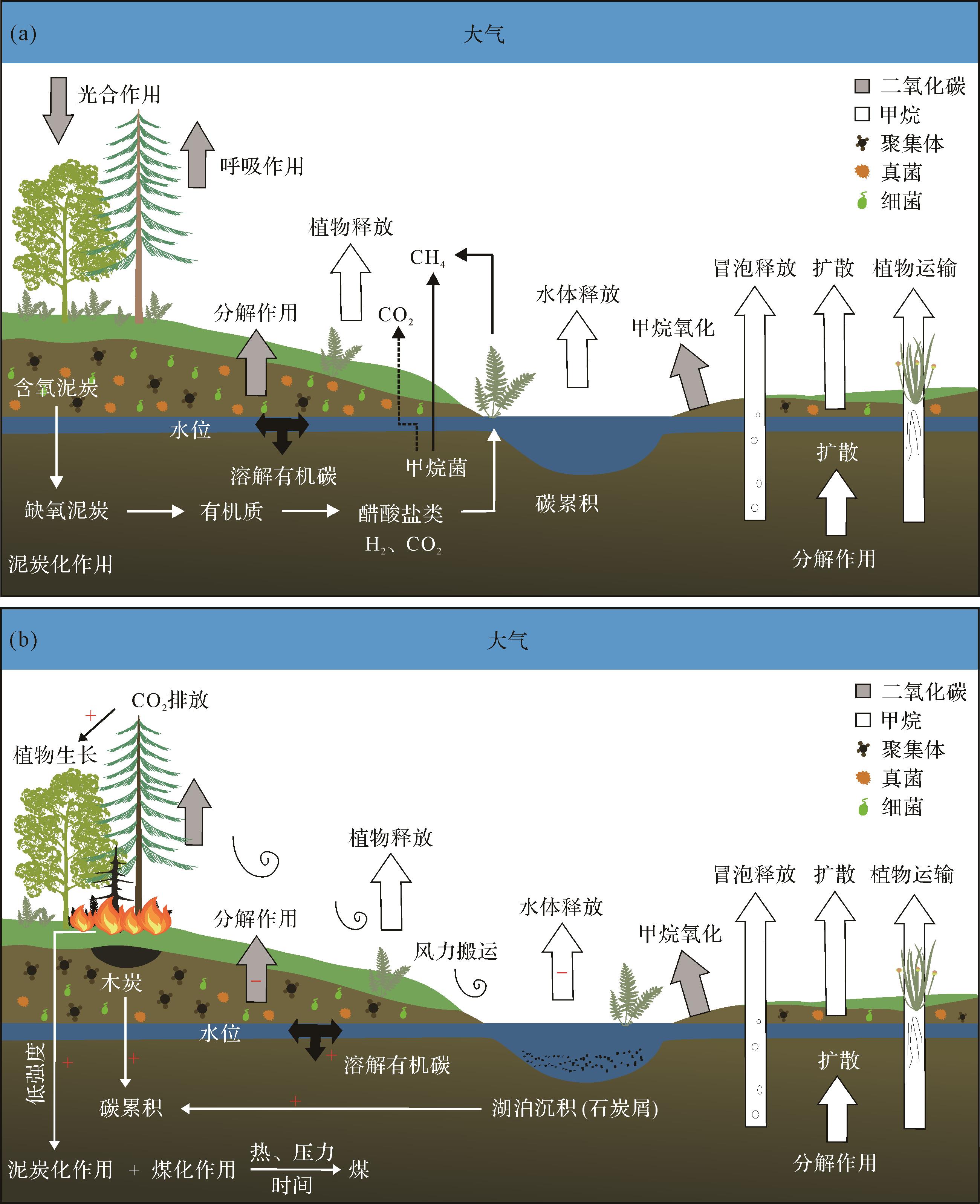
关于野火对气候及环境影响,存在年尺度和百万年尺度的讨论。现代泥炭地的碳循环过程及变化驱动机制显示,野火作为泥炭地生态系统的重要干扰因子,影响着泥炭地的碳循环和碳储存(图6a)(张卉等,2023)。野火产生大量二氧化碳很可能只是短期(年尺度)效应,而长期(百万年尺度)来看野火后森林生态系统的恢复和野火产物—木炭能够固定更多的碳(Pausas and Keeley,2019;邵龙义等,2024),低强度野火可能在泥炭地碳循环中发挥着重要作用(图6b)。

图 6 (a)正常埋藏下泥炭地主要碳循环过程(据张卉等,2023修改);(b)野火干扰后泥炭地主要碳循环过程
Figure 6. (a) Main carbon cycle processes in peatlands under normal burial conditions (modified from Zhang et al., 2023); (b) main carbon cycle processes in peatlands after disturbance by wildfires
当今泥炭地主要分布在北半球冰后期地区和北极地区,对于泥炭地野火导致的碳排放和全球碳循环及气候变化的理解可能仍局限于数十年到几千年的时间尺度(Turetsky et al.,2015)。泥炭地野火一旦发生,必然会扰乱碳储存导致土壤碳流失(Frolking et al.,2011)。若泥炭地发生深层阴燃,可能会释放以前积聚的土壤碳储存并转变为主要碳排放源(Turetsky et al.,2015)。泥炭地野火在地表扩散产生的大量烟雾会降低光照水平,抑制植物对大气二氧化碳的吸收效率(Heil et al.,2007)。
泥炭地野火通常发生在植被干枯、土壤湿度高的休眠期,造成泥炭地表层瞬间加热,而底层泥炭几乎没有泥炭损失,在一定程度上形成千年尺度泥炭有机质保存(Flanagan et al.,2020)。低强度野火是指燃烧速度较慢,火焰高度较低和破坏程度较小的火灾,作为全球泥炭地有机物的一种保护机制,它能够在泥炭聚集体表面增加土壤有机质(SOM)官能团的碳聚合和芳构化程度,从而增加稳定土壤碳库和降低微生物呼吸速率(Flanagan et al.,2020)。低强度野火还能够降低泥炭的温度敏感性,SOM稳定性的增加导致泥炭地存在更大比例泥炭有机物,这些有机物垂直迁移到泥炭地土壤剖面区域并在水饱和厌氧区存活,这种生物化学保护机制可使碳储存免受数千年的分解,这表明周期性的低强度野火可以支持长期的碳储存(Flanagan et al.,2020)。此外,虽然目前关于野火如何影响土壤溶解有机碳输出、组成和产量的研究尚且缺乏,但许多研究表明野火能够明显增加土壤中的溶解有机碳(Andersson et al.,2004;Pardini et al.,2004;Wang et al.,2012)。
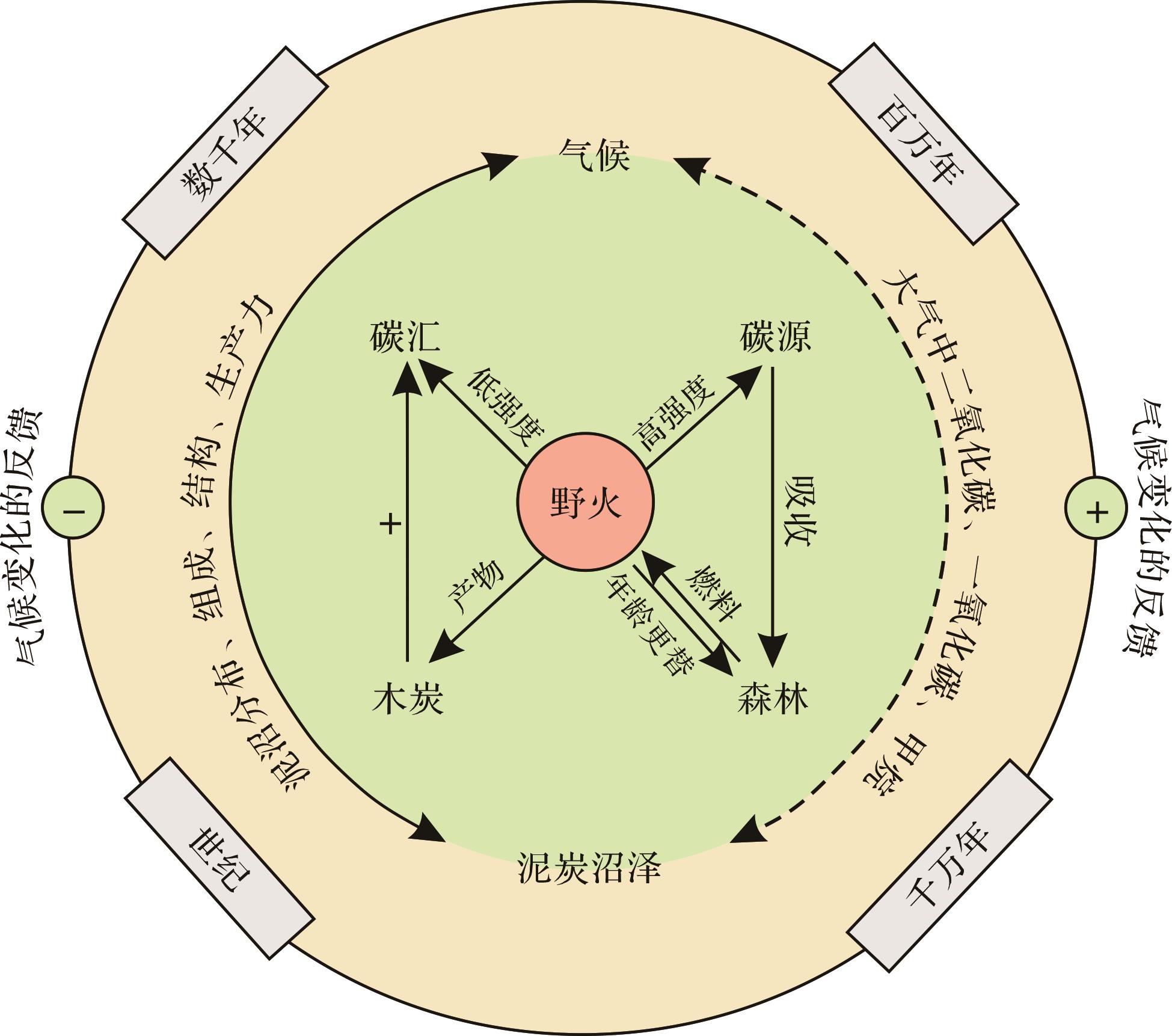
关于野火—泥炭地长期(百万年尺度)效应,森林生态系统在经历了数万年的恢复与重建,植被更替进行光合作用固定大气二氧化碳,同时泥炭沼泽的大规模发育也持续增加陆地生态系统碳固定含量。野火产物木炭和水体沉积中的炭屑不断促进碳累积,未被杀死土壤微生物和新形成的稳定聚集体对植物组织发生泥炭化作用和煤化作用形成正向反馈,在一定温度、压力和时间条件下成煤(图6b)。此外,野火可能与地质历史时期的重大地质事件(如生物大灭绝、大洋缺氧和极热事件)密切联系(Shen et al.,2011;Robson et al.,2015;Xu et al.,2022b)。若以东北地区早白垩世古野火环境—气候效应为例,阿普特阶和阿尔必阶主要发生中低温的地表火和地下火,低矮的被子植物能够适应这种相对低强度野火并迅速生长繁殖和吸收大气二氧化碳,野火此时在长期气候—泥炭沼泽相互作用下发挥着减缓“温室效应”的作用(Gao et al.,2024;王帅等,2025)(图7)。

图 7 气候和泥炭沼泽的相互作用以及野火和碳循环的可能反馈机制(据Loehman,2020;邵龙义等,2024修改)
Figure 7. Interaction between climate and peatlands, as well as the potential feedback mechanisms of wildfires and the carbon cycle (modified from Loehman, 2020; Shao et al., 2024)
-
随着对森林火灾排放的温室气体研究的深入,如何准确计算野火产生的温室气体也成为许多学者研究重点。根据塞勒公式可计算出野火温室气体排放量(Seiler and Crutzen,1980),其中不完全燃烧形成残余固体计算公式为:
(1) 式中:R是由质量(M)的植物不完全燃烧产生总碳量(单位:t),代表古野火产生的残余固体—惰质体;M为野火事件中损失的可燃物载量(单位:t);fc是燃料的碳含量,通常取50%作为树木材料的平均碳含量(Crutzen and Andreae,1990);β是生物质燃料的燃烧效率,即单位面积森林燃烧过程中损失的可燃物载量与燃烧前可燃物载量的比值,政府间气候变化专门委员会(IPCC)的经验估计β值为45%(常禹等,2015)。
生物质燃烧的碳排放量(Kasischke et al.,1995;Levine et al.,1995):
(2) 式中:Ct是燃料燃烧过程中排放的碳总量(单位:t),M是野火燃烧导致的燃料损失量(单位:t)。
含碳气体的排放量(French et al.,2002):
(3) 式中:Es是某种碳气体的排放(单位:g);Efs是某种碳气体的排放因子(单位:g/kg)。根据胡海清等(2012)收集的针叶林排放因子平均值计算,二氧化碳排放因子取3 107.9 g/kg,一氧化碳排放因子取195.7 g/kg,甲烷排放因子取18.6 g/kg。
本文收集了中国东北地区早白垩世泥炭沉积时期古野火记录的显微组分数据(表1)。中国白垩纪的煤资源主要形成于早白垩世,集中分布在东北富煤区(宁树正等,2020),其资源预测量为136.48 Gt(陈文敏等,2021)。假设煤中惰质体均为野火燃烧残余产物,根据早白垩世煤炭资源预测量与表2中不同地层惰质体(%)乘积,可大致计算出古野火产生的残余固体R的质量。利用公式(1)求得火灾损失的可燃物载量M,代入公式(2)计算出中国东北地区早白垩世泥炭形成过程中古野火活动的碳排放总量(表2)为200.7 Gt。闫志明等(2016)计算出中国东北二连盆地早白垩世煤层沉积速率为0.37~0.41cm·kyr-1。中国东北地区煤层厚度变化较大且考虑到早白垩世煤层平均厚度约为20 m(邵凯等,2013;邵龙义等,2022)。假设煤层厚度为20 m,沉积速率为0.4 cm·kyr-1,那么煤层沉积时间为5 000 kyr,进而计算得到中国东北地区早白垩世古野火活动年平均碳排放量为0.04 Mt(1 Mt=106 t)。每吨标准煤完全燃烧产生的碳排放系数,国家发展改革委能源研究所推荐值为0.67,日本能源经济研究所推荐0.68,美国能源部能源信息推荐0.69。如果折中取值0.68,意味着每消耗1 kg标准煤,将产生0.68 kg的碳排放。若假设早白垩世中国东北煤为标煤,野火在一定程度上促进成煤,则136.48 Gt的标煤可储存碳量为92.81 Gt,年平均碳储存量为0.019 Mt。在早白垩世野火频发的背景下,即使丰富的煤炭形成将大部分应排放至大气的大量碳暂时封存,东北地区沉积盆地的野火活动仍然导致碳排放量在短期(年尺度)内维持较高水平。
表 1 中国东北地区早白垩世泥炭沉积时期的显微组分统计
Table 1. Statistical analysis of microcomponents during the peat deposition period of the Early Cretaceous in Northeast China
位置 地层 时代 腐殖体/% 惰质体/% 壳质体/% 矿物/% 参考文献 海拉尔盆地 伊敏组 Alb 81.5 18.6 — 1.3 Wang et al.,2019 伊敏组 Alb 80.0 19.9 0.1 0.8 Wang et al.,2021b 伊敏组 Alb 35.0 55.0 11.0 — Moore et al.,2021 伊敏组 Alb 34.3 56.0 9.7 — Wheeler et al.,2022 平均 57.7 37.4 6.9 1.1 大磨拐河组 Ber-Alb 75.1 23.3 1.5 — Wang et al.,2023 二连盆地 赛汉塔拉组 Apt 46.8 52.5 0.6 — Dai et al.,2012 赛汉塔拉组 Apt 53.4 40.5 6.1 — Dai et al.,2015 平均 50.1 46.5 3.4 — 腾格尔组 Apt 63.1 33.9 3.0 4.9 Wang et al. 2019 三江盆地 城子河组 Alb 87.0 9.8 3.2 0.4 Wang et al. 2019 松辽盆地 沙河子组 Apt-Alb 70.2 28.8 0.5 0.5 Zhang et al.,2022 注: Alb. Albian,阿尔布阶;Apt. Aptian,阿普第阶;Ber. Berriasian,贝里阿斯阶。表 2 中国东北地区早白垩世泥炭形成过程中碳排放量计算
Table 2. Calculation of carbon emissions during the peat deposition period of the Early Cretaceous in Northeast China
位置 地层 时代 惰质体/% R/Gt M/Gt Ct/Gt 海拉尔盆地 伊敏组 Alb 37.4 51.0 185.6 41.8 大磨拐河组 Ber-Alb 23.3 31.8 115.6 26.0 二连盆地 赛汉塔拉组 Apt 46.5 63.5 230.8 51.9 腾格组 Apt 33.9 46.3 168.2 37.9 三江盆地 城子河组 Alb 9.8 13.4 48.6 10.9 松辽盆地 沙河子组 Apt-Alb 28.8 39.3 142.9 32.2 合计 200.7 注: R.质量(M)的植物不完全燃烧产生总碳量;M.火灾事件中损失的可燃物载量;Gt.燃料燃烧过程中排放的碳总量。根据全国泥炭资源调查(1983—1985年)和《中国泥炭资源》(尹善春,1999),中国东北泥炭地分布面积约为2 050 km2,碳储量约2.1 Gt。东北地区的大小兴安岭山地、长白山地、三江平原和松嫩平原分布大量泥炭沼泽,年平均固碳速率1.07 t/hm2。尽管现代与早白垩世泥炭地固碳效率可能存在差异,但若以现代东北泥炭地固碳效率作为参考,计算得到中国东北地区泥炭地年平均固碳量为0.22 Mt。孙滨峰等(2018)采用净生态系统生产力(NEP)评估中国东北地区森林固碳服务。结果表明,东北森林带森林生态系统整体上是碳汇,年平均森林固碳总量为36.41 TgC,即36.41 Mt。由此可见,泥炭地和森林长期碳汇远超野火直接碳排放,植物生长、森林生态系统再生和木炭碳储存的长期过程能够平衡野火释放的二氧化碳(Lenton,2013;Yue et al.,2016;Pausas and Keeley,2019),长时间尺度下泥炭地和森林的碳汇能力能够抵消野火导致的碳排放(邵龙义等,2024)。许多研究表明,野火导致大量碳排放只是短期(年尺度)效应,野火后森林生态系统再生过程和泥炭地的长期(百万年尺度)碳汇作用能够平衡野火带来的碳源效应(French et al.,2002;Pausas and Keeley,2019),木炭在野火排放温室气体后的碳固定过程同样发挥着重要作用(Santín et al.,2015;Yue et al.,2016;邵龙义等,2024)。未来野火作为碳源导致的碳排放需要多长时间被森林和泥炭地等碳汇平衡,有待进一步研究和思考。
-
(1) 泥炭地作为大型陆地碳汇之一,在全球碳循环中发挥重要作用。泥炭地野火的发生短时间会产生大量的碳排放,影响泥炭地的碳汇功能。但野火产物木炭的稳定碳储存能力和野火对土壤微生物、聚集体和有机质的影响表明,低强度野火可以支持长期的碳储存。
(2) 煤中惰质体的野火成因现已被地质学者广泛接受并应用,被认为近似等同于木炭。木炭在一系列环境变化中可存在数千年,是重建古野火的重要工具,其火后迁移与运输能够指示古野火活动,物质组成与微观结构变化能够反映古野火温度范围。
(3) 野火导致直接大量碳排放和深层泥炭燃烧的碳释放,但野火驱动下的土壤微生物、聚集体和有机质的持久性变化,可能会直接抵消部分碳损,同时木炭可提供稳定碳储。中国东北地区早白垩世泥炭沉积时期古野火的碳排放与碳储存结果表明,深时碳循环短期(年尺度)内以碳源效应为主;长期(百万年尺度)的森林植被生长和泥炭地碳汇完全有能力中和野火导致碳源效应。未来有必要从时间尺度上量化不同野火强度对全球碳循环的正负反馈,推动深时—现今气候变化和碳循环研究的深度融合。
-
摘要: 意义 泥炭沼泽作为古野火事件和古气候信息的沉积载体,在全球碳循环中发挥重要作用。通过系统梳理泥炭沼泽野火类型,结合燃烧产物木炭等明确野火产物相关学术术语,讨论泥炭沼泽野火的碳源和碳汇效应,为深时碳循环研究提供借鉴。 【进展】 野火产物木炭,近似等同于煤中惰质体,是植物不完全燃烧残留体,是一种相对稳定的碳储,木炭也能够提供千年至亿年地质历史中野火活动记录。木炭物质组成(如多糖和木质素)和微观结构(如细胞壁均质化)的变化能够反映古野火温度范围,结合反射率和惰质体含量等指标,可以恢复古野火类型和约束古氧气含量。野火对全球碳循环的影响包括短期(年尺度)碳源和长期(百万年尺度)碳汇效应,野火导致直接大量碳排放和深层泥炭燃烧的碳释放。但野火驱动下的土壤微生物、聚集体和有机质的持久性变化,可直接抵消部分碳损,同时木炭可提供稳定碳储。 【结论与展望】 在正常埋藏条件下泥炭地碳循环模型的基础上,引入野火、土壤聚集体、真菌和细菌等影响因子,提出火后泥炭地碳循环模型。利用惰质体野火成因和温室气体排放模型,以东北地区早白垩世泥炭成煤沼泽野火的碳排放与碳储存量为例,结果表明森林植被生长和泥炭地长期(百万年尺度)碳汇完全有能力中和野火带来的短期(年尺度)碳源效应。未来评价野火深时碳循环响应时,需考虑时间周期长短和野火强度,提高野火导致气候变化和环境演变的认识,以推动深时—现今气候变化和碳循环研究的深度融合。Abstract: Significance Peat bogs play an important role in the global carbon cycle as a depositional carrier of paleo-wildfire events and paleoclimate information. By systematically sorting wildfires types in peat bogs and clarifying the academic terminology related to wildfire products such as charcoal, the carbon source and sink effects of wildfires in peat bogs were discussed. This information is useful for the study of the carbon cycle in deep time. Progress Wildfire product charcoal, approximately equivalent to the inertinite in coal, is a relatively stable carbon store of plant-incomplete combustion residues, which can provide a record of wildfire activities in geological history, from millennia to billions of years. Changes in charcoal material composition (e.g., polysaccharides and lignin) and microstructure (e.g., cell wall homogenization) can reflect the temperature range of paleo-wildfires. Wildfire types can be recovered and atmospheric oxygen content can be constrained using inertinite reflectance and content. The impacts of wildfires on the global carbon cycle include both short-term carbon source and long-term carbon sink effects. Wildfires lead to direct large carbon emissions and carbon release from deep peat burning. However, wildfire-driven persistent changes in soil microorganisms, aggregates, and organic matter can directly offset certain carbon losses, and charcoal provides a stable carbon store. Conclusions and Prospects Based on the carbon cycle model of peatland under normal burial conditions, the influence factors of wildfire, soil aggregates, fungi, and bacteria were introduced to propose a post-fire peatland carbon cycle model. Using the inertinite wildfire genesis and greenhouse gas emission models, and taking the carbon emission and carbon storage of wildfires in Early Cretaceous peat (coal-forming) bogs in Northeast China as an example, the results show that the long-term (million-year time scale) carbon sinks of forest vegetation growth and peatland are fully capable of neutralizing the short-term (year time scale) carbon source effect brought by wildfires. In the future, when evaluating the deep-time carbon cycle response to wildfires, it is necessary to consider the length of the time period and wildfire intensity, improving our understanding of climate change and environmental evolution caused by wildfire to promote the in-depth integration of deep-time and present-day climate change and carbon cycle research.
-
Key words:
- paleo-wildfire /
- charcoal /
- peat bogs /
- deep-time carbon cycle /
- Cretaceous
-
图 1 泥炭地沉积体系及野火类型和作用(据李勇等,2022修改)
(a) shoreline marsh and terrestrial marsh sedimentation; (b) schematic of peat formation; (c) schematic of coalification process
Figure 1. Peatland sedimentary systems and types and functions of wildfires (modified from Li et al., 2022)
Fig.1
图 2 木炭等相关野火产物学术术语关系
wildfire image from veer gallery, aerosol image from Rein and Huang, 2021, and inertinite image from Shao et al., 2024
Figure 2. Relationship between academic terms related to charcoal and other wildfire products
Fig.2
图 3 树木外部燃烧、炭化宏观过程与微观特征
(a) microstructure of the charred process of the fibrous body (modified from Hui, 2023); (b) microscopic structure of charred wood under 300 ℃ for 4 h; (c) microscopic structure of charred wood under 400 ℃ for 1 h; (d) microscopic structure of charred wood under 450 ℃ for 2 h; (e) microscopic structure of charred wood under 650 ℃ for 1 h; (f) microscopic structure of charred wood under 650 ℃ for 2 h; (g) microscopic structure of cell wall homogenization (b-g modified from Li et al., 2024)
Figure 3. Macroscopic process and microscopic characteristics of external combustion and carbonization of trees
Fig.3
图 4 泥炭地野火主要产物迁移、沉积示意图(据Glasspool and Scott,2013;Yan et al.,2019修改)
Figure 4. Schematic diagram of the migration and deposition of the main products of peatland wildfires (modified from Glasspool and Scott, 2013; Yan et al., 2019)
图 5 木炭炭化过程结构及理化性质变化图(据Li et al.,2024修改)
Figure 5. Diagram of the structural and physicochemical property changes during the carbonization process of charcoal (modified from Li et al., 2024)
图 6 (a)正常埋藏下泥炭地主要碳循环过程(据张卉等,2023修改);(b)野火干扰后泥炭地主要碳循环过程
Figure 6. (a) Main carbon cycle processes in peatlands under normal burial conditions (modified from Zhang et al., 2023); (b) main carbon cycle processes in peatlands after disturbance by wildfires
图 7 气候和泥炭沼泽的相互作用以及野火和碳循环的可能反馈机制(据Loehman,2020;邵龙义等,2024修改)
Figure 7. Interaction between climate and peatlands, as well as the potential feedback mechanisms of wildfires and the carbon cycle (modified from Loehman, 2020; Shao et al., 2024)
表 1 中国东北地区早白垩世泥炭沉积时期的显微组分统计
Table 1. Statistical analysis of microcomponents during the peat deposition period of the Early Cretaceous in Northeast China
位置 地层 时代 腐殖体/% 惰质体/% 壳质体/% 矿物/% 参考文献 海拉尔盆地 伊敏组 Alb 81.5 18.6 — 1.3 Wang et al.,2019 伊敏组 Alb 80.0 19.9 0.1 0.8 Wang et al.,2021b 伊敏组 Alb 35.0 55.0 11.0 — Moore et al.,2021 伊敏组 Alb 34.3 56.0 9.7 — Wheeler et al.,2022 平均 57.7 37.4 6.9 1.1 大磨拐河组 Ber-Alb 75.1 23.3 1.5 — Wang et al.,2023 二连盆地 赛汉塔拉组 Apt 46.8 52.5 0.6 — Dai et al.,2012 赛汉塔拉组 Apt 53.4 40.5 6.1 — Dai et al.,2015 平均 50.1 46.5 3.4 — 腾格尔组 Apt 63.1 33.9 3.0 4.9 Wang et al. 2019 三江盆地 城子河组 Alb 87.0 9.8 3.2 0.4 Wang et al. 2019 松辽盆地 沙河子组 Apt-Alb 70.2 28.8 0.5 0.5 Zhang et al.,2022 注: Alb. Albian,阿尔布阶;Apt. Aptian,阿普第阶;Ber. Berriasian,贝里阿斯阶。 下载: 导出CSV
表 2 中国东北地区早白垩世泥炭形成过程中碳排放量计算
Table 2. Calculation of carbon emissions during the peat deposition period of the Early Cretaceous in Northeast China
位置 地层 时代 惰质体/% R/Gt M/Gt Ct/Gt 海拉尔盆地 伊敏组 Alb 37.4 51.0 185.6 41.8 大磨拐河组 Ber-Alb 23.3 31.8 115.6 26.0 二连盆地 赛汉塔拉组 Apt 46.5 63.5 230.8 51.9 腾格组 Apt 33.9 46.3 168.2 37.9 三江盆地 城子河组 Alb 9.8 13.4 48.6 10.9 松辽盆地 沙河子组 Apt-Alb 28.8 39.3 142.9 32.2 合计 200.7 注: R.质量(M)的植物不完全燃烧产生总碳量;M.火灾事件中损失的可燃物载量;Gt.燃料燃烧过程中排放的碳总量。
下载: 导出CSV
-
[1] 常禹,黄文韬,胡远满,等. 2015. 林火碳排放研究概况及展望[J]. 生态学杂志,34(10):2922-2929. Chang Yu, Huang Wentao, Hu Yuanman, et al. 2015. Contemporary research advances on carbon emissions by forest fires and future prospects[J]. Chinese Journal of Ecology, 34(10): 2922-2929. [2] 陈佩元,孙达三,丁丕训,等. 1996. 中国煤岩图鉴[M]. 北京:煤炭工业出版社:6- 9. Chen Peiyuan, Sun Dasan, Ding Pixun, et al. 1996. Coal petrologic atlas of China[M]. Beijing: China Coal Industry Publishing House: 6-9. [3] 陈文敏,丁华,傅丛. 2021. 中国中生代晚三叠世煤的资源分布与煤质特征[J]. 煤质技术,36(1):27-35. Chen Wenmin, Ding Hua, Fu Cong. 2021. Resource distribution and coal quality characteristics of Mesozoic Late Triassic coal in China[J]. Coal Quality Technology, 36(1): 27-35. [4] 代世峰,王绍清,唐跃刚,等. 2021. 煤的显微组分定义与分类(ICCP system 1994)解析Ⅱ:惰质体[J]. 煤炭学报,46(7):2212-2226. Dai Shifeng, Wang Shaoqing, Tang Yuegang, et al. 2021. An in-depth interpretation of definition and classification of macerals in coal (ICCP system 1994) for Chinese researchers, II: Inertinite[J]. Journal of China Coal Society, 46(7): 2212-2226. [5] 韩德馨. 1996. 中国煤岩学[M]. 徐州:中国矿业大学出版社:26-37. Han Dexin. 1996. Coal petrology of China[M]. Xuzhou: China University of Mining and Technology Press: 26-37. [6] 胡海清,罗斯生,罗碧珍,等. 2020. 林火干扰对森林生态系统土壤有机碳的影响研究进展[J]. 生态学报,40(6):1839-1850. Hu Haiqing, Luo Sisheng, Luo Bizhen, et al. 2020. Effects of forest fire disturbance on soil organic carbon in forest ecosystems: A review[J]. Acta Ecologica Sinica, 40(6): 1839-1850. [7] 胡海清,魏书精,孙龙. 2012. 1965—2010年大兴安岭森林火灾碳排放的估算研究[J]. 植物生态学报,36(7):629-644. Hu Haiqing, Wei Shujing, Sun Long. 2012. Estimation of carbon emissions due to forest fire in Daxing’an Mountains from 1965 to 2010[J]. Chinese Journal of Plant Ecology, 36(7): 629-644. [8] 惠建国. 2023. 酒西盆地早白垩世木炭化石及其古环境意义[D]. 兰州:兰州大学: 13-18. Hui Jianguo. 2023. Early Cretaceous charcoal fossils and their palaeoenvironmental significance from Jiuxi Basin[D]. Lanzhou: Lanzhou University: 13-18. [9] 李勇,潘松圻,宁树正,等. 2022. 煤系成矿学内涵与发展:兼论煤系成矿系统及其资源环境效应[J]. 中国科学:地球科学,52(10):1948-1965. Li Yong, Pan Songqi, Ning Shuzheng, et al. 2022. Coal measure metallogeny: Metallogenic system and implication for resource and environment[J]. Science China Earth Sciences, 52(10): 1948-1965. [10] 罗运利,陈怀成,吴国瑄,等. 2001. 南海最近3个冰期旋回中的天然火与气候:ODP1144孔深海沉积中的炭屑记录[J]. 中国科学:地球科学, 31(10):854-860. Luo Yunli, Chen Huaicheng, Wu Guoxuan, et al. 2001. Records of natural fire and climate history during the last three glacial-interglacial cycles around the South China Sea[J]. Science China Earth Sciences, 31(10): 854-860. [11] 吕静,王宇飞,李承森. 2002. 古炭屑与古森林火[J]. 古地理学报,4(2):71-76. Jing Lü, Wang Yufei, Li Chengsen. 2002. Fossil charcoal and ancient forest fire[J]. Journal of Palaeogeography, 4(2): 71-76. [12] 宁树正,黄少青,张莉,等. 2020. 中国北方不同成煤时代煤中金属矿点(床)分布及资源前景[J]. 煤田地质与勘探,48(2):42-48. Ning Shuzheng, Huang Shaoqing, Zhang Li, et al. 2020. Distribution and resource prospect of metal ore spots(deposits) in coal of different coal-forming ages in northern China[J]. Coal Geology & Exploration, 48(2): 42-48. [13] 邵凯,邵龙义,曲延林,等. 2013. 东北地区早白垩世含煤岩系层序地层研究[J]. 煤炭学报,38(增刊2):423-433. Shao Kai, Shao Longyi, Qu Yanlin, et al. 2013. Study of sequence stratigraphy of the Early Cretaceous coal measures in northeastern China[J]. Journal of China Coal Society, 38(Suppl.2): 423-433. [14] 邵龙义,党星宇,高祥宇,等. 2022. 厚煤层成因机制:天文周期控制的多期次泥炭沼泽叠加模式[J]. 煤炭科学技术,50(1):186-195. Shao Longyi, Dang Xingyu, Gao Xiangyu, et al. 2022. Genetic mechanism of thick coal seams: Astronomical-forcing superimposed multi-staged swamp model[J]. Coal Science and Technology, 50(1): 186-195. [15] 邵龙义,周家民, Jones T P,等. 2024. 煤中惰质组及其古环境意义:来自AI和大数据分析的启示[J]. 中国科学:地球科学,54(6):1806-1829. Shao Longyi, Zhou Jiamin, Jones T P, et al. 2024. Inertinite in coal and its geoenvironmental significance: Insights from AI and big data analysis[J]. Science China Earth Sciences, 54(6): 1806-1829. [16] 孙滨峰,赵红,逯非,等. 2018. 东北森林带森林生态系统固碳服务空间特征及其影响因素[J]. 生态学报,38(14):4975-4983. Sun Binfeng, Zhao Hong, Lu Fei, et al. 2018. Spatial and temporal patterns of carbon sequestration in the Northeastern Forest Regions and its impact factors analysis[J]. Acta Ecologica Sinica, 38(14): 4975-4983. [17] 孙龙,李光新,胡同欣,等. 2021. 野外火灾所致的泥炭地碳损失研究进展[J]. 湿地科学,19(5):615-622. Sun Long, Li Guangxin, Hu Tongxin, et al. 2021. Advance in carbon loss of peatlands caused by wildfire[J]. Wetland Science, 19(5): 615-622. [18] 孙楠,李小强. 2016. 木炭研究方法[J]. 人类学学报,35(1):149-160. Sun Nan, Li Xiaoqiang. 2016. Methodology in fossil charcoal analysis[J]. Acta Anthropologica Sinica, 35(1): 149-160. [19] 王帅,董涛,李雅楠,等. 2025. 东北地区早白垩世古野火事件及其对深时生态系统影响[J]. 地学前缘,32(4):497-509. Wang Shuai, Dong Tao, Li Yanan, et al. 2025.Early Cretaceous wildfire events in NE China and implications on deep-time ecosystems[J]. Earth Science Frontiers, 32(4): 497-509. [20] 徐有明. 2019. 木材学[M]. 北京:中国林业出版社:31-36. Xu Youming. 2019. Timber science[M]. Beijing: China Forestry Publishing House: 31-36. [21] 闫志明,邵龙义,王帅,等. 2016. 早白垩世泥炭地净初级生产力及其控制因素:来自二连盆地吉尔嘎郎图凹陷6号煤的证据[J]. 沉积学报,34(6):1068-1076. Yan Zhiming, Shao Longyi, Wang Shuai, et al. 2016. Net primary productivity and its control factors of Early Cretaceous peatlands: Evidence from No. 6 coal in the Jiegalangtu Sag of the Erlian Basin[J]. Acta Sedimentologica Sinica, 34(6): 1068-1076. [22] 尹善春. 1999. 中国泥炭资源[J]. 地学前缘,6(增刊1):116-124. Yin Shanchun. 1999. Peat resources of China[J]. Earth Science Frontiers, 6(Suppl.1): 116-124. [23] 张卉,郭正堂,赵艳. 2023. 泥炭地碳源汇功能与“双碳”目标[J]. 第四纪研究,43(2):324-335. Zhang Hui, Guo Zhengtang, Zhao Yan. 2023. Peatland carbon cycling and its contribution to carbon peak and carbon neutrality[J]. Quaternary Sciences, 43(2): 324-335. [24] 张健平,吕厚远. 2006. 现代植物炭屑形态的初步分析及其古环境意义[J]. 第四纪研究,26(5):857-863. Zhang Jianping, Houyuan Lü. 2006. Preliminary study of charcoal morphology and its environmental significance[J]. Quaternary Sciences, 26(5): 857-863. [25] Aaltonen H, Palviainen M, Zhou X, et al. 2019. Temperature sensitivity of soil organic matter decomposition after forest fire in Canadian permafrost region[J]. Journal of Environmental Management, 241: 637-644. [26] Almendros G, Martín F, González-Vila F J. 1988. Effects of fire on humic and lipid fractions in a dystric xerochrept in Spain[J]. Geoderma, 42(2): 115-127. [27] Andersson M, Michelsen A, Jensen M, et al. 2004. Tropical savannah woodland: Effects of experimental fire on soil microorganisms and soil emissions of carbon dioxide[J]. Soil Biology and Biochemistry, 36(5): 849-858. [28] Arcenegui V, Mataix-Solera J, Guerrero C, et al. 2008. Immediate effects of wildfires on water repellency and aggregate stability in Mediterranean calcareous soils[J]. Catena, 74(3): 219-226. [29] Ascough P L, Bird M I, Scott A C, et al. 2010. Charcoal reflectance measurements: Implications for structural characterization and assessment of diagenetic alteration[J]. Journal of Archaeological Science, 37(7): 1590-1599. [30] Astuti R. 2021. Governing the ungovernable: The politics of disciplining pulpwood and palm oil plantations in Indonesia’s tropical peatland[J]. Geoforum, 124: 381-391. [31] Belcher C M. 2013. Fire phenomena and the earth system: An interdisciplinary guide to fire science[M]. West Sussex: John Wiley & Sons: 4-9. [32] Belcher C M, Yearsley J M, Hadden R M, et al. 2010. Baseline intrinsic flammability of Earth’s ecosystems estimated from paleoatmospheric oxygen over the past 350 million years[J]. Proceedings of the National Academy of Sciences of the United States of America, 107(52): 22448-22453. [33] Berner R A. 2006. GEOCARBSULF: A combined model for Phanerozoic atmospheric O2 and CO2 [J]. Geochimica et Cosmochimica Acta, 70(23): 5653-5664. [34] Berner R A. 2009. Phanerozoic atmospheric oxygen: New results using the GEOCARBSULF model[J]. American Journal of Science, 309(7): 603-606. [35] Bowring S P K, Jones M W, Ciais P, et al. 2022. Pyrogenic carbon decomposition critical to resolving fire’s role in the Earth system[J]. Nature Geoscience, 15(2): 135-142. [36] Braadbaart F, Poole I. 2008. Morphological, chemical and physical changes during charcoalification of wood and its relevance to archaeological contexts[J]. Journal of Archaeological Science, 35(9): 2434-2445. [37] Brown S A E, Scott A C, Glasspool I J, et al. 2012. Cretaceous wildfires and their impact on the Earth system[J]. Cretaceous Research, 36: 162-190. [38] Bustin R M, Guo Y. 1999. Abrupt changes (jumps) in reflectance values and chemical compositions of artificial charcoals and inertinite in coals[J]. International Journal of Coal Geology, 38(3/4): 237-260. [39] Canadell J G, Le Quéré C, Raupach M R, et al. 2007. Contributions to accelerating atmospheric CO2 growth from economic activity, carbon intensity, and efficiency of natural sinks[J]. Proceedings of the National Academy of Sciences of the United States of America, 104(47): 18866-18870. [40] Conedera M, Tinner W, Neff C, et al. 2009. Reconstructing past fire regimes: Methods, applications, and relevance to fire management and conservation[J]. Quaternary Science Reviews, 28(5/6): 555-576. [41] Cope M J, Chaloner W G. 1985. Wildfire: An interaction of biological and physical processes[M]//Tiffney B H. Geological factors and the evolution of plants. Hartford: Yale University Press: 257-277. [42] Cousins W J. 1975. Optical microscopy of charcoal[J]. Journal of Microscopy, 105(1): 15-18. [43] Crutzen P J, Andreae M O. 1990. Biomass burning in the tropics: Impact on atmospheric chemistry and biogeochemical cycles[J]. Science, 250(4988): 1669-1678. [44] Dai S F, Liu J J, Ward C R, et al. 2015. Petrological, geochemical, and mineralogical compositions of the low-Ge coals from the Shengli coalfield, China: A comparative study with Ge-rich coals and a formation model for coal-hosted Ge ore deposit[J]. Ore Geology Reviews, 71: 318-349. [45] Dai S F, Wang X B, Seredin V V, et al. 2012. Petrology, mineralogy, and geochemistry of the Ge-rich coal from the Wulantuga Ge ore deposit, Inner Mongolia, China: New data and genetic implications[J]. International Journal of Coal Geology, 90/91: 72-99. [46] Dargie G C, Lewis S L, Lawson I T, et al. 2017. Age, extent and carbon storage of the central Congo Basin peatland complex[J]. Nature, 542(7639): 86-90. [47] de la Rosa J M, Faria S R, Varela M E, et al. 2012. Characterization of wildfire effects on soil organic matter using analytical pyrolysis[J]. Geoderma, 191: 24-30. [48] DeBano L F. 2000. The role of fire and soil heating on water repellency in wildland environments: A review[J]. Journal of Hydrology, 231-232: 195-206. [49] Dias Junior A F, Esteves R P, da Silva Á M, et al. 2020. Investigating the pyrolysis temperature to define the use of charcoal[J]. European Journal of Wood and Wood Products, 78(1): 193-204. [50] Diessel C F K. 2010. The stratigraphic distribution of inertinite[J]. International Journal of Coal Geology, 81(4): 251-268. [51] Dommain R, Couwenberg J, Joosten H. 2010. Hydrological self-regulation of domed peatlands in south-east Asia and consequences for conservation and restoration[J]. Mires and Peat, 6(5): 1-17. [52] El-Swaify S A. 1980. Physical and mechanical properties of oxisols[M]//Theng B K G. Soils with variable charge. Lower Hütt: New Zealand Society of Soil Science: 303-324. [53] Evans C D, Peacock M, Baird A J, et al. 2021. Overriding water table control on managed peatland greenhouse gas emissions[J]. Nature, 593(7860): 548-552. [54] Flanagan N E, Wang H J, Winton S, et al. 2020. Low-severity fire as a mechanism of organic matter protection in global peatlands: Thermal alteration slows decomposition[J]. Global Change Biology, 26(7): 3930-3946. [55] Forbes M S, Raison R J, Skjemstad J O. 2006. Formation, transformation and transport of black carbon (charcoal) in terrestrial and aquatic ecosystems[J]. Science of the Total Environment, 370(1): 190-206. [56] French N H F, Kasischke E S, Williams D G. 2002. Variability in the emission of carbon-based trace gases from wildfire in the Alaskan boreal forest[J]. Journal of Geophysical Research: Atmospheres, 107(D1): 8151. [57] Friedlingstein P, O'Sullivan M, Jones M W, et al. 2022. Global carbon budget 2022[J]. Earth System Science Data, 14(11): 4811-4900. [58] Frolking S, Talbot J, Jones M C, et al. 2011. Peatlands in the Earth’s 21st century climate system[J]. Environmental Reviews, 19: 371-396. [59] Gao C Y, Knorr K H, Yu Z G, et al. 2016. Black carbon deposition and storage in peat soils of the Changbai Mountain, China[J]. Geoderma, 273: 98-105. [60] Gao S, Li Y, Shao L Y, et al. 2024. Occurrences of paleo-wildfires in the Early Albian, Erlian Basin, NE China: Evidence from coal petrography and geochemistry[J]. International Journal of Coal Geology, 294: 104616. [61] Girona-García A, Vieira D, Doerr S, et al. 2024. Into the unknown: The role of post‐fire soil erosion in the carbon cycle[J]. Global Change Biology, 30(6): e17354. [62] Glasspool I J, Scott A C. 2010. Phanerozoic concentrations of atmospheric oxygen reconstructed from sedimentary charcoal[J]. Nature Geoscience, 3(9): 627-630. [63] Glasspool I J, Scott A C. 2013. Identifying past fire events[M]//Belcher C M. Fire phenomena and the earth system: An interdisciplinary guide to fire science. Chichester: Wiley-Blackwell: 177-206. [64] Glasspool I J, Scott A C, Waltham D, et al. 2015. The impact of fire on the Late Paleozoic Earth system[J]. Frontiers in Plant Science, 6: 756. [65] Goldberg E D. 1985. Black carbon in the environment: Properties and distribution[M]. New York: John Wiley & Sons, Ltd: 1-10. [66] Goldstein J E, Graham L, Ansori S, et al. 2020. Beyond slash-and-burn: The roles of human activities, altered hydrology and fuels in peat fires in Central Kalimantan, Indonesia[J]. Singapore Journal of Tropical Geography, 41(2): 190-208. [67] González-Pérez J A, González-Vila F J, González-Vázquez R, et al. 2008. Use of multiple biogeochemical parameters to monitor the recovery of soils after forest fires[J]. Organic Geochemistry, 39(8): 940-944. [68] Greb S F, DiMichele W A, Gastaldo R A. 2006. Evolution and importance of wetlands in earth history[M]//Greb S F, DiMichele W A. Wetlands through time. Boulder: Geological Society of America: 1-40. [69] Guo Y, Bustin R M. 1998. FTIR spectroscopy and reflectance of modern charcoals and fungal decayed woods: Implications for studies of inertinite in coals[J]. International Journal of Coal Geology, 37(1/2): 29-53. [70] Harada T. 2001. Time to ignition, heat release rate and fire endurance time of wood in cone calorimeter test[J]. Fire and Materials, 25(4): 161-167. [71] Hart S C, DeLuca T H, Newman G S, et al. 2005. Post-fire vegetative dynamics as drivers of microbial community structure and function in forest soils[J]. Forest Ecology and Management, 220(1/2/3): 166-184. [72] Hartford R A, Frandsen W H. 1992. When it's hot, it's hot... or maybe it's not! (Surface flaming may not portend extensive soil heating)[J]. International Journal of Wildland Fire, 2(3): 139-144. [73] Hedges J I, Eglinton G, Hatcher P G, et al. 2000. The molecularly-uncharacterized component of nonliving organic matter in natural environments[J]. Organic Geochemistry, 31(10): 945-958. [74] Heil A, Langmann B, Aldrian E. 2007. Indonesian peat and vegetation fire emissions: Study on factors influencing large-scale smoke haze pollution using a regional atmospheric chemistry model[J]. Mitigation and Adaptation Strategies for Global Change, 12(1): 113-133. [75] Holden S R, Rogers B M, Treseder K K, et al. 2016. Fire severity influences the response of soil microbes to a boreal forest fire[J]. Environmental Research Letters, 11(3): 035004. [76] Hoscilo A, Page S E, Tansey K J, et al. 2011. Effect of repeated fires on land-cover change on peatland in southern Central Kalimantan, Indonesia, from 1973 to 2005[J]. International Journal of Wildland Fire, 20(4): 578-588. [77] Huang C C, Pang J L, Su H E, et al. 2006. Charcoal records of fire history in the Holocene loess–soil sequences over the southern Loess Plateau of China[J]. Palaeogeography, Palaeoclimatology, Palaeoecology, 239(1/2): 28-44. [78] Hudspith V A, Belcher C M. 2017. Observations of the structural changes that occur during charcoalification: Implications for identifying charcoal in the fossil record[J]. Palaeontology, 60(4): 503-510. [79] Jasper A, Uhl D, Guerra-Sommer M, et al. 2008. Palaeobotanical evidence of wildfires in the Late Palaeozoic of South America–Early Permian, Rio Bonito Formation, Paraná Basin, Rio Grande do Sul, Brazil[J]. Journal of South American Earth Sciences, 26(4): 435-444. [80] Jones T. 1994. New morphological and chemical evidence supporting a wildfire origin for fusain from comparisons with modern charcoal[M]//Collinson M, Scott A C. Studies in palaeobotany and palynology in honour of professor W. G. Chaloner, F.R.S., Special Papers in Palaeontology, vol. 49. London: Palaeontological Association: 113-123. [81] Jones T P. 1998. Fusain in Late Jurassic sediments from the Witch Ground Graben, North Sea, UK[J]. Oceanographic Literature Review, 45(9): 1554. [82] Jones T P, Scott A C, Cope M. 1991. Reflectance measurements and the temperature of formation of modern charcoals and implications for studies of fusain[J]. Bulletin de la Société Géologique de France, 162(2): 193-200. [83] Kasischke E S, French N H F, Bourgeau-Chavez L L, et al. 1995. Estimating release of carbon from 1990 and 1991 forest fires in Alaska[J]. Journal of Geophysical Research: Atmospheres, 100(D2): 2941-2951. [84] Kuhlbusch T A J. 1998. Black carbon and the carbon cycle[J]. Science, 280(5371): 1903-1904. [85] Lamberson M N, Bustin R M, Kalkreuth W D, et al. 1996. The formation of inertinite-rich peats in the mid-Cretaceous Gates Formation: Implications for the interpretation of mid-Albian history of paleo-wildfire[J]. Palaeogeography, Palaeoclimatology, Palaeoecology, 120(3/4): 235-260. [86] Lasslop G, Coppola A I, Voulgarakis A, et al. 2019. Influence of fire on the carbon cycle and climate[J]. Current Climate Change Reports, 5(2): 112-123. [87] Lehmann J, Skjemstad J, Sohi S, et al. 2008. Australian climate–carbon cycle feedback reduced by soil black carbon[J]. Nature Geo-science, 1(12): 832-835. [88] Leifeld J, Alewell C, Bader C, et al. 2018. Pyrogenic carbon contri-butes substantially to carbon storage in intact and degraded northern peatlands[J]. Land Degradation & Development, 29(7): 2082-2091. [89] Leifeld J, Wüst-Galley C, Page S. 2019. Intact and managed peatland soils as a source and sink of GHGs from 1850 to 2100[J]. Nature Climate Change, 9(12): 945-947. [90] Lenton T M. 2013. Fire feedbacks on atmospheric oxygen[M]//Belcher C M. Fire phenomena and the Earth system: An interdisciplinary guide to fire science. Chichester: Wiley-Blackwell: 289-308. [91] Levine J S, Cofer III W R, Cahoon Jr D R, et al. 1995. A driver for global change[J]. Environmental Science & Technology, 29(3): 120A-125A. [92] Li G, Gao L L, Liu F W, et al. 2024. Quantitative studies on charcoalification: Physical and chemical changes of charring wood[J]. Fundamental Research, 4(1): 113-122. [93] Liu Q, Wang S R, Wang K G, et al. 2009. Pyrolysis of wood species based on the compositional analysis[J]. Korean Journal of Chemical Engineering, 26(2): 548-553. [94] Liu Y Q, Goodrick S, Heilman W. 2014. Wildland fire emissions, carbon, and climate: Wildfire–climate interactions[J]. Forest Ecology and Management, 317: 80-96. [95] Liu Z Y, Selby D, Hackley P C, et al. 2020. Evidence of wildfires and elevated atmospheric oxygen at the Frasnian–Famennian boundary in New York (USA): Implications for the Late Devonian mass extinction[J]. GSA Bulletin, 132(9/10): 2043-2054. [96] Loehman R A. 2020. Drivers of wildfire carbon emissions[J]. Nature Climate Change, 10(12): 1070-1071. [97] Loisel J, Gallego-Sala A. 2022. Ecological resilience of restored peatlands to climate change[J]. Communications Earth & Environment, 3(1): 208. [98] Marlon J R, Bartlein P J, Carcaillet C, et al. 2008. Climate and human influences on global biomass burning over the past two millennia[J]. Nature Geoscience, 1(10): 697-702. [99] Masiello C A. 2004. New directions in black carbon organic geochemistry[J]. Marine Chemistry, 92(1/2/3/4): 201-213. [100] Mataix-Solera J, Cerdà A, Arcenegui V, et al. 2011. Fire effects on soil aggregation: A review[J]. Earth-Science Reviews, 109(1/2): 44-60. [101] Mataix-Solera J, Doerr S H. 2004. Hydrophobicity and aggregate stability in calcareous topsoils from fire-affected pine forests in southeastern Spain[J]. Geoderma, 118(1/2): 77-88. [102] McGinnes E A, Szopa P S, Phelps J E. 1974. Use of scanning electron microscopy in studies of wood charcoal formation[C]//Scanning electron microscopy (Part II): Proceedings of the workshop on scanning electron miecroscope and the plant sciences. Chicago, IL: The IIT Research Institute: 469-476. [103] McParland L C, Collinson M E, Scott A C, et al. 2009. The use of reflectance values for the interpretation of natural and anthropogenic charcoal assemblages[J]. Archaeological and Anthropological Sciences, 1(4): 249-261. [104] Mikkola E. 1991. Charring of wood based materials[J]. Fire Safety Science, 3: 547-556. [105] Mills B J W, Krause A J, Jarvis I, et al. 2023. Evolution of atmospheric O2 through the Phanerozoic, revisited[J]. Annual Review of Earth and Planetary Sciences, 51: 253-276. [106] Moore P D. 1978. Forest fires[J]. Nature, 272(5656): 754. [107] Moore P D. 1982. Fire: Catastrophic or creative force?[J]. Impact of Science on Society, 32(1): 5-14. [108] Moore T A, Moroeng O M, Shen J, et al. 2021. Using carbon isotopes and organic composition to decipher climate and tectonics in the Early Cretaceous: An example from the Hailar Basin, Inner Mongolia, China[J]. Cretaceous Research, 118: 104674. [109] Moore T A, Shearer J C. 2003. Peat/coal type and depositional environment—are they related?[J]. International Journal of Coal Geology, 56(3/4): 233-252. [110] Moore T A, Shearer J C, Miller S L. 1996. Fungal origin of oxidised plant material in the Palangkaraya peat deposit, Kalimantan Tengah, Indonesia: Implications for 'inertinite' formation in coal[J]. International Journal of Coal Geology, 30(1/2): 1-23. [111] Page S E, Hooijer A. 2016. In the line of fire: The peatlands of southeast Asia[J]. Philosophical Transactions of the Royal Society B: Biological Sciences, 371(1696): 20150176. [112] Page S E, Siegert F, Rieley J O, et al. 2002. The amount of carbon released from peat and forest fires in Indonesia during 1997[J]. Nature, 420(6911): 61-65. [113] Pardini G, Gispert M, Dunjó G. 2004. Relative influence of wildfire on soil properties and erosion processes in different Mediterranean environments in NE Spain[J]. Science of the total Environment, 328(1/2/3): 237-246. [114] Pausas J G, Keeley J E. 2019. Wildfires as an ecosystem service[J]. Frontiers in Ecology and the Environment, 17(5): 289-295. [115] Pellegrini A F A, Caprio A C, Georgiou K, et al. 2021. Low-intensity frequent fires in coniferous forests transform soil organic matter in ways that may offset ecosystem carbon losses[J]. Global Change Biology, 27(16): 3810-3823. [116] Petersen H I, Lindström S. 2012. Synchronous wildfire activity rise and mire deforestation at the Triassic–Jurassic boundary[J]. PLoS One, 7(10): e47236. [117] Pressler Y, Moore J C, Cotrufo M F. 2019.Belowground community responses to fire: Meta-analysis reveals contrasting responses of soil microorganisms and mesofauna[J]. Oikos, 128(3): 309-327. [118] Preston C M, Schmidt M W I. 2006. Black (pyrogenic) carbon: A synthesis of current knowledge and uncertainties with special consideration of boreal regions[J]. Biogeosciences, 3(4): 397-420. [119] Rein G, Cleaver N, Ashton C, et al. 2008. The severity of smouldering peat fires and damage to the forest soil[J]. Catena, 74(3): 304-309. [120] Rein G, Huang X Y. 2021. Smouldering wildfires in peatlands, forests and the arctic: Challenges and perspectives[J]. Current Opinion in Environmental Science & Health, 24: 100296. [121] Reisser M, Purves R S, Schmidt M W I, et al. 2016. Pyrogenic carbon in soils: A literature-based inventory and a global estimation of its content in soil organic carbon and stocks[J]. Frontiers in Earth Science, 4: 80. [122] Restuccia F, Huang X Y, Rein G. 2017. Self-ignition of natural fuels: Can wildfires of carbon-rich soil start by self-heating?[J]. Fire Safety Journal, 91: 828-834. [123] Robson B E, Collinson M E, Riegel W, et al. 2015. Early Paleogene wildfires in peat-forming environments at Schöningen, Germany[J]. Palaeogeography, Palaeoclimatology, Palaeoecology, 437: 53-62. [124] Santín C, Doerr S H, Kane E S, et al. 2016. Towards a global assessment of pyrogenic carbon from vegetation fires[J]. Global Change Biology, 22(1): 76-91. [125] Santín C, Doerr S H, Preston C M, et al. 2015. Pyrogenic organic matter production from wildfires: A missing sink in the global carbon cycle[J]. Global Change Biology, 21(4): 1621-1633. [126] Schmidt M W I, Noack A G. 2000. Black carbon in soils and sediments: Analysis, distribution, implications, and current challenges[J]. Global Biogeochemical Cycles, 14(3): 777-793. [127] Schopf J M. 1975. Modes of fossil preservation[J]. Review of Palaeobotany and Palynology, 20(1/2): 27-53. [128] Scott A C. 1989. Observations on the nature and origin of fusain[J]. International Journal of Coal Geology, 12(1/2/3/4): 443-475. [129] Scott A C. 2000. The pre-Quaternary history of fire[J]. Palaeogeography, Palaeoclimatology, Palaeoecology, 164(1/2/3/4): 281-329. [130] Scott A C. 2002. Coal petrology and the origin of coal macerals: A way ahead?[J]. International Journal of Coal Geology, 50(1/2/3/4): 119-134. [131] Scott A C. 2010. Charcoal recognition, taphonomy and uses in palaeoenvironmental analysis[J]. Palaeogeography, Palaeo-climatology, Palaeoecology, 291(1/2): 11-39. [132] Scott A C, Glasspool I J. 2005. Charcoal reflectance as a proxy for the emplacement temperature of pyroclastic flow deposits[J]. Geology, 33(7): 589-592. [133] Scott A C, Glasspool I J. 2007. Observations and experiments on the origin and formation of inertinite group macerals[J]. International Journal of Coal Geology, 70(1/2/3): 53-66. [134] Scott A C, Jones T P. 1994. The nature and influence of fire in Carboniferous ecosystems[J]. Palaeogeography, Palaeoclimatology, Palaeoecology, 106(1/2/3/4): 91-112. [135] Scott A C, Stea R. 2002. Fires sweep across the mid-Cretaceous landscape of Nova Scotia[J]. Geoscientist, 12(1): 4-6. [136] Seiler W, Crutzen P J. 1980. Estimates of gross and net fluxes of carbon between the biosphere and the atmosphere from biomass burning[J]. Climatic Change, 2(3): 207-247. [137] Shao L Y, Wang H, Yu X H, et al. 2012. Paleo-fires and atmospheric oxygen levels in the latest Permian: Evidence from maceral compositions of coals in eastern Yunnan, southern China[J]. Acta Geologica Sinica (English Edition), 86(4): 949-962. [138] Shen W J, Sun Y G, Lin Y T, et al. 2011. Evidence for wildfire in the Meishan section and implications for Permian–Triassic events[J]. Geochimica et Cosmochimica Acta, 75(7): 1992-2006. [139] Smith D M, Griffin J J, Goldberg E D. 1973. Elemental carbon in marine sediments: A baseline for burning[J]. Nature, 241(5387): 268-270. [140] Sollins P, Homann P, Caldwell B A. 1996. Stabilization and destabilization of soil organic matter: Mechanisms and controls[J]. Geoderma, 74(1/2): 65-105. [141] Stephens S L, Finney M A. 2002. Prescribed fire mortality of Sierra Nevada mixed conifer tree species: Effects of crown damage and forest floor combustion[J]. Forest Ecology and Management, 162(2/3): 261-271. [142] Stracher G B, Prakash A, Rein G. 2016. Coal and peat fires: A global perspective. Volume 4: Peat—geology, combustion, and case studies[M]. Amsterdam: Elsevier: 13-38. [143] Strickland T C, Kerle E A, Sollins P, et al. 1988. Aggregation and aggregate stability in forest and range soils[J]. Soil Science Society of America Journal, 52(3): 829-833. [144] Swain A M. 1973. A history of fire and vegetation in northeastern Minnesota as recorded in lake sediments[J]. Quaternary Research, 3(3): 383-396. [145] Tarnocai C, Canadell J G, Schuur E A G, et al. 2009. Soil organic carbon pools in the northern circumpolar permafrost region[J]. Global Biogeochemical Cycles, 23(2): GB2023. [146] Teichmüller M. 1989. The genesis of coal from the viewpoint of coal petrology[J]. International Journal of Coal Geology, 12(1/2/3/4): 1-87. [147] Tran H C, White R H. 1992. Burning rate of solid wood measured in a heat release rate calorimeter[J]. Fire and Materials, 16(4): 197-206. [148] Trumbore S. 2009. Radiocarbon and soil carbon dynamics[J]. Annual Review of Earth and Planetary Sciences, 37: 47-66. [149] Turetsky M R, Abbott B W, Jones M C, et al. 2020. Carbon release through abrupt permafrost thaw[J]. Nature Geoscience, 13(2): 138-143. [150] Turetsky M R, Benscoter B, Page S, et al. 2015. Global vulnerability of peatlands to fire and carbon loss[J]. Nature Geoscience, 8(1): 11-14. [151] Uhl D, Kerp H. 2003. Wildfires in the Late Palaeozoic of central Europe: The Zechstein (Upper Permian) of NW-Hesse (Germany)[J]. Palaeogeography, Palaeoclimatology, Palaeoecology, 199(1/2): 1-15. [152] van der Werf G R, Randerson J T, Giglio L, et al. 2010. Global fire emissions and the contribution of deforestation, savanna, forest, agricultural, and peat fires (1997–2009)[J]. Atmospheric Chemistry and Physics, 10(23): 11707-11735. [153] van der Werf G R, Randerson J T, Giglio L, et al. 2017. Global fire emissions estimates during 1997–2016[J]. Earth System Science Data, 9(2): 697-720. [154] Veal R, O'Donnell L, McParland L. 2016. Reflectance-Current state of research and future directions for archaeological charcoal; Results from a pilot study on Irish Bronze Age cremation charcoals[J]. Journal of Archaeological Science, 75: 72-81. [155] Waddington J M, Morris P J, Kettridge N, et al. 2015. Hydrological feedbacks in northern peatlands[J]. Ecohydrology, 8(1): 113-127. [156] Waldrop M P, Harden J W. 2008. Interactive effects of wildfire and permafrost on microbial communities and soil processes in an Alaskan black spruce forest[J]. Global Change Biology, 14(11): 2591-2602. [157] Walker X J, Baltzer J L, Cumming S G, et al. 2019. Increasing wildfires threaten historic carbon sink of boreal forest soils[J]. Nature, 572(7770): 520-523. [158] Wang D D, Yin L S, Shao L Y, et al. 2021a. Characteristics and evolution of inertinite abundance and atmospheric pO2 during China’s coal-forming periods[J]. Journal of Palaeogeography, 10(1): 13. [159] Wang Q K, Zhong M C, Wang S L. 2012. A meta-analysis on the response of microbial biomass, dissolved organic matter, respiration, and N mineralization in mineral soil to fire in forest ecosystems[J]. Forest Ecology and Management, 271: 91-97. [160] Wang S, Shao L Y, Li J X, et al. 2021b. Coal petrology of the Yimin Formation (Albian) in the Hailar Basin, NE China: Paleoenvironments and wildfires during peat formation[J]. Cretaceous Research, 124: 104815. [161] Wang S, Shao L Y, Yan Z M, et al. 2019. Characteristics of Early Cretaceous wildfires in peat-forming environment, NE China[J]. Journal of Palaeogeography, 8(1): 17. [162] Wang S R, Liu Q, Luo Z Y, et al. 2007. Mechanism study on cellulose pyrolysis using thermogravimetric analysis coupled with infrared spectroscopy[J]. Frontiers of Energy and Power Engineering in China, 1(4): 413-419. [163] Wang Z W, Xu Y, Zhao Q J, et al. 2023. Peatland wildfires in the Lower Cretaceous Damoguaihe Formation, Hailar Basin, Northeast China[J]. Cretaceous Research, 150: 105578. [164] Warkentin B P, Maeda T. 1980. Physical and mechanical characteristics of andisols[M]//Theng B K G. Soils with variable charge. Soil Bureau, Lower Hutt: New Zealand Society of Soil Science: 281-302. [165] Wheeler A, Shen J, Moore T A, et al. 2022. Palaeoecology and palaeoclimate of an Early Cretaceous peat mire in East Laurasia (Hailar Basin, Inner Mongolia, China)[J]. Palaeogeography, Palaeoclimatology, Palaeoecology, 599: 111050. [166] White R H, Nordheim E V. 1992. Charring rate of wood for ASTM E 119 exposure[J]. Fire Technology, 28(1): 5-30. [167] Wilkinson S L, Andersen R, Moore P A, et al. 2023. Wildfire and degradation accelerate northern peatland carbon release[J]. Nature Climate Change, 13(5): 456-461. [168] Wösten J H M, Ismail A B, van Wijk A L M. 1997. Peat subsidence and its practical implications: A case study in Malaysia[J]. Geoderma, 78(1/2): 25-36. [169] Xu X T, Shao L Y, Eriksson K A, et al. 2022a. Widespread wildfires linked to Early Albian Ocean Anoxic Event 1b: Evidence from the Fuxin lacustrine basin, NE China[J]. Global and Planetary Change, 215: 103858. [170] Xu X T, Shao L Y, Eriksson K A, et al. 2022b. Terrestrial records of the Early Albian Ocean Anoxic Event: Evidence from the Fuxin lacustrine basin, NE China[J]. Geoscience Frontiers, 13(1): 101275. [171] Xu Y, Uhl D, Zhang N, et al. 2020. Evidence of widespread wildfires in coal seams from the Middle Jurassic of Northwest China and its impact on paleoclimate[J]. Palaeogeography, Palaeoclimatology, Palaeoecology, 559: 109819. [172] Yan Z M, Shao L Y, Glasspool I J, et al. 2019. Frequent and intense fires in the final coals of the Paleozoic indicate elevated atmospheric oxygen levels at the onset of the End-Permian Mass Extinction Event[J]. International Journal of Coal Geology, 207: 75-83. [173] Yin Y, Bloom A A, Worden J, et al. 2020. Fire decline in dry tropical ecosystems enhances decadal land carbon sink[J]. Nature Communications, 11(1): 1900. [174] Yu Z C, Loisel J, Brosseau D P, et al. 2010. Global peatland dynamics since the Last Glacial Maximum[J]. Geophysical research letters, 37(13): L13402. [175] Yue C, Ciais P, Zhu D, et al. 2016. How have past fire disturbances contributed to the current carbon balance of boreal ecosystems?[J]. Biogeosciences, 13(3): 675-690. [176] Zhang Z H, Lü D W, Wang T T, et al. 2022. Intensive peatland wildfires during the Aptian–Albian oceanic anoxic event 1b: Evidence from borehole SK-2 in the Songliao Basin, NE China[J]. Journal of Palaeogeography, 11(3): 448-467. [177] Zhang Z H, Wang C S, Lü D W, et al. 2020. Precession-scale climate forcing of peatland wildfires during the early Middle Jurassic greenhouse period[J]. Global and Planetary Change, 184: 103051. [178] Zheng B, Ciais P, Chevallier F, et al. 2021. Increasing forest fire emissions despite the decline in global burned area[J]. Science Advances, 7(39): eabh2646. [179] Zheng B, Ciais P, Chevallier F, et al. 2023. Record-high CO2 emissions from boreal fires in 2021[J]. Science, 379(6635): 912-917. [180] Zhu D Q, Pignatello J J. 2005. Characterization of aromatic compound sorptive interactions with black carbon (charcoal) assisted by graphite as a model[J]. Environmental Science & Technology, 39(7): 2033-2041. -

 点击查看大图
计量
- 文章访问数: 425
- HTML全文浏览量: 86
- PDF下载量: 197
- 被引次数: 0