




-
沼泽是地表薄层积水或土壤充分湿润、有湿性植物和沼泽植物生长、有泥炭聚集或虽无泥炭聚集但有潜育层存在的土地(黄锡畴和马学慧,1988;闫庆武,2017)。沼泽作为全球陆地碳库的重要组成部分,具有巨大的碳储能力和气候调节功能,在全球碳循环中发挥着至关重要的作用(Chmura et al.,2003;Page et al.,2011;Davidson et al.,2022)。沼泽湿地作为最主要的湿地类型,约占全球天然湿地面积的85%(罗玲等,2016)。在地质历史上,沼泽是成煤环境,其中聚集的植物残体在特定的温度和压力条件下,经过长期的物理和化学变化,最终转化为煤炭(杨起和韩德馨,1979;Taylor et al.,1998;邵龙义等,2022)。微生物分解、沉积物压实及地壳运动等地质作用共同促进了煤炭的形成。煤不仅是重要的能源矿产,其中还保存了地球演化历史、古气候及古环境等方面的相关信息。
过去数十年间,地质学领域众多学者围绕沼泽开展了大量研究。了解煤地质学沼泽研究的热点,并探讨其发展趋势,对指导未来研究具有参考意义。此外,在科研论文撰写及专业术语应用的过程中,鉴于沼泽这一概念及其对应的英文表述存在多样性,不同领域的学者时常面临混淆或误用词汇的风险。因此,明确并准确运用沼泽的相关术语尤为重要。
本文基于Web of Science数据库,应用PRISMA流程图系统地筛选符合要求的文献,对1943年以来地质学领域沼泽研究的演进趋势和煤地质学中的研究热点问题进行了分析。通过结合沼泽的词汇释义以及研究热点,简化并提出了沼泽英文词汇的使用建议,以提高相关研究表述的准确性。
-
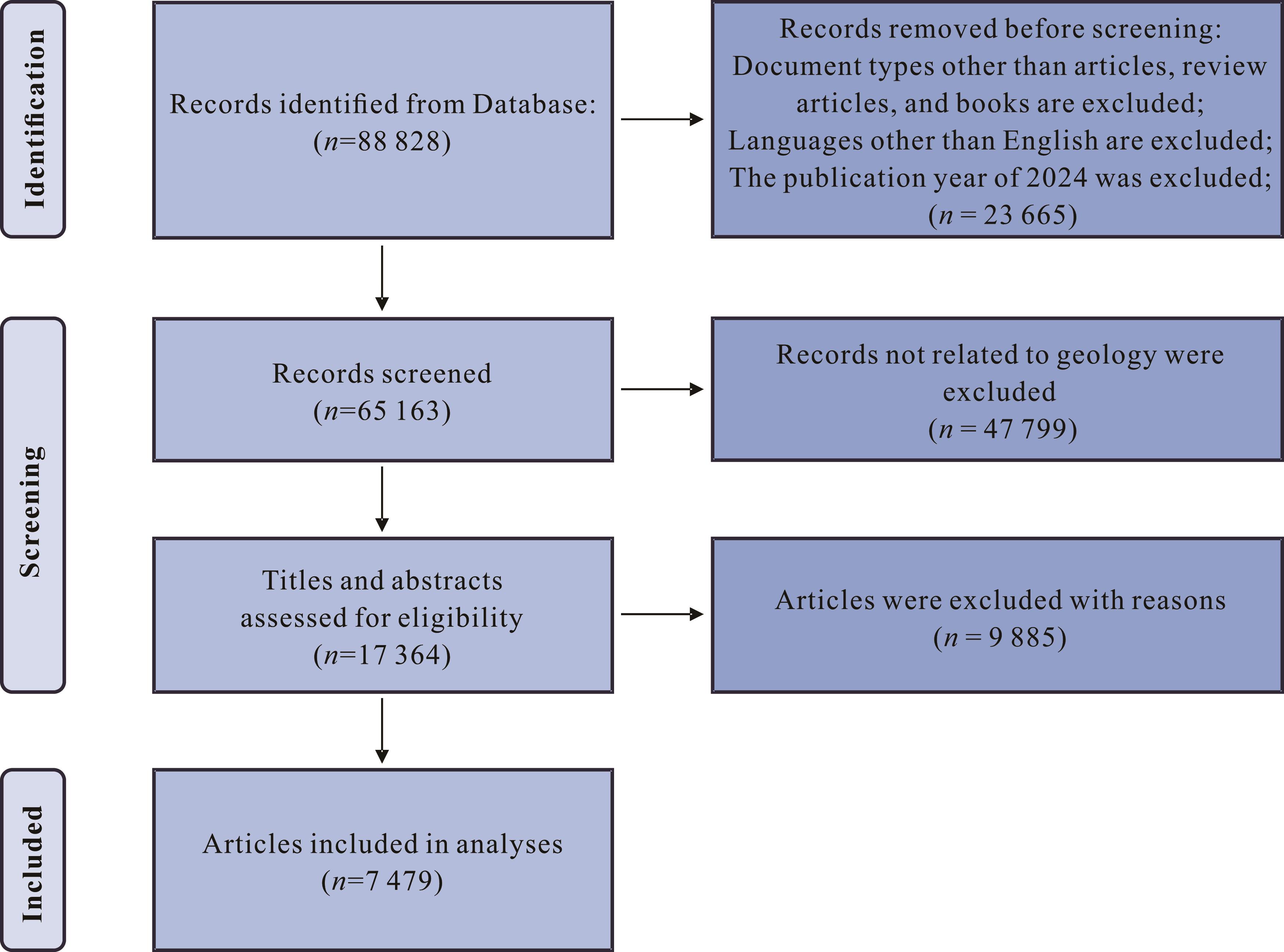
本文在Web of Science数据库中,以marsh、swamp、bog等与沼泽相关的英文词汇进行检索。数据库中的文献检索数量排名前五的英文单词被用来进行数据分析,包括marsh、moor、swamp、bog、mire,检索的截止日期为2023年12月31日,共获得88 828条有效记录。文献的筛选应用PRISMA流程图,分为Identification、Screening和Included三个阶段(Page et al.,2021;Hagiwara et al.,2024)。检索到的文献根据文献类型、书写语言、发表时间、研究领域等方面进行逐步筛选,具体步骤和筛选结果见流程图(图1)。经过筛选,7 479篇研究论文或综述文章被纳入本文的演进趋势分析。数据清洗、分类和可视化过程使用Python 3.11.8、tableau 2024.3、VOSviewer 1.6.20和CiteSpace 6.3.R1(van Eck and Waltman,2010)。

图 1 基于PRISMA流程图的沼泽相关文献筛选与纳入过程
Figure 1. Screening and inclusion process of mire-related publications based on the PRISMA flowchart
-
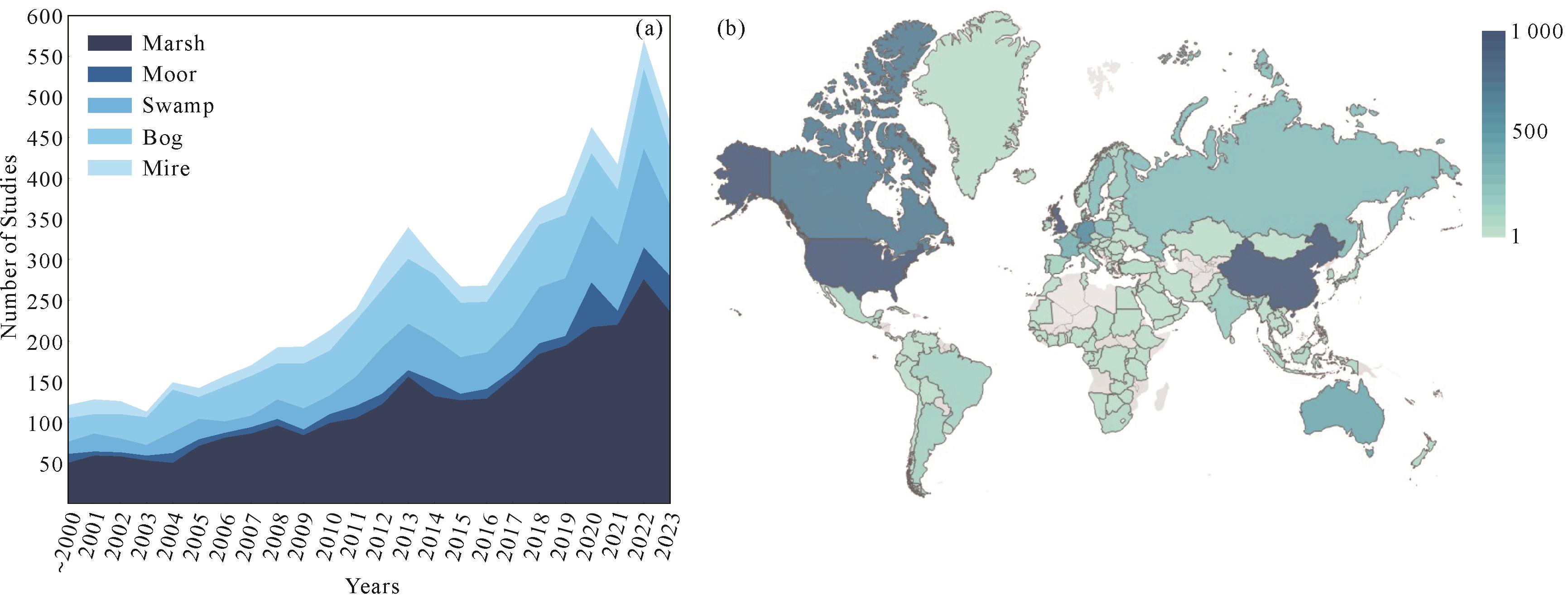
在地质学领域,Web of Science数据库检索筛选出的关于沼泽研究文献年度出版趋势如图2a所示。1943年—2000年累积发表的论文数量较少,其总数少于2001年全年产出的文献数量。这一现象表明,2000年是沼泽研究逐渐升温并成为热点议题的一个关键转折点。2000年以后,年度发表量总体呈现出上升的趋势。此外,2019年之前,沼泽相关英文词汇的使用频率由高至低大致为:marsh,bog,swamp,moor。但自2020年起,这一排序出现了显著变化,转变为marsh占据首位,随后依次为swamp,bog,moor,而“mire”的发文量相对有所下降。Swamp和bog使用频率的变动可能反映了领域内研究热点从雨养型泥炭沼泽向木本沼泽的转变。

图 2 地质学领域中沼泽研究论文的(a)年际变化及(b)地理分布(~2000对应的是1943—2000年所有的发文量)
Figure 2. The annual variation (a) and geographical distribution (b) of geologically based mire⁃related literature (“~2000” includes the total number of publications from 1943 to 2000)
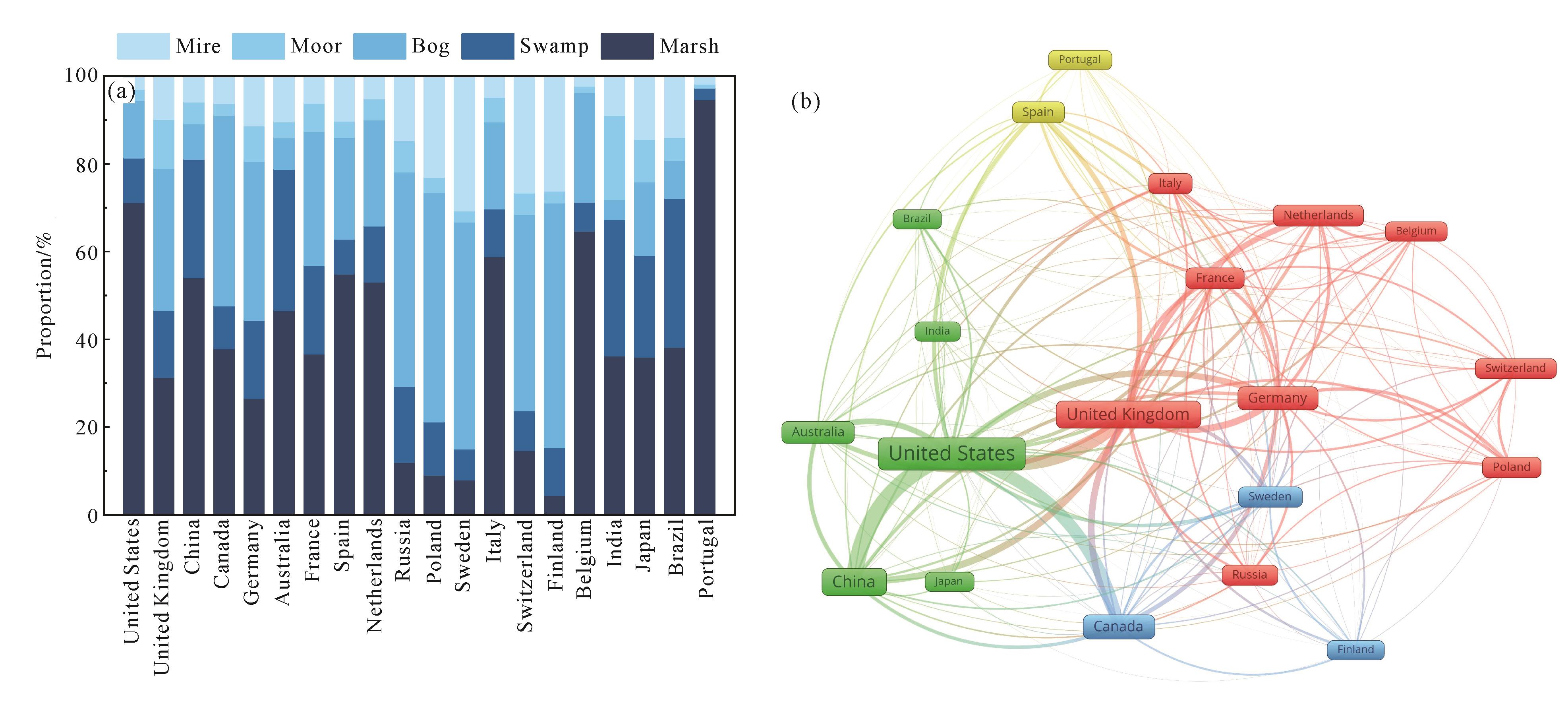
对7 479篇地质学领域沼泽研究出版物的分析表明,1943—2023年,全球123个国家/地区参与了关于沼泽的研究活动(图2b)。就发文数量而言,排名前五的国家是美国、英国、中国、加拿大和德国。2000—2023年的前10个国家中发文量年度分布情况(表1)显示,早期美国、英国和加拿大的地质学者对沼泽的研究较为活跃,每年的发文量均大于10篇。2008年以后,许多国家关于沼泽的科研论文发表数量均明显增多,特别是自2020年以来,中国的年发文量开始超过100篇,在2022年和2023年超过了美国,成为世界上年发文量最多的国家。图3a列出了发文量前20国家中与沼泽相关词汇的使用情况。具体而言,有12个国家主要使用marsh一词,包括美国、英国和中国,而加拿大、德国和俄罗斯等另外8个国家则倾向于使用bog。对年发文量前20的国家使用VOSviewer 1.6.20软件进行的共现分析结果显示(图3b),美国、英国、中国、加拿大、德国、澳大利亚和法国与其余19个国家均存在合作关系,其中美国、英国、中国、加拿大和德国之间保持着较紧密的学术合作与交流。
表 1 全球前10个国家的年度出版物数量变化趋势
Table 1. Trends in annual numbers of publications in top 10 countries globally

图 3 发文量前20个国家的沼泽词汇使用占比和共现分析
Figure 3. Proportion of mire⁃related terminology usage and co⁃occurrence analysis in the top 20 countries based on publication numbers
-
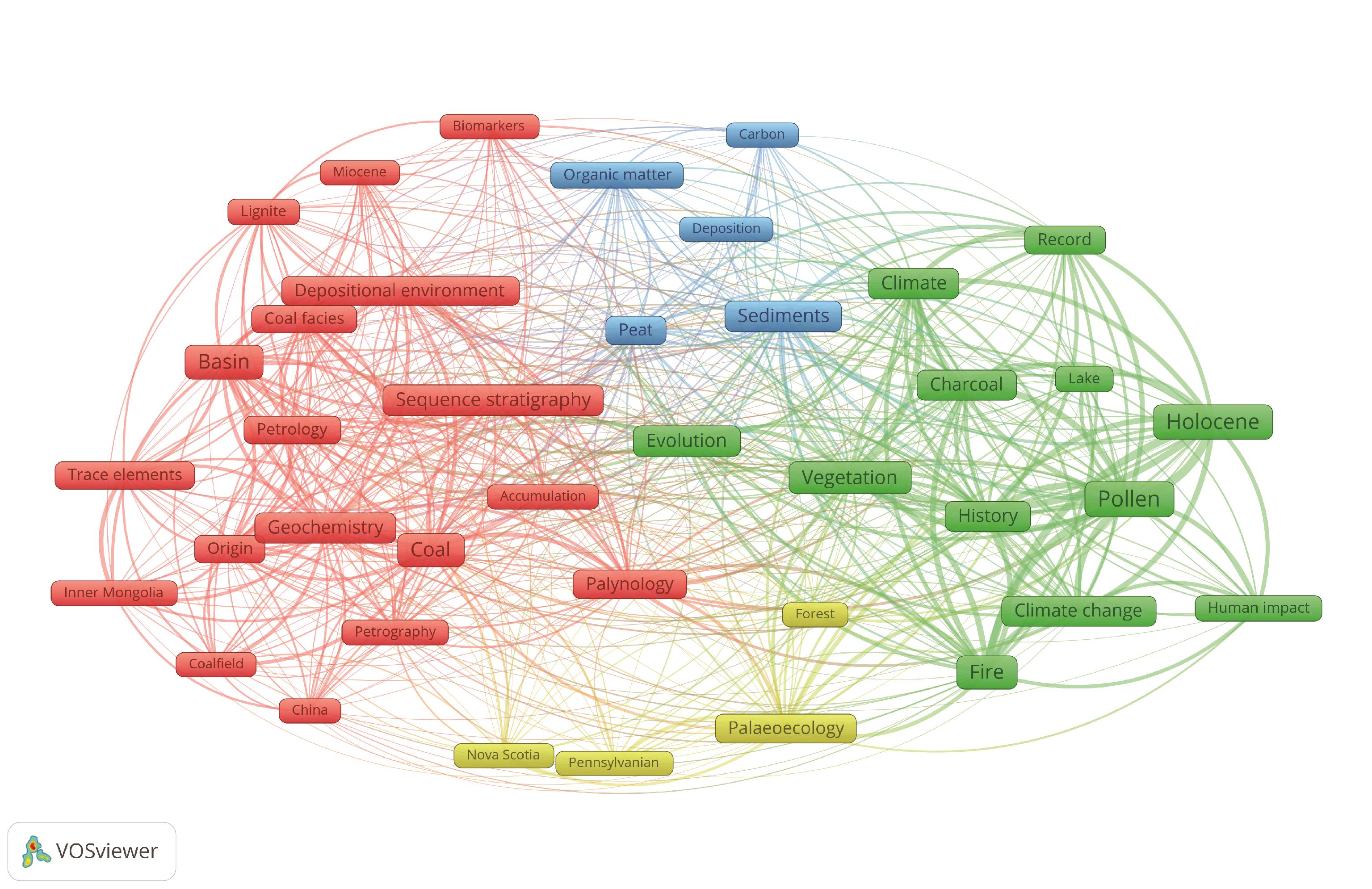
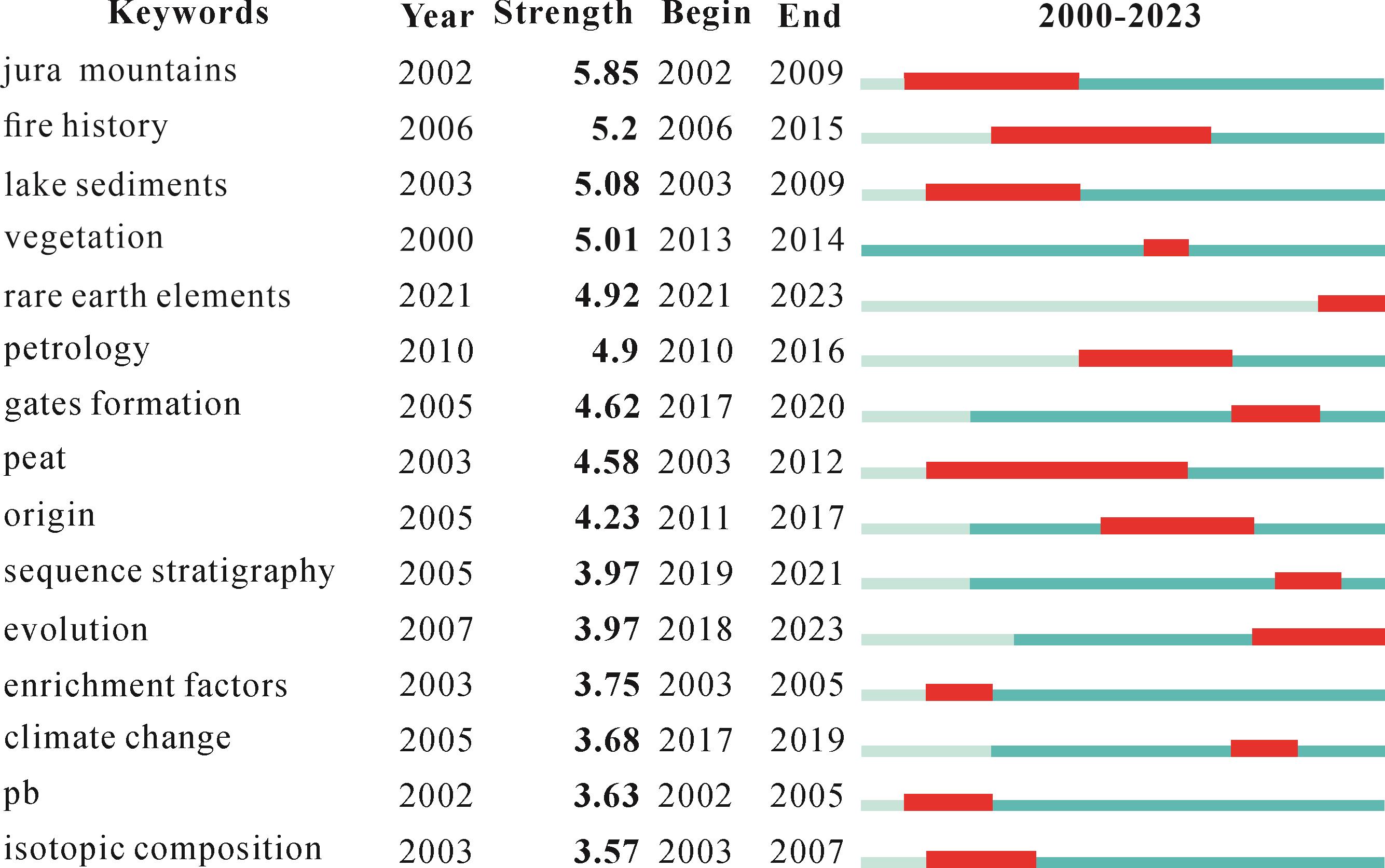
关键词是对研究主题和内容的总结凝练。深入分析高频关键词可以直观地呈现该研究领域内的核心热点(Zhao et al.,2020)。本研究从7 479篇文献中筛选出726篇聚焦于煤地质学领域内沼泽研究的论文,随后采用VOSviewer 1.6.20对这些论文进行了关键词共现网络分析。关键词出现的频次阈值设定为20次,共筛选出了39个高频关键词(图4)。为进一步挖掘关键词随时间的变化趋势,应用CiteSpace 6.3.R1软件,针对2000年及之后的文献数量显著增长的时期进行了关键词突现分析(图5)。

图 4 关键词共现与聚类分析
Figure 4. Analysis of keyword co⁃occurrence and cluster

图 5 关键词突现分析(前15个关键词)
Figure 5. Burst analysis of top 15 keywords
颜色聚类对应于特定的研究领域,可以呈现出这些领域内部和之间的主题的相互作用(Han and Zhou,2024)。由不同颜色表示的子领域代表性主题如表2所示,有关“沉积环境与矿产”的关键词在数量上占主导地位,其次是“古气候”,“碳聚集”和“古生态学”关键词的数量相对较少。按照主题和高引用论文(引用次数>10次)对煤地质学中关于沼泽研究的四个热点进行了总结。
表 2 关键词聚类分析中不同子领域的代表性主题
Table 2. Representative themes in different sub⁃fields from keyword cluster analysis
-
煤作为古泥炭沼泽的产物,其中蕴藏着丰富的“深时”古气候信息。古植物学、孢粉学、沉积学、层序地层学、矿物学、地球化学和有机岩石学等方法被综合应用于探究成煤沼泽类型及演化、成煤植物类型等科学问题(Dai et al.,2020)。Diessel(1992)提出了凝胶化作用指数(GI)及组织保存指数(TPI),Calder et al.(1991)提出了地下水影响指数(GWI)和植物指数(VI),这些煤相参数可以反映成煤沼泽微环境及沼泽演化过程(邵龙义等,2021)。迄今为止,煤相参数依然是评估成煤沼泽环境的关键依据,并且在2010年至2016年间成为研究的热门话题(图5)。但也有些学者对这些指数的应用提出反对意见,例如:Moore
and Shearer(2003)指出,泥炭类型和沉积环境之间的相关性很小,所以利用显微组分比率指示沉积环境或气候条件的方法不应被接受;Sen et al.(2016)对广泛使用的煤岩学指标和煤相模式进行了评述,指出利用煤岩组分解析古沼泽环境存在局限性。因此,煤相参数并非判定沼泽环境及其演化过程的唯一标准,其结果需和其他分析方法进行相互验证和补充。 煤提取物中生物标志物的有机地球化学分析提供了关于细菌、藻类或维管植物类型、沼泽水体盐度和氧化还原条件的信息,可以用于含煤地层形成期间泥炭沼泽植被组合的评估和古环境条件的重建(Mitrović et al.,2016),其结果可以对煤相分析进行补充。基于这一认识,Jasper et al.(2010)、Zieger and Littke(2019)、Zdravkov et al.(2020)等学者在应用煤相参数研究成煤沼泽环境时,引入有机地球化学和孢粉学等指标,为重建沼泽古环境演化过程提供了多维度证据。还有一些学者对沉积环境与煤系生烃潜力之间的关系进行研究,发现在还原条件(Zhu et al.,2012)、低水体盐度(Shi et al.,2022)、海陆过渡环境(Yu et al.,2022)、潮湿森林沼泽(Zhang et al.,2010)形成的煤层是非常规油气的有利储层。
沼泽环境形成的泥炭敏感地记录了沉积过程中的环境波动,包括地下水位、基准面和可容空间的变化(Jerrett et al.,2011)。引入层序地层学理论解析泥炭沼泽沉积过程,有助于进一步理解煤层及其沉积环境的演化,并有助于构建煤相演化与基准面波动之间的动态关联(Lu et al.,2017;李增学等,2022)。层序地层学自从应用于煤沉积环境演化研究以来,在2019—2021年形成了研究热点(图5)。含煤岩系层序地层学研究迅速升温的原因是一批学者在2019年前后注意到层序地层学的应用可以对厚煤层成因及控制因素进行很好地解释。利用层序地层学方法可以将煤细分为几个干燥或湿润旋回,特别是夏季高日照和低日照的气候交替会形成煤层中所记录的干—湿旋回(Guo et al.,2018;Li et al.,2020);此外,煤中的高频旋回与前体沼泽中的地下水位波动密切相关,这种水位波动受相对稳定的沉积环境中的降水强度和季节性变化的驱动(Wang et al.,2020)。这些成果为解析地质历史时期泥炭沼泽的水文特征及厚煤层中的古气候与海平面波动记录提供了关键依据。
地球化学和矿物学研究可以提供关于煤沉积条件、无机成分来源、微量元素甚至关键金属的存在方式和迁移等地质信息。研究表明,地质历史时期沼泽环境中无机成分的输入与火山活动、陆源供给、海水作用及热液活动等地质过程密切相关(Dai et al.,2008;Li et al.,2012;Zhao et al.,2013),这些活动所携带的矿物颗粒在古沼泽中历经沉积与成煤作用最终得以保存。煤中矿物质还与特定微量元素浓度之间存在一定的联系,包括As、Cd、Se、Ti、Hg、Pb、Sb和Zn等元素与硫化物矿物的关联,Rb、Ti、Cr、Zr、Hf等元素与铝硅酸盐矿物的关联,Sr和Ba主要与碳酸盐或铝磷酸盐矿物相关(Ward,2002)。
随着新能源技术和高端制造业的飞速发展,煤系关键金属的富集规律、赋存机制和资源潜力长期受到学界关注(Chitlango et al.,2023;Xu et al.,2025),其中有关于稀土元素(rare earth elements)的研究自2021年以来成为研究热点(图5)。火山灰喷发、热液流体侵入和改造、富关键金属蚀源区向泥炭沼泽持续供给,可富集关键金属,在合适条件下得以保存并成矿,形成煤系关键金属矿床或煤型关键金属矿床(代世峰,2025)。
-
近年来,全球许多地区经历了越来越多的野火活动,预计气候变化将导致更频繁和更严重的野火事件(Vachula et al.,2022)。重建过去的野火事件可以为现代和未来的野火研究提供古环境背景(Marlon,2020)。有机岩石学和有机地球化学的紧密结合,可以更精确客观地评价古野火的类型、频率和强度(Shao et al.,2024a)。科学界已广泛接受沉积物中出现的木炭(惰质组)是古野火发生的直接证据(Scott,2010)。热解多环芳烃(PAHs)也越来越多地被用作地质历史中野火发生的分子生物标志化合物(D’Anjou et al.,2012;Denis et al.,2012)。
气候条件包括温度和湿度是控制野火活动的最重要的外源因素(Langdon et al.,2003;Hughes and Barber,2004)。沼泽野火通常发生在干燥的时期,有关沼泽野火的研究从2006年到2015年持续引发关注并形成热潮,如今仍是热点话题(图5)。沼泽野火研究聚焦于野火类型和频率(Jasper et al.,2011;Sillasoo et al.,2011;Hudspith et al.,2012;Petersen and Lindström,2012)、气候调控机制(Haberle and Ledru,2001;Bal et al.,2011;Holz et al.,2012)、植被类型(Yan et al.,2016;Jasper et al.,2017)及气候反馈效应(Xu et al.,2020,2022;Zhou et al.,2024)等科学问题,其时间跨度从近百年至百万年前。
-
2000年以后,相关研究开始关注泥炭沼泽中微量金属和类金属(As,Sb,Hg和Pb)的大气沉降历史,2002—2005年成为热点(图5)。Roos-Barraclough et al.(2002)分析了瑞士侏罗山脉现代泥炭沼泽中长达14 500年的大气汞积累记录,发现工业革命前后大气汞沉积从火山喷发主导转变为燃煤排放主导;Cloy et al.(2009)的研究指出,苏格兰现代泥炭沼泽中Pb沉积通量的降低速度较As、Sb更快,主要归因于含铅汽油的逐步淘汰及As、Sb新排放源的出现;Allan et al.(2013)在欧洲—北美的研究发现,泥炭沼泽中汞的平均累积率在工业革命后比工业革命前高出63倍。近年来,沼泽湿地中痕量金属沉降的污染问题与人类活动密切相关,其污染源主要为区域性农业生产、矿产资源开发以及化石燃料燃烧等过程(Sierra-Hernández et al.,2018)。此外,微塑料和多环芳烃(PAHs)沉降对沼泽的污染问题正逐渐受到科学界的关注(Ouyang et al.,2022;Ortiz et al.,2023)。
-
泥炭地在全球碳循环中发挥着重要作用,它储存了约6 000亿吨碳,占全球碳总量的三分之一(Yu et al.,2011)。泥炭沼泽碳聚集速率和机制是地质学者长期研究的重点问题之一,在2003年至2012年间成为研究热点(图5)。现有研究表明,控制碳储量的因素包括气候变化、火灾、植被类型、生产力、地下水位和人类活动等(Callaway et al.,2012;Charman et al.,2015;Watson et al.,2017;Gałka et al.,2022; Shao et al.,2024b)。其中,气候是千年时间尺度上泥炭地碳聚集的最重要驱动力,而野火对泥炭沼泽碳聚集的影响则存在明显争议,有学者认为野火促使泥炭地从净碳汇转变为大气源,从而导致泥炭地碳储存率下降(Wieder et al.,2009),也有学者认为野火机制与碳聚集之间并没有明确的关联,从千年尺度来看,野火并不是影响碳封存的因素(van Bellen et al.,2012)。
-
该聚类只包含Pennsylvanian、forest、palaeoecology和Nova Scotia四个核心关键词,精准指向了宾夕法尼亚纪的森林沼泽古生态这一科学问题。晚古生代冰期是显生宙最后一个大规模的前更新世冰期,其多阶段的气候变化深刻影响了生物演化(DiMichele,2014)。宾夕法尼亚纪泥炭聚集的森林沼泽是研究最深入的显生宙生态系统之一,该时期形成的煤层保存了最早形成泥炭的雨林遗迹(Gastaldo et al.,2004;DiMichele et al.,2007)。许多学者利用煤中的孢粉、植物化石和生物标志物等研究了宾夕法尼亚纪沼泽植物的组成和动态演替,及植被类型演替背后隐含的气候变化驱动机制(Cleal et al.,2012;Pendleton et al.,2012;Bernardes-De-Oliveira et al.,2016;Quick et al.,2016;DiMichele et al.,2017)。
-
国际上关于沼泽的术语使用多种多样,不同国家建立了不同的定义体系。本文采用泥炭沼泽不同的分类方案(孙广友,1998),对沼泽相关单词的具体释义进行了叙述。同时,将沼泽术语释义与当前的研究热点相结合,针对沼泽英文词汇在学术研究中的使用提出建议。泥炭沼泽(mire或peatland)是指一类具有未完全分解的植物残体组成的泥炭层聚集的沼泽湿地,通常泥炭层厚度超过30 cm(Joosten and Clarke,2002)。Mire用来表示泥炭正在形成的湿地,而peatland指的是有或无植被覆盖且地表存在一层自然聚集泥炭层的区域(Barthelmes et al.,2015)。Godwin(1941)首先提出了mire这个术语,该术语与瑞典语和挪威语中myr密切相关,作为所有自然和半自然泥炭沼泽生态系统的通用词(Wheeler and Proctor,2000)。加拿大和俄罗斯分别用muskeg和bolote来表示泥炭沼泽(罗玲等,2016)。德国用moor来指代泥炭沼泽,然而该词在英语中有“使停泊、系住”的意思(卜兆君等,2005),鉴于此,本文不建议在英文写作中应用moor来表示泥炭沼泽。
泥炭沼泽传统上被认为分为两大类——由地下水或地表水供养的矿养泥炭沼泽(minerotrophic/eutrophic mire,即fen),以及完全由大气降水提供营养的雨养泥炭沼泽(ombrotrophic mire,即bog)(Du Rietz,1949;Lindsay,2016)。德国学者Weber(1902)对泥炭沼泽进行了分类,将其明确区分为低位泥炭沼泽(Niedermoor)、中位泥炭沼泽(Übergangsmoor)以及高位泥炭沼泽(Hochmoor)三类,这三类德语术语在意义范畴上分别对应fen、poor fen和raised bog(Gore,1983;陈槐等,2021),所以建议使用相关的英语术语替代moor。
根据植被类型,沼泽可分为草本沼泽(marsh)和木本沼泽(swamp)。草本沼泽是地表及地表下层土壤经常过度湿润,主要生长着水生和沼生草本植物的沼泽(Gong et al.,2020;Shen et al.,2021),而木本沼泽(森林沼泽)的植物以树木(乔木或灌木)为主(Mitsch and Gosselink,2000)。草本沼泽和木本沼泽之间的另一个关键区别体现在供养水源上,草本沼泽通常由地下水或地表水补给,而木本沼泽由地下水、河流和大气降水供养(Taylor et al.,2021)。在运用煤相指数(GI-TPI相图)判别煤沉积沼泽类型的过程中,也会涉及三个与沼泽类型密切相关的英文术语,即limnic、limno-telmatic和telmatic,它们对应的中文含义依次是湖沼、湖沼—树沼以及树沼(姜尧发,1994;Kara-Gülbay,2015)。
此外,还有部分学者将“湿地(wetland)”这一术语简单地等同于“沼泽”是不恰当的,因为它具有更为宽泛的涵盖范围。湿地是潮湿或浅积水地带发育水生生物群和水成土壤的地理综合体(Dugan,1993;孙广友,2011)。湿地包括天然或人工的、永久或暂时的沼泽地、泥炭地或水域地带,具有静止或流动的淡水、半咸水或咸水体,包括低潮时水深不超过6 m的海域(Finlayson and Moser,1991)。
在煤地质学领域,针对沼泽的研究内容主要聚焦于泥炭沼泽。鉴于此,建议将mire作为首要考虑或用于统称的词汇来应用。在形态特征描述层面,需强调泥炭沼泽的空间分布时,低位沼泽宜用fen,高位沼泽则应采用bog,以精准地反映其地质发育特征;当研究聚焦于野火事件、沼泽古环境重建、沼泽发育的植被类型以及气候变化等需要凸显沼泽生态或植被特征的内容时,建议使用swamp或marsh。
本文采用PRISMA流程图、文献计量学和可视化相结合的方法,快速掌握了地质学中沼泽研究的发展趋势及研究热点。标准化的数据提取、筛选、纳入和可视化流程确保了分析结果的可靠性。该方法灵活且可复现,可推广至多领域的宏观分析,尤其适合处理需整合大量文献的复杂问题。
-
(1) 1943—2023年,全球123个国家/地区参与沼泽研究,其中2000年是沼泽研究升温并成为热点议题的重要转折点。此后,地质学领域关于沼泽的研究发文数量总体呈上升趋势,且主流研究国家间的学者保持着频繁交流和学术探讨。不同国家在沼泽相关英文词汇的使用频率上存在差异,这一现象反映出各国在研究中所聚焦的沼泽类型各有侧重。
(2) 系统梳理与总结了煤地质学领域中的沼泽研究热点,发现针对沼泽的研究主题广泛,涵盖了煤沉积环境及其演化过程、厚煤层成因、关键金属、古野火事件、大气沉降、碳聚集、古气候以及古生态等多个方面。
(3) 基于沼泽的具体释义,结合煤地质学中沼泽研究的发展简史及关键热点,对其在煤地质领域的英语词汇用法进行简化和统一,并提出了沼泽研究术语的规范应用准则。mire作为首要考虑的词汇或用于对沼泽进行统称;当需要着重强调泥炭沼泽的空间分布时,低位沼泽适宜用fen,高位沼泽则应采用bog替代常规表述中的mire;当研究中需凸显沼泽的生态或植被特征,建议引入swamp或marsh。
(4) 在煤地质学领域中,沼泽的研究今后应加强以下几个方面:①大数据和人工智能的快速发展正在推动地球科学领域的重大变革和创新,在以后的研究中应积极有效地应用大数据或机器学习方法(如模拟、建立数据库、数据统计分析和图像识别分类等)。②在研究分析过程中,不可避免地会运用到各类地学指标(如煤相参数、化学蚀变指数等),然而这些指标的应用目前存在争议。鉴于此,应综合运用地球化学、有机岩石学、煤岩学、矿物学等多种方法开展研究。每种方法各有其独特的优势与局限,通过多种方法的相互印证与补充,能够有效规避单一指标可能引发的误判,显著提升研究结果的可靠性。
Research Fronts and Terminology Suggestions for Mires in Coal Geology: A bibliometric analysis based on the Web of Science
-
摘要: 意义 沼泽在地质历史上是煤沉积的基本环境,不仅为探究地球历史、古气候及环境演变提供了珍贵的信息,还在全球碳循环进程中扮演着重要角色。 【进展】 基于Web of Science数据库,以常用沼泽英文词汇为检索关键词,分析地质学领域沼泽研究的时间演进及国家分布趋势,深入探究煤地质学中沼泽的研究热点,同时对沼泽英文术语的应用给出简化建议。研究结果表明:(1)从1943年到2023年,全球有123个国家/地区参与到沼泽研究之中,2000年是沼泽研究升温并成为热点议题的节点;(2)关于沼泽的研究主题包括煤沉积环境及其演化、古野火、大气沉降、碳聚集、古气候和古生态等;(3)Mire用于对沼泽进行统称。当需要强调空间分布时,低位沼泽适宜用fen,高位沼泽建议用bog表述;当需要凸显生态或植被特征时,建议引入swamp或marsh。 【结论与展望】 该研究对于理解国际沼泽研究的发展进程、把握煤地质学中沼泽的研究热点以及规范沼泽英文词汇的应用具有借鉴意义。Abstract: Significance Mires serve as the fundamental environment for coal deposition throughout geological history, offering invaluable insights into Earth’s history, palaeoclimate and environmental evolution, and they are also significant with regards to the global carbon cycle. Numerous geological scholars have conducted a wealth of research on mires. Understanding the research fronts and trends in mire-related studies within coal geology can guide future research. When writing research papers and using professional terminology, scholars may confuse or misuse terminology due to the diverse concepts and English expressions of mires, thus making it particularly crucial to clarify and accurately apply mire-related terminology. Progress Based on data from the Web of Science, common English terms related to “mire” were used as search keywords. A PRISMA flowchart was used to screen out 7479 relevant articles which focused investigations into the temporal evolution and international distribution of mire research in the field of geology. This was further examined using VOSviewer 1.6.20 to conduct keyword co-occurrence analysis on 726 research papers focused on mires in coal geology (selected from the 7479 screened articles). Subsequently, by integrating English definitions of mire-related terms with studies on mires in coal geology, suggestions are offered for simplifying the application of mire-related terminology. Conclusions (1) From 1943 to 2023, a total of 123 nations and regions worldwide participated in mire research, with the year 2000 marking a significant turning point when mire studies gained momentum and became a subject for detailed discussion. Since then, the number of research publications on mires in geology has generally exhibited an upward trend, with scholars from leading research countries engaging in frequent exchanges and academic discussion. Usage frequencies of English mire-related terminology vary between countries, reflecting particular research emphases on different mire types. (2) By integrating meta-analysis, bibliometrics and visualization techniques, research on mires in the field of coal geology is systematically reviewed and summarized. Research themes linked to the topic include coal depositional environments and their evolution, palaeowildfire, atmospheric deposition, carbon accumulation, palaeoclimate and palaeoecology. (3) “Mire” should be considered as a general term for mire-related concepts. When there is a need to emphasize the spatial distribution of mires, “fen” is an appropriate term for low-lying mire, and “bog” should be used instead of “mire” for raised mires. When the ecological or vegetative characteristics of mires need to be highlighted in research, it is recommended to use the words “swamp” or “marsh”. [Prospects] The results offer valuable insights for understanding the deve-lopmental trajectory of international mire research, identifying research fronts of mires in coal geology, and standardizing the application of mire-related terminology in English. Future research on mires in the field of coal geology should actively and effectively utilize big data or machine learning techniques (e.g., simulation modeling, database construction, statistical data analysis, and image recognition classification). Additionally, a multidisciplinary approach integrating geochemical, organic petrological, coal petrological, and mineralogical methods should be systematically employed throughout the research process to ensure comprehensive insights.
-
Key words:
- mire /
- coal geology /
- research fronts /
- terminology /
- bibliometrics
-
图 1 基于PRISMA流程图的沼泽相关文献筛选与纳入过程
Figure 1. Screening and inclusion process of mire-related publications based on the PRISMA flowchart
图 2 地质学领域中沼泽研究论文的(a)年际变化及(b)地理分布(~2000对应的是1943—2000年所有的发文量)
Figure 2. The annual variation (a) and geographical distribution (b) of geologically based mire⁃related literature (“~2000” includes the total number of publications from 1943 to 2000)
图 3 发文量前20个国家的沼泽词汇使用占比和共现分析
(a) proportion of English terminology related to mire; (b) analysis of co-occurrence of international cooperation
Figure 3. Proportion of mire⁃related terminology usage and co⁃occurrence analysis in the top 20 countries based on publication numbers
Fig.3 表 1 全球前10个国家的年度出版物数量变化趋势
Table 1. Trends in annual numbers of publications in top 10 countries globally
 下载: 导出CSV
表 2 关键词聚类分析中不同子领域的代表性主题
Table 2. Representative themes in different sub⁃fields from keyword cluster analysis
下载: 导出CSV
-
[1] 卜兆君,王升忠,谢宗航. 2005. 泥炭沼泽学若干基本概念的再认识[J]. 东北师大学报(自然科学版),37(2):105-110. Bu Zhaojun, Wang Shengzhong, Xie Zonghang. 2005. Re-understanding some elementary concepts in mire science[J]. Journal of Northeast Normal University (Natural Science Edition), 37(2): 105-110. [2] 陈槐,吴宁,王艳芬,等. 2021. 泥炭沼泽湿地研究的若干基本问题与研究简史[J]. 中国科学:地球科学,51(1):15-26. Chen Huai, Wu Ning, Wang Yanfen, et al. 2021. A historical overview about basic issues and studies of mires[J]. Science China Earth Sciences, 51(1): 15-26. [3] 代世峰. 2025. 煤系关键金属矿产研究:中美对比[J]. 煤炭学报,50(1):506-515. Dai Shifeng. 2025. Critical metals in coal and coal-bearing sequences: A comparison between China and the United States[J]. Journal of China Coal Society, 50(1): 506-515. [4] 黄锡畴,马学慧. 1988. 我国沼泽研究的进展[J]. 海洋与湖沼,19(5):499-504. Huang Xichou, Ma Xuehui. 1988. Progress of mire research in China[J]. Oceanologia et Limnologia Sinica, 19(5): 499-504. [5] 姜尧发. 1994. 浅析GI和TPI与泥炭沼泽类型的关系[J]. 中国煤田地质,6(4):36-38. Jiang Yaofa. 1994. Analysis on the relationship between GI and TPI and types of peat bog[J]. Coal Geology of China, 6(4): 36-38. [6] 李增学,刘莹,李晓静,等. 2022. 琼东南盆地古近纪泥炭沼泽破坏与重建作用对煤型源岩物质形成的控制[J]. 石油与天然气地质,43(6):1309-1320. Li Zengxue, Liu Ying, Li Xiaojing, et al. 2022. The control of Paleogene peat swamp destruction and reconstruction on the formation of coal-type source material in the Qiongdongnan Basin[J]. Oil & Gas Geology, 43(6): 1309-1320. [7] 罗玲,王宗明,毛德华,等. 2016. 沼泽湿地主要类型英文词汇内涵及辨析[J]. 生态学杂志,35(3):834-842. Luo Ling, Wang Zongming, Mao Dehua, et al. 2016. Connotation and differentiation of terminology on main kinds of wetlands in English[J]. Chinese Journal of Ecology, 35(3): 834-842. [8] 邵龙义,党星宇,高祥宇,等. 2022. 厚煤层成因机制:天文周期控制的多期次泥炭沼泽叠加模式[J]. 煤炭科学技术,50(1):186-195. Shao Longyi, Dang Xingyu, Gao Xiangyu, et al. 2022. Genetic mechanism of thick coal seams: Astronomical-forcing super-imposed multi-staged swamp model[J]. Coal Science and Technology, 50(1): 186-195. [9] 邵龙义,徐小涛,王帅,等. 2021. 中国含煤岩系古地理及古环境演化研究进展[J]. 古地理学报,23(1):19-38. Shao Longyi, Xu Xiaotao, Wang Shuai, et al. 2021. Research progress of palaeogeography and palaeoenvironmental evolution of coal-bearing series in China[J]. Journal of Palaeogeography, 23(1): 19-38. [10] 孙广友. 1998. 试论沼泽综合分类系统[J]. 地理学报,53(增刊1):141-148. Sun Guangyou. 1998. A study on mire comprehensive classification[J]. Acta Geographica Sinica, 53(Suppl.1): 141-148. [11] 孙广友. 2011. 湿地学名词术语编撰原则和方法的探讨[J]. 湿地科学与管理,7(3):71-73. Sun Guangyou. 2011. An introduction to the principles and methodology of compiling technical terms for wetland[J]. Wetland Science & Management, 7(3): 71-73. [12] 闫庆武. 2017. 地理学基础教程[M]. 徐州: 中国矿业大学出版社:336. [13] 杨起,韩德馨. 1979. 中国煤田地质学(上册)[M]. 北京:煤炭工业出版社:261. [14] Allan M, Le Roux G, Sonke J E, et al. 2013. Reconstructing historical atmospheric mercury deposition in western Europe using: Misten Peat Bog Cores, Belgium[J]. Science of the Total Environment, 442: 290-301. [15] Bal M C, Pelachs A, Perez-Obiol R, et al. 2011. Fire history and human activities during the last 3300cal yr BP in Spain’s central Pyrenees: The case of the Estany de burg [J]. Palaeogeography, Palaeoclimatology, Palaeoecology, 300(1/2/3/4): 179-190. [16] Barthelmes A, Couwenberg J, Risager M, et al. 2015. Peatlands and climate in a Ramsar context: A Nordic-Baltic perspective[M]. Copenhagen: Nordisk Ministerråd, 244. [17] Bernardes-De-Oliveira M E C, Kavali P S, Mune S E, et al. 2016. Pennsylvanian-Early Cisuralian interglacial macrofloristic succession in Paraná Basin of the state of São Paulo[J]. Journal of South American Earth Sciences, 72: 351-374. [18] Calder J H, Gibling M R, Mukhopadhyay P K, et al. 1991. Peat formation in a Westphalian B Piedmont setting, Cumberland Basin, Nova Scotia: Implications for the maceral-based interpretation of rheotrophic and raised paleomires[J]. Bulletin de la Société géologique de France, 162(2): 283-298. [19] Callaway J C, Borgnis E L, Turner R E, et al. 2012. Carbon sequestration and sediment accretion in San Francisco Bay Tidal Wetlands[J]. Estuaries and Coasts, 35(5): 1163-1181. [20] Charman D J, Amesbury M J, Hinchliffe W, et al. 2015. Drivers of Holocene peatland carbon accumulation across a climate gradient in northeastern north America[J]. Quaternary Science Reviews, 121: 110-119. [21] Chitlango F Z, Wagner N J, Moroeng O M. 2023. Characterization and pre-concentration of rare earth elements in density fractionated samples from the Waterberg coalfield, South Africa[J]. International Journal of Coal Geology, 275: 104299. [22] Chmura G L, Anisfeld S C, Cahoon D R, et al. 2003. Global carbon sequestration in tidal, saline wetland soils[J]. Global Biogeochemical Cycles, 17(4): 1111. [23] Cleal C J, Uhl D, Cascales-Miñana B, et al. 2012. Plant biodiversity changes in Carboniferous tropical wetlands[J]. Earth-Science Reviews, 114(1-2): 124-155. [24] Cloy J M, Farmer J G, Graham M C, et al. 2009. Retention of As and Sb in ombrotrophic peat bogs: Records of As, Sb, and Pb deposition at four Scottish sites[J]. Environmental Science & Technology, 43(6): 1756-1762. [25] D’Anjou R M, Bradley R S, Balascio N L, et al. 2012. Climate impacts on human settlement and agricultural activities in northern Norway revealed through sediment biogeochemistry[J]. Proceedings of the National Academy of Sciences of the United States of America, 109(50): 20332-20337. [26] Dai S F, Bechtel A, Eble C F, et al. 2020. Recognition of peat depositional environments in coal: A review[J]. International Journal of Coal Geology, 219: 103383. [27] Dai S F, Ren D Y, Zhou Y P, et al. 2008. Mineralogy and geochemistry of a superhigh-organic-sulfur coal, Yanshan coalfield, Yunnan, China: Evidence for a volcanic ash component and influence by sub-marine exhalation[J]. Chemical Geology, 255(1-2): 182-194. [28] Davidson S J, Dazé E, Byun E, et al. 2022. The unrecognized importance of carbon stocks and fluxes from swamps in Canada and the USA[J]. Environmental Research Letters, 17(5): 053003. [29] Denis E H, Toney J L, Tarozo R, et al. 2012. Polycyclic aromatic hydrocarbons (PAHs) in lake sediments record historic fire events: Validation using HPLC-fluorescence detection[J]. Organic Geochemistry, 45: 7-17. [30] Diessel C F K. 1992. Coal-bearing depositional systems:Coal facies and depositional environments[M]. Berlin: Springer-Verlag: 721. [31] DiMichele W A. 2014. Wetland-dryland vegetational dynamics in the Pennsylvanian ice age tropics[J]. International Journal of Plant Sciences, 175(2): 123-164. [32] DiMichele W A, Elrick S D, Nelson W J. 2017. Vegetational zonation in a swamp forest, Middle Pennsylvanian, Illinois Basin, U.S.A., indicates niche differentiation in a wetland plant community[J]. Palaeogeography, Palaeoclimatology, Palaeoecology, 487: 71-92. [33] DiMichele W A, Falcon-Lang H J, Nelson W J, et al. 2007. Ecological gradients within a Pennsylvanian mire forest[J]. Geology, 35(5): 415-418. [34] Du Rietz G E. 1949. Huvudenheter och huvudgränser i svensk myrvegetation (main units and main limits is Swedish mire vegetation)[J]. Svensk Botanisk Tidskrift, 43: 274-309. [35] Dugan P. 1993. Wetlands in danger: A world conservation atlas[M]. New York: Oxford University Press: 192. [36] Finlayson M, Moser M. 1991. Wetlands[M]. Oxford: Facts on File: 224. [37] Gałka M, Diaconu A C, Feurdean A, et al. 2022. Relations of fire, palaeohydrology, vegetation succession, and carbon accumulation, as reconstructed from a mountain bog in the Harz Mountains (Germany) during the last 6200 years[J]. Geoderma, 424: 115991. [38] Gastaldo R A, Stevanović-Walls I M, Ware W N, et al. 2004. Community heterogeneity of Early Pennsylvanian peat mires[J]. Geology, 32(8): 693-696. [39] Godwin H. 1941. The factors which differentiate marsh, fen, bog and heath[J]. Chronica Botanica, 6: 11. [40] Gong C, Song C C, Sun L, et al. 2020. Response of methane emissions to litter input manipulation in a temperate freshwater marsh, Northeast China[J]. Ecological Indicators, 115: 106377. [41] Gore A J P. 1983. Mires: Swamp, bog, fen and moor[M]. Amsterdam: Elsevier: 478. [42] Guo B, Shao L Y, Hilton J, et al. 2018. Sequence stratigraphic interpretation of peatland evolution in thick coal seams: Examples from Yimin Formation (Early Cretaceous), Hailaer Basin, China[J]. International Journal of Coal Geology, 196: 211-231. [43] Haberle S G, Ledru M P. 2001. Correlations among charcoal records of fires from the past 16,000 years in Indonesia, Papua New Guinea, and central and south America[J]. Quaternary Research, 55(1): 97-104. [44] Hagiwara N, Duffy C, Cyrus J, et al. 2024. The nature and validity of implicit bias training for health care providers and trainees: A systematic review[J]. Science Advances, 10(33): eado5957. [45] Han M Y, Zhou Y T. 2024. Exploring trends and emerging topics in oceanography (1992–2021) using deep learning-based topic modeling and cluster analysis[J]. npj Ocean Sustainability, 3(1): 59. [46] Holz A, Haberle S, Veblen T T, et al. 2012. Fire history in western Patagonia from paired tree-ring fire-scar and charcoal records[J]. Climate of the Past, 8(2): 451-466. [47] Hudspith V, Scott A C, Collinson M E, et al. 2012. Evaluating the extent to which wildfire history can be interpreted from inertinite distribution in coal pillars: An example from the Late Permian, Kuznetsk Basin, Russia[J]. International Journal of Coal Geology, 89: 13-25. [48] Hughes P D M, Barber K E. 2004. Contrasting pathways to Ombrotrophy in three raised bogs from Ireland and Cumbria, England[J]. The Holocene, 14(1): 65-77. [49] Jasper A, Agnihotri D, Tewari R, et al. 2017. Fires in the mire: Repeated fire events in Early Permian ‘peat forming’ vegetation of India[J]. Geological Journal, 52(6): 955-969. [50] Jasper A, Uhl D, Guerra-Sommer M, et al. 2011. Upper Paleozoic charcoal remains from south America: Multiple evidences of fire events in the coal bearing strata of the Paraná Basin, Brazil[J]. Palaeogeography, Palaeoclimatology, Palaeoecology, 306(3/4): 205-218. [51] Jasper K, Hartkopf-Fröder C, Flajs G, et al. 2010. Evolution of Pennsylvanian (Late Carboniferous) peat swamps of the Ruhr Basin, Germany: Comparison of palynological, coal petrographical and organic geochemical data[J]. International Journal of Coal Geology, 83(4): 346-365. [52] Jerrett R M, Flint S S, Davies R C, et al. 2011. Sequence stratigraphic interpretation of a Pennsylvanian (Upper Carboniferous) coal from the Central Appalachian Basin, USA[J]. Sedimentology, 58(5): 1180-1207. [53] Joosten H, Clarke D. 2002. Wise use of mires and peatlands: Background and principles including a framework for decision-making[M]. Devon: International Mire Conservation Group and International Peat Society: 304. [54] Kara-Gülbay R. 2015. Organic geochemical and petrographical characteristics of coal bearing Oligo-Miocene sequence in the Oltu-Narman Basin (Erzurum), NE Turkey[J]. International Journal of Coal Geology, 149: 93-107. [55] Langdon P G, Barber K E, Hughes P D M. 2003. A 7500-year peat-based palaeoclimatic reconstruction and evidence for an 1100-year cyclicity in bog surface wetness from temple hill moss, Pentland Hills, southeast Scotland[J]. Quaternary Science Reviews, 22(2/3/4): 259-274. [56] Li J, Zhuang X G, Querol X, et al. 2012. High quality of Jurassic coals in the southern and eastern Junggar coalfields, Xinjiang, NW China: Geochemical and mineralogical characteristics[J]. International Journal of Coal Geology, 99: 1-15. [57] Li Y N, Shao L Y, Fielding C R, et al. 2020. Sequence stratigraphic analysis of thick coal seams in paralic environments: A case study from the Early Permian Shanxi Formation in the Anhe coalfield, Henan province, North China[J]. International Journal of Coal Geology, 222: 103451. [58] Lindsay R. 2016. Peatland (mire types): Based on origin and behavior of water, peat genesis, landscape position, and climate[M]//Finlayson C M, Milton G R, Prentice R C, et al. The wetland book. Dordrecht: Springer: 1-23. [59] Lu J, Shao L Y, Yang M F, et al. 2017. Depositional model for peat swamp and coal facies evolution using sedimentology, coal macerals, geochemistry and sequence stratigraphy[J]. Journal of Earth Science, 28(6): 1163-1177. [60] Marlon J R. 2020. What the past can say about the present and future of fire[J]. Quaternary Research, 96: 66-87. [61] Mitrović D, Đoković N, Životić D, et al. 2016. Petrographical and organic geochemical study of the Kovin lignite deposit, Serbia[J]. International Journal of Coal Geology, 168: 80-107. [62] Mitsch W J, Gosselink J G. 2000. Wetlands[M]. New York: John Wiley & Sons Inc: 771-784. [63] Moore T A, Shearer J C. 2003. Peat/coal type and depositional environment: Are they related?[J]. International Journal of Coal Geology, 56(3/4): 233-252. [64] Ortiz J E, Sánchez-Palencia Y, Gallego J L R, et al. 2023. Deposition of atmospheric polycyclic aromatic hydrocarbons in rural areas: Current data and historical record from an ombrotrophic peatland[J]. International Journal of Coal Geology, 268: 104199. [65] Ouyang X G, Duarte C M, Cheung S G, et al. 2022. Fate and effects of macro- and microplastics in coastal wetlands[J]. Environmental Science & Technology, 56(4): 2386-2397. [66] Page M J, Moher D, Bossuyt P M, et al. 2021. PRISMA 2020 explanation and elaboration: Updated guidance and exemplars for reporting systematic reviews[J]. BMJ, 372: n160. [67] Page S E, Rieley J O, Banks C J. 2011. Global and regional importance of the tropical peatland carbon pool[J]. Global Change Biology, 17(2): 798-818. [68] Pendleton J L, Cleal C J, Falcon-Lang H J, et al. 2012. Palaeobotany of the Pennsylvanian (mid-Bolsovian–Cantabrian; Moscovian) warwickshire group of the Bristol coalfield, U.K.: Biostratigraphy and palaeoecology[J]. Review of Palaeobotany and Palynology, 179: 17-43. [69] Petersen H I, Lindström S. 2012. Synchronous wildfire activity rise and mire deforestation at the Triassic-Jurassic boundary[J]. PLoS One, 7(10): e47236. [70] Quick L J, Meadows M E, Bateman M D, et al. 2016. Vegetation and climate dynamics during the last glacial period in the Fynbos-Afrotemperate Forest Ecotone, southern Cape, south Africa[J]. Quaternary International, 404: 136-149. [71] Roos-Barraclough F, Martinez-Cortizas A, Garcı́a-Rodeja E, et al. 2002. A 14 500 year record of the accumulation of atmospheric mercury in peat: Volcanic signals, anthropogenic influences and a correlation to bromine accumulation[J]. Earth and Planetary Science Letters, 202(2): 435-451. [72] Scott A C. 2010. Charcoal recognition, taphonomy and uses in palaeo-environmental analysis[J]. Palaeogeography, Palaeoclimatology, Palaeoecology, 291(1/2): 11-39. [73] Sen S, Naskar S, Das S. 2016. Discussion on the concepts in paleo-environmental reconstruction from coal macerals and petrographic indices[J]. Marine and Petroleum Geology, 73: 371-391. [74] Shao L Y, Zhou J M, Jones T P, et al. 2024a. Inertinite in coal and its geoenvironmental significance: Insights from AI and big data analysis[J]. Science China Earth Sciences, 67(6): 1779-1801. [75] Shao Y W, Zhao F H, Spiro B, et al. 2024b. Net primary productivity of paleo-peatlands linked to deep-time glacial periods in the Late Carboniferous and Early Permian icehouse interval[J]. International Journal of Coal Geology, 296: 104644. [76] Shen X J, Jiang M, Lu X G, et al. 2021. Aboveground biomass and its spatial distribution pattern of herbaceous marsh vegetation in China[J]. Science China Earth Sciences, 64(7): 1115-1125. [77] Shi Q M, Li C H, Wang S M, et al. 2022. Effect of the depositional environment on the formation of tar-rich coal: A case study in the northeastern Ordos Basin, China[J]. Journal of Petroleum Science and Engineering, 216: 110828. [78] Sierra-Hernández M R, Gabrielli P, Beaudon E, et al. 2018. Atmospheric depositions of natural and anthropogenic trace elements on the Guliya Ice Cap (Northwestern Tibetan Plateau) during the last 340 years[J]. Atmospheric Environment, 176: 91-102. [79] Sillasoo Ü, Väliranta M, Tuittila E S. 2011. Fire history and vegetation recovery in two raised bogs at the Baltic Sea[J]. Journal of Vegetation Science, 22(6): 1084-1093. [80] Taylor G H, Teichmueller M, Davis A, et al. 1998. Organic petrology; a new handbook incorporating some revised parts of Stach's textbook of coal petrology[M]. Berlin: Borntraeger: 704. [81] Taylor N G, Grillas P, Smith R K, et al. 2021. Marsh and swamp conservation: Global evidence for the effects of interventions to conserve marsh and swamp vegetation[M]. Cambridge: University of Cambridge: 627. [82] Vachula R S, Karp A T, Denis E H, et al. 2022. Spatially calibrating polycyclic aromatic hydrocarbons (PAHs) as proxies of area burned by vegetation fires: Insights from comparisons of historical data and sedimentary PAH fluxes[J]. Palaeogeography, Palaeoclimatology, Palaeoecology, 596: 110995. [83] van Bellen S, Garneau M, Ali A A, et al. 2012. Did fires drive Holocene carbon sequestration in boreal ombrotrophic peatlands of eastern Canada?[J]. Quaternary Research, 78(1): 50-59. [84] van Eck N J, Waltman L. 2010. Software survey: VOSviewer, a computer program for bibliometric mapping[J]. Scientometrics, 84(2): 523-538. [85] Wang S, Shao L Y, Wang D D, et al. 2020. Controls on accumulation of anomalously thick coals: Implications for sequence stratigraphic analysis[J]. Sedimentology, 67(2): 991-1013. [86] Ward C R. 2002. Analysis and significance of mineral matter in coal seams[J]. International Journal of Coal Geology, 50(1/2/3/4): 135-168. [87] Watson E B, Raposa K B, Carey J C, et al. 2017. Anthropocene survival of southern New England’s salt marshes[J]. Estuaries and Coasts, 40(3): 617-625. [88] Weber C A. 1902. Überdie vegetationund entstehungdes hochmoorsvon Augstumal im Memeldelta mit vergleichenden Ausblicken auf andere Hochmoore der Erde[M]. Berlin: Verlagsbuchhandlung Paul Parcy: 252. [89] Wheeler B D, Proctor M C F. 2000. Ecological gradients, subdivisions and terminology of north-west European mires[J]. Journal of Ecology, 88(2): 187-203. [90] Wieder R K, Scott K D, Kamminga K, et al. 2009. Postfire carbon balance in boreal bogs of Alberta, Canada[J]. Global Change Biology, 15(1): 63-81. [91] Xu N, Li F, Zhu W, et al. 2025. Predicting the concentrations of rare earth elements and yttrium in coal using self-organizing map[J]. Natural Resources Research, 34(3): 1467-1479. [92] Xu X T, Shao L Y, Eriksson K A, et al. 2022. Widespread wildfires linked to Early Albian ocean anoxic event 1b: Evidence from the Fuxin lacustrine basin, NE China[J]. Global and Planetary Change, 215: 103858. [93] Xu Y, Uhl D, Zhang N, et al. 2020. Evidence of widespread wildfires in coal seams from the Middle Jurassic of Northwest China and its impact on paleoclimate[J]. Palaeogeography, Palaeoclimatology, Palaeoecology, 559: 109819. [94] Yan M X, Wan M L, He X Z, et al. 2016. First report of Cisuralian (Early Permian) charcoal layers within a coal bed from Baode, North China with reference to global wildfire distribution[J]. Palaeogeography, Palaeoclimatology, Palaeoecology, 459: 394-408. [95] Yu K, Ju Y W, Wan Z J, et al. 2022. Paleoenvironment, provenance, and hydrocarbon potential of Lower Permian coal-bearing source rocks in the southern North China Basin: A case study of the Pingdingshan coalfield[J]. ACS Earth and Space Chemistry, 6(5): 1299-1310. [96] Yu Z C, Beilman D W, Frolking S, et al. 2011. Peatlands and their role in the global carbon cycle[J]. Eos, Transactions American Geophysical Union, 92(12): 97-98. [97] Zdravkov A, Stefanova M, Worobiec E, et al. 2020. Implications for peat formation in Maritsa-West Basin, SE Bulgaria: Insights from organic petrology, palynology and biomarker assemblage[J]. International Journal of Coal Geology, 222: 103447. [98] Zhang S H, Tang S H, Tang D Z, et al. 2010. The characteristics of coal reservoir pores and coal facies in Liulin district, Hedong coal field of China[J]. International Journal of Coal Geology, 81(2): 117-127. [99] Zhao L, Ward C R, French D, et al. 2013. Mineralogical composition of Late Permian coal seams in the Songzao coalfield, southwestern China[J]. International Journal of Coal Geology, 116-117: 208-226. [100] Zhao Y X, Cheng S X, Yu X Y, et al. 2020. Chinese public’s attention to the COVID-19 epidemic on social media: Observational descriptive study[J]. Journal of Medical Internet Research, 22(5): e18825. [101] Zhou J M, Shao L Y, Jones T P, et al. 2024. Mechanisms of inertinite enrichment in Jurassic coals: Insights from a big data-driven review[J]. Earth-Science Reviews, 257: 104889. [102] Zhu Y M, Li Y, Zhou J, et al. 2012. Geochemical characteristics of tertiary coal-bearing source rocks in Xihu Depression, East China Sea Basin[J]. Marine and Petroleum Geology, 35(1): 154-165. [103] Zieger L, Littke R. 2019. Bolsovian (Pennsylvanian) tropical peat depositional environments: The example of the Ruhr Basin, Germany[J]. International Journal of Coal Geology, 211: 103209. -

 点击查看大图
计量
- 文章访问数: 298
- HTML全文浏览量: 58
- PDF下载量: 248
- 被引次数: 0