




-
白垩纪是地球历史上极端温室气候的典型时期,一直是地球系统科学研究的前沿热点(Skelton et al.,2003)。气候变化对地球表层系统(包括陆地与海洋)产生深远影响,其中海洋环境中的大洋红层是国内外学者广泛关注的重要记录之一(Hu et al.,2005;王成善和胡修棉,2005)。同样,陆相沉积也保存了丰富的古气候信息,为白垩纪气候演化研究提供了重要线索。然而,相较于海相地层,陆相地层在古环境研究中面临更多挑战,如沉积连续性较差、年代控制难度大、气候指示物有限以及多重环境因素干扰等(Frakes et al.,1992;高远等,2017;Li et al.,2019)。当前,白垩纪陆相古气候的研究多集中在特殊沉积类型,如黏土矿物、膏盐沉积、沙漠沉积、冰筏沉积等(曹珂等,2007;曹珂和王猛,2009)。陆相红层作为气候敏感沉积物之一,广泛发育于白垩纪(Yan et al.,2019)。然而,红层沉积可形成于多种环境(从热带森林气候到沙漠气候),仅凭红层的发育无法直接指示特定气候条件(张鸿禹和杨文涛,2023)。因此,识别合适的红层气候判别指标对于陆相红层的古气候研究具有重要意义。
丹霞盆地位于广东省韶关市,呈近菱形状,是华南地区晚中生代“盆岭构造”体系中陆相断陷盆地的典型代表(吴根耀,2006)。盆地内充填有厚达数千米的白垩系红色砂岩和砾岩(张显球,1992;黄进,2010),构成了丹霞山著名的“赤壁丹崖”景观(刘富军,2020),并且是“丹霞地貌”及“中国红石公园”的命名地(彭华,2004;Young et al.,2009)。尽管丹霞地貌的研究已在地貌学领域取得丰硕成果(彭华,2000;巫建华等,2002;彭华等,2013),但对于其岩石地层成因演化、沉积环境及古气候等的研究仍相对匮乏。现有研究主要基于沉积相或古土壤、风成砂岩等气候敏感沉积物进行环境判别,侧重于宏观和定性的描述(李祥辉等,2009;文星跃等,2015;李余亮,2018;刘芮岑,2018;陈留勤等,2019),而从碎屑沉积岩地球化学特征的角度探讨丹霞红层的古气候则更为稀少(史月欣,2023)。沉积物中的地球化学元素及其比值对沉积环境和气候变化具有敏感性,能够在一定程度上反映区域气候变化和环境演化。因此,通过沉积学与地球化学等替代性指标对陆相红层的气候信息进行定量解析,不仅对理解红层的沉积过程、白垩纪气候变化及相关地质事件具有重要意义,也将为深入探讨丹霞盆地的古环境与古生态提供新视角。
在陆相沉积物中,细粒沉积物(如黏土级)能有效减小粒度效应,更精确地反映气候条件(Wronkiewicz and Condie,1987;Cullers,1995;Chen and Robertson,2020;Dinis et al.,2020;傅寒晶等,2021)。基于此,选择丹霞盆地上白垩统陆相湖盆红层为研究对象,重点关注盆地内出露较好的细粒碎屑岩,包括上白垩统长坝组二段与四段(长坝剖面、张滩剖面)和丹霞组锦石岩段(晚秀岩剖面和巴寨剖面)。通过对特定岩石地层的特征性地球化学指标进行深入分析,提取和解读湖盆红层中的古气候信息,进而探讨丹霞盆地白垩纪气候演化特征。
-
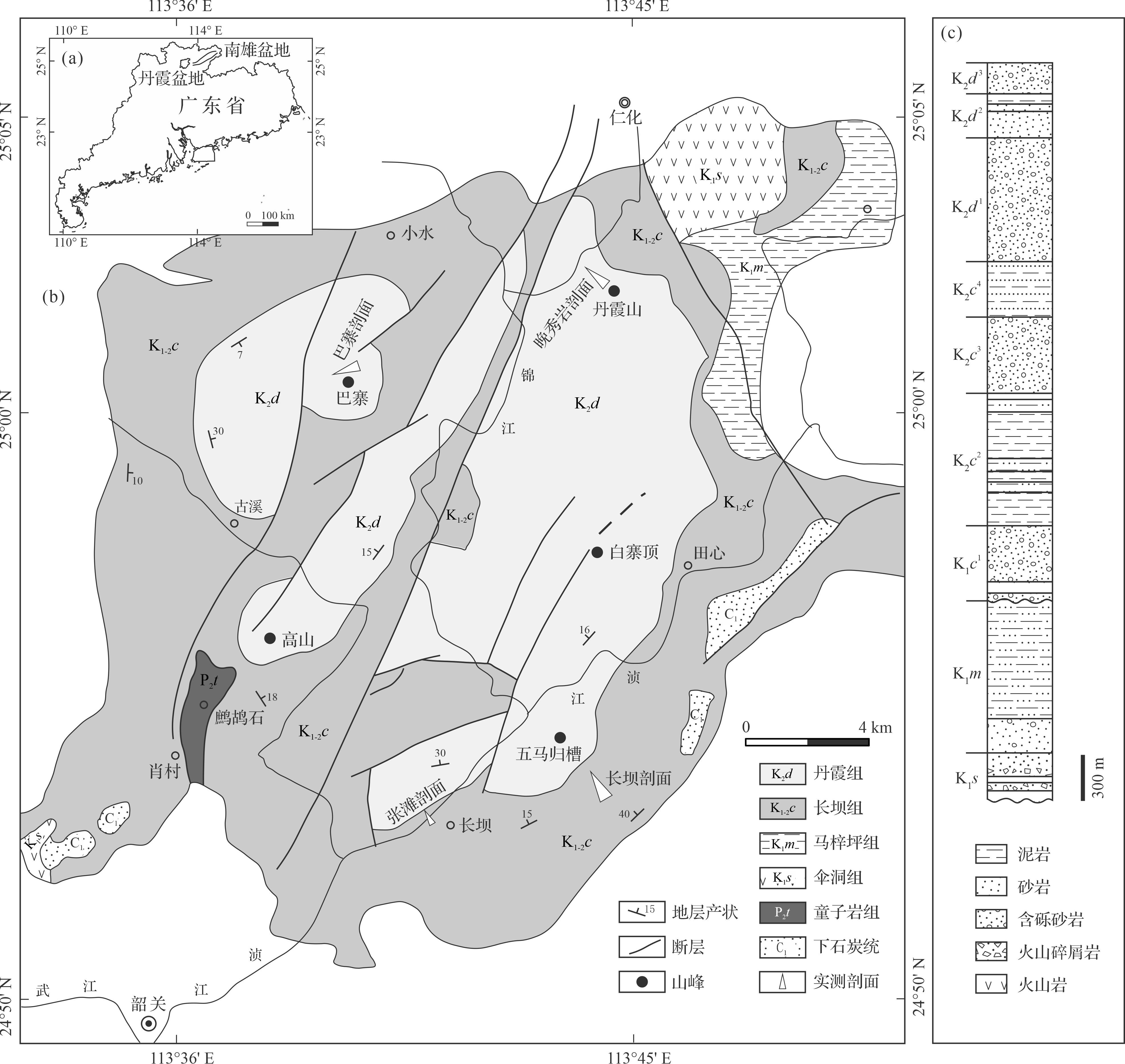
粤北丹霞盆地位于湖南、江西、广东三省交界的仁化县境内,是我国面积最大的丹霞地貌区之一,与东北部的南雄盆地相邻(图1a)。丹霞盆地及周缘出露有震旦系、寒武系、奥陶系、志留系、泥盆系、石炭系等古生代及中生代地层(吴起俊,1994)。盆地的基底被推测为一套石炭纪地层(周红健,1990;吴甲添等,2001)(图1b)。盆地内沉积均为白垩系红层(周红健,1990;张显球和林小燕,2013),厚度达4 000 m,自下而上可分为伞洞组(K1s)、马梓坪组(K1m)、长坝组(一段至四段;K1c1~K2c4)以及丹霞组(巴寨段K2d1、锦石岩段K2d2和白寨顶段K2d3)(图1c)。

图 1 粤北丹霞盆地地理位置(a)、上白垩统特定岩石地层(长坝组二段、长坝组四段及丹霞组锦石岩段)实测剖面位置(据张显球和林小燕,2013修改)(b)及丹霞盆地白垩系岩性柱状简图(c)
Figure 1. (a) Geographic location of the Danxia Basin in northern Guangdong; (b) locations of specific measured sections of Upper Cretaceous rock formations, including the Second member and Fourth member of the Changba Formation and the Jinshiyan member of the Danxia Formation (modified from Zhang and Lin, 2013); (c) simplified lithological column of Cretaceous lithologies in Danxia Basin
长坝组是一套红色碎屑岩沉积,不整合覆盖于马梓坪组或古生代地层之上,沉积序列可划分为粗—细—粗—细四段。长坝组一段以紫红色砾岩和砂砾岩为主,局部可见火山岩夹层,其玄武岩夹层K-Ar法同位素测年年龄为(128±2)Ma(早白垩世中期)(周红健,1990);长坝组二段与长坝组一段整合接触,包括紫红色厚层粉砂质泥岩和泥质粉砂岩,局部夹有细砂岩和粉砂岩薄层。产介形类动物群Mongolocypris⁃Cypridea⁃Darwinula组合以及植物孢粉等,时代归为晚白垩世赛诺曼期(Cenomanian)(张显球和林小燕,2013);长坝组三段整合于长坝组二段之上,以灰褐色和黄褐色的砾岩、砂砾岩和砂岩为主,局部含钙质粉砂岩;长坝组四段为褐红色、紫红色和棕红色粉砂质泥岩、泥质粉砂岩和砂岩,伴有少量细砂岩、钙质粉砂岩、含砾砂岩薄夹层。产介形类动物群Cypridea⁃Altanicypris⁃Candona组合,属晚白垩世土伦期(Turonian)(张显球和林小燕,2013)。
丹霞组整合于长坝组之上(许汉森等,2008),按岩性组合和粒度特征,自下而上表现为粗—细—粗的变化,可分为巴寨段、锦石岩段和白寨顶段三段。巴寨段以褐红色、紫红色块状砾岩、砂砾岩和含砾砂岩为主。在丹霞山剖面发现介形虫、轮藻化石,指示其时代约为晚白垩世康尼亚克期(Coniacian)至圣通期(Santonian)(张显球,1992)。锦石岩段主要由肉红色、褐红色厚层块状长石砂岩组成,夹有少量细砾岩、含砾砂岩和粉砂质泥岩。全岩Rb-Sr法年龄测定显示锦石岩段顶部棕红色薄层粉砂质泥岩的年龄为(76±22)Ma(周红健,1990),且其粉砂质泥岩夹层产介形虫和轮藻化石(张显球,1992),指示形成时代为晚白垩世坎潘期(Campanian)。白寨顶段岩性主要为棕红色砾岩和砂砾岩,偶见中—粗粒砂岩夹粉细砂岩薄层。据丹霞山剖面磁性地层研究结果,其中、上段地层剩磁极性的正负交替与70~75 Ma磁性条带相似,指示其顶部地层时代不晚于70 Ma(徐行等,1990;张显球,1992)。结合介形类和轮藻化石,其年代大致归属于晚白垩世坎潘期(Campanian)至马斯特里赫特期(Maastrichtian)(张显球,1992)。
-
长坝组一段发育棱角状复成分砾岩,杂基支撑、砾石分布杂乱、分选性极差。砾岩间发育冲刷界面,局部可见叠瓦状构造、二元结构等,推断为河流主导的冲积扇相沉积体系(吴甲添等,2001);长坝组二段以细粒碎屑沉积为主,水平层理发育,局部见小型交错层理,泥质、钙质结核较多,见生物虫穴,具湖泊相(滨湖—浅湖亚相)沉积特征(吴甲添等,2001;许汉森等,2008);长坝组三段发育粗碎屑沉积,底部常见冲刷—填充构造,局部可见平行层理,反映冲积扇相—湖泊相—河流相的沉积特征;长坝组四段主要为细碎屑沉积,具水平层理及交错层理等,反映湖泊相(滨湖亚相)沉积特征(吴甲添等,2001;许汉森等,2008)。
丹霞组巴寨段以厚层状砂砾岩为主,在砾岩层中可见粒序层理、叠瓦状构造、底冲刷面构造、平行层理等,反映河流主导的冲积扇沉积体系(吴甲添等,2001;许汉森等,2008;陈留勤等,2019);锦石岩段砂岩和砾岩互层状产出,砾岩底部发育明显的冲刷侵蚀界面,砂岩层多具有平行层理、斜层理等,偶见粒序层理以及叠瓦状构造等。段内上部发育巨厚层砂岩,具大型高角度交错层理,夹多层古土壤以及连片分布的泥裂构造等,反映了风成沉积、河流沉积占据主体,夹小型沙漠湖泊沉积(陈留勤等,2019);白寨顶段以砾岩和中粗砂岩为主,粒序层理发育,砂岩层多无层理构造,砾岩层中多发育底冲刷界面及叠瓦状构造,代表了河流主导的冲积扇沉积体系(吴甲添等,2001;许汉森等,2008;陈留勤等,2019)。
丹霞盆地长坝组的沉积充填,大体代表了早白垩世晚期至晚白垩世早期盆地断陷、湖盆扩大,继而萎缩、消亡的旋回过程(许汉森等,2008;黄进,2010;陈留勤等,2019)。早白垩世长坝组一段时期,盆地边缘发育冲积扇沉积;到晚白垩世早期,丹霞盆地湖盆扩大,湖面上升,沉积了长坝组二段紫红色泥岩、粉砂岩和页岩;在长坝组三段沉积期,湖盆有所萎缩,冲积扇沉积向湖中进积,形成粗碎屑沉积层。至长坝组四段,盆地仍处于湖相环境,发育泥岩沉积。盆地进入晚白垩世中晚期(丹霞组),丹霞盆地湖盆基本萎缩消失,取而代之的是冲积扇(巴寨段、白寨顶段)、风成沉积相和小型沙丘间沙漠湖泊相沉积(锦石岩段)(黄进,2010;陈留勤等,2019)。
-
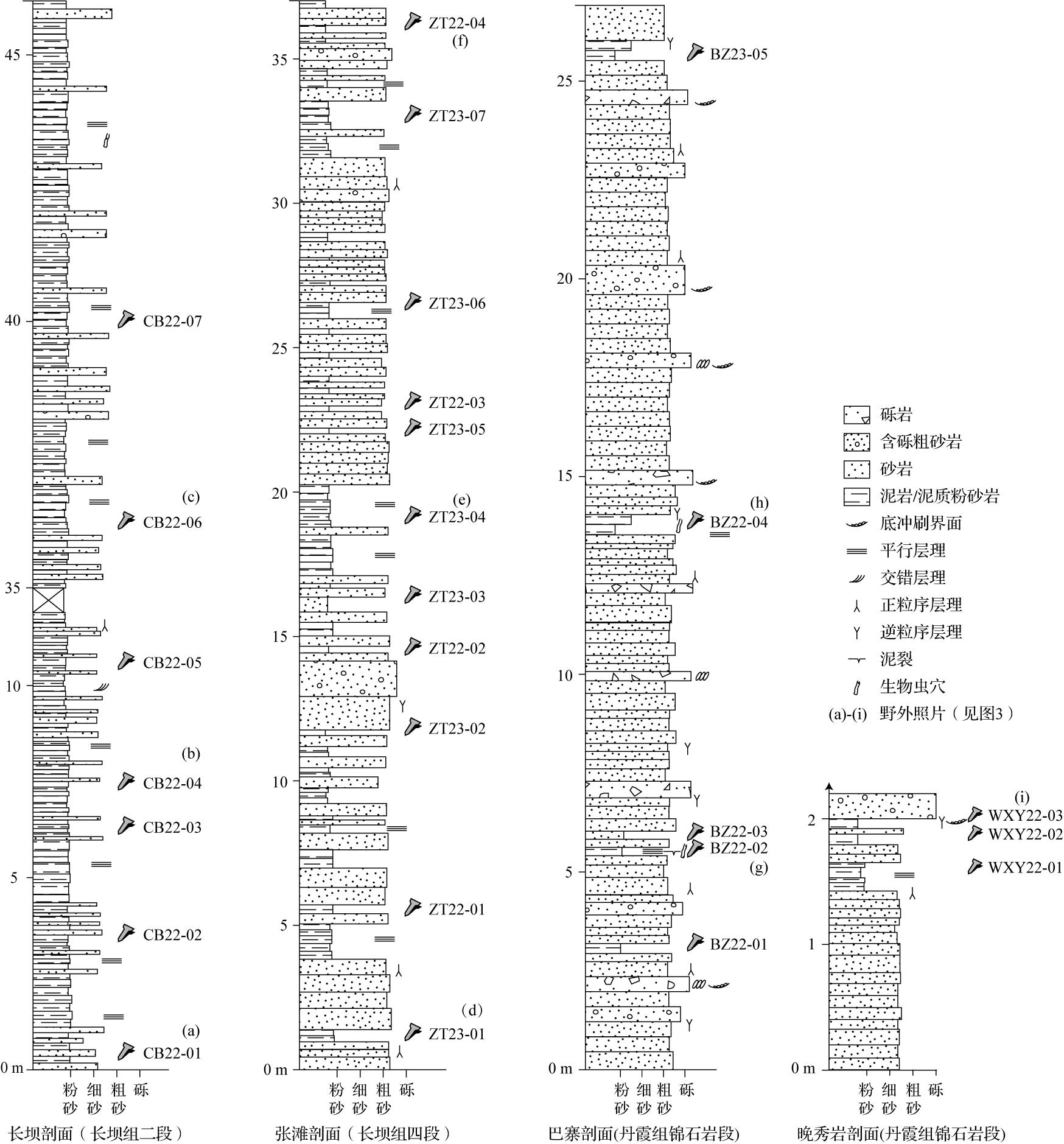
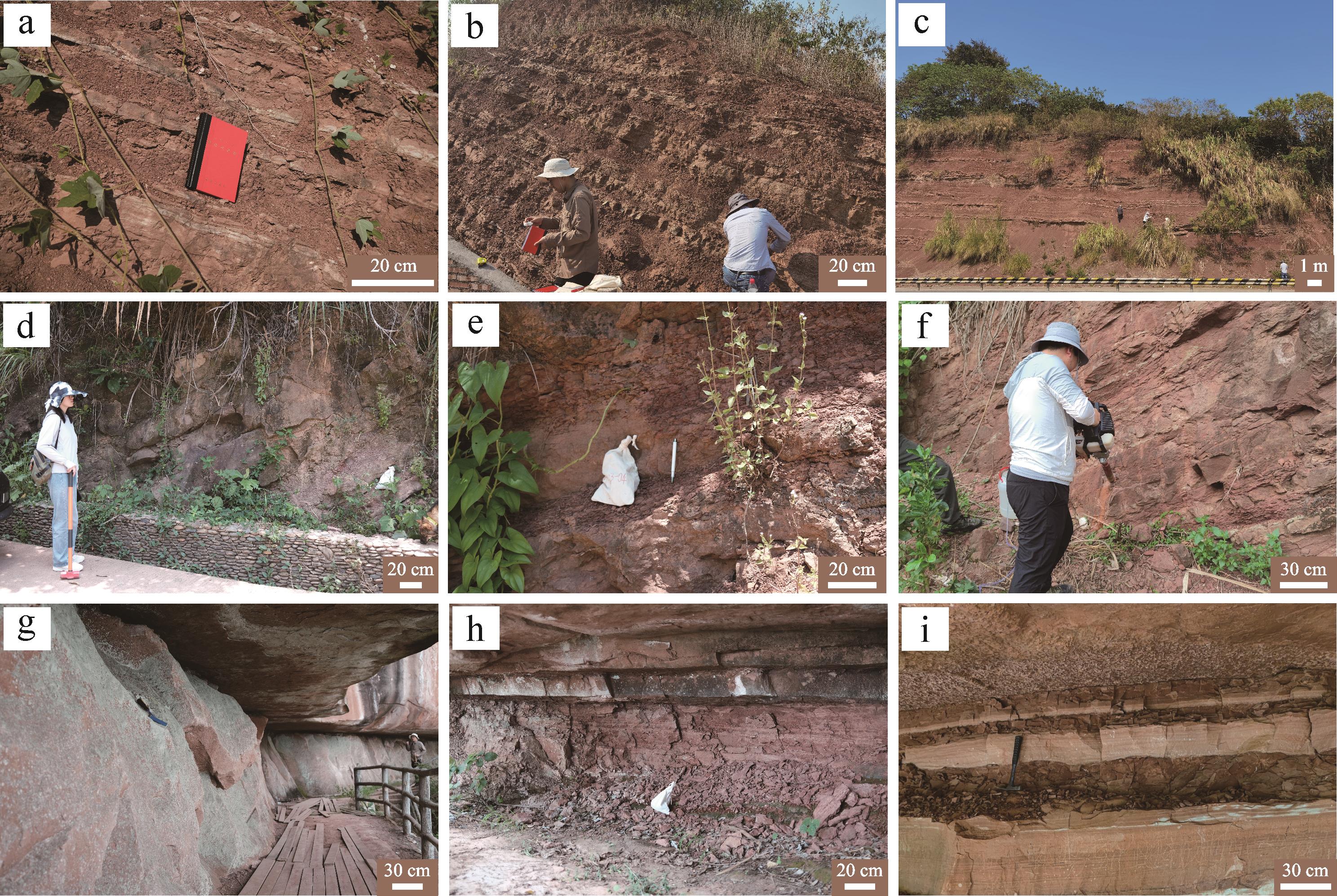
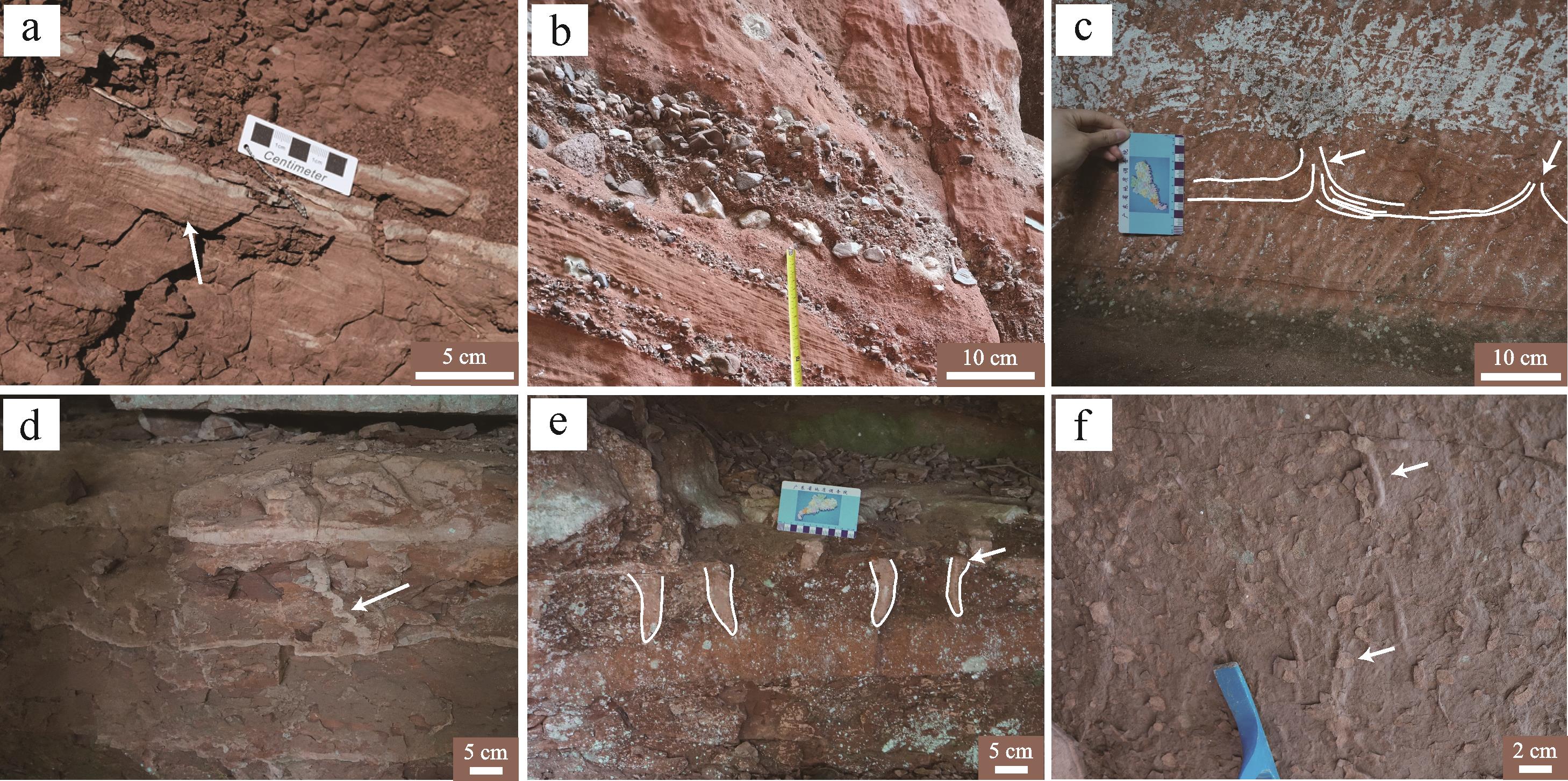
丹霞盆地已有较为成熟的生物地层框架(张显球,1992),以此为基础,对上白垩统特定岩石地层(长坝剖面、张滩剖面、巴寨剖面和晚秀岩剖面)进行地层剖面测量及连续采样(图2,3)。长坝剖面沿仁化县大桥镇公路养护所旁的G106国道公路观察、采样,剖面起点坐标为24°52'59.5" N,113°44'01.1" E,终点位于公路西北面陡立小山一侧(24°53'00.8" N,113°43'58.7" E)。沿公路所见地层较为平缓,倾角约为25°,一般覆盖严重,但因修建道路及居民自建房屋等挖出较好露头。剖面中长坝组二段底部以连续出露的红色粉砂质泥岩层为主,多含钙质、泥质胶结的砂岩夹层,可见小型波状交错层理(图4a)。剖面顶部泥岩占比明显增加,偶夹中厚层含砾砂岩(图2)。张滩剖面起点位于仁化县大桥镇张滩村养鸡场内(24°52′30″ N,113°40′31″ E),终点位于西北小路山坡一侧(24°52'33" N,113°40'30" E),为人工修路开挖露头,植被覆盖度高,地层倾角轻微变化(21°~34°)。剖面底部以长坝组四段厚层状砂岩(钙泥质胶结)为主,往上砂岩占比减少,逐渐出现高频次的粉砂质泥岩—砂岩互层(图2)。巴寨剖面起点位于丹霞山公园巴寨景区观景平台(25°00'26.3" N,113°39'24.5" E),地层露头均为近垂直的岩壁,地层产状近乎水平,终点为25°00'23.1" N,113°39'19.2" E。剖面为厚度变化较大(5~70 cm)的丹霞组锦石岩段砂岩层,岩性主要为粗粒砂岩,部分夹砾岩透镜体(陈留勤等,2019)。剖面可见3~4层红色泥岩夹层(图3),Scoyenia遗迹相发育,于局部地区(混元洞)可见连片分布的泥裂构造(图4)。晚秀岩剖面为一顺层洞穴,发育于丹霞组锦石岩段和白寨顶段交界处(25°01′33″ N,113°44′25″ E)(彭华等,2014)。剖面自下而上分别为均质细砂岩、泥质粉砂岩、水平层理细砂岩、粉砂质泥岩、水平层理细砂岩和粉砂质泥岩(图2)。

图 2 丹霞盆地上白垩统实测剖面地层柱状图
Figure 2. Stratigraphic columns of the Upper Cretaceous measured sections in the Danxia Basin

图 3 丹霞盆地长坝组—丹霞组剖面野外照片
Figure 3. Field photographs of the Changba Formation⁃Danxia Formation sections in the Danxia Basin

图 4 丹霞盆地长坝组—丹霞组剖面典型沉积构造
Figure 4. Sedimentary structures of the Changba Formation⁃Danxia Formation sections in the Danxia Basin
-
从4个剖面采集的26个样品经送至南京宏创地质勘查技术服务有限公司,制备成厚度为0.03 mm的标准光学薄片。使用NIKON LV100 POL透反射偏光显微镜对薄片进行详细观察,选取具有代表性的视域后,分别拍摄透射单偏光和透射正交偏光图像,以获取岩石的显微结构信息。
-
对采集的26件粉砂质泥岩/泥岩样品进行了全岩主微量元素和稀土元素分析,相关实验在贵州同微分析技术有限公司完成。岩石样品经颚式破碎机破碎后,放入玛瑙球磨机中粉碎至200目,然后装袋供分析使用。采用X射线荧光光谱(XRF)技术对全岩主量元素进行分析,仪器为Thermo Fisher公司生产的ARL Perform’X 4200型X射线荧光光谱仪,并使用OXSAS定量分析软件进行数据分析处理。精密度和准确度通过国家标准物质GBW标样检测,不确定度一般低于1%。全岩微量和稀土元素分析采用配有Cetac自动进样器的电感耦合等离子体质谱(inductively coupled plasma mass spectrometry,ICP-MS)(Thermo Fisher iCAP RQ)进行。分析精度通过在上机溶液中添加内标元素Rh、In、Re、Bi以及在测试过程中使用美国地质调查局USGS的玄武岩标样BCR-2、BHVO-2作为外部标准进行控制,分析结果相对误差小于5%。
-
所采集的26个样品的锂同位素组成通过Neptune Plus多接收电感耦合等离子质谱仪(MC-ICP-MS)进行测试,并采用标样(LSVEC)—样品交叉法对质量分馏效应进行内部校正。内部溶液标样(QCUSTC)的实验室长期测试精度2SD<0.3‰(Liu et al.,2019),国际岩石标样(GSP-2)的测试结果与前人研究数据基本一致。详细的测试方法参考汪齐连等(2006)。全岩样品的锂同位素分析工作在贵州同微测试科技有限公司完成。
-
所采集的26个样品的钼同位素组成分析在贵州同微测试科技有限公司完成。测试使用Thermo Fisher公司生产的Nu Instruments Plasma 3多接收器电感耦合等离子体质谱仪(MC-ICP-MS),通过双稀释剂法对仪器的质量分馏进行校正。参考标样包括AGV-2、GSR-3和海水(Seawater)样品,测试结果显示98Mo/95Mo的偏差小于0.05‰(2SD)。详细的测试方法见Li et al.(2014)。
-
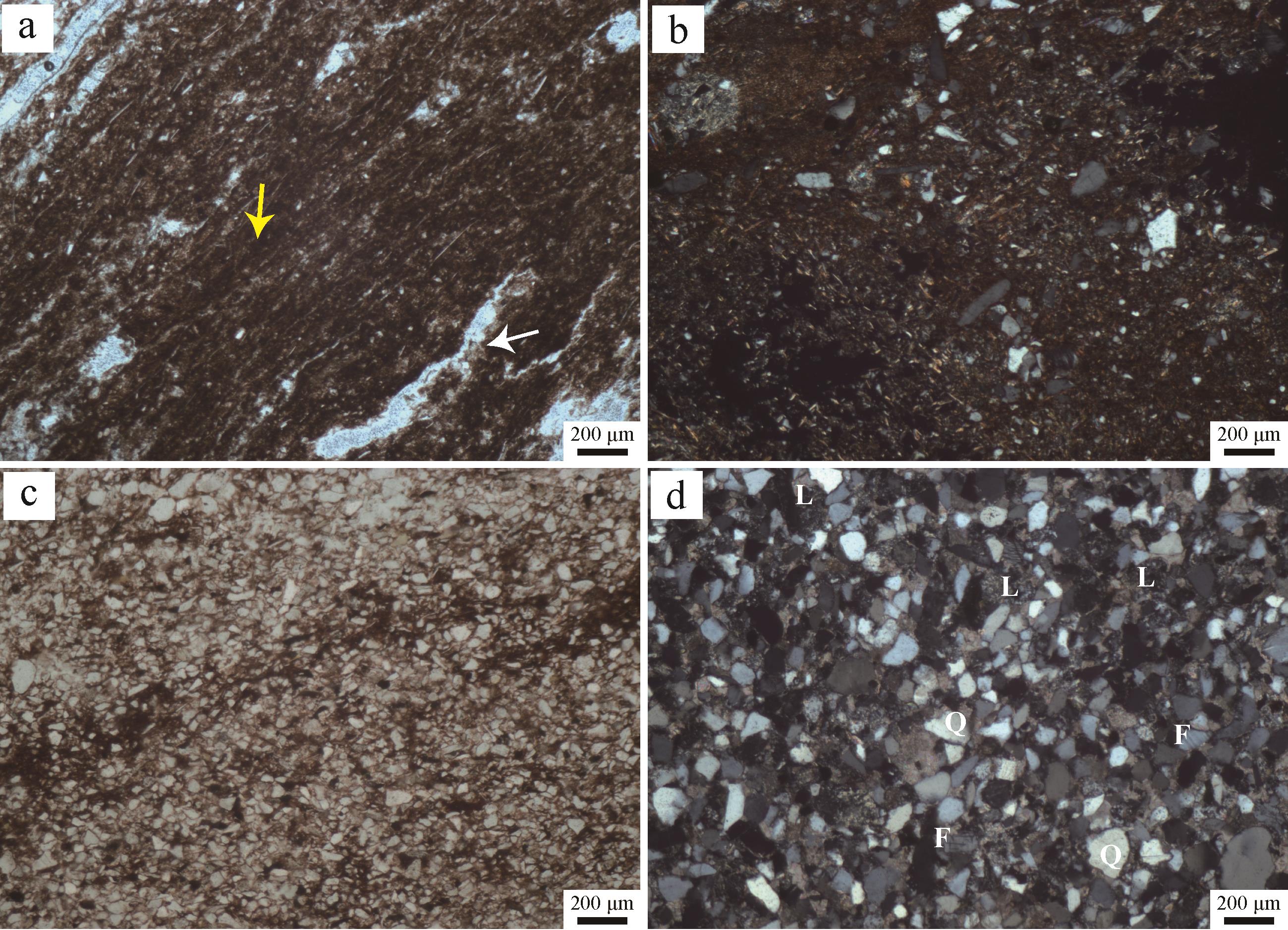
研究主要关注陆相湖盆沉积的古气候地球化学指标,为避免沉积物的粒度效应,所采集样品多为细粒碎屑岩,如泥岩、粉砂岩。泥岩样品发育纹层状构造,富含黏土,局部发育多个透镜状粉砂条带(主要为石英长石)(图5a);粉砂岩样品镜下可见棱角状—次棱角状碎屑颗粒,主要为石英、长石、碳酸盐及岩屑,少量硅质、铁质矿物,常见块状或层状构造(图5b,c)。块状构造表现为黏土矿物和粉砂级碎屑矿物均匀分布。层状构造常明暗相间,颜色和粒度变化明显;此外,部分砂泥互层样品中局部区域含较粗碎屑颗粒(细粒长石岩屑砂岩;图5d),碎屑以质地干净的石英为主(>70%),轻微至中度蚀变的长石次之(约10%),含少量石英岩、方解石岩屑,呈次棱角—次圆状,钙泥质胶结。

图 5 丹霞盆地长坝组—丹霞组典型细粒碎屑岩显微照片
Figure 5. Photomicrographs of typical Upper Cretaceous fine⁃grained clastic rocks in the Changba Formation⁃Danxia Formation, Danxia Basin
-
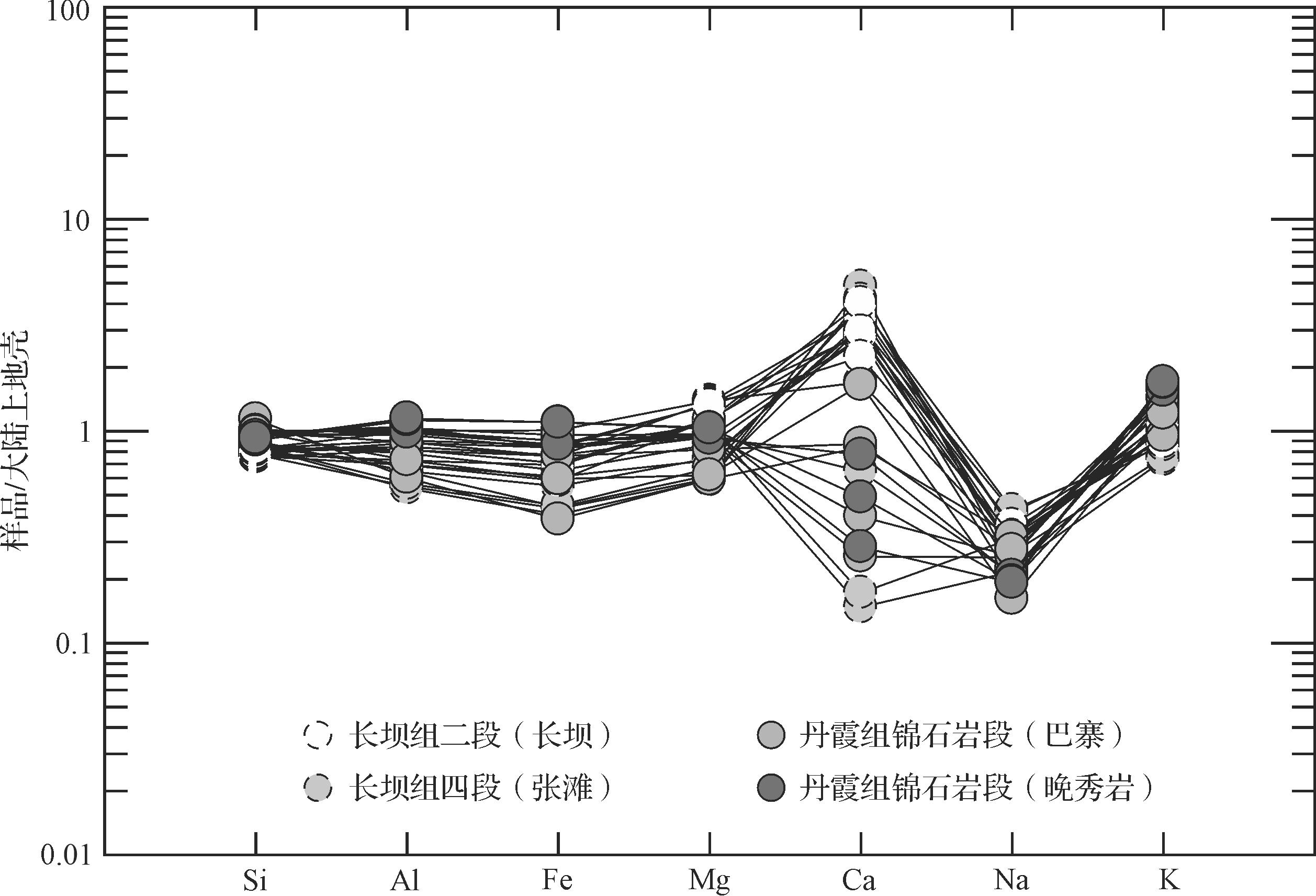
全岩主量元素测试结果如表1所示。与大陆上地壳值(UCC)(Rudnick and Gao,2003;Hu and Gao,2008)相比,所分析的细粒碎屑岩SiO2含量较为均一,与UCC质量分数平均值66.2%大体相当(图6);Al2O3、Fe2O3、MgO大多略低于大陆上地壳值(0.4~1.0倍);CaO质量分数变化较大,尤其是长坝组四段样品(0.53%~17.29%),可能代表风化蚀变作用或碳酸盐成分差异;Na2O含量远低于UCC(0.2~0.5倍);K2O含量略高于UCC值。
表 1 丹霞盆地上白垩统长坝组—丹霞组细粒碎屑沉积岩主量元素含量(%)
Table 1. Major element compositions of fine⁃grained clastic rocks in the Upper CretaceousChangba Formation⁃Danxia Formation, Danxia Basin (%)
样品 SiO2 Al2O3 Fe2O3 MgO CaO Na2O K2O MnO P2O5 TiO2 LOI Sum 丹霞组锦石岩段 WXY22-03 61.64 17.70 6.51 2.56 1.02 0.63 4.78 0.045 0.193 0.769 4.57 100.44 WXY22-02 60.31 17.36 6.53 2.57 1.75 0.64 4.73 0.040 0.213 0.760 5.27 100.18 WXY22-01 63.32 15.17 5.11 2.29 2.78 0.68 4.35 0.047 0.159 0.624 5.70 100.24 BZ23-05 66.01 11.24 3.52 1.54 5.95 0.53 3.39 0.047 0.063 0.449 7.06 99.80 BZ22-04 65.95 13.67 4.51 2.04 3.13 0.90 4.00 0.034 0.101 0.552 5.34 100.24 BZ22-03 64.41 15.91 5.68 2.40 1.42 0.84 4.52 0.035 0.109 0.676 4.43 100.45 BZ22-02 66.98 15.19 5.35 2.33 0.92 0.83 4.37 0.032 0.102 0.627 3.77 100.51 BZ22-01 75.81 9.28 2.27 1.47 3.02 1.04 2.66 0.020 0.086 0.387 4.18 100.24 长坝组四段 ZT22-04 56.70 8.71 2.64 1.66 14.02 1.39 2.40 0.059 0.138 0.456 11.84 100.03 ZT23-07 59.68 9.91 2.59 1.54 11.14 0.95 2.91 0.045 0.076 0.431 10.76 100.04 ZT23-06 56.05 8.28 2.39 1.46 14.99 0.87 2.11 0.058 0.086 0.483 13.62 100.39 ZT22-03 59.36 9.99 3.25 1.85 11.25 1.36 2.50 0.051 0.106 0.535 10.02 100.30 ZT23-05 51.61 8.47 2.55 1.48 17.29 0.74 2.05 0.059 0.072 0.432 15.44 100.19 ZT23-04 56.23 10.69 3.62 1.81 11.69 0.72 2.77 0.069 0.085 0.517 11.68 99.89 ZT23-03 56.83 12.12 3.86 2.15 9.85 0.64 3.18 0.048 0.121 0.650 10.64 100.09 ZT22-02 65.49 16.17 4.94 2.65 0.62 1.02 4.08 0.071 0.151 0.750 4.04 99.99 ZT23-02 67.24 15.40 5.33 2.40 0.53 0.71 3.91 0.049 0.106 0.644 3.86 100.18 ZT22-01 54.77 12.97 4.57 2.33 10.00 0.94 3.52 0.044 0.113 0.565 10.17 100.00 ZT23-01 64.33 14.81 4.90 2.40 2.32 0.69 3.98 0.060 0.124 0.619 5.26 99.50 长坝组二段 CB22-07 55.17 13.90 5.09 3.29 8.04 1.05 3.10 0.072 0.160 0.625 9.30 99.81 CB22-06 54.12 12.62 4.18 2.81 10.60 1.18 2.83 0.107 0.139 0.595 11.03 100.22 CB22-05 52.05 13.54 4.95 3.32 10.24 0.92 3.18 0.076 0.157 0.587 11.16 100.19 CB22-04 50.87 10.67 3.45 2.82 14.45 1.12 2.48 0.098 0.140 0.518 13.18 99.83 CB22-03 50.21 12.50 4.52 3.39 12.61 0.99 2.90 0.078 0.158 0.577 12.37 100.32 CB22-02 52.06 11.21 4.10 2.75 13.22 1.12 2.59 0.085 0.141 0.570 12.28 100.14 CB22-01 55.07 15.42 5.98 3.45 6.11 0.94 3.61 0.075 0.157 0.643 8.94 100.41 标样数据 GBW03121 53.85 31.85 0.46 0.14 0.13 0 0.31 0.001 0.115 0.670 GBW07103 71.95 13.27 2.09 0.35 1.54 2.99 4.95 0.059 0.090 0.279 GBW07111 59.07 16.42 6.16 2.76 4.62 3.92 3.48 0.094 0.341 0.725 GBW07113 72.09 12.93 3.18 0.13 0.62 2.41 5.43 0.144 0.046 0.279 GBW07103 72.85 13.60 2.35 0.47 1.53 3.28 5.00 0.064 0.108 0.283 GBW07109 54.58 17.77 7.36 0.89 1.38 7.15 7.52 0.119 0.051 0.472 GBW07725 47.02 9.06 1.68 1.02 20.21 1.15 2.39 0.265 0.046 0.263 
图 6 丹霞盆地上白垩统长坝组—丹霞组细粒碎屑岩大陆上地壳标准化曲线
Figure 6. Upper continental crust (UCC)⁃normalized major element spider plots of fine⁃grained clastic rocks in the Upper Cretaceous Changba Formation⁃Danxia Formation, Danxia Basin
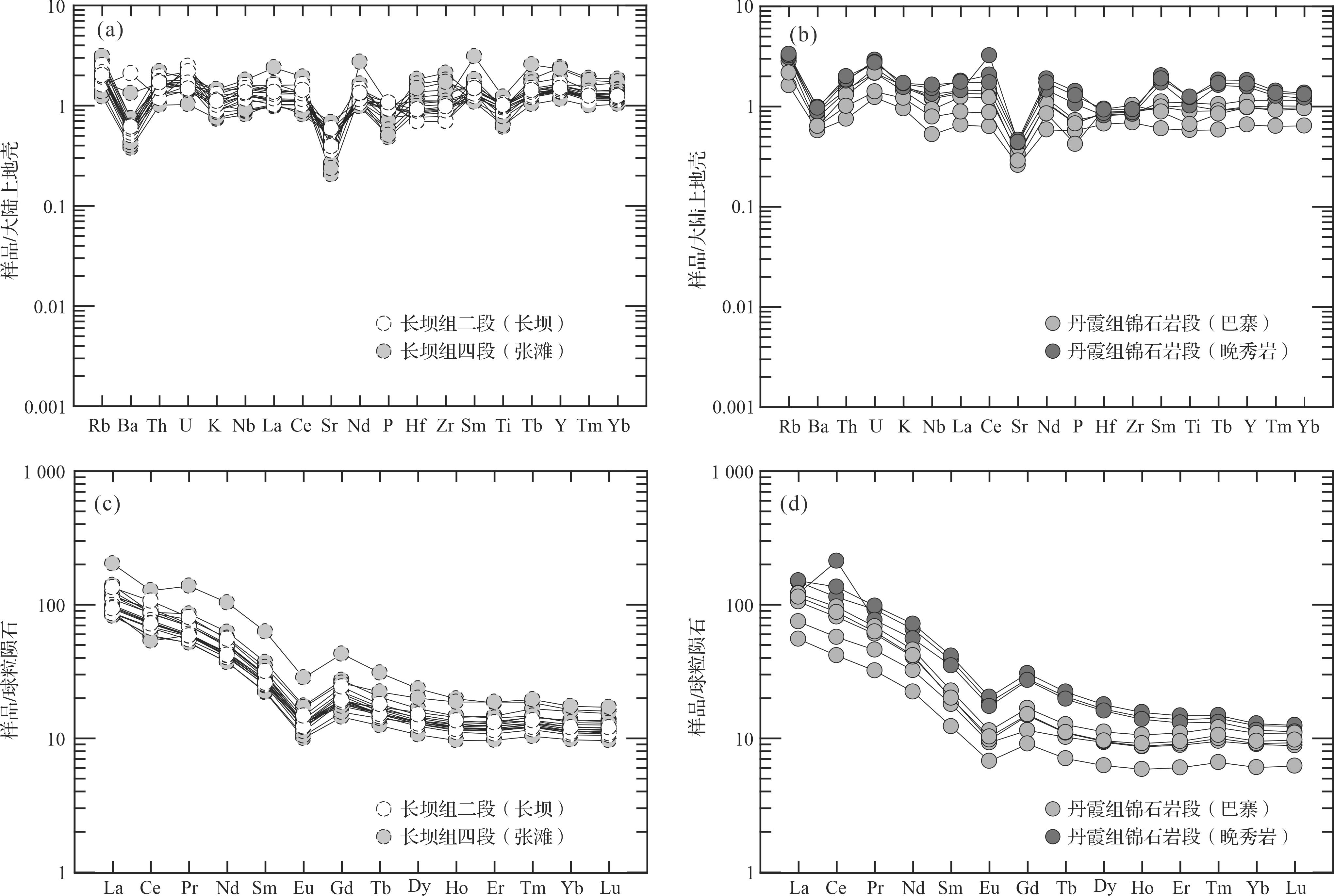
全岩微量及稀土元素如表2和表3所示。样品普遍富集Rb、Th,亏损Ba、Sr,La、Ce、Nd、Zr、Hf等元素在UCC上下波动(图7a,b)。长坝组二段和长坝组四段微量元素蛛网图相似,可能代表物源的亲缘(或继承)性;长坝组四段中个别元素,如Th、U、La、Ce等变化较大。丹霞组锦石岩段样品微量元素曲线相似,晚秀岩剖面样品各元素相对富集。分析样品ΣREE为(93~341)×10-6,总体高于大陆上地壳(148×10-6)(Rudnick and Gao,2003;Hu and Gao,2008);LREE/HREE比值为9.3~20.46,轻重稀土分馏明显,轻稀土明显富集(图7c,d)。样品均具有明显Eu负异常(Eu/Eu*=0.52~0.65)。
表 3 丹霞盆地上白垩统长坝组—丹霞组细粒碎屑岩稀土元素含量(质量分数/×10-6)
Table 3. Rare earth element compositions of Upper Cretaceous fine⁃grained clastic rocks, Changba Formation⁃Danxia Formation, Danxia Basin
样品 La Ce Pr Nd Sm Eu Gd Tb Dy Ho Er Tm Yb Lu 丹霞组锦石岩段 WXY22-03 54.4 109 12.6 46.6 8.88 1.62 8.51 1.19 6.30 1.23 3.44 0.502 3.08 0.468 WXY22-02 55.5 130 13.4 51.0 9.54 1.77 9.36 1.29 6.80 1.33 3.67 0.528 3.19 0.477 WXY22-01 44.7 203 10.5 39.5 8.08 1.51 8.31 1.14 6.11 1.18 3.25 0.470 2.85 0.426 BZ23-05 27.4 54.7 6.28 22.9 4.15 0.807 3.51 0.591 3.55 0.736 2.21 0.339 2.23 0.336 BZ22-04 38.6 77.5 8.27 28.9 4.66 0.847 4.53 0.635 3.61 0.744 2.26 0.355 2.27 0.353 BZ22-03 44.4 92.1 9.38 32.6 5.23 0.991 5.14 0.735 4.25 0.902 2.73 0.428 2.70 0.417 BZ22-02 41.9 84.0 8.59 29.6 4.62 0.891 4.61 0.642 3.65 0.778 2.36 0.375 2.36 0.370 BZ22-01 20.3 39.8 4.39 15.8 2.83 0.586 2.78 0.409 2.38 0.499 1.50 0.235 1.50 0.236 长坝组四段 ZT22-04 31.8 65.2 7.95 31.0 6.39 1.13 6.33 0.920 5.04 1.01 2.88 0.437 2.79 0.435 ZT23-07 30.9 55.2 7.13 26.3 5.09 0.871 4.42 0.722 4.05 0.820 2.41 0.368 2.42 0.366 ZT23-06 30.2 56.4 7.08 26.3 5.15 0.907 4.80 0.817 4.94 1.04 3.15 0.484 3.14 0.479 ZT22-03 35.3 71.3 7.95 29.3 5.72 0.979 5.75 0.875 5.14 1.08 3.24 0.516 3.34 0.521 ZT23-05 32.2 51.2 8.11 31.3 6.34 1.13 5.50 0.889 5.01 1.01 2.91 0.436 2.82 0.416 ZT23-04 35.7 70.4 8.12 30.4 5.97 1.13 5.33 0.876 5.14 1.04 3.08 0.462 3.03 0.451 ZT23-03 42.5 81.5 9.51 35.2 6.77 1.15 5.93 0.953 5.49 1.12 3.33 0.510 3.37 0.509 ZT22-02 74.2 122 18.9 73.6 14.5 2.47 13.1 1.79 8.96 1.68 4.59 0.657 4.05 0.608 ZT23-02 43.1 86.6 9.51 34.4 6.51 1.13 5.71 0.995 5.95 1.22 3.66 0.593 3.94 0.583 ZT22-01 51.3 84.1 11.7 44.4 8.57 1.52 8.33 1.18 6.35 1.25 3.54 0.523 3.25 0.494 ZT23-01 46.0 83.1 10.6 40.0 7.86 1.48 7.94 1.29 7.62 1.59 4.65 0.694 4.31 0.651 长坝组二段 CB22-07 42.2 89.4 9.82 35.9 6.96 1.21 6.81 0.991 5.38 1.08 3.07 0.461 2.89 0.441 CB22-06 40.3 82.7 9.44 35.4 6.92 1.14 6.58 0.952 5.18 1.02 2.96 0.450 2.82 0.429 CB22-05 36.3 72.8 8.26 30.9 6.14 1.11 5.96 0.875 4.86 0.974 2.82 0.433 2.73 0.415 CB22-04 31.5 64.0 7.48 28.5 5.82 1.05 5.71 0.843 4.69 0.944 2.69 0.412 2.63 0.401 CB22-03 34.8 69.6 7.98 29.6 6.09 1.11 5.97 0.889 4.99 1.01 2.94 0.456 2.91 0.441 CB22-02 34.2 68.7 8.01 29.8 5.98 1.06 5.90 0.876 4.88 0.990 2.84 0.430 2.72 0.412 CB22-01 49.3 102 11.0 39.3 7.32 1.28 7.43 1.04 5.71 1.15 3.26 0.482 2.98 0.458 标样数据 BCR-2 25.3 53.0 6.84 28.9 6.52 1.94 6.71 1.07 6.30 1.30 3.73 0.533 3.37 0.500 BHVO-2 15.6 38.5 5.53 25.4 6.37 2.11 6.40 0.991 5.42 1.01 2.60 0.354 2.06 0.299 
图 7 丹霞盆地上白垩统长坝组—丹霞组细粒碎屑岩微量元素大陆上地壳标准化(a,b)及稀土元素球粒陨石标准化(c,d)蛛网图;大陆上地壳数据来自Rudnick and Gao(2003)及Hu and Gao(2008);球粒陨石数据来自Taylor and McLennan(1985)
Figure 7. (a, b) Upper continental crust (UCC)⁃normalized trace element spider plots and (c, d) chondrite⁃normalized REE spider plots of fine⁃grained clastic rocks in the Upper Cretaceous Changba Formation⁃Danxia Formation, Danxia Basin; UCC data are from Rudnick and Gao (2003) and Hu and Gao (2008); chondrite data are from Taylor and McLennan (1985)
-
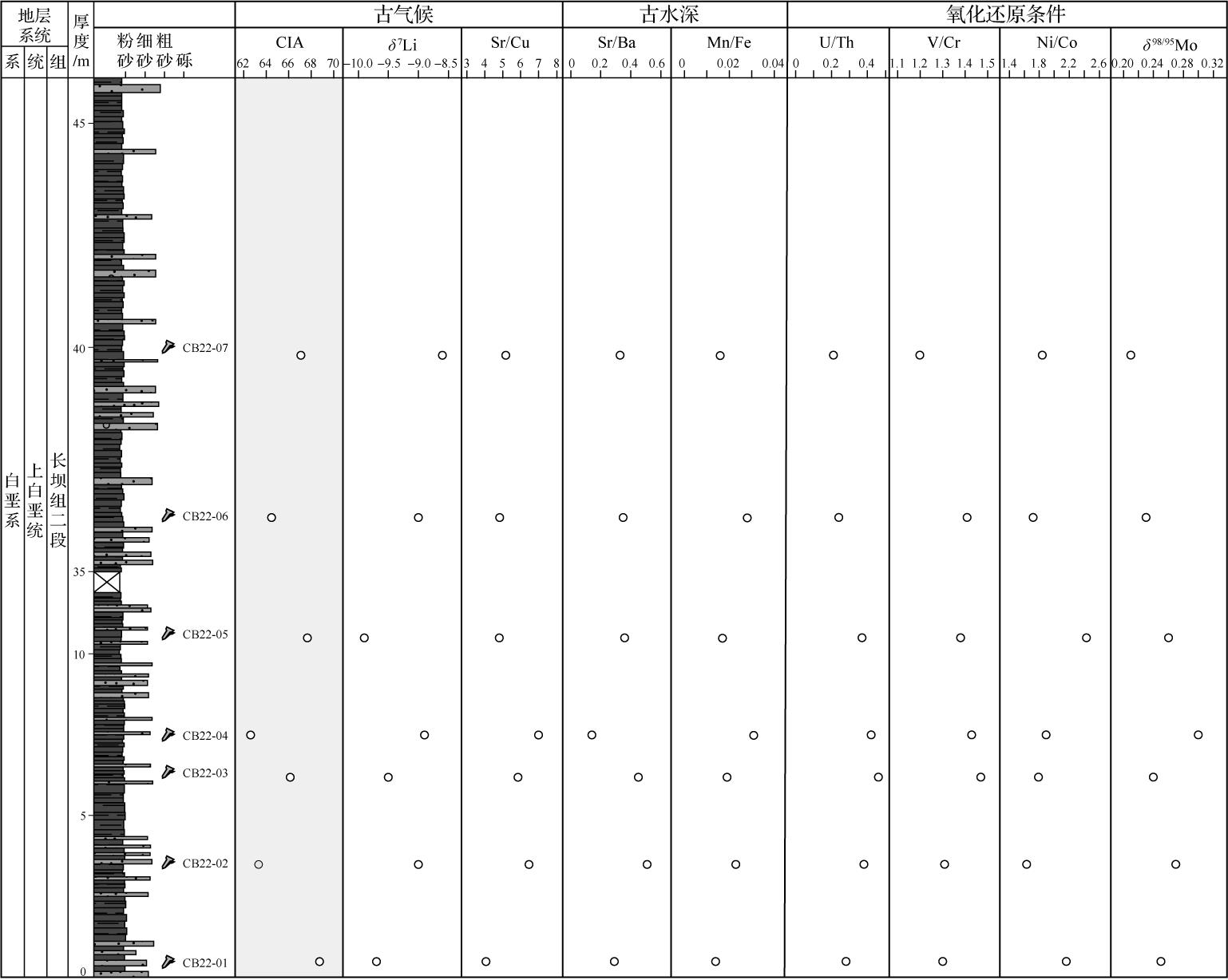
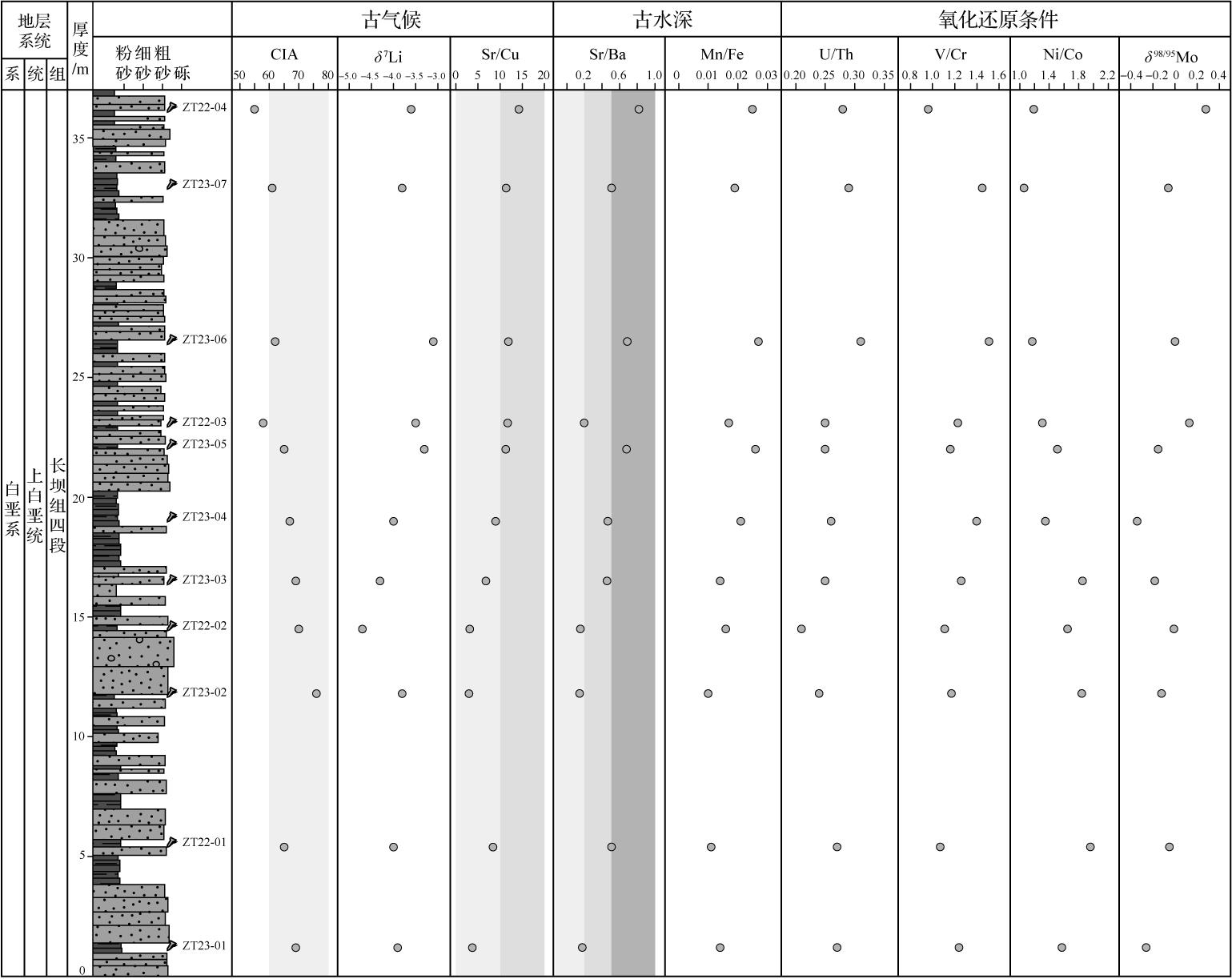
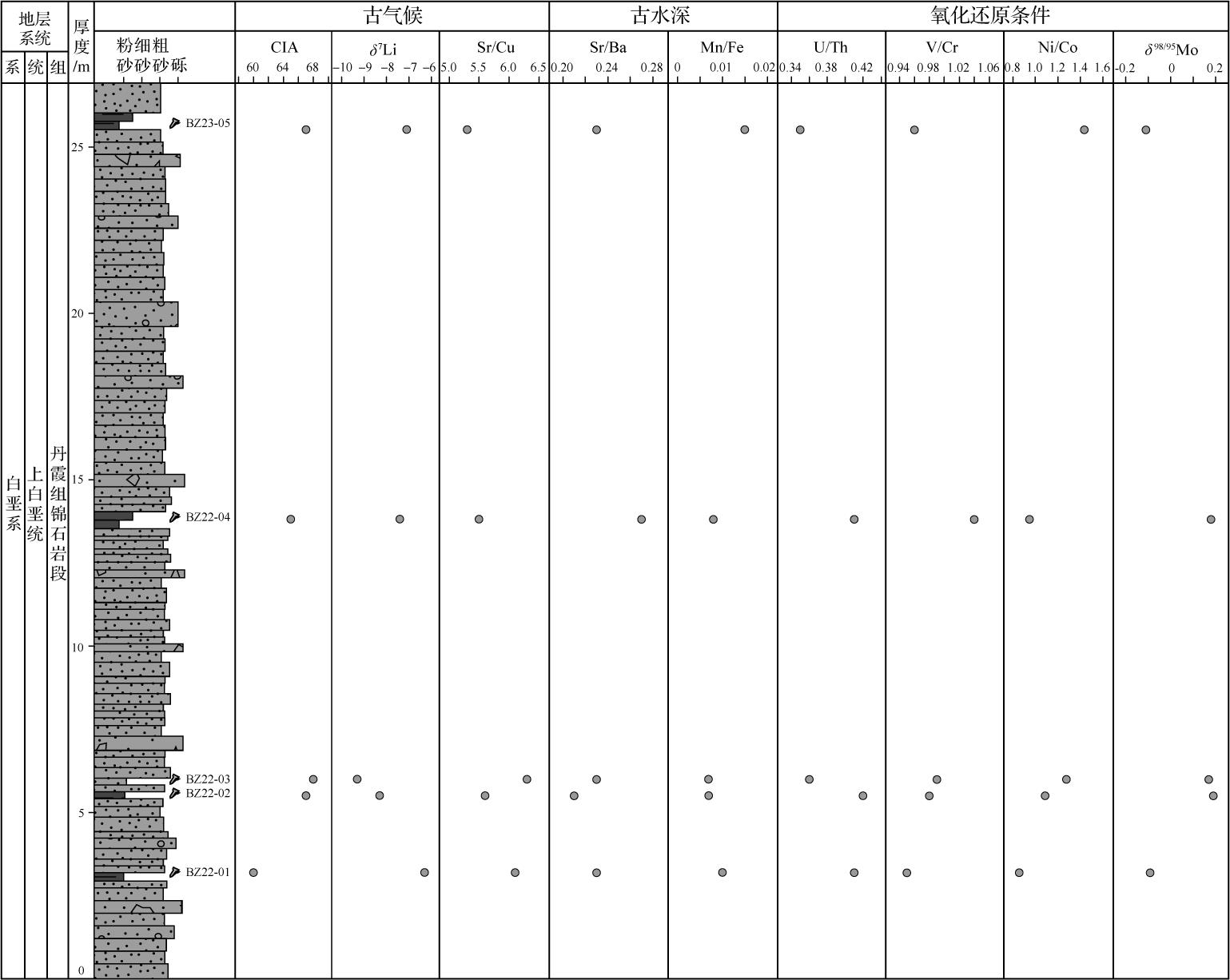
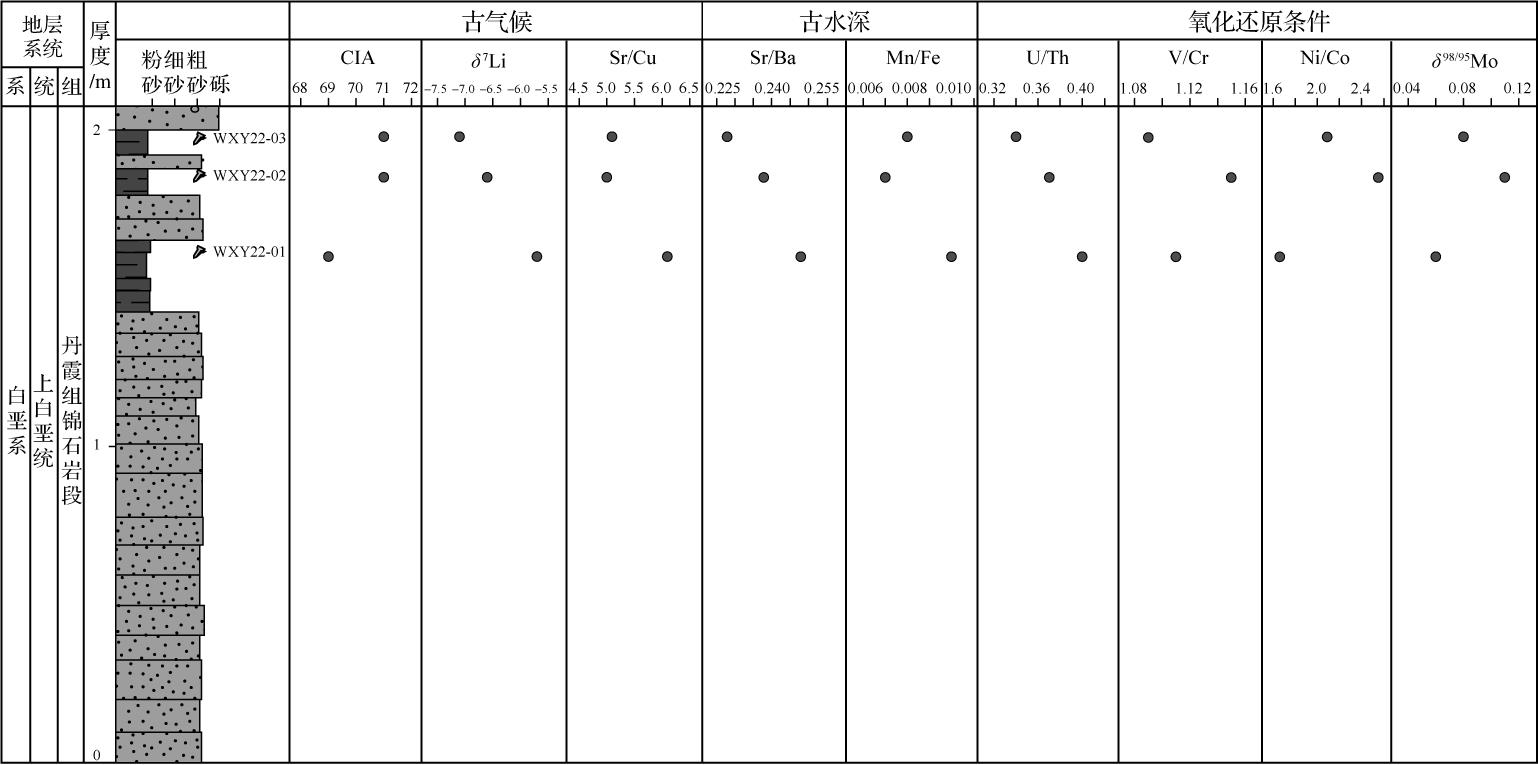
长坝组二段细粒碎屑岩Li含量介于(170~224)×10-6;δ7Li介于-9.9‰~-8.6‰(表2),远低于大陆上地壳δ7Li值(~0‰)(Teng et al.,2004);剖面呈现两个δ7Li逐渐变高区段(图8)。长坝组四段Li含量波动较大,介于(84.9~226)×10-6;δ7Li介于-4.7‰~-3.1‰,变化幅度相对较小;剖面自下而上呈现δ7Li值先降低后增高的变化趋势(图9)。丹霞组锦石岩段(巴寨剖面)Li含量介于(58.3~111)×10-6;δ7Li介于-9.3‰~-6.3‰(图10)。丹霞组锦石岩段(晚秀岩剖面)Li含量相对较高,介于(119~147)×10-6;δ7Li逐渐降低,介于-5.7‰~-7.1‰(图11)。

图 8 丹霞盆地上白垩统长坝组二段细粒碎屑岩地球化学指标垂向变化特征
Figure 8. Geochemical indicators of fine⁃grained clastic rocks in the Second member of the Changba Formation, Upper Cretaceous, Danxia Basin

图 9 丹霞盆地上白垩统长坝组四段细粒碎屑岩地球化学指标垂向变化特征
Figure 9. Geochemical indicators of fine⁃grained clastic rocks in the Fourth member of the Changba Formation, Upper Cretaceous, Danxia Basin

图 10 丹霞盆地上白垩统丹霞组锦石岩段(巴寨剖面)细粒碎屑岩地球化学指标垂向变化特征
Figure 10. Geochemical indicators of fine⁃grained clastic rocks in the Jinshiyan member of the Danxia Formation, Upper Cretaceous (Bazhai section), Danxia Basin

图 11 丹霞盆地上白垩统丹霞组锦石岩段(晚秀岩剖面)细粒碎屑岩地球化学指标垂向变化特征
Figure 11. Geochemical indicators of fine⁃grained clastic rocks in the Jinshiyan member of the Danxia Formation, Upper Cretaceous (Wanxiuyan section), Danxia Basin
-
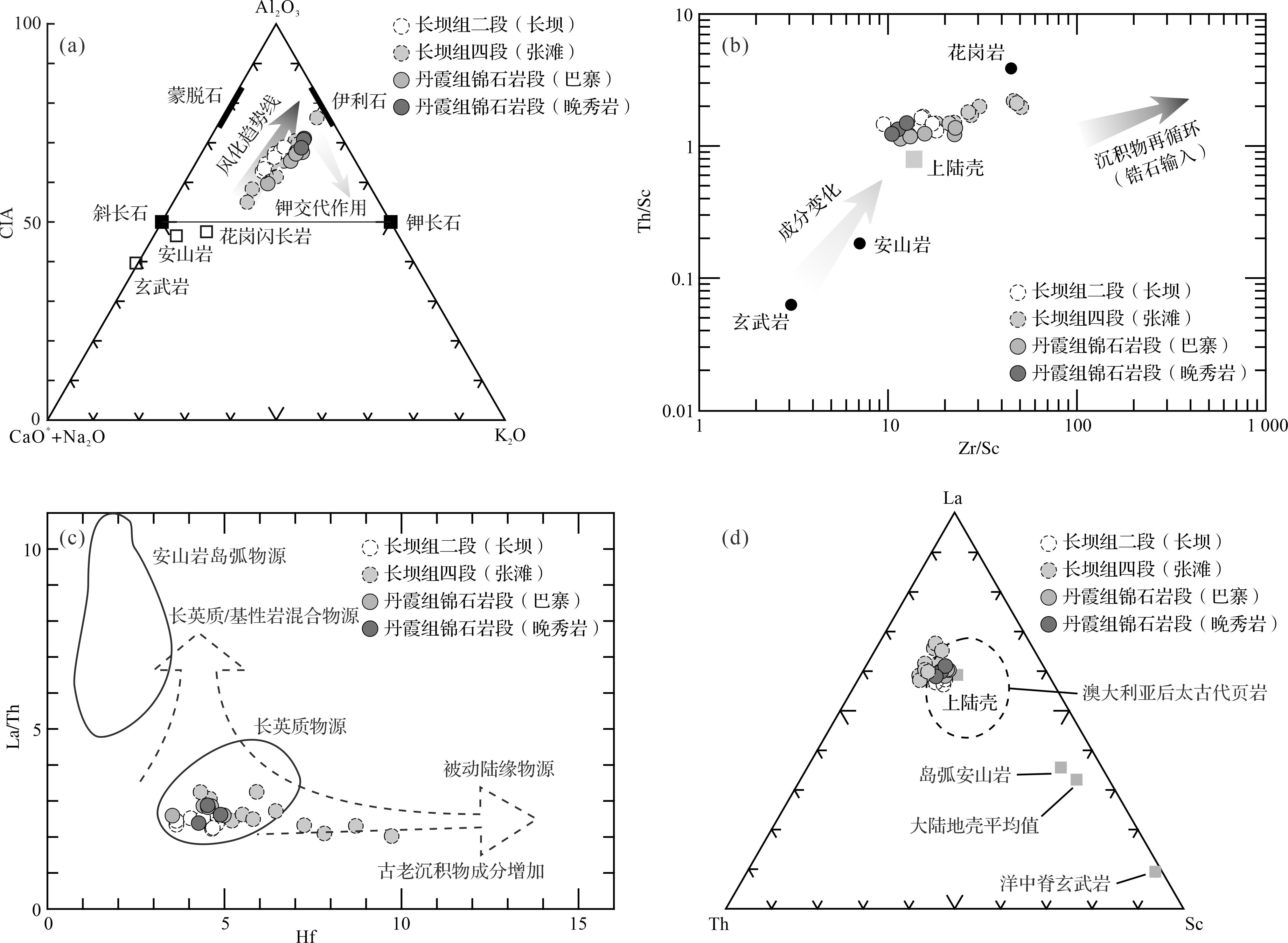
A-CN-K三角图解(图12a)显示,样品大致落于理想风化趋势线周缘,部分细粒沉积物受到埋藏过程中钾流体的交代作用而略微偏离(Fedo et al.,1995)。这些样品(如晚秀岩剖面泥岩)主要由黏土矿物组成(彭华等,2014),其偏离可能与伊利石形成相关(Fedo et al.,1995)。细粒碎屑岩成分投点落于上陆壳与花岗岩附近,表明其成分受长英质母岩成分控制,未经历明显沉积再循环(图12b)。在La/Th-Hf协变图中(图12c),样品较为集中并以长英质物源为主;少量样品(长坝组四段)具较大Hf值,可能来自被动陆源物源贡献。在La-Th-Sc图解中(图12d),样品位于后太古代澳大利亚平均页岩(Post-Archean Australian Average Shale,PAAS)及上陆壳附近,指示长英质母岩物源贡献。

图 12 (a)丹霞盆地上白垩统长坝组—丹霞组细粒碎屑岩化学蚀变指数CIA及Al2O3⁃CaO*+Na2O⁃K2O图解(Nesbitt and Young,1984;McLennan et al.,1993;Fedo et al.,1995),其中CaO*为硅酸盐矿物中的CaO,计算方法见McLennan(1993);(b)Th/Sc⁃Zr/Sc图解(底图据McLennan et al.,1993),黑色圆点代表花岗岩、安山岩和玄武岩的平均成分(数据来自Condie,1993),灰色方块代表了大陆上地壳的平均成分(Rudnick and Gao,2003;Hu and Gao,2008),左侧箭头指示成分差异,右侧箭头代表沉积物再循环;(c)La/Th⁃Hf图解(底图据Floyd and Leveridge,1987);(d)La⁃Th⁃Sc三角图解,潜在物源数据来自McLennan and Taylor(1984)
Figure 12. (a) Ternary diagram of molecular proportions of Al2O3⁃(CaO*+Na2O)⁃K2O (Nesbitt and Young, 1984; McLennan et al., 1993; Fedo et al., 1995) for Upper Cretaceous fine⁃grained clastic rocks of the Changba Formation⁃Danxia Formation, Danxia Basin; CaO* represents the Ca in the silicate fraction only (after McLennan, 1993); (b) Th/Sc vs. Zr/Sc diagram (after McLennan et al., 1993). Black solid circles indicate average compositions of granite, andesite and basalt (after Condie, 1993); Grey square represents the average compositions of UCC (Rudnick and Gao, 2003; Hu and Gao, 2008); The left arrow indicates compositional variations; the right arrow indicates sedimentary recycling effects (i.e., zircon addition); (c) La/Th vs. Hf diagram (after Floyd and Leveridge, 1987); (d) ternary plot of La⁃Th⁃Sc; Values of potential source rocks (grey squares) from McLennan and Taylor (1984)
长石的蚀变和黏土矿物的新生是上地壳化学风化的重要过程,因此,Nesbitt et al.(1980)、Nesbitt and Young(1982)设计了化学蚀变指数(Chemical Index of Alteration,CIA)以判断物源区(母岩)的风化程度。通常认为,CIA介于50~60,表明寒冷、干燥环境下的初级风化;CIA介于60~80,指示温暖、湿润环境下的中等风化;CIA大于80,代表炎热、潮湿环境下的强化学风化(Nesbitt et al.,1980;Nesbitt and Young,1982;Fedo et al.,1995)。长坝组二段样品CIA介于63~69,平均值为66,表明该沉积期整体受中等化学风化作用,反映气候为温暖、湿润的环境(图8)。长坝组四段样品CIA介于55~76,平均值为65,该沉积期整体受中等化学风化作用,气候温暖湿润。在剖面上部CIA逐渐降低(图9),气候转向干冷渐显端倪。丹霞组锦石岩段(巴寨剖面)样品CIA介于60~68且向上逐渐增加(图10),代表环境逐渐温湿的过程。丹霞组锦石岩段(晚秀岩剖面)样品CIA介于69~71(图11),指示物源区气候以温湿为主。
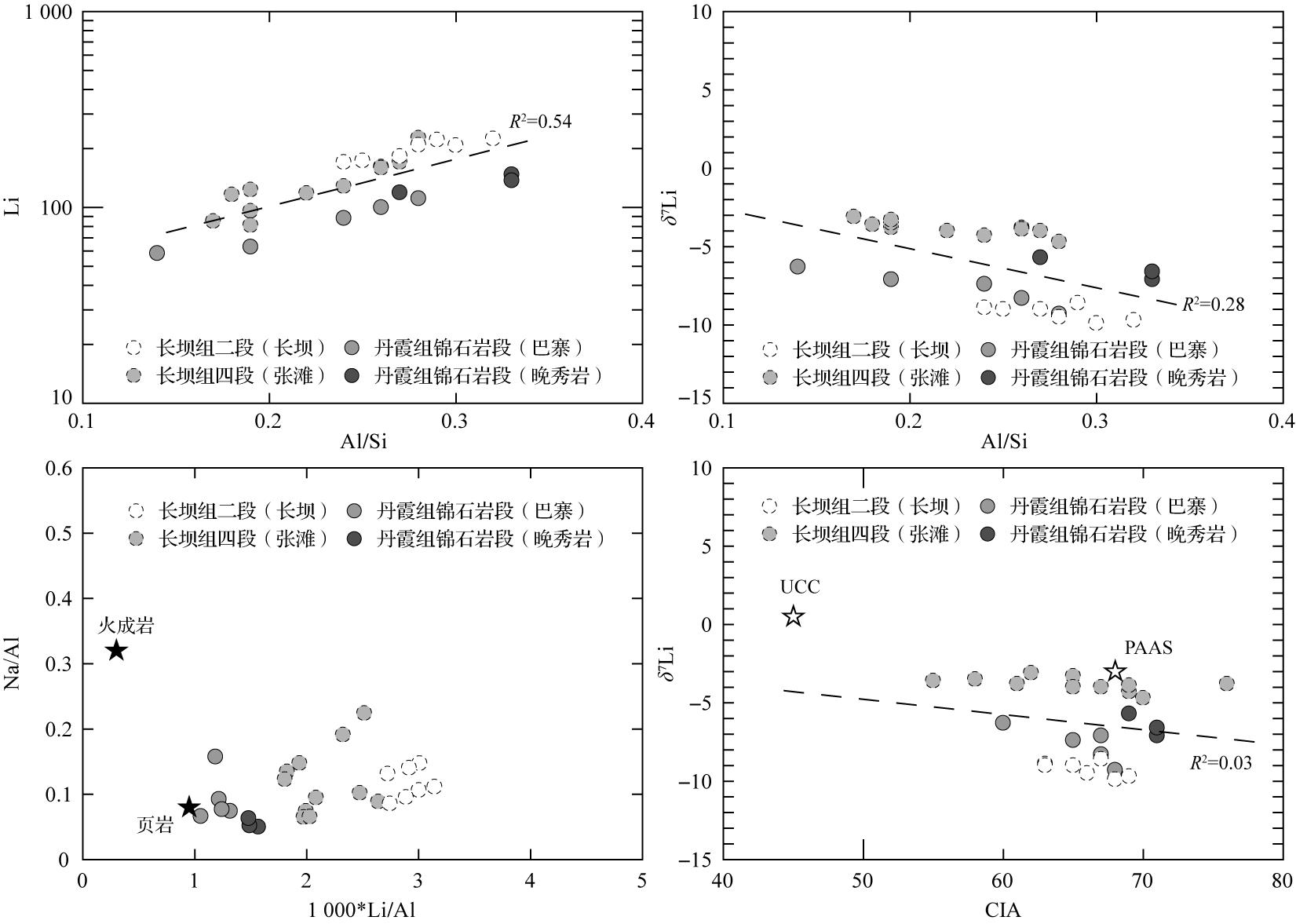
沉积物中的δ7Li常用于示踪地表化学风化强度(Li et al.,2016)。所分析样品Al/Si比值介于0.14~0.33,且整体大于0.15(细粒河流悬浮颗粒)(Dellinger et al.,2014,2017),表明样品粒度较细,以黏土矿物为主(Dellinger et al.,2014)。Al/Si与Li的变化趋势一致(图13a),说明其变化主要受黏土矿物含量的影响。总体上,剖面中Al/Si与δ7Li呈现弱负相关关系(图13b),表明δ7Li在一定程度上受到粒度的影响(Dellinger et al.,2014,2017)。通过物源端元对比,样品分布在或偏离页岩的右侧(图13c),这可能反映了原生矿物溶解和次生矿物形成的影响(Li et al.,2023)。此外,δ7Li与CIA表现出较强的负相关关系(图13d)。样品δ7Li值(-9.9‰~-3.1‰)大体与花岗岩的δ7Li值相当(Tang et al.,2007),这表明花岗岩母岩对物源有显著贡献。值得注意的是,各剖面段的物源相对一致,且样品呈现出明显的群簇分布(图12,13),暗示相关元素的分布主要受到沉积过程中古气候条件的影响。

图 13 (a,b)Al/Si与Li含量以及Li同位素关系图解;(c)Li/Al与Na/Al比值的关系图;黑色五角星代表两个源岩端元,火成岩和页岩端元数据来自Dellinger et al.,(2014);(d)CIA与Li同位素的相关性,上地壳(UCC)和澳大利亚后太古代页岩(PAAS)值来自Taylor and McLennan(1985)及Mude et al.(2019)
Figure 13. (a, b) Relationship between Al/Si, Li abundance and Li isotopic composition; (c) relationship between Li/Al and Na/Al; Black stars represent the two source end⁃members, igneous rocks and shales, respectively, from Dellinger et al. (2014); (d) relationship between Li isotopic composition and CIA, UCC and PAAS compositions are from Taylor and McLennan (1985) and Mude et al. (2019)
-
Sr和Ba元素在淡水中性质相近,但其硫酸盐化合物溶解度相差较大。因此,Sr/Ba比值可大体指示沉积水体盐度差异(熊小辉和肖加飞,2011;Wei and Algeo,2020;魏巍等,2021)。一般来说,Sr/Ba比值小于0.2指示淡水相,介于0.2~0.5指示半咸水相,大于0.5为海水相(Wei and Algeo,2020;魏巍等,2021)。所分析细粒碎屑岩样品Sr/Ba比值介于0.14~0.82(图8~11),平均值为0.35,指示半咸水为主的水体沉积环境。
长坝组二段Sr/Ba比值从底到顶呈现先增后减的趋势(图8),反映了湖泊的先缩后扩过程,但总的趋势是相对扩张。长坝组四段水体盐度较高(图9),剖面中下部Sr/Ba相对较低、CIA较高,指示降水增多、盐度降低、湖面扩张的气候温湿加剧;随后Sr/Ba比值增高且CIA明显降低,代表了降雨变少、湖泊浓缩的气候干旱化(高盐度半咸水)过程。丹霞组锦石岩段Sr/Ba先降后升(图10,11),指示了湖泊面积先扩张后收缩的过程。
-
不同元素在岩石风化过程中表现出不同性质及气候响应敏感性。通常认为,Sr/Cu比值介于1~10代表温暖湿润的气候,大于10则指示干燥炎热的气候(熊小辉和肖加飞,2011)。长坝组二段Sr/Cu=4.1~7.0,表现为先升后降的变化趋势(图8),但总体仍以温湿为主。长坝组四段Sr/Cu=3.0~14.3,呈持续上升(图9),反映了整体气候从温湿到干热的变化过程。丹霞组锦石岩段Sr/Cu=5.0~6.3,均呈波动下降趋势(图10,11),指示环境总体以温湿为主。
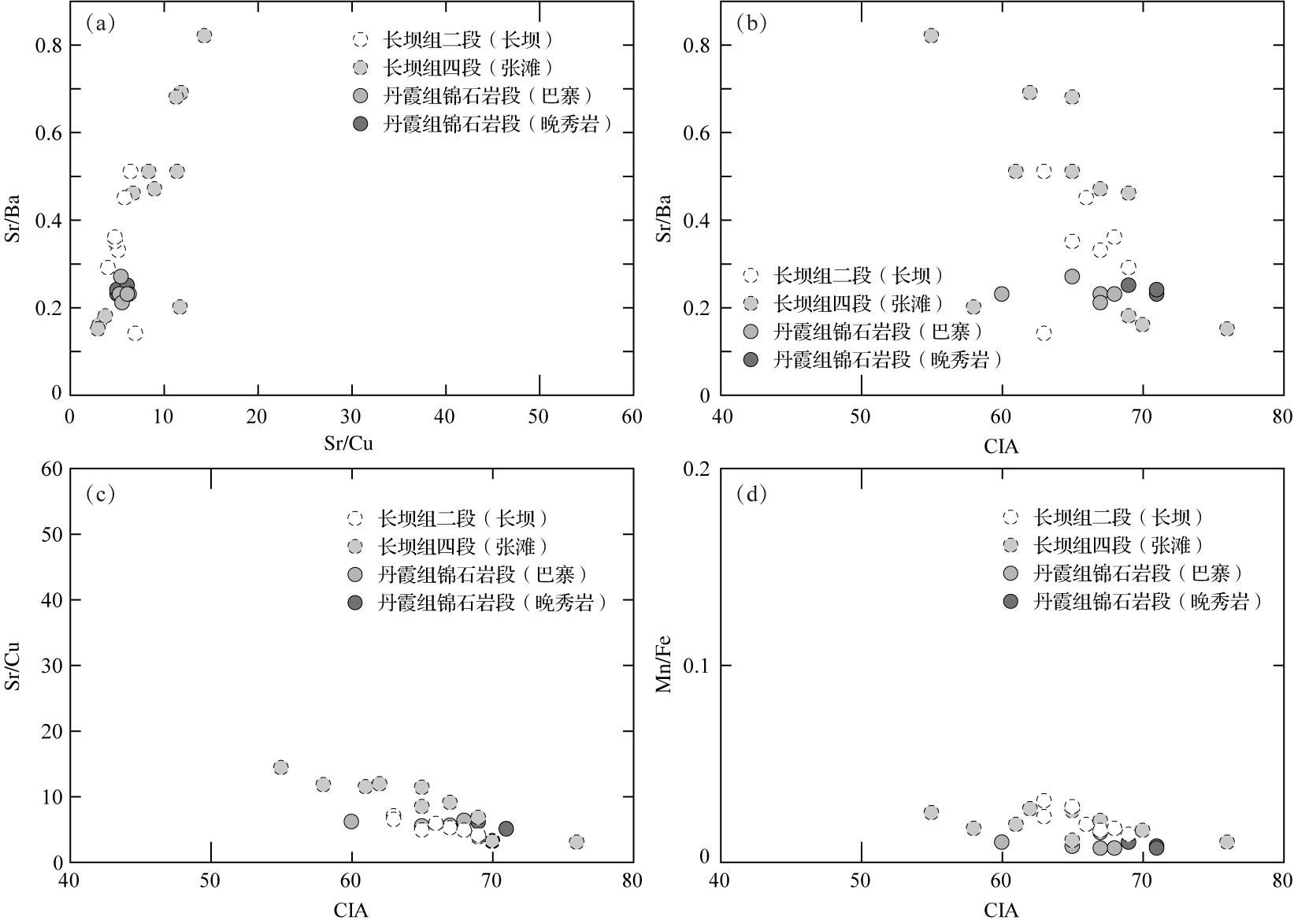
Sr/Ba比值不仅用于表征沉积水体的古盐度,还因其在不同气候环境下碳酸盐与硫酸盐的溶解度差异,广泛应用于古气候条件的分析。通常,Sr/Ba比值的升高指示水体盐度增加、反映气候干旱和蒸发强烈;反之,则表明气候相对湿润(熊小辉和肖加飞,2011)。此外,Mn/Fe比值不仅可以指示古水深,还能用来判别古气候(陈亮等,2009)。具体而言,低Mn/Fe值对应于相对温湿的环境,而高Mn/Fe值则指示相对干热的气候。对于陆相湖盆的细粒碎屑岩样品,Sr/Ba与Sr/Cu呈正相关,而Sr/Ba、Sr/Cu及Mn/Fe与CIA则呈负相关(图14)。这些元素比值大体展现出一致的气候变化趋势(图8~11),如在温暖湿润的气候条件下,古盐度较低、水体水深较深。

图 14 Sr/Ba、Sr/Cu、Mn/Fe及CIA关系图解
Figure 14. Relationships between Sr/Ba, Sr/Cu, Mn/Fe and CIA
-
U、V、Mo、Cr、Ni等元素的存在形式通常受到水体氧化还原条件的控制(常华进等,2009;熊小辉和肖加飞,2011)。研究表明,这些元素在沉积物(岩)中的含量或比值可以用于重建沉积环境的氧化还原条件(van der Sloot et al.,1985;Wright et al.,1987;Jones and Manning,1994;Bau and Dulski,1996;林治家等,2008;Bai et al.,2024)。如Cr、U和V离子常会在缺氧的脱硝酸环境中被还原而沉淀析出,Ni、Cu、Co和Mo等元素则倾向于在硫酸盐还原的环境中富集沉淀(熊小辉和肖加飞,2011)。在长坝组二段、长坝组四段及丹霞组锦石岩段的样品中,U/Th、V/Cr及Ni/Co比值均指示氧化环境;而Ce/Ce*则显示出氧化与缺氧环境之间的波动(表4)。需要注意的是,大多样品具Ce异常,且明显受到La异常的影响(图6)(Bau and Dulski,1996;林治家等,2008)。Ce/Ce*指向的缺氧环境(表4)可能受到多种因素的影响,如陆源输入、成岩作用、热液活动及水体的封闭性等(Bau and Dulski,1996;林治家等,2008;Bai et al.,2024)。因此,Ce/Ce*的环境指示可靠性有待探讨。
表 4 丹霞盆地上白垩统细粒碎屑岩沉积水体氧化还原指标对比
Table 4. Comparison of redox indicators in the depositional water body of fine⁃grained clastic rocks from the Upper Cretaceous, Danxia Basin
U/Th V/Cr Ni/Co Ce/Ce* δ98/95Mo/‰ 缺氧(无H2S) >1.25 >4.25 >7 <1 1.3~1.8 缺氧硫化 2.1~2.6 氧化 <0.75 <2 <5 >1 -0.7~0 次氧化 0.75~1.25 2~4.25 5~7 -0.5~1.3 长坝组二段 0.21~0.46 1.20~1.47 1.63~2.43 0.95~1.01 0.21~0.30 长坝组四段 0.21~0.31 0.96~1.51 1.06~1.96 0.73~0.98 -0.34~0.28 丹霞组锦石岩段(巴寨) 0.35~0.42 0.95~1.04 0.85~1.43 0.96~1.04 -0.11~0.19 丹霞组锦石岩段(晚秀岩) 0.34~0.40 1.09~1.15 1.66~2.55 0.96~2.15 0.06~0.11 水体环境判别 氧化 氧化 氧化 氧化—缺氧 次氧化—氧化 注: 不同沉积环境下特征微量元素比参考值引自Wright et al.(1987) ,Jones and Manning(1994)及Fujisaki et al.(2016) ;Mo同位素比值引自Poulson et al.(2006) 及Siebert et al.(2006) ;Ce/Ce*=2CeN/(LaN+PrN),N为北美页岩标准化值(Fujisaki et al.,2016 )。Mo同位素是示踪湖泊水体—沉积物界面氧化还原条件的有效判别指标(Barling et al.,2001;Siebert et al.,2003;朱建明等,2008;周炼等,2011)。在氧化环境中,沉积物的δ98/95Mo较轻,而在缺氧环境中,δ98/95Mo则较重。此外,上覆水体中较高的O2量对应沉积物中较低的δ98/95Mo值,反之亦然(朱建明等,2008)。长坝组二段δ98/95Mo(0.21‰~0.30‰,平均值0.25‰;表4)落在次氧化环境沉积物的范围内(-0.5‰~1.3‰)(Poulson et al.,2006;Siebert et al.,2006);Mo同位素表现出先升高后降低的趋势(图7),反映了上覆水体含氧量先减少后增加的波动过程。长坝组四段样品具δ98/95Mo=-0.34‰~0.28‰,平均值为-0.07‰,整体指示了氧化至次氧化环境的变化;Mo同位素显著升高(图8),指示水体含氧量不断减低,也暗示温度愈发干热、水体盐度不断增高(王成善等,1999)。锦石岩段(巴寨剖面)δ98/95Mo介于-0.11‰~0.19‰,平均值为0.11‰,属于次氧化—氧化的水体条件。剖面上先重后轻的变化趋势(图9)代表了上覆水体含氧量先降后升的波动。丹霞组锦石岩段(晚秀岩剖面)的δ98/95Mo均呈正值(0.06‰~0.11‰,平均值为0.08‰;图10),属次氧化环境。综上所述,长坝组二、长坝组四段及丹霞组锦石岩段整体应处于次氧化—氧化的沉积水体环境,也佐证了相对温湿的气候条件。
-
晚白垩世早期,随着古太平洋板块俯冲后撤,华南东南缘的构造演化以伸展作用为主,形成了一系列北东向伸展型盆地(李祥辉等,2018),如广东南雄盆地、湖南茶陵盆地、湖北江汉盆地等(表5)。代表性地层包括三水盆地三水组、丹霞—南雄盆地长坝组、闽西崇安组、浙西方岩组及赣东北信江盆地圭峰群(李祥辉等,2018),沉积物以河流和湖泊相砂岩和泥岩为主。三水组的黏土矿物组合(如伊利石、绿泥石和高岭土的相对富集)反映了干旱向半干旱和湿润气候的转变(张哲,2018),而浙闽西南部的红壤型古土壤(如衢县组)的出现则代表亚热带温湿气候,伴随着降雨的增加与生物活动的增强(李祥辉等,2009)(表5)。整体来看,此期区域呈现出干旱—半干旱至湿润的气候特征。
表 5 华南东南陆缘区域晚白垩世—古近纪古气候特征对比
Table 5. Comparison of Late Cretaceous⁃Paleogene paleoclimates at the southeastern margin of South China
时代 华南内陆 华南沿海 湖南(茶陵、衡阳盆地) 湖北(江汉盆地) 江西(广丰、永崇盆地) 浙江西部 福建西部(永安盆地) 广东北部(丹霞—南雄盆地) 广东南部(三水盆地) 古近纪古新世 较炎热的干旱—半干旱气候(刘芮岑,2018;黄乐清等,2019) 极度干旱气候(Teng et al.,2019) 干旱—温暖气候(王开发等,1989) 干旱—湿润—干旱气候(张哲,2018) 湿热—干旱—半干旱气候(王尹等,2015) 晚白垩世晚期 半干旱气候(Teng et al.,2019) 半湿润—半干旱—湿润气候(Chen et al.,2017) 干旱—炎热气候(王开发等,1989) 干旱—半干旱气候(王尹等,2015;王文艳等,2016),温湿(本文) 干旱—半干旱气候(张哲,2018) 干旱气候(梁西文,2008) 干旱—半干旱气候(陈金牛等,2020) 晚白垩世早期 干旱气候(王宇佳,2019) 干旱—半干旱—温湿气候(李祥辉等,2009;刘玲等,2012) 干冷—温湿气候(李祥辉等,2009;何岸北,2022) 温湿为主,局部干旱(本文) 干旱—半干旱—湿润气候(张哲,2018) 丹霞盆地保存了晚白垩世早期(赛诺曼期至土伦期)的部分气候记录,尤其是长坝组二段和长坝组四段的陆相湖盆沉积。地球化学分析表明,这些沉积物主要反映出温暖湿润的气候特征,如中等风化强度的CIA指数及较低Sr/Cu比值。在局部层位(如长坝组四段)中,气候愈发干旱炎热,伴有较高CIA值(源区强风化)、较高的Sr/Ba(高盐度)和Mn/Fe比值(湖面收缩)以及不断升高的Mo同位素比值(水体含氧量逐渐降低)。尽管细粒碎屑岩的产出形式各异(如长坝组二段、长坝组四段;夹层/大套厚层),相关的地球化学指标(Sr/Ba、Mn/Fe)与风化强度(图8~11)及沉积相(从冲积扇到湖相,再到湖盆萎缩和冲积扇进积(许汉森等,2008;黄进,2010;陈留勤等,2019))等现象的同步变化,体现了陆相湖盆沉积地球化学指标对于气候波动的有效反馈。
晚白垩世晚期(坎潘期),区域以三水盆地大塱山组、南雄盆地主田组、江汉盆地渔洋组及茶陵盆地戴家坪组等为代表。风成沉积、旱地扇及钙质古土壤等气候敏感沉积显示干旱—半干旱的气候条件(刘芮岑,2018)(表5)。黏土矿物中伊利石的主导地位(张哲,2018)以及孢粉植物群(刘耕武等,2006)等证据进一步支持了这一干旱气候特征。在丹霞盆地,康尼亚克期—圣通期的湖盆基本萎缩消失(许汉森等,2008;黄进,2010),坎潘期—马斯特里赫特期区域以冲积扇(巴寨段、白寨顶段)以及风成沉积相和小型沙丘间沙漠湖泊相沉积(锦石岩段)为主。虽然锦石岩段的细粒沉积样品保存较差,但较低Sr/Cu比值(温湿)以及水深先深后浅的记录(Sr/Ba、Mn/Fe比值先降后升)似乎暗示着局部小型沙丘间沙漠湖泊的发育(陈留勤等,2019)及因冲积扇进积导致的水体变浅。尽管风成沉积反映了干热气候(陈留勤等,2019),锦石岩段的细粒碎屑岩地球化学指标却指示温湿气候特征(中等化学风化CIA、较低Sr/Cu),反映物源区气候的短期交替变化。
国内外众多学者通过地层记录、化石记录、沉积物源变化、热年代学、碳酸盐团簇同位素研究以及古地形模拟等多手段/方法(陈丕基,1997;汪品先,2005;田云涛等,2022;叶婷婷,2023)推测,晚白垩世期间中国东南沿海可能存在海拔高达4 000 m的古海岸山脉(陈丕基,1997)。精细分析华南东南缘盆地的气候变化(表5)发现,古海岸山脉的隆升与剥蚀解体可能与该区域气候演变密切相关。从纵向时间序列来看,晚白垩世早期,气候以干旱为主、湿润气候零星分布,反映了全球“温室效应”与山脉隆升的共同作用;而在晚白垩世晚期,华南东南缘的气候则转变为以干旱—半干旱的炎热气候为主(表5),此时古海岸山脉完全隆起,形成巨大的海拔高差(陈丕基,1997;Tan et al.,2020),持续阻挡来自古特提斯洋与太平洋的暖湿气流(Ding et al.,2019)。在干旱气候的主导下,特殊沉积物如石膏、钙芒硝层等蒸发盐类、沙化和盐碱化以及风成沙丘(如锦石岩段风成沉积)逐渐发育(Boucot et al.,2009;向芳等,2009;Cao,2018)。进入古新世后,湿润气候再次出现,可能表明古海岸山脉的剥蚀和海拔下降,使得暖湿空气重新进入内陆,带来季风雨等气候变化(汪新胜等,2000;Ding et al.,2019)。从横向区域变化来看,华南东南缘的不同盆地气候差异显著。例如,古新世时期,三水盆地的沉积记录显示出温暖湿润的特征,而江汉和茶陵盆地则呈现更加显著的干旱气候。
尽管晚白垩世全球整体呈现干旱—半干旱的气候格局(Boucot et al.,2009),但由于地形、风向和气流等因素的影响,部分地区(如丹霞盆地)仍可能出现短暂的湿润期,这表明山间局部小盆地的气候变化受到区域特征的显著制约。综上,丹霞—南雄等华南沿海盆地位于古海岸山脉西南端,紧邻华南内陆(Chen et al.,2022),其气候记录反映了在“干热”大背景下、受地形地貌(如山间盆地)和季节性降雨(汪新胜等,2000)等局部特征影响的气候演化。
-
(1) 丹霞盆地上白垩统长坝组二段、长坝组四段及丹霞组锦石岩段细粒碎屑岩,主要形成于温暖湿润气候条件,以长英质岩石为母岩,整体受中等化学风化作用,沉积再循环作用较弱,保存了较好的物源信息。
(2) 长坝组二段的沉积整体处于次氧化状态,水体含氧量先降后升,盐度则先增后减,指示湖泊水体发生先收缩(变浅)后扩张(加深)的波动过程,但总体以半咸水环境为主;长坝组四段的沉积显示出氧化—次氧化环境的波动,较高的水体盐度(局部高盐度半咸水)和逐渐变浅的古水深,反映了气候愈发干旱化;丹霞组锦石岩段细粒碎屑岩则表现为次氧化—氧化环境,且水体盐度较低,水体深度先深后浅,可能与沉积环境的转变(沙漠湖泊相和冲积扇进积等)相关。
(3) 化学蚀变指数CIA和δ7Li能够有效示踪丹霞盆地陆相湖盆细粒碎屑岩的化学风化强度;Sr/Ba、Sr/Cu、Mn/Fe等比值展现出相似的波动趋势,能够有效反映湖盆物质沉积时古盐度、古水深(湖盆面积)等关键气候信息;钼同位素是示踪湖泊水体—沉积物氧化还原特征、水体含氧量变化的有效指标。
(4) 丹霞—南雄盆地等华南东南缘山间盆地的陆相沉积记录所蕴含的气候信息,体现了晚白垩世全球气候格局的影响,同时受古海岸山脉古地貌演化等地质过程的综合制约。
样品 Li Sc V Cr Co Ni Cu Zn Ga Rb Sr Y Zr Nb Mo Cs Ba Hf Ta Pb Th U δ7Li 2SD δ98/95Mo 2SE 丹霞组锦石岩段 WXY22-03 147 15.8 90.0 82.5 20.2 42.2 27.9 99.8 26.4 313 141 35.2 180 19.0 0.632 99.7 602 4.91 1.80 43.5 20.9 7.07 -7.1 0.2 0.08 0.03 WXY22-02 137 15.9 90.5 79.0 15.5 39.5 29.4 97.5 25.4 303 148 38.3 168 17.6 0.500 95.6 615 4.54 1.55 43.1 19.4 7.18 -6.6 0.1 0.11 0.03 WXY22-01 119 12.8 74.1 66.5 24.0 39.8 22.7 83.6 22.1 288 139 33.1 162 15.4 0.395 80.1 554 4.29 1.58 40.0 18.9 7.57 -5.7 0 0.06 0.04 BZ23-05 62.8 8.77 47.9 50.0 20.0 28.6 17.3 48.0 14.2 203 91.8 20.6 199 9.14 0.497 58.0 397 5.00 0.90 25.2 10.6 3.66 -7.1 0.1 -0.11 0.03 BZ22-04 88.1 11.1 61.5 59.3 53.3 50.0 19.8 57.4 18.6 264 108 20.4 175 10.8 0.473 73.8 397 4.64 1.44 31.9 13.6 5.62 -7.4 0.1 0.18 0.03 BZ22-03 111 13.9 79.3 80.4 34.6 44.1 20.1 66.5 21.7 302 127 24.2 163 14.2 0.472 105.0 548 4.42 1.44 45.4 15.6 5.59 -9.3 0.3 0.17 0.03 BZ22-02 100 12.8 74.8 76.0 44.8 48.4 18.5 63.3 20.9 289 103 20.9 169 13.9 0.444 90.9 486 4.55 1.53 44.4 14.9 6.29 -8.3 0.1 0.19 0.04 BZ22-01 58.3 5.80 32.5 34.1 45.6 38.6 13.5 32.8 11.0 152 83.0 13.8 133 6.09 0.307 30.7 358 3.55 0.98 22.6 7.88 3.20 -6.3 0.4 -0.09 0.04 长坝组四段 ZT22-04 116 7.05 37.0 38.4 20.3 24.1 15.2 44.6 11.5 159 218 31.3 330 10.5 0.344 36.7 267 7.84 1.24 25.2 15.3 4.22 -3.6 0.1 0.28 0.04 ZT23-07 95.8 6.44 54.4 37.4 23.9 25.3 13.9 42.1 12.1 177 159 24.3 198 10.3 0.234 36.5 312 5.23 1.30 21.9 12.7 3.70 -3.8 0.4 -0.06 0.04 ZT23-06 84.9 6.79 57.6 38.1 21.0 24.6 14.4 43.1 10.5 129 171 31.8 347 10.2 0.304 30.8 248 8.73 1.15 16.5 13.2 4.09 -3.1 0.3 0 0.04 ZT22-03 123 8.43 51.3 41.6 20.0 26.1 14.3 51.9 13.5 163 168 32.3 408 12.5 0.394 35.3 827 9.74 1.46 22.3 17.6 4.38 -3.5 0.2 0.13 0.04 ZT23-05 81.0 6.27 40.2 34.6 13.6 20.5 14.1 39.2 9.57 115 160 30.2 174 9.44 0.258 27.0 235 4.61 0.98 15.4 10.6 2.67 -3.3 0.1 -0.15 0.03 ZT23-04 118 9.35 63.2 45.1 20.3 27.4 17.8 60.0 15.0 185 161 31.3 214 14.7 0.389 44.2 343 5.53 1.50 25.4 13.7 3.60 -4.0 0.2 -0.34 0.02 ZT23-03 128 10.3 72.2 57.5 14.6 27.0 21.9 65.9 16.3 203 148 33.5 276 17.6 0.372 55.7 322 7.27 1.68 24.2 18.4 4.68 -4.3 0 -0.18 0.03 ZT22-02 226 13.9 69.5 62.5 21.3 35.2 23.8 89.0 24.0 292 75.3 48.7 215 20.9 0.255 66.3 460 5.93 2.28 49.5 22.9 4.85 -4.7 0 -0.01 0.03 ZT23-02 161 11.9 66.9 57.2 20.3 37.3 21.9 77.8 20.0 255 65.4 33.5 216 18.8 0.515 65.1 425 5.83 2.01 41.8 17.4 4.10 -3.8 0.3 -0.12 0.04 ZT22-01 170 11.7 60.6 56.8 15.0 29.4 21.5 75.1 18.6 248 181 39.3 162 15.6 0.350 60.5 353 4.34 1.70 29.2 15.9 4.25 -4.0 0.1 -0.05 0.04 ZT23-01 159 11.6 72.7 58.6 24.8 38.9 22.1 76.1 20.1 261 84.1 50.3 247 17.0 0.552 59.3 465 6.47 1.75 38.5 17.0 4.56 -3.9 0.1 -0.26 0.08 长坝组二段 CB22-07 221 12.4 72.5 60.6 16.8 30.9 24.2 86.4 19.6 188 125 31.3 188 15.6 0.647 69.2 381 4.82 1.54 30.2 17.8 3.82 -8.6 0.1 0.21 0.03 CB22-06 182 11.3 77.0 54.5 16.7 28.7 26.7 77.0 18.3 181 129 30.1 171 17.2 0.445 59.9 364 4.67 1.79 24.3 18.3 4.37 -9.0 0.1 0.23 0.04 CB22-05 207 12.5 85.6 62.0 12.9 31.3 27.4 86.1 19.2 200 132 28.9 135 15.2 0.610 70.5 370 3.68 1.45 25.3 15.5 5.66 -9.9 0.2 0.26 0.03 CB22-04 170 9.59 72.5 50.7 13.9 26.3 26.9 65.3 14.3 151 188 28.7 173 13.5 0.437 51.8 1 300 4.43 1.50 18.2 12.4 5.24 -8.9 0.1 0.30 0.03 CB22-03 208 11.6 86.5 58.7 18.4 32.9 25.3 82.4 17.2 179 148 30.2 151 14.7 0.603 60.5 332 4.06 1.48 26.0 13.9 6.43 -9.5 0.5 0.24 0.04 CB22-02 173 10.5 71.2 54.2 19.1 31.2 24.9 72.8 15.7 157 161 29.7 182 14.6 0.563 53.4 314 4.69 1.43 24.3 15.3 5.76 -9.0 0 0.27 0.04 CB22-01 224 14.0 86.8 66.7 16.4 35.4 27.7 98.0 22.5 236 113 34.5 134 18.5 0.608 73.7 390 3.66 1.81 33.0 20.3 5.68 -9.7 0 0.25 0.03 标样数据 BCR-2 9.37 33.1 416 15.4 37.4 11.9 20.0 132 22.2 47.7 338 36.4 187 12.7 234 1.12 696 4.84 0.76 9.92 5.88 1.69 BHVO-2 5.37 33.5 336 306 45.4 120 134 117 22.7 10.0 413 27.5 178 20.6 4.00 0.116 138 4.51 1.25 1.58 1.34 0.47 GSP-2 -0.6 0 GSP-2 -0.6 0.2 GSR-3 -0.45 0.03 AGV-2 -0.16 0.03 AGV-2 -0.12 0.03 SW-2 2.10 0.03 AGV-2-4 -0.10 0.03 AGV-2-1 -0.19 0.02 GSR-3-1 -0.58 0.03 GSR-3-4 -0.58 0.02 SW-1 2.14 0.03 SW-2 2.01 0.03
Geochemical Characteristics and Paleoclimate Significance of the Upper Cretaceous Continental Red Beds in the Danxia Basin, Northern Guangdong Province
-
摘要: 目的 丹霞地层是白垩纪陆相红层的典型代表,解读其所蕴含的气候信息对于研究红层沉积过程及白垩纪地质事件具有重要的指示意义。 方法 以丹霞盆地上白垩统长坝组二段、长坝组四段及丹霞组锦石岩段的陆相湖盆细粒碎屑岩为研究对象,综合运用沉积学、元素地球化学等多种方法,探讨其沉积环境及晚白垩世关键气候时段(赛诺曼期、土伦期、坎潘期)的古气候意义。 结果 长坝组二段、长坝组四段及丹霞组锦石岩段的细粒碎屑岩沉积期主要处于温暖湿润的气候阶段,水体呈次氧化—氧化性质。沉积水体以半咸水为主,局部高盐度半咸水、低氧环境(长坝组四段)与区域湖泊萎缩和气候干旱化过程密切相关。湖泊水体(水深变化)表现出先萎缩后扩张、逐渐萎缩以及先扩张后萎缩的变化趋势,大致与沉积相及环境等变化相吻合。 结论 丹霞盆地的上白垩统陆相湖盆沉积记录了在晚白垩世全球气候格局背景下,山间小盆地受地形地貌等局部特征显著影响的气候演化信息。Abstract: Objective The climate signals of the Danxia strata, a representative of Cretaceous continental red beds, offers key insights into red-bed sedimentation and Cretaceous geological events. Methods This study examined fine-grained clastic rocks in the Upper Cretaceous Danxia Basin, specifically the Second member and Fourth member of the Changba Formation and the Jinshiyan member of the Danxia Formation. Sedimentology, elemental and isotopic geochemistry were used to investigate the sedimentary environment and paleoclimate significance during key Upper Cretaceous stages (Cenomanian, Turonian, Campanian). Results It was found that the fine-grained clastic rocks of these formations were deposited during a warm and humid climate phase, with suboxic to oxic water conditions. The water bodies were predominantly brackish, while localized high-salinity brackish and low-oxygen environments (e.g., the Fourth member of the Changba Formation) were associated with lake shrinkage and climatic aridification. Water depth variations exhibit trends of initial contraction followed by expansion, gradual contraction, then initial expansion followed by contraction, which align with the changes in sedimentary facies and environment. Conclusions The Upper Cretaceous terrestrial sedimentary records of the Danxia Basin illustrate the climatic evolution of intermontane basins, shaped by global climate patterns of the Upper Cretaceous, as well as by significant influences from local topographic and geomorphic features.
-
Key words:
- Upper Cretaceous /
- Danxia Basin /
- continental red beds /
- geochemistry /
- paleoclimate
-
图 1 粤北丹霞盆地地理位置(a)、上白垩统特定岩石地层(长坝组二段、长坝组四段及丹霞组锦石岩段)实测剖面位置(据张显球和林小燕,2013修改)(b)及丹霞盆地白垩系岩性柱状简图(c)
Figure 1. (a) Geographic location of the Danxia Basin in northern Guangdong; (b) locations of specific measured sections of Upper Cretaceous rock formations, including the Second member and Fourth member of the Changba Formation and the Jinshiyan member of the Danxia Formation (modified from Zhang and Lin, 2013); (c) simplified lithological column of Cretaceous lithologies in Danxia Basin
图 2 丹霞盆地上白垩统实测剖面地层柱状图
Figure 2. Stratigraphic columns of the Upper Cretaceous measured sections in the Danxia Basin
图 3 丹霞盆地长坝组—丹霞组剖面野外照片
(a, b) high-frequency interbedding of brick-red mudstone and thin-bedded sandstone at the lower- to middle part of the Second member of the Changba Formation; (c) brick-red mudstone and medium to thick sandstone interbeds at the top of the Second member of the Changba Formation; (d) thick-bedded, massive sandstone layers and interbedded mudstone/silty rock in the middle- to lower part of the Fourth member of the Changba Formation; (e) thin-bedded silty mudstone layers of the Fourth member of the Changba Formation; (f) medium- to thick-bedded gravelly sandstone and interbedded mudstone at the top of the Fourth member of the Changba Formation; (g) thick-bedded, massive sandstone and interbedded mudstone/silty mudstone of the Jinshiyan member, Danxia Formation, viewed along the base of the Bazhai Scenic Platform and its trails; (h) thin- to medium-bedded brownish-red silty mudstone of the Jinshiyan member, Danxia Formation; (i) multiple thin-bedded interlayers of mudstone and sandstone in the Jinshiyan member, Danxia Formation
Figure 3. Field photographs of the Changba Formation⁃Danxia Formation sections in the Danxia Basin
Fig.3
图 4 丹霞盆地长坝组—丹霞组剖面典型沉积构造
(a) wavy cross- laminations in interbedded fine-grained sandstones and mudstones, Second member, Changba Formation; (b) rhythmic coarse-to-fine fluvial fan deposits, Jinshiyan member, Danxia Formation; (c) water escape structures in fine- to medium-grained sandstones, Jinshiyan member, Danxia Formation; (d) liquefied sand dikes in Jinshiyan member, Danxia Formation; (e) sand infilled mud cracks forming sand wedges, Jinshiyan member, Danxia Formation; (f) purple-red mudstones with abundant Scoyenia burrows, Jinshiyan member, Danxia Formation
Figure 4. Sedimentary structures of the Changba Formation⁃Danxia Formation sections in the Danxia Basin
Fig.4
图 5 丹霞盆地长坝组—丹霞组典型细粒碎屑岩显微照片
(a) mudstone, sample CB22-01, lower part of Second member of Changba Formation, plane-polarized light (PPL); (b) siltstone with massive structure, sample ZT22-02, middle part of Fourth member, Changba Formation, cross-polarized light (XPL); (c) siltstone with layered structure, sample BZ23-05, Jinshiyan member, Danxia Formation, PPL; (d) fine-grained feldspathic lithic sandstone, sample BZ22-03, Jinshiyan member, Danxia Formation, XPL
Figure 5. Photomicrographs of typical Upper Cretaceous fine⁃grained clastic rocks in the Changba Formation⁃Danxia Formation, Danxia Basin
Fig.5
图 6 丹霞盆地上白垩统长坝组—丹霞组细粒碎屑岩大陆上地壳标准化曲线
Figure 6. Upper continental crust (UCC)⁃normalized major element spider plots of fine⁃grained clastic rocks in the Upper Cretaceous Changba Formation⁃Danxia Formation, Danxia Basin
图 7 丹霞盆地上白垩统长坝组—丹霞组细粒碎屑岩微量元素大陆上地壳标准化(a,b)及稀土元素球粒陨石标准化(c,d)蛛网图;大陆上地壳数据来自Rudnick and Gao(2003)及Hu and Gao(2008);球粒陨石数据来自Taylor and McLennan(1985)
Figure 7. (a, b) Upper continental crust (UCC)⁃normalized trace element spider plots and (c, d) chondrite⁃normalized REE spider plots of fine⁃grained clastic rocks in the Upper Cretaceous Changba Formation⁃Danxia Formation, Danxia Basin; UCC data are from Rudnick and Gao (2003) and Hu and Gao (2008); chondrite data are from Taylor and McLennan (1985)
图 8 丹霞盆地上白垩统长坝组二段细粒碎屑岩地球化学指标垂向变化特征
Figure 8. Geochemical indicators of fine⁃grained clastic rocks in the Second member of the Changba Formation, Upper Cretaceous, Danxia Basin
图 9 丹霞盆地上白垩统长坝组四段细粒碎屑岩地球化学指标垂向变化特征
Figure 9. Geochemical indicators of fine⁃grained clastic rocks in the Fourth member of the Changba Formation, Upper Cretaceous, Danxia Basin
图 10 丹霞盆地上白垩统丹霞组锦石岩段(巴寨剖面)细粒碎屑岩地球化学指标垂向变化特征
Figure 10. Geochemical indicators of fine⁃grained clastic rocks in the Jinshiyan member of the Danxia Formation, Upper Cretaceous (Bazhai section), Danxia Basin
图 11 丹霞盆地上白垩统丹霞组锦石岩段(晚秀岩剖面)细粒碎屑岩地球化学指标垂向变化特征
Figure 11. Geochemical indicators of fine⁃grained clastic rocks in the Jinshiyan member of the Danxia Formation, Upper Cretaceous (Wanxiuyan section), Danxia Basin
图 12 (a)丹霞盆地上白垩统长坝组—丹霞组细粒碎屑岩化学蚀变指数CIA及Al2O3⁃CaO*+Na2O⁃K2O图解(Nesbitt and Young,1984;McLennan et al.,1993;Fedo et al.,1995),其中CaO*为硅酸盐矿物中的CaO,计算方法见McLennan(1993);(b)Th/Sc⁃Zr/Sc图解(底图据McLennan et al.,1993),黑色圆点代表花岗岩、安山岩和玄武岩的平均成分(数据来自Condie,1993),灰色方块代表了大陆上地壳的平均成分(Rudnick and Gao,2003;Hu and Gao,2008),左侧箭头指示成分差异,右侧箭头代表沉积物再循环;(c)La/Th⁃Hf图解(底图据Floyd and Leveridge,1987);(d)La⁃Th⁃Sc三角图解,潜在物源数据来自McLennan and Taylor(1984)
Figure 12. (a) Ternary diagram of molecular proportions of Al2O3⁃(CaO*+Na2O)⁃K2O (Nesbitt and Young, 1984; McLennan et al., 1993; Fedo et al., 1995) for Upper Cretaceous fine⁃grained clastic rocks of the Changba Formation⁃Danxia Formation, Danxia Basin; CaO* represents the Ca in the silicate fraction only (after McLennan, 1993); (b) Th/Sc vs. Zr/Sc diagram (after McLennan et al., 1993). Black solid circles indicate average compositions of granite, andesite and basalt (after Condie, 1993); Grey square represents the average compositions of UCC (Rudnick and Gao, 2003; Hu and Gao, 2008); The left arrow indicates compositional variations; the right arrow indicates sedimentary recycling effects (i.e., zircon addition); (c) La/Th vs. Hf diagram (after Floyd and Leveridge, 1987); (d) ternary plot of La⁃Th⁃Sc; Values of potential source rocks (grey squares) from McLennan and Taylor (1984)
图 13 (a,b)Al/Si与Li含量以及Li同位素关系图解;(c)Li/Al与Na/Al比值的关系图;黑色五角星代表两个源岩端元,火成岩和页岩端元数据来自Dellinger et al.,(2014);(d)CIA与Li同位素的相关性,上地壳(UCC)和澳大利亚后太古代页岩(PAAS)值来自Taylor and McLennan(1985)及Mude et al.(2019)
Figure 13. (a, b) Relationship between Al/Si, Li abundance and Li isotopic composition; (c) relationship between Li/Al and Na/Al; Black stars represent the two source end⁃members, igneous rocks and shales, respectively, from Dellinger et al. (2014); (d) relationship between Li isotopic composition and CIA, UCC and PAAS compositions are from Taylor and McLennan (1985) and Mude et al. (2019)
图 14 Sr/Ba、Sr/Cu、Mn/Fe及CIA关系图解
Figure 14. Relationships between Sr/Ba, Sr/Cu, Mn/Fe and CIA
表 1 丹霞盆地上白垩统长坝组—丹霞组细粒碎屑沉积岩主量元素含量(%)
Table 1. Major element compositions of fine⁃grained clastic rocks in the Upper CretaceousChangba Formation⁃Danxia Formation, Danxia Basin (%)
样品 SiO2 Al2O3 Fe2O3 MgO CaO Na2O K2O MnO P2O5 TiO2 LOI Sum 丹霞组锦石岩段 WXY22-03 61.64 17.70 6.51 2.56 1.02 0.63 4.78 0.045 0.193 0.769 4.57 100.44 WXY22-02 60.31 17.36 6.53 2.57 1.75 0.64 4.73 0.040 0.213 0.760 5.27 100.18 WXY22-01 63.32 15.17 5.11 2.29 2.78 0.68 4.35 0.047 0.159 0.624 5.70 100.24 BZ23-05 66.01 11.24 3.52 1.54 5.95 0.53 3.39 0.047 0.063 0.449 7.06 99.80 BZ22-04 65.95 13.67 4.51 2.04 3.13 0.90 4.00 0.034 0.101 0.552 5.34 100.24 BZ22-03 64.41 15.91 5.68 2.40 1.42 0.84 4.52 0.035 0.109 0.676 4.43 100.45 BZ22-02 66.98 15.19 5.35 2.33 0.92 0.83 4.37 0.032 0.102 0.627 3.77 100.51 BZ22-01 75.81 9.28 2.27 1.47 3.02 1.04 2.66 0.020 0.086 0.387 4.18 100.24 长坝组四段 ZT22-04 56.70 8.71 2.64 1.66 14.02 1.39 2.40 0.059 0.138 0.456 11.84 100.03 ZT23-07 59.68 9.91 2.59 1.54 11.14 0.95 2.91 0.045 0.076 0.431 10.76 100.04 ZT23-06 56.05 8.28 2.39 1.46 14.99 0.87 2.11 0.058 0.086 0.483 13.62 100.39 ZT22-03 59.36 9.99 3.25 1.85 11.25 1.36 2.50 0.051 0.106 0.535 10.02 100.30 ZT23-05 51.61 8.47 2.55 1.48 17.29 0.74 2.05 0.059 0.072 0.432 15.44 100.19 ZT23-04 56.23 10.69 3.62 1.81 11.69 0.72 2.77 0.069 0.085 0.517 11.68 99.89 ZT23-03 56.83 12.12 3.86 2.15 9.85 0.64 3.18 0.048 0.121 0.650 10.64 100.09 ZT22-02 65.49 16.17 4.94 2.65 0.62 1.02 4.08 0.071 0.151 0.750 4.04 99.99 ZT23-02 67.24 15.40 5.33 2.40 0.53 0.71 3.91 0.049 0.106 0.644 3.86 100.18 ZT22-01 54.77 12.97 4.57 2.33 10.00 0.94 3.52 0.044 0.113 0.565 10.17 100.00 ZT23-01 64.33 14.81 4.90 2.40 2.32 0.69 3.98 0.060 0.124 0.619 5.26 99.50 长坝组二段 CB22-07 55.17 13.90 5.09 3.29 8.04 1.05 3.10 0.072 0.160 0.625 9.30 99.81 CB22-06 54.12 12.62 4.18 2.81 10.60 1.18 2.83 0.107 0.139 0.595 11.03 100.22 CB22-05 52.05 13.54 4.95 3.32 10.24 0.92 3.18 0.076 0.157 0.587 11.16 100.19 CB22-04 50.87 10.67 3.45 2.82 14.45 1.12 2.48 0.098 0.140 0.518 13.18 99.83 CB22-03 50.21 12.50 4.52 3.39 12.61 0.99 2.90 0.078 0.158 0.577 12.37 100.32 CB22-02 52.06 11.21 4.10 2.75 13.22 1.12 2.59 0.085 0.141 0.570 12.28 100.14 CB22-01 55.07 15.42 5.98 3.45 6.11 0.94 3.61 0.075 0.157 0.643 8.94 100.41 标样数据 GBW03121 53.85 31.85 0.46 0.14 0.13 0 0.31 0.001 0.115 0.670 GBW07103 71.95 13.27 2.09 0.35 1.54 2.99 4.95 0.059 0.090 0.279 GBW07111 59.07 16.42 6.16 2.76 4.62 3.92 3.48 0.094 0.341 0.725 GBW07113 72.09 12.93 3.18 0.13 0.62 2.41 5.43 0.144 0.046 0.279 GBW07103 72.85 13.60 2.35 0.47 1.53 3.28 5.00 0.064 0.108 0.283 GBW07109 54.58 17.77 7.36 0.89 1.38 7.15 7.52 0.119 0.051 0.472 GBW07725 47.02 9.06 1.68 1.02 20.21 1.15 2.39 0.265 0.046 0.263  下载: 导出CSV
表 3 丹霞盆地上白垩统长坝组—丹霞组细粒碎屑岩稀土元素含量(质量分数/×10-6)
Table 3. Rare earth element compositions of Upper Cretaceous fine⁃grained clastic rocks, Changba Formation⁃Danxia Formation, Danxia Basin
样品 La Ce Pr Nd Sm Eu Gd Tb Dy Ho Er Tm Yb Lu 丹霞组锦石岩段 WXY22-03 54.4 109 12.6 46.6 8.88 1.62 8.51 1.19 6.30 1.23 3.44 0.502 3.08 0.468 WXY22-02 55.5 130 13.4 51.0 9.54 1.77 9.36 1.29 6.80 1.33 3.67 0.528 3.19 0.477 WXY22-01 44.7 203 10.5 39.5 8.08 1.51 8.31 1.14 6.11 1.18 3.25 0.470 2.85 0.426 BZ23-05 27.4 54.7 6.28 22.9 4.15 0.807 3.51 0.591 3.55 0.736 2.21 0.339 2.23 0.336 BZ22-04 38.6 77.5 8.27 28.9 4.66 0.847 4.53 0.635 3.61 0.744 2.26 0.355 2.27 0.353 BZ22-03 44.4 92.1 9.38 32.6 5.23 0.991 5.14 0.735 4.25 0.902 2.73 0.428 2.70 0.417 BZ22-02 41.9 84.0 8.59 29.6 4.62 0.891 4.61 0.642 3.65 0.778 2.36 0.375 2.36 0.370 BZ22-01 20.3 39.8 4.39 15.8 2.83 0.586 2.78 0.409 2.38 0.499 1.50 0.235 1.50 0.236 长坝组四段 ZT22-04 31.8 65.2 7.95 31.0 6.39 1.13 6.33 0.920 5.04 1.01 2.88 0.437 2.79 0.435 ZT23-07 30.9 55.2 7.13 26.3 5.09 0.871 4.42 0.722 4.05 0.820 2.41 0.368 2.42 0.366 ZT23-06 30.2 56.4 7.08 26.3 5.15 0.907 4.80 0.817 4.94 1.04 3.15 0.484 3.14 0.479 ZT22-03 35.3 71.3 7.95 29.3 5.72 0.979 5.75 0.875 5.14 1.08 3.24 0.516 3.34 0.521 ZT23-05 32.2 51.2 8.11 31.3 6.34 1.13 5.50 0.889 5.01 1.01 2.91 0.436 2.82 0.416 ZT23-04 35.7 70.4 8.12 30.4 5.97 1.13 5.33 0.876 5.14 1.04 3.08 0.462 3.03 0.451 ZT23-03 42.5 81.5 9.51 35.2 6.77 1.15 5.93 0.953 5.49 1.12 3.33 0.510 3.37 0.509 ZT22-02 74.2 122 18.9 73.6 14.5 2.47 13.1 1.79 8.96 1.68 4.59 0.657 4.05 0.608 ZT23-02 43.1 86.6 9.51 34.4 6.51 1.13 5.71 0.995 5.95 1.22 3.66 0.593 3.94 0.583 ZT22-01 51.3 84.1 11.7 44.4 8.57 1.52 8.33 1.18 6.35 1.25 3.54 0.523 3.25 0.494 ZT23-01 46.0 83.1 10.6 40.0 7.86 1.48 7.94 1.29 7.62 1.59 4.65 0.694 4.31 0.651 长坝组二段 CB22-07 42.2 89.4 9.82 35.9 6.96 1.21 6.81 0.991 5.38 1.08 3.07 0.461 2.89 0.441 CB22-06 40.3 82.7 9.44 35.4 6.92 1.14 6.58 0.952 5.18 1.02 2.96 0.450 2.82 0.429 CB22-05 36.3 72.8 8.26 30.9 6.14 1.11 5.96 0.875 4.86 0.974 2.82 0.433 2.73 0.415 CB22-04 31.5 64.0 7.48 28.5 5.82 1.05 5.71 0.843 4.69 0.944 2.69 0.412 2.63 0.401 CB22-03 34.8 69.6 7.98 29.6 6.09 1.11 5.97 0.889 4.99 1.01 2.94 0.456 2.91 0.441 CB22-02 34.2 68.7 8.01 29.8 5.98 1.06 5.90 0.876 4.88 0.990 2.84 0.430 2.72 0.412 CB22-01 49.3 102 11.0 39.3 7.32 1.28 7.43 1.04 5.71 1.15 3.26 0.482 2.98 0.458 标样数据 BCR-2 25.3 53.0 6.84 28.9 6.52 1.94 6.71 1.07 6.30 1.30 3.73 0.533 3.37 0.500 BHVO-2 15.6 38.5 5.53 25.4 6.37 2.11 6.40 0.991 5.42 1.01 2.60 0.354 2.06 0.299
下载: 导出CSV
表 4 丹霞盆地上白垩统细粒碎屑岩沉积水体氧化还原指标对比
Table 4. Comparison of redox indicators in the depositional water body of fine⁃grained clastic rocks from the Upper Cretaceous, Danxia Basin
U/Th V/Cr Ni/Co Ce/Ce* δ98/95Mo/‰ 缺氧(无H2S) >1.25 >4.25 >7 <1 1.3~1.8 缺氧硫化 2.1~2.6 氧化 <0.75 <2 <5 >1 -0.7~0 次氧化 0.75~1.25 2~4.25 5~7 -0.5~1.3 长坝组二段 0.21~0.46 1.20~1.47 1.63~2.43 0.95~1.01 0.21~0.30 长坝组四段 0.21~0.31 0.96~1.51 1.06~1.96 0.73~0.98 -0.34~0.28 丹霞组锦石岩段(巴寨) 0.35~0.42 0.95~1.04 0.85~1.43 0.96~1.04 -0.11~0.19 丹霞组锦石岩段(晚秀岩) 0.34~0.40 1.09~1.15 1.66~2.55 0.96~2.15 0.06~0.11 水体环境判别 氧化 氧化 氧化 氧化—缺氧 次氧化—氧化 注: 不同沉积环境下特征微量元素比参考值引自Wright et al.(1987) ,Jones and Manning(1994)及Fujisaki et al.(2016) ;Mo同位素比值引自Poulson et al.(2006) 及Siebert et al.(2006) ;Ce/Ce*=2CeN/(LaN+PrN),N为北美页岩标准化值(Fujisaki et al.,2016 )。
下载: 导出CSV
表 5 华南东南陆缘区域晚白垩世—古近纪古气候特征对比
Table 5. Comparison of Late Cretaceous⁃Paleogene paleoclimates at the southeastern margin of South China
时代 华南内陆 华南沿海 湖南(茶陵、衡阳盆地) 湖北(江汉盆地) 江西(广丰、永崇盆地) 浙江西部 福建西部(永安盆地) 广东北部(丹霞—南雄盆地) 广东南部(三水盆地) 古近纪古新世 较炎热的干旱—半干旱气候(刘芮岑,2018;黄乐清等,2019) 极度干旱气候(Teng et al.,2019) 干旱—温暖气候(王开发等,1989) 干旱—湿润—干旱气候(张哲,2018) 湿热—干旱—半干旱气候(王尹等,2015) 晚白垩世晚期 半干旱气候(Teng et al.,2019) 半湿润—半干旱—湿润气候(Chen et al.,2017) 干旱—炎热气候(王开发等,1989) 干旱—半干旱气候(王尹等,2015;王文艳等,2016),温湿(本文) 干旱—半干旱气候(张哲,2018) 干旱气候(梁西文,2008) 干旱—半干旱气候(陈金牛等,2020) 晚白垩世早期 干旱气候(王宇佳,2019) 干旱—半干旱—温湿气候(李祥辉等,2009;刘玲等,2012) 干冷—温湿气候(李祥辉等,2009;何岸北,2022) 温湿为主,局部干旱(本文) 干旱—半干旱—湿润气候(张哲,2018)
下载: 导出CSV
样品 Li Sc V Cr Co Ni Cu Zn Ga Rb Sr Y Zr Nb Mo Cs Ba Hf Ta Pb Th U δ7Li 2SD δ98/95Mo 2SE 丹霞组锦石岩段 WXY22-03 147 15.8 90.0 82.5 20.2 42.2 27.9 99.8 26.4 313 141 35.2 180 19.0 0.632 99.7 602 4.91 1.80 43.5 20.9 7.07 -7.1 0.2 0.08 0.03 WXY22-02 137 15.9 90.5 79.0 15.5 39.5 29.4 97.5 25.4 303 148 38.3 168 17.6 0.500 95.6 615 4.54 1.55 43.1 19.4 7.18 -6.6 0.1 0.11 0.03 WXY22-01 119 12.8 74.1 66.5 24.0 39.8 22.7 83.6 22.1 288 139 33.1 162 15.4 0.395 80.1 554 4.29 1.58 40.0 18.9 7.57 -5.7 0 0.06 0.04 BZ23-05 62.8 8.77 47.9 50.0 20.0 28.6 17.3 48.0 14.2 203 91.8 20.6 199 9.14 0.497 58.0 397 5.00 0.90 25.2 10.6 3.66 -7.1 0.1 -0.11 0.03 BZ22-04 88.1 11.1 61.5 59.3 53.3 50.0 19.8 57.4 18.6 264 108 20.4 175 10.8 0.473 73.8 397 4.64 1.44 31.9 13.6 5.62 -7.4 0.1 0.18 0.03 BZ22-03 111 13.9 79.3 80.4 34.6 44.1 20.1 66.5 21.7 302 127 24.2 163 14.2 0.472 105.0 548 4.42 1.44 45.4 15.6 5.59 -9.3 0.3 0.17 0.03 BZ22-02 100 12.8 74.8 76.0 44.8 48.4 18.5 63.3 20.9 289 103 20.9 169 13.9 0.444 90.9 486 4.55 1.53 44.4 14.9 6.29 -8.3 0.1 0.19 0.04 BZ22-01 58.3 5.80 32.5 34.1 45.6 38.6 13.5 32.8 11.0 152 83.0 13.8 133 6.09 0.307 30.7 358 3.55 0.98 22.6 7.88 3.20 -6.3 0.4 -0.09 0.04 长坝组四段 ZT22-04 116 7.05 37.0 38.4 20.3 24.1 15.2 44.6 11.5 159 218 31.3 330 10.5 0.344 36.7 267 7.84 1.24 25.2 15.3 4.22 -3.6 0.1 0.28 0.04 ZT23-07 95.8 6.44 54.4 37.4 23.9 25.3 13.9 42.1 12.1 177 159 24.3 198 10.3 0.234 36.5 312 5.23 1.30 21.9 12.7 3.70 -3.8 0.4 -0.06 0.04 ZT23-06 84.9 6.79 57.6 38.1 21.0 24.6 14.4 43.1 10.5 129 171 31.8 347 10.2 0.304 30.8 248 8.73 1.15 16.5 13.2 4.09 -3.1 0.3 0 0.04 ZT22-03 123 8.43 51.3 41.6 20.0 26.1 14.3 51.9 13.5 163 168 32.3 408 12.5 0.394 35.3 827 9.74 1.46 22.3 17.6 4.38 -3.5 0.2 0.13 0.04 ZT23-05 81.0 6.27 40.2 34.6 13.6 20.5 14.1 39.2 9.57 115 160 30.2 174 9.44 0.258 27.0 235 4.61 0.98 15.4 10.6 2.67 -3.3 0.1 -0.15 0.03 ZT23-04 118 9.35 63.2 45.1 20.3 27.4 17.8 60.0 15.0 185 161 31.3 214 14.7 0.389 44.2 343 5.53 1.50 25.4 13.7 3.60 -4.0 0.2 -0.34 0.02 ZT23-03 128 10.3 72.2 57.5 14.6 27.0 21.9 65.9 16.3 203 148 33.5 276 17.6 0.372 55.7 322 7.27 1.68 24.2 18.4 4.68 -4.3 0 -0.18 0.03 ZT22-02 226 13.9 69.5 62.5 21.3 35.2 23.8 89.0 24.0 292 75.3 48.7 215 20.9 0.255 66.3 460 5.93 2.28 49.5 22.9 4.85 -4.7 0 -0.01 0.03 ZT23-02 161 11.9 66.9 57.2 20.3 37.3 21.9 77.8 20.0 255 65.4 33.5 216 18.8 0.515 65.1 425 5.83 2.01 41.8 17.4 4.10 -3.8 0.3 -0.12 0.04 ZT22-01 170 11.7 60.6 56.8 15.0 29.4 21.5 75.1 18.6 248 181 39.3 162 15.6 0.350 60.5 353 4.34 1.70 29.2 15.9 4.25 -4.0 0.1 -0.05 0.04 ZT23-01 159 11.6 72.7 58.6 24.8 38.9 22.1 76.1 20.1 261 84.1 50.3 247 17.0 0.552 59.3 465 6.47 1.75 38.5 17.0 4.56 -3.9 0.1 -0.26 0.08 长坝组二段 CB22-07 221 12.4 72.5 60.6 16.8 30.9 24.2 86.4 19.6 188 125 31.3 188 15.6 0.647 69.2 381 4.82 1.54 30.2 17.8 3.82 -8.6 0.1 0.21 0.03 CB22-06 182 11.3 77.0 54.5 16.7 28.7 26.7 77.0 18.3 181 129 30.1 171 17.2 0.445 59.9 364 4.67 1.79 24.3 18.3 4.37 -9.0 0.1 0.23 0.04 CB22-05 207 12.5 85.6 62.0 12.9 31.3 27.4 86.1 19.2 200 132 28.9 135 15.2 0.610 70.5 370 3.68 1.45 25.3 15.5 5.66 -9.9 0.2 0.26 0.03 CB22-04 170 9.59 72.5 50.7 13.9 26.3 26.9 65.3 14.3 151 188 28.7 173 13.5 0.437 51.8 1 300 4.43 1.50 18.2 12.4 5.24 -8.9 0.1 0.30 0.03 CB22-03 208 11.6 86.5 58.7 18.4 32.9 25.3 82.4 17.2 179 148 30.2 151 14.7 0.603 60.5 332 4.06 1.48 26.0 13.9 6.43 -9.5 0.5 0.24 0.04 CB22-02 173 10.5 71.2 54.2 19.1 31.2 24.9 72.8 15.7 157 161 29.7 182 14.6 0.563 53.4 314 4.69 1.43 24.3 15.3 5.76 -9.0 0 0.27 0.04 CB22-01 224 14.0 86.8 66.7 16.4 35.4 27.7 98.0 22.5 236 113 34.5 134 18.5 0.608 73.7 390 3.66 1.81 33.0 20.3 5.68 -9.7 0 0.25 0.03 标样数据 BCR-2 9.37 33.1 416 15.4 37.4 11.9 20.0 132 22.2 47.7 338 36.4 187 12.7 234 1.12 696 4.84 0.76 9.92 5.88 1.69 BHVO-2 5.37 33.5 336 306 45.4 120 134 117 22.7 10.0 413 27.5 178 20.6 4.00 0.116 138 4.51 1.25 1.58 1.34 0.47 GSP-2 -0.6 0 GSP-2 -0.6 0.2 GSR-3 -0.45 0.03 AGV-2 -0.16 0.03 AGV-2 -0.12 0.03 SW-2 2.10 0.03 AGV-2-4 -0.10 0.03 AGV-2-1 -0.19 0.02 GSR-3-1 -0.58 0.03 GSR-3-4 -0.58 0.02 SW-1 2.14 0.03 SW-2 2.01 0.03
下载: 导出CSV
-
[1] 曹珂,马继彪,陈安清,等. 2007. 白垩纪陆相红层及其古温度的氧同位素重建方法探讨[J]. 地质与资源,16(1):50-55. Cao Ke, Ma Jibiao, Chen Anqing, et al. 2007. Cretaceous continental red beds and the reconstruction of paleotemperature by oxygen isotope[J]. Geology and Resources, 16(1): 50-55. [2] 曹珂,王猛. 2009. 沉积记录对白垩纪中国大陆古气候模拟的约束[J]. 地学前缘,16(5):29-36. Cao Ke, Wang Meng. 2009.Constraints of sedimentary records on Cretaceous paleoclimate simulation in China mainland[J]. Earth Science Frontiers, 2009. 16(5): 29-36. [3] 常华进,储雪蕾,冯连君,等. 2009. 氧化还原敏感微量元素对古海洋沉积环境的指示意义[J]. 地质论评,55(1):91-99. Chang Huajin, Chu Xuelei, Feng Lianjun, et al. 2009. Redox sensitive trace elements as paleoenvironments proxies[J]. Geological Review, 55(1): 91-99. [4] 陈金牛,毛学刚,师永辉,等. 2020. 闽西晚白垩世红层的古环境探究[J]. 地球物理学报,63(4):1553-1568. Chen Jinniu, Mao Xuegang, Shi Yonghui, et al. 2020. Study on the Late Cretaceous paleoenvironment documented by red beds in the western Fujian province[J]. Chinese Journal of Geophysics, 63(4): 1553-1568. [5] 陈亮,刘春莲,庄畅,等. 2009. 三水盆地古近系下部湖相沉积的稀土元素地球化学特征及其古气候意义[J]. 沉积学报,27(6):1155-1162. Chen Liang, Liu Chunlian, Zhuang Chang, et al. 2009. Rare earth element records of the Lower Paleogene sediments in the Sanshui Basin and their paleoclimate implications[J]. Acta Sedimentologica Sinica, 27(6): 1155-1162. [6] 陈留勤,李鹏程,郭福生,等. 2019. 粤北丹霞盆地晚白垩世丹霞组沉积相及古气候意义[J]. 沉积学报,37(1):17-29. Chen Liuqin, Li Pengcheng, Guo Fusheng, et al. 2019. Facies analysis and paleoclimate implications of the Late Cretaceous Danxia Formation in the Danxia Basin, northern Guangdong province, South China[J]. Acta Sedimentologica Sinica, 37(1): 17-29. [7] 陈丕基. 1997. 晚白垩世中国东南沿岸山系与中南地区的沙漠和盐湖化[J]. 地层学杂志,21(3):203-213. Chen Piji. 1997. Coastal mountains of SE China, desertization and saliniferous lakes of central China during the Upper Cretaceous[J]. Journal of Stratigraphy, 21(3): 203-213. [8] 傅寒晶,简星,梁杭海. 2021. 硅酸盐化学风化强度评估的沉积物指标与方法研究进展[J]. 古地理学报,23(6):1192-1209. Fu Hanjing, Jian Xing, Liang Hanghai. 2021. Research progress of sediment indicators and methods for evaluation of silicate chemical weathering intensity[J]. Journal of Palaeogeography, 23(6): 1192-1209. [9] 高远,王成善,黄永建,等. 2017. 大陆科学钻探开展古气候研究进展[J]. 地学前缘,24(1):229-241. Gao Yuan, Wang Chengshan, Huang Yongjian, et al. 2017. Progress in the study of paleoclimate change in continental scientific drilling projects[J]. Earth Science Frontiers, 24(1): 229-241. [10] 许汉森、李水林、刘建雄,等. (广东省佛山地质局,广东省地质勘查局七〇六地质大队). 2008. 丹霞山世界地质公园丹霞地貌地质成因研究[R]. Xu Hansen, Li Shuilin, Liu Jianxiong, et al.(Foshan Geological Bureau of Guangdong Province, 706 Geological Brigade, Guangdong Geological Exploration Bureau). 2008. Study on geological genesis of Danxia geomorphology in Dan-xiashan Geopark[R]. [11] 何岸北. 2022. 东南沿海古海岸山脉演化:永安盆地晚中生代沉积及古气候响应[D]. 北京:中国科学院大学:1-108. He Anbei. 2022. Evolution of paleo-coastal mountains along the southeast coast: Sedimentation and paleoclimate response in Yong’an Basin of the Late Mesozoic[D]. Beijing: University of Chinese Academy of Sciences: 1-108. [12] 黄进. 2010. 丹霞山地貌[M]. 北京:科学出版社:1-239. Huang Jin.2010. The landform of the Danxiashan[M]. Beijing: Science Press: 1-239. [13] 黄乐清,黄建中,罗来,等. 2019. 湖南衡阳盆地东缘白垩系风成沉积的发现及其古环境意义[J]. 沉积学报,37(4):735-748. Huang Leqing, Huang Jianzhong, Luo Lai, et al. 2019. The discovery of Cretaceous eolian deposits at the eastern margin of the Hengyang Basin, Hunan, and its paleoenvironmental significance[J]. Acta Sedimentologica Sinica, 37(4): 735-748. [14] 江新胜,潘忠习,付清平. 2000.白垩纪时期东亚大气环流格局初探[J]. 中国科学:地球科学,30(5):526-532. Jiang Xinsheng, Pan Zhongxi, Fu Qingping. 2000. Primary study on pattern of general circulation of atmosphere before uplift of the Tibetan Plateau in eastern Asia[J]. Science China Earth Sciences, 30(5): 526-532. [15] 李祥辉,陈斯盾,曹珂,等. 2009. 浙闽地区白垩纪中期古土壤类型与古气候[J]. 地学前缘,16(5):63-70. Li Xianghui, Chen Sidun, Cao Ke, et al. 2009. Paleosols of the mid-Cretaceous: A report from Zhejiang and Fujian, SE China[J]. Earth Science Frontiers, 16(5): 63-70. [16] 李祥辉,张朝凯,王尹,等. 2018. 华南晚中生代陆相地层年代及关系研究[J]. 地质学报,92(6):1107-1130. Li Xianghui, Zhang Chaokai, Wang Yin, et al. 2018. Geochronostratigraphy and relationship of the Late Mesozoic terrestrial lithostratigraphic units in South China[J]. Acta Geologica Sinica, 92(6): 1107-1130. [17] 李余亮. 2018. 广东省韶关市丹霞盆地长坝组沉积特征与古气候研究[D]. 南昌:东华理工大学:1-49. Li Yuliang. 2018. Sedimentary characteristics and paleoclimate of the Changba Formation in the Danxia Basin, Shaoguan city, Guangdong province, South China[D]. Nanchang: East China University of Technology: 1-49. [18] 梁西文. 2008. 中扬子区晚三叠世—新近纪层序岩相古地理演化研究[D]. 成都:成都理工大学:1-167. Liang Xiwen. 2008. Study on lithofacies paleographic evolution of Late Triassic-Neogene sequence in mid-Yangtze region[D]. Chengdu: Chengdu University of Technology: 1-167. [19] 林治家,陈多福,刘芊. 2008. 海相沉积氧化还原环境的地球化学识别指标[J]. 矿物岩石地球化学通报,27(1):72-80. Lin Zhijia, Chen Duofu, Liu Qian. 2008. Geochemical indices for redox conditions of marine sediments[J]. Bulletin of Mineralogy, Petrology and Geochemistry, 27(1): 72-80. [20] 刘富军. 2020. 广东丹霞山丹霞地貌成景地层沉积环境与地貌演化[D]. 成都:成都理工大学:1-127. Liu Fujun. 2020. Sedimentary environment and geomorphologic evolution of Danxia landscape layer from Danxiashan, Guangdong province[D]. Chengdu: Chengdu University of Technology: 1-127. [21] 刘耕武,李伟同,张清如,等. 2006. 江汉盆地渔洋组上部的古新世孢粉组合[J]. 古生物学报,45(1):60-68. Liu Gengwu, Li Weitong, Zhang Qingru, et al. 2006. Paleocene palynoflora from upper member of Yuyan Formation, Jianghan Basin of central China[J]. Acta Palaeontologica Sinica, 45(1): 60-68. [22] 刘玲,李祥辉,王尹,等. 2012. 浙闽地区白垩纪早中期黏土矿物组成特征及其古气候显示[J]. 沉积学报,30(1):120-127. Liu Ling, Li Xianghui, Wang Yin, et al. 2012. The early-mid Cretaceous changes of clay mineral composition from Zhejiang and Fujian provinces, SE China: Indications to paleoclimate changes[J]. Acta Sedimentologica Sinica, 30(1): 120-127. [23] 刘芮岑. 2018. 湖南茶陵盆地晚白垩世—古新世古气候分析[D]. 南京:南京大学:1-60. Liu Ruicen. 2018. limate of the Late Cretaceous-Paleocene in the Chaling Basin, Hunan, South China[D]. Nanjing: Nanjing University: 1-60. [24] 彭华. 2000. 中国丹霞地貌研究进展[J]. 地理科学,20(3):203-211. Peng Hua. 2000. A survey of the Danxia landform research in China[J]. Scientia Geographica Sinica, 20(3): 203-211. [25] 彭华. 2004. 中国红石公园丹霞山[M]. 北京:地质出版社:1-120. Peng Hua. 2004. The red stone park of China[M]. Beijing: Geological Publishing House: 1-120. [26] 彭华,潘志新,闫罗彬,等. 2013. 外红层与丹霞地貌研究述评[J]. 地理学报,68(9):1170-1181. Peng Hua, Pan Zhixin, Yan Luobin, et al. 2013. A review of the research on red beds and Danxia landform[J]. Acta Geographica Sinica, 68(9): 1170-1181. [27] 彭华,邱卓炜,潘志新. 2014. 山顺层洞穴风化特征的试验研究[J]. 地理科学,34(4):454-463. Peng Hua, Qiu Zhuowei, Pan Zhixin. 2014. Experimental study on the weathering features of bedding caves at Mt. Danxiashan[J]. Scientia Geographica Sinica, 34(4): 454-463. [28] 史月欣. 2023. 丹霞盆地晚白垩世红层沉积特征及地球化学研究[D]. 南昌:东华理工大学:1-53. Shi Yuexin. 2023. Sedimentary characteristics and geochemistry of Late Cretaceous red beds in Danxia Basin[D]. Nanchang: East China University of Technology: 1-53. [29] 田云涛,秦咏辉,胡杰,等. 2022. 白垩纪以来东亚地貌演化与构造驱动:来自沉积盆地与构造变形的记录[J]. 大地构造与成矿学,46(3):471-482. Tian Yuntao, Qin Yonghui, Hu Jie, et al. 2022. Cretaceous-Cenozoic first-order landscape evolution of the East Asia and its tectonic drivers: A synthesis of sedimentary and structural records[J]. Geotectonica et Metallogenia, 46(3): 471-482. [30] 汪品先. 2005. 新生代亚洲形变与海陆相互作用[J]. 地球科学:中国地质大学学报,30(1):1-18. Wang Pinxian. 2005. Cenozoic deformation and history of sea-land interactions in Asia[J]. Earth Science: Journal of China University of Geosciences, 30(1): 1-18. [31] 汪齐连,赵志琦,刘丛强,等. 2006. 天然样品中锂的分离及其同位素比值的测定[J]. 分析化学,34(6):764-768. Wang Qilian, Zhao Zhiqi, Liu Congqiang, et al. 2006. Separation and isotopic determination of lithium in natural samples[J]. Chinese Journal of Analytical Chemistry, 34(6): 764-768. [32] 王成善,胡修棉. 2005. 白垩纪世界与大洋红层[J]. 地学前缘,12(2):11-21. Wang Chengshan, Hu Xiumian. 2005. Cretaceous world and oceanic red beds[J]. Earth Science Frontiers, 12(2): 11-21. [33] 王成善,胡修棉,李祥辉. 1999. 古海洋溶解氧与缺氧和富氧问题研究[J]. 海洋地质与第四纪地质,19(3):39-48. Wang Chengshan, Hu Xiumian, Li Xianghui. 1999. Dissolved oxygen in palaeo-ocean: Anoxic events and high-oxic problems[J]. Marine Geology and Quaternary Geology, 19(3): 39-48. [34] 王开发,张玉兰,蒋辉,等. 1989. 浙江白垩—第三纪孢粉组合及其古植被、古气候[J]. 古生物学报,28(5):653-662. Wang Kaifa, Zhang Yulan, Jiang Hui, et al. 1989. Cretaceous-Tertiary sporo-pollen assemblages of Zhejiang with their paleovegetation and paleoclimate[J]. Acta Palaeontologica Sinica, 28(5): 653-662. [35] 王文艳,刘秀铭,马明明,等. 2016. 南雄盆地白垩纪红层沉积环境分析[J]. 亚热带资源与环境学报,11(3):29-37. Wang Wenyan, Liu Xiuming, Ma Mingming, et al. 2016. Sedimentary environment of Cretaceous red beds in Nanxiong Basin, Guangdong pro-vince[J]. Journal of Subtropical Resources and Environment, 11(3): 29-37. [36] 王尹,李祥辉,周勇,等. 2015. 南雄盆地晚白垩世—古新世陆源沉积组份变化的古气候指示[J]. 沉积学报,33(1):116-123. Wang Yin, Li Xianghui, Zhou Yong, et al. 2015. Paleoclimate indication of terrigenous clastic rock’s component during the Late Cretaceous-Early Paleocene in the Nanxiong Basin[J]. Acta Sedimentologica Sinica, 33(1): 116-123. [37] 王宇佳. 2019. 江西广丰晚白垩世周田组沉积特征与古气候分析[D]. 南昌:东华理工大学:1-55. Wang Yujia. 2019. Sedimentary characteristics and paleoclimate of the Zhoutian Formation in the Guangfeng Basin of Jiangxi province[D]. Nanchang: East China University of Technology: 1-55. [38] 魏巍, Algeo T J,陆永潮,等. 2021. 古盐度指标与渤海湾盆地古近系海侵事件初探[J]. 沉积学报,39(3):571-592. Wei Wei, Algeo T J, Lu Yongchao, et al. 2021. Paleosalinity proxies and marine incursions into the Paleogene Bohai Bay Basin lake system, northeastern China[J]. Acta Sedimentologica Sinica, 39(3): 571-592. [39] 文星跃,黄成敏,王成善. 2015. 重要环境与气候变化事件:深时古土壤的记录与响应[J]. 土壤通报,46(5):1272-1280. Wen Xingyue, Huang Chengmin, Wang Chengshan. 2015. Critical events in paleoenvironmental and paleoclimatic change revealed by deep-time paleosols[J]. Chinese Journal of Soil Science, 46(5): 1272-1280. [40] 巫建华,周维勋,章邦桐. 2002. 江西及广东北部中生代晚期地层层序和时代:兼论《江西省岩石地层》中存在的问题[J]. 地质论评,48(1):44-53. Wu Jianhua, Zhou Weixun, Zhang Bangtong. 2002. Stratigraphical sequence and geochronology of the Late Mesozoic Era in Jiangxi province and northern Guangdong province[J]. Geological Review, 48(1): 44-53. [41] 吴根耀. 2006. 白垩纪:中国及邻区板块构造演化的一个重要变换期[J]. 中国地质,33(1):64-77. Wu Genyao. 2006. Cretaceous: A key transition period of the plate tectonic evolution in China and its adjacent areas[J]. Geology in China, 33(1): 64-77. [42] 吴甲添,刘建雄,廖示庭. 2001. 丹霞盆地地质特征和演化[J]. 中国区域地质,20(3):274-279. Wu Jiatian, Liu Jianxiong, Liao Shi-ting. 2001. Geological characteristics, evolution of the Danxia Basin[J]. Regional Geology of China, 20(3): 274-279. [43] 吴起俊. 1994. 丹霞盆地的基本地质特征[C]//经济地理,第二届丹霞地貌旅游开发学术研讨会论文集(增刊1):1-21. Wu Qijun. 1994. Basic geological characteristics of Danxia Basin[C]//Proceedings of the 2nd Symposium on Danxia Landform and Tourism Development. Economic Geography( Suppl. 1): 1-21. [44] 向芳,宋见春,罗来,等. 2009. 白垩纪早期陆相特殊沉积的分布特征及气候意义[J]. 地学前缘,16(5):48-62. Xiang Fang, Song Jianchun, Luo Lai, et al. 2009. Distribution characteristics and climate significance of continental special deposits in the Early Cretaceous[J]. Earth Science Frontiers, 16(5): 48-62. [45] 熊小辉,肖加飞. 2011. 沉积环境的地球化学示踪[J]. 地球与环境,39(3):405-414. Xiong Xiaohui, Xiao Jiafei. 2011. Geochemical indicators of sedimentary environments: A summary[J]. Earth and Environment, 39(3): 405-414. [46] 徐行,葛同明,肖晖. 1990. 丹霞盆地红层时代的初探:古地磁研究的新证据[J]. 成都地质学院学报,17(2):79-86. Xu Xing, Ge Tongming, Xiao Hui. 1990. Preliminary search on the age for red beds in Danxia Basin: New evidence of paleomagnetic study[J]. Journal of Chengdu College of Geology, 17(2): 79-86. [47] 叶婷婷. 2023. 华南地区新生代陆相气候敏感沉积物时空分布特征与古气候演化规律[D]. 南昌:东华理工大学:1-63. Ye Tingting. 2023. Spatiotemporal distribution characteristics of Cenozoic continental climate-sensitive deposits and paleoclimate evolution in South China[D]. Nanchang: East China University of Technology: 1-63. [48] 张鸿禹,杨文涛. 2023. 陆相细粒沉积岩与古土壤深时气候分析方法综述[J]. 沉积学报,41(2):333-348. Zhang Hongyu, Yang Wentao. 2023. Research status of deep-time paleoclimate analysis methods for terrestrial pulveryte and paleosols[J]. Acta Sedimentologica Sinica, 41(2): 333-348. [49] 张显球. 1992. 丹霞盆地白垩系的划分与对比[J]. 地层学杂志,16(2):81-95. Zhang Xianqiu. 1992. Division and correlation of the Cretaceous rocks in the Danxia Basin[J]. Journal of Stratigraphy, 16(2): 81-95. [50] 张显球,林小燕. 2013. 粤北丹霞盆地白垩系长坝组的介形类动物群[J]. 微体古生物学报,30(1):58-86. Zhang Xianqiu, Lin Xiaoyan. 2013. Cretaceous ostracods from the Changba Formation in the Danxia Basin of northern Guangdong province[J]. Acta Micropalaeontologica Sinica, 30(1): 58-86. [51] 张哲. 2018. 三水盆地下白垩统—始新统粘土矿物特征及其对区域构造—气候事件的响应[D]. 北京:中国地质大学(北京):1-64. Zhang Zhe. 2018. Clay mineral characteristics of Sanshui Basin from Lower Cretaceous to Eocene and their response to tectonic activities and climate changes in the region[D]. Beijing: China University of Geosciences (Beijing): 1-64. [52] 周红健. 1990. 广东丹霞盆地地层的划分及时代归属[J]. 广东地质,5(4):51-58. Zhou Hongjian. 1990. Stratigraphic division and age attribution of the Danxia Basin, Guangdong province[J]. Guangdong Geology, 5(4): 51-58. [53] 周炼,苏洁,黄俊华,等. 2011. 判识缺氧事件的地球化学新标志:钼同位素[J]. 中国科学:地球科学,41(3):309-319. Zhou Lian, Su Jie, Huang Junhua, et al. 2011. A new paleoenvironmental index for anoxic events-Mo isotopes in black shales from Upper Yangtze marine sediments[J]. Science China Earth Sciences, 41(3): 309-319. [54] 朱建明,朱祥坤,黄方. 2008. 钼的稳定同位素体系及其地质应用[J]. 岩石矿物学杂志,27(4):353-360. Zhu Jianming, Zhu Xiangkun, Huang Fang. 2008. The systematics of molybdenum stable isotope and its application to earth science[J]. Acta Petrologica et Mineralogica, 27(4): 353-360. [55] 朱立平,王君波,林晓,等. 2007. 西藏纳木错深水湖芯反映的8.4 ka以来气候环境变化[J]. 第四纪研究,27(4),588-597. Zhu Li-ping, Wang Junbo, Lin Xiao, et al. 2007. Environmental changes reflected by core sediments since 8.4 ka in Nam Co, central Tibet of China[J]. Quaternary Sciences, 27(4): 588-597. [56] Bai J H, Wu C, Wu H, et al. 2024. δ 142Ce minus δ 146Nd value as a redox indicator in Earth's surface environments[J]. Earth and Planetary Science Letters, 629: 118597. [57] Barling J, Arnold G L, Anbar A D. 2001. Natural mass-dependent variations in the isotopic composition of molybdenum[J]. Earth and Planetary Science Letters, 193(3/4): 447-457. [58] Bau M, Dulski P. 1996. Distribution of yttrium and rare-earth elements in the Penge and Kuruman iron-formations, Transvaal Supergroup, South Africa[J]. Precambrian Research, 79(1/2): 37-55. [59] Boucot A, Chen X, Scotese C, et al. 2009. Reconstruction of the Phanerozoic global paleoclimate[M]. Beijing: Science Press. [60] Cao K. 2018. Cretaceous terrestrial deposits in China[J]. China Geology, 1(3): 402-414. [61] Chen G H, Robertson A H F. 2020. User's guide to the interpretation of sandstones using whole-rock chemical data, exemplified by sandstones from Triassic to Miocene passive and active margin settings from the southern Neotethys in Cyprus[J]. Sedimentary Geology, 400: 105616. [62] Chen L Q, Steel R J, Guo F S, et al. 2017. Alluvial fan facies of the Yongchong Basin: Implications for tectonic and paleoclimatic changes during Late Cretaceous in SE China[J]. Journal of Asian Earth Sciences, 134: 37-54. [63] Chen Y, Meng J, Liu H, et al. 2022. Detrital zircons record the evolution of the Cathaysian coastal mountains along the South China margin[J]. Basin Research, 34(2): 688-701. [64] Condie K C. 1993. Chemical composition and evolution of the upper continental crust: Contrasting results from surface samples and shales[J]. Chemical Geology, 104(1/2/3/4): 1-37. [65] Cullers R L. 1995. The controls on the major- and trace-element evolution of shales, siltstones and sandstones of Ordovician to Tertiary age in the Wet Mountains region, Colorado, U.S.A.[J]. Chemical Geology, 123(1/2/3/4): 107-131. [66] Dellinger M, Bouchez J, Gaillardet J, et al. 2017. Tracing weathering regimes using the lithium isotope composition of detrital sediments[J]. Geology, 45(5): 411-414. [67] Dellinger M, Gaillardet J, Bouchez J, et al. 2014. Lithium isotopes in large rivers reveal the cannibalistic nature of modern continental weathering and erosion[J]. Earth and Planetary Science Letters, 401: 359-372. [68] Ding R X, Min K, Zou H P. 2019. Inversion of topographic evolution using low-T thermal history: A case study from coastal mountain system in southeastern China[J]. Gondwana Research, 67: 21-32. [69] Dinis P A, Garzanti E, Hahn A, et al. 2020. Weathering indices as climate proxies. A step forward based on Congo and SW African river muds[J]. Earth-Science Reviews, 201: 103039. [70] Fedo C M, Wayne Nesbitt H, Young G M. 1995. Unraveling the effects of potassium metasomatism in sedimentary rocks and paleosols, with implications for paleoweathering conditions and provenance[J]. Geology, 23(10): 921-924. [71] Floyd P A, Leveridge B F. 1987. Tectonic environment of the Devonian Gramscatho Basin, south Cornwall: Framework mode and geochemical evidence from turbiditic sandstones[J]. Journal of the Geological Society, 144(4): 531-542. [72] Frakes L A, Francis J E, Syktus J I. 1992. Climate modes of the Phanerozoic: The history of the earth's climate over the past 600 million years[M]. Cambridge: Cambridge University Press. [73] Fujisaki W, Sawaki Y, Yamamoto S, et al. 2016. Tracking the redox history and nitrogen cycle in the pelagic Panthalassic deep ocean in the Middle Triassic to Early Jurassic: Insights from redox-sensitive elements and nitrogen isotopes[J]. Palaeogeography, Palaeo-climatology, Palaeoecology, 449: 397-420. [74] Hu X M, Jansa L, Wang C S, et al. 2005. Upper Cretaceous oceanic red beds (CORBs) in the Tethys: Occurrences, lithofacies, age, and environments[J]. Cretaceous Research, 26(1): 3-20. [75] Hu Z C, Gao S. 2008. Upper crustal abundances of trace elements: A revision and update[J]. Chemical Geology, 253(3/4): 205-221. [76] Jones B, Manning D A C. 1994. Comparison of geochemical indices used for the interpretation of palaeoredox conditions in ancient mudstones[J]. Chemical Geology, 111(1/2/3/4): 111-129. [77] Li J, Liang X R, Zhong L F, et al. 2014. Measurement of the isotopic composition of molybdenum in geological samples by MC‐ICP‐MS using a novel chromatographic extraction technique[J]. Geostandards and Geoanalytical Research, 38(3): 345-354. [78] Li M S, Huang C J, Ogg J, et al. 2019. Paleoclimate proxies for cyclostratigraphy: Comparative analysis using a Lower Triassic marine section in South China[J]. Earth-Science Reviews, 189: 125-146. [79] Li S, Gaschnig R M, Rudnick R L. 2016. Insights into chemical weathering of the upper continental crust from the geochemistry of ancient glacial diamictites[J]. Geochimica et Cosmochimica Acta, 176: 96-117. [80] Li S, Nie J S, Ren X P, et al. 2023. Increased primary mineral dissolution control on a terrestrial silicate lithium isotope record during the Middle Miocene climate optimum[J]. Geochimica et Cosmochimica Acta, 348: 41-53. [81] Liu H Y, Sun H, Xiao Y L, et al. 2019. Lithium isotope systematics of the Sumdo Eclogite, Tibet: Tracing fluid/rock interaction of subducted low-T altered oceanic crust[J]. Geochimica et Cosmochimica Acta, 246: 385-405. [82] McLennan S M. 1993. Weathering and global denudation[J]. The Journal of Geology, 101(2): 295-303. [83] McLennan S M, Hemming S, McDaniel D K, et al. 1993. Geochemical approaches to sedimentation, provenance, and tectonics[C]//Johnsson M J, Basu A. Processes controlling the composition of clastic sediments. Geological Society of America, Special Papers, 284: 21-40. [84] McLennan S M, Taylor S R. 1984. Archaean sedimentary rocks and their relation to the composition of the Archaean continental crust[M]//Kröner A, Hanson G N, Goodwin A M. Archaean geochemistry: The origin and evolution of the Archaean continental crust. Berlin: Springer: 47-72. [85] Mude S N, Parcha S K, Pandey S, et al. 2019. Geochemistry, provenance, compositional maturity of Mastani Lake sediments, India[J]. Journal of Geosciences Research, 4(2): 143-154. [86] Nesbitt H W, Markovics G, Price R C. 1980. Chemical processes affecting alkalis and alkaline earths during continental weathering[J]. Geochimica et Cosmochimica Acta, 44(11): 1659-1666. [87] Nesbitt H W, Young G M. 1982. Early Proterozoic climates and plate motions inferred from major element chemistry of lutites[J]. Nature, 299(5885): 715-717. [88] Nesbitt H W, Young G M. 1984. Prediction of some weathering trends of plutonic and volcanic rocks based on thermodynamic and kinetic considerations[J]. Geochimica et Cosmochimica Acta, 48(7): 1523-1534. [89] Poulson R L, Siebert C, McManus J, et al. 2006. Authigenic molybdenum isotope signatures in marine sediments[J]. Geology, 34(8): 617-620. [90] Rudnick R L, Gao S. 2003. Composition of the continental crust[C]//Holland H D, Turekian K K. Treatise on geochemistry. Oxford: Elsevier-Pergamon, 3: 1-64. [91] Siebert C, McManus J, Bice A, et al. 2006. Molybdenum isotope signatures in continental margin marine sediments[J]. Earth and Planetary Science Letters, 241(3/4): 723-733. [92] Siebert C, Nägler T F, von Blanckenburg F, et al. 2003. Molybdenum isotope records as a potential new proxy for paleoceanography[J]. Earth and Planetary Science Letters, 211(1/2): 159-171. [93] Skelton P W, Spicer R A, Kelley S P, et al. 2003. The Cretaceous world[M]. Cambridge: Cambridge University Press. [94] Tan J, Zhang L M, Wang C S, et al. 2020. Late Cretaceous provenance change in the Jiaolai Basin, East China: Implications for paleogeographic evolution of East Asia[J]. Journal of Asian Earth Sciences, 194: 104188. [95] Tang Y J, Zhang H F, Ying J F. 2007. Review of the lithium isotope system as a geochemical tracer[J]. International Geology Review, 49(4): 374-388. [96] Taylor S R, McLennan S M. 1985. The continental crust: Its composition and evolution: An examination of the geochemical record preserved in sedimentary rocks[M]. Oxford: Blackwell Scientific Publications. [97] Teng F Z, Mcdonough W F, Rudnick R L, et al. 2004. Lithium isotopic composition and concentration of the upper continental crust[J]. Geochimica et Cosmochimica Acta, 68(20): 4167-4178. [98] Teng X H, Fang X M, Kaufman A J, et al. 2019. Sedimentological and mineralogical records from drill core SKD1 in the Jianghan Basin, central China, and their implications for Late Cretaceous–Early Eocene climate change[J]. Journal of Asian Earth Sciences, 182: 103936. [99] van der Sloot H A, Hoede D, Wijkstra J, et al. 1985. Anionic species of V, As, Se, Mo, Sb, Te and W in the Scheldt and Rhine estuaries and the Southern Bight (North Sea)[J]. Estuarine, Coastal and Shelf Science, 21(5): 633-651. [100] Wei W, Algeo T J. 2020. Elemental proxies for paleosalinity analysis of ancient shales and mudrocks[J]. Geochimica et Cosmochimica Acta, 287: 341-366. [101] Wright J, Schrader H, Holser W T. 1987. Paleoredox variations in ancient oceans recorded by rare earth elements in fossil apatite[J]. Geochimica et Cosmochimica Acta, 51(3): 631-644. [102] Wronkiewicz D J, Condie K C. 1987. Geochemistry of Archean shales from the Witwatersrand Supergroup, South Africa: Source-area weathering and provenance[J]. Geochimica et Cosmochimica Acta, 51(9): 2401-2416. [103] Yan L B, Peng H, Zhang S Y, et al. 2019. The spatial patterns of red beds and Danxia landforms: Implication for the formation factors–China[J]. Scientific Reports, 9(1): 1961. [104] Young R W, Wray R A L, Young A R M. 2009. Sandstone landforms[M]. Cambridge: Cambridge University Press. -

 点击查看大图
计量
- 文章访问数: 441
- HTML全文浏览量: 65
- PDF下载量: 202
- 被引次数: 0