
Advanced Search
Volume 44 Issue 4
Aug.  2026
Turn off MathJax
Article Contents

WANG JiaLe, RONG Jia, LIU ZiLiang, GAO Bo, ZHANG MingHe, LIU HuiPing, YANG QiHang, YOU Lang. Paleoenvironmental Reconstruction and Organic Matter Accumulation Mechanisms in the Cambrian Qiongzhusi Shale: A high-resolution case study of the Chengjiaba section, northern margin of Sichuan Basin[J]. Acta Sedimentologica Sinica, 2026, 44(4): 1535-1551. doi: 10.14027/j.issn.1000-0550.2025.004
Citation: WANG JiaLe, RONG Jia, LIU ZiLiang, GAO Bo, ZHANG MingHe, LIU HuiPing, YANG QiHang, YOU Lang. Paleoenvironmental Reconstruction and Organic Matter Accumulation Mechanisms in the Cambrian Qiongzhusi Shale: A high-resolution case study of the Chengjiaba section, northern margin of Sichuan Basin[J]. Acta Sedimentologica Sinica, 2026, 44(4): 1535-1551. doi: 10.14027/j.issn.1000-0550.2025.004

Paleoenvironmental Reconstruction and Organic Matter Accumulation Mechanisms in the Cambrian Qiongzhusi Shale: A high-resolution case study of the Chengjiaba section, northern margin of Sichuan Basin

doi: 10.14027/j.issn.1000-0550.2025.004
More Information
  • Corresponding author: LIU ZiLiang, E-mail: bugliu2001@163.com
  • Received Date: 2024-11-20
  • Accepted Date: 2025-02-24
  • Rev Recd Date: 2025-01-15
  • Available Online: 2025-02-24
  • Publish Date: 2026-08-10
  • Objective The shale gas of the Cambrian Qiongzhusi Formation in the Sichuan Basin has good prospects for exploration and development, and a knowledge of its sedimentary environment is necessary to evaluate these resources. Methods The focus of this study was the Chengjiaba section shale series in the Qiongzhusi Formation. A detailed field geological survey and whole rock X-ray diffraction and geochemical analyses were carried out. The elements and ratio parameters in the study area were optimized to determine the sedimentary paleoenvironment of the organic-rich shale. Results (1) The First and Second members of the Qiongzhusi Formation are mainly gray-black or black mudstone and silty mudstone, with siliceous rock and siliceous shale facies. The horizontal bedding indicates a deep-water shelf paleoenvironment. (2) The shale TOC(Total Organic Carbon) is relatively high in the Qiongzhusi Formation, ranging from 0.22% to 4.34% (average 2.68%). (3) The geochemistry of the elements indicates a warm and humid paleoclimate during the deposition of the black shale. The water body was anoxic and highly retained. Conclusions The formation of organic-rich shale in the Qiongzhusi Formation is controlled by multiple factors. Organic matter enrichment in the First member of the Qiongzhusi Formation conforms to the preservation mode, primarily controlled by redox conditions and sedimentation rate. In contrast, the organic matter enrichment in the Second member of the Qiongzhusi Formation follows the comprehensive model, synergistically controlled by paleoclimate, paleoproductivity, sedimentation rate, and redox conditions.
  • [1] 蔡意兰. 2023. 四川盆地东部寒武系沉积特征及演化研究[D]. 北京:中国石油大学(北京).

    Cai Yilan. 2023. Study on the sedimentary characteristics and evolution of the Cambrian in the eastern Sichuan Basin[D]. Beijing: China University of Petroleum (Beijing).
    [2] 储呈林,陈强路,张博,等. 2016. 热液活动对东二沟剖面玉尔吐斯组烃源岩形成的影响[J]. 沉积学报,34(4):803-810.

    Chu Chenglin, Chen Qianglu, Zhang Bo, et al. 2016. Influence on formation of Yuertusi source rock by hydrothermal activities at Dongergou section, Tarim Basin[J]. Acta Sedimentologica Sinica, 34(4): 803-810.
    [3] 丁江辉,张金川,李兴起,等. 2019. 黔南坳陷下石炭统台间黑色岩系有机质富集特征及控制因素[J]. 岩性油气藏,31(2):83-95.

    Ding Jianghui, Zhang Jinchuan, Li Xingqi, et al. 2019. Characteristics and controlling factors of organic matter enrichment of Lower Carboniferous black rock series deposited in inter-platform region, southern Guizhou Depression[J]. Lithologic Reservoirs, 31(2): 83-95.
    [4] 丁江辉,张金川,石刚,等. 2021. 皖南地区上二叠统大隆组页岩沉积环境与有机质富集机理[J]. 石油与天然气地质,42(1):158-172.

    Ding Jianghui, Zhang Jinchuan, Shi Gang, et al. 2021. Sedimentary environment and organic matter enrichment mechanisms of the Upper Permian Dalong Formation shale, southern Anhui province, China[J]. Oil & Gas Geology, 42(1): 158-172.
    [5] 董大忠,邹才能,杨桦,等. 2012. 中国页岩气勘探开发进展与发展前景[J]. 石油学报,33(增刊1):107-114.

    Dong Dazhong, Zou Caineng, Yang Hua, et al. 2012. Progress and prospects of shale gas exploration and development in China[J]. Acta Petrolei Sinica, 33(Suppl.1): 107-114.
    [6] 杜金虎,汪泽成,邹才能,等. 2016. 上扬子克拉通内裂陷的发现及对安岳特大型气田形成的控制作用[J]. 石油学报,37(1):1-16.

    Du Jinhu, Wang Zecheng, Zou Caineng, et al. 2016. Discovery of intra-cratonic rift in the Upper Yangtze and its coutrol effect on the formation of Anyue giant gas field[J]. Acta Petrolei Sinica, 37(1): 1-16.
    [7] 范海经,邓虎成,伏美燕,等. 2021. 四川盆地下寒武统筇竹寺组沉积特征及其对构造的响应[J]. 沉积学报,39(4):1004-1019.

    Fan Haijing, Deng Hucheng, Fu Meiyan, et al. 2021. Sedimentary characteristics of the lower Cambrian Qiongzhusi Formation in the Sichuan Basin and its response to construction[J]. Acta Sedimentologica Sinica, 39(4): 1004-1019.
    [8] 高波,刘忠宝,舒志国,等. 2020. 中上扬子地区下寒武统页岩气储层特征及勘探方向[J]. 石油与天然气地质,41(2):284-294.

    Gao Bo, Liu Zhongbao, Shu Zhiguo, et al. 2020. Reservoir characteristics and exploration of the lower Cambrian shale gas in the Middle-Upper Yangtze area[J]. Oil & Gas Geology, 41(2): 284-294.
    [9] 高硒. 2014. 南郑—宁强地区晚前寒武纪地层沉积特征及年代学研究[D]. 西安:西北大学.

    Gao Xi. 2014. The study on the sedimentology and chronology of Late Precambrian strata in Nanzheng-Ningqiang region[D]. Xi’an: Northwest University.
    [10] 何龙. 2020. 四川盆地东南缘五峰组—龙马溪组页岩有机质富集机制及沉积环境演化[D]. 广州:中国科学院大学(中国科学院广州地球化学研究所).

    He Long. 2020. Organic matter enrichment and evolution of sedimentary environment of the Wufeng-Longmaxi shale in southeastern margins of the Sichuan Basin[D]. Guangzhou: University of Chinese Academy of Sciences (Guangzhou Institute of Geochemistry, Chinese Academy of Sciences).
    [11] 何庆,高键,董田,等. 2021. 鄂西地区下寒武统牛蹄塘组页岩元素地球化学特征及沉积古环境恢复[J]. 沉积学报,39(3):686-703.

    He Qing, Gao Jian, Dong Tian, et al. 2021. Elemental geochemistry and paleo-environmental conditions of the lower Cambrian Niutitang shale in western Hubei province[J]. Acta Sedimentologica Sinica, 39(3): 686-703.
    [12] 黄正清,方朝刚,李建青,等. 2020. 宁镇地区五峰组—高家边组页岩U-Mo协变模式与古海盆水体滞留程度[J]. 成都理工大学学报(自然科学版),47(4):443-450,471.

    Huang Zhengqing, Fang Chaogang, Li Jianqing, et al. 2020. U-Mo covariance model of Wufeng-Gaojiabian Formation marine shale in Ningjing-Zhenjiang area and its implication for water retention degree in ancient sea basin[J]. Journal of Chengdu University of Technology (Science & Technology Edition), 47(4): 443-450, 471.
    [13] 李依林,伏美燕,邓虎成,等. 2022. 滨岸闭塞环境中有机质富集模式:以川西南峨边葛村剖面筇竹寺组为例[J]. 天然气地球科学,33(4):588-604.

    Li Yilin, Fu Meiyan, Deng Hucheng, et al. 2022. The enrichment model of organic matter in the coastal detention environment: Case study of the Qiongzhusi Formation in the Gecun section of Ebian in southwestern Sichuan Basin[J]. Natural Gas Geoscience, 33(4): 588-604.
    [14] 梁峰,姜巍,戴赟,等. 2022. 四川盆地威远—资阳地区筇竹寺组页岩气富集规律及勘探开发潜力[J]. 天然气地球科学,33(5):755-763.

    Liang Feng, Jiang Wei, Dai Yun, et al. 2022. Enrichment law and resource potential of shale gas of Qiongzhusi Formation in Weiyuan-Ziyang areas, Sichuan Basin[J]. Natural Gas Geoscience, 33(5): 755-763.
    [15] 刘慧萍,戎佳,刘自亮,等. 2024. 四川盆地广元北部寒武系筇竹寺组元素地球化学特征及地质意义[J]. 天然气地球科学,36(5):936-952.

    Liu Huiping, Rong Jia, Liu Ziliang, et al. 2024. Element geochemical characteristics and geological significance of the Cambrian Qiongzhusi Formation in northern Guangyuan, Sichuan Basin[J]. Natural Gas Geoscience, 36(5): 936-952.
    [16] 刘树根,王一刚,孙玮,等. 2016. 拉张槽对四川盆地海相油气分布的控制作用[J]. 成都理工大学学报(自然科学版),43(1):1-23.

    Liu Shugen, Wang Yigang, Sun Wei, et al. 2016. Control of intracratonic sags on the hydrocarbon accumulations in the marine strata across the Sichuan Basin, China[J]. Journal of Chengdu University of Technology (Science & Technology Edition), 43(1): 1-23.
    [17] 刘忠宝,高波,张钰莹,等. 2017. 上扬子地区下寒武统页岩沉积相类型及分布特征[J]. 石油勘探与开发,44(1):21-31.

    Liu Zhongbao, Gao Bo, Zhang Yuying, et al. 2017. Types and distribution of the shale sedimentary facies of the lower Cambrian in Upper Yangtze area, South China[J]. Petroleum Exploration and Development, 44(1): 21-31.
    [18] 鲁国. 2021. 四川盆地震旦—寒武纪关键构造期构造—沉积响应[D]. 北京:中国地质大学(北京).

    Lu Guo. 2021. Tectonic-sedimentary response in the key tectonic period of the Sinian-Cambrian in the Sichuan Basin[D]. Beijing: China University of Geosciences (Beijing).
    [19] 马文辛,刘树根,黄文明,等. 2012. 四川盆地周缘筇竹寺组泥页岩储层特征[J]. 成都理工大学学报(自然科学版),39(2):182-189.

    Ma Wenxin, Liu Shugen, Huang Wenming, et al. 2012. Mud shale reservoirs characteristics of Qiongzhusi Formation on the margin of Sichuan Basin, China[J]. Journal of Chengdu University of Technology (Science & Technology Edition), 39(2): 182-189.
    [20] 聂海宽,张金川,李玉喜. 2011. 四川盆地及其周缘下寒武统页岩气聚集条件[J]. 石油学报,32(6):959-967.

    Nie Haikuan, Zhang Jinchuan, Li Yuxi. 2011. Accumulation conditions of the lower Cambrian shale gas in the Sichuan Basin and its periphery[J]. Acta Petrolei Sinica, 32(6): 959-967.
    [21] 孙东. 2011. 米仓山构造带构造特征及中—新生代构造演化[D]. 成都:成都理工大学.

    Sun Dong. 2011. The structural character and Meso-Cenozoic evolution of Micang Mountain structural zone, northern Sichuan Basin, China[D]. Chengdu: Chengdu University of Technology.
    [22] 孙自明,刘光祥,卞昌蓉,等. 2023. 四川盆地东部寒武系油气跨层成藏及天然气勘探意义[J]. 石油实验地质,45(3):504-516.

    Sun Ziming, Liu Guangxiang, Bian Changrong, et al. 2023. Cross-formational hydrocarbon accumulation of Cambrian sequences and its significance for natural gas exploration in eastern Sichuan Basin[J]. Petroleum Geology & Experiment, 45(3): 504-516.
    [23] 王瀚. 2020. 上扬子北缘震旦纪—早寒武世沉积—构造格局及其油气地质意义[D]. 成都:成都理工大学.

    Wang Han. 2020. Sedimentary structural pattern and its significance of petroleum ge-ology from Sinian to early Cambrian in northern margin of Upper Yangtze[D]. Chengdu: Chengdu University of Technology.
    [24] 王玉满,王淑芳,董大忠,等. 2016. 川南下志留统龙马溪组页岩岩相表征[J]. 地学前缘,23(1):119-133.

    Wang Yuman, Wang Shufang, Dong Dazhong, et al. 2016. Lithofacies characterization of Longmaxi Formation of the Lower Silurian, southern Sichuan[J]. Earth Science Frontiers, 23(1): 119-133.
    [25] 王振飞. 2022. 埃迪卡拉纪—寒武纪早期海洋氮循环研究:以扬子板块和塔里木板块为例[D]. 西安:西北大学.

    Wang Zhenfei. 2022. Marine nitrogen evolution during the Ediacaran-Cambrian transition: A case study of the Yangtze Block and Tarim Block[D]. Xi’an: Northwest University.
    [26] 魏国齐,焦贵浩,杨威,等. 2010. 四川盆地震旦系—下古生界天然气成藏条件与勘探前景[J]. 天然气工业,30(12):5-9.

    Wei Guoqi, Jiao Guihao, Yang Wei, et al. 2010. Hydrocarbon pooling conditions and exploration potential of Sinian-Lower Paleozoic gas reservoirs in the Sichuan Basin[J]. Natural Gas Industry, 30(12): 5-9.
    [27] 吴冬,邓虎成,熊亮,等. 2023. 四川盆地及其周缘下寒武统麦地坪组—筇竹寺组层序充填和演化模式[J]. 石油与天然气地质,44(3):764-777.

    Wu Dong, Deng Hucheng, Xiong Liang, et al. 2023. Sequence filling and evolutionary model of the lower Cambrian Maidiping-Qiongzhusi Formations in Sichuan Basin and on its periphery[J]. Oil & Gas Geology, 44(3): 764-777.
    [28] 熊亮. 2019. 四川盆地及周缘下寒武统富有机质页岩孔隙发育特征[J]. 天然气地球科学,30(9):1319-1331.

    Xiong Liang. 2019. The characteristics of pore development of the lower Cambrian organic-rich shale in Sichuan Basin and its periphery[J]. Natural Gas Geoscience, 30(9): 1319-1331.
    [29] 熊亮,董晓霞,魏力民,等. 2024. 川西南井研—犍为地区筇竹寺组沉积古环境与有机质富集机制[J]. 天然气地球科学,35(12):2091-2105.

    Xiong Liang, Dong Xiaoxia, Wei Limin, et al. 2024. Sedimentary paleoenvironment and organic matter enrichment mechanism of the Qiongzhusi Formation in Jingyan-Qianwei area, southwest Sichuan[J]. Natural Gas Geoscience, 35(12): 2091-2105.
    [30] 燕继红,李启桂,朱祥. 2016. 四川盆地及周缘下寒武统页岩气成藏主控因素与勘探方向[J]. 石油实验地质,38(4):445-452.

    Yan Jihong, Li Qigui, Zhu Xiang. 2016. Main factors controlling shale gas accumulation and exploration targets in the lower Cambrian, Sichuan Basin and its periphery[J]. Petroleum Geology & Experiment, 38(4): 445-452.
    [31] 杨桦. 2023. 埃迪卡拉纪—寒武纪之交南华盆地深水氧化还原状态[D]. 贵阳:贵州师范大学.

    Yang Hua. 2023. Redox condition of deepwater in the Nanhua Basin at the Ediacaran-Cambrian transition[D]. Guiyang: Guizhou Normal University.
    [32] 于乐丹,彭军,许天宇,等. 2024. 陆相断陷咸化湖盆细粒沉积地层有机质富集特征及控制因素分析:以东营凹陷沙河街组第四段上亚段纯上次亚段为例[J]. 沉积学报,42(2):701-722.

    Yu Ledan, Peng Jun, Xu Tianyu, et al. 2024. Analysis of organic matter enrichment and influences in fine-grained sedimentary strata in saline lacustrine basins of continental fault depressions: Case study of the upper sub-section of the upper 4th member of the Shahejie Formation in the Dongying Sag[J]. Acta Sedimentologica Sinica, 42(2): 701-722.
    [33] 曾雄伟,程龙,王建坡,等. 2014. 云贵交界地区中上三叠统之交地球化学特征及其环境意义[J]. 古地理学报,16(4):503-516.

    Zeng Xiongwei, Cheng Long, Wang Jianpo, et al. 2014. Geochemical characteristics and environmental significance of the Middle-Upper Triassic transition in the boundary area of Guizhou and Yunnan[J]. Journal of Palaeogeography, 16(4): 503-516.
    [34] 张美洲,朱筱敏,姜振学,等. 2023. 陆相淡水湖盆页岩有机质富集主控因素研究:以四川盆地东北部侏罗系自流井组为例[J]. 古地理学报,25(4):806-822.

    Zhang Meizhou, Zhu Xiaomin, Jiang Zhenxue, et al. 2023. Main controlling factors of organic matter enrichment in continental freshwater lacustrine shale: A case study of the Jurassic Ziliujing Formation in northeastern Sichuan Basin[J]. Journal of Palaeogeography, 25(4): 806-822.
    [35] 张明何,魏祥峰,高波,等. 2024. 川北山前带寒武系筇竹寺组富有机质页岩发育模式[J]. 石油与天然气地质,45(4):992-1006.

    Zhang Minghe, Wei Xiangfeng, Gao Bo, et al. 2024. Developmental models of organic-rich shales in the Cambrian Qiongzhusi Formation in the piedmont zone of northern Sichuan Basin[J]. Oil & Gas Geology, 45(4): 992-1006.
    [36] 张水昌,张宝民,边立曾,等. 2005. 中国海相烃源岩发育控制因素[J]. 地学前缘,12(3):39-48.

    Zhang Shuichang, Zhang Baomin, Bian Lizeng, et al. 2005. Development constraints of marine source rocks in China[J]. Earth Science Frontiers, 12(3): 39-48.
    [37] 张天怡,黄士鹏,李贤庆,等. 2024. 四川盆地下寒武统筇竹寺组沉积地球化学特征与有机质富集机制[J]. 天然气地球科学,35(4):688-703.

    Zhang Tianyi, Huang Shipeng, Li Xianqing, et al. 2024. Sedimentary geochemical characteristics and organic matter enrichment of the lower Cambrian Qiongzhusi Formation in the Sichuan Basin[J]. Natural Gas Geoscience, 35(4): 688-703.
    [38] 赵建华,金之钧,林畅松,等. 2019. 上扬子地区下寒武统筇竹寺组页岩沉积环境[J]. 石油与天然气地质,40(4):701-715.

    Zhao Jianhua, Jin Zhijun, Lin Changsong, et al. 2019. Sedimentary environment of the lower Cambrian Qiongzhusi Formation shale in the Upper Yangtze region[J]. Oil & Gas Geology, 40(4): 701-715.
    [39] 朱茂炎,杨爱华,袁金良,等. 2019. 中国寒武纪综合地层和时间框架[J]. 中国科学:地球科学,49(1):26-65.

    Zhu Maoyan, Yang Aihua, Yuan Jinliang, et al. 2019. Cambrian integrative stratigraphy and timescale of China[J]. Science China Earth Sciences, 49(1): 26-65.
    [40] 邹才能,杜金虎,徐春春,等. 2014. 四川盆地震旦系—寒武系特大型气田形成分布、资源潜力及勘探发现[J]. 石油勘探与开发,41(3):278-293.

    Zou Caineng, Du Jinhu, Xu Chunchun, et al. 2014. Formation, distribution, resource potential and discovery of the Sinian-Cambrian giant gas field, Sichuan Basin, SW China[J]. Petroleum Exploration and Development, 41(3): 278-293.
    [41] Algeo T J, Lyons T W. 2006. Mo-total organic carbon covariation in modern anoxic marine environments: Implications for analysis of paleoredox and paleohydrographic conditions[J]. Paleoceanography, 21(1): PA1016.
    [42] Algeo T J, Maynard J B. 2004. Trace-element behavior and redox facies in core shales of Upper Pennsylvanian Kansas-type cyclothems[J]. Chemical Geology, 206(3/4): 289-318.
    [43] Algeo T J, Tribovillard N. 2009. Environmental analysis of paleoceanographic systems based on molybdenum-uranium covariation[J]. Chemical Geology, 268(3/4): 211-225.
    [44] Bau M, Dulski P. 1996. Distribution of yttrium and rare-earth elements in the Penge and Kuruman iron-formations, Transvaal Supergroup, South Africa[J]. Precambrian Research, 79(1/2): 37-55.
    [45] Cao J, Wu M, Chen Y, et al. 2012. Trace and rare earth element geochemistry of Jurassic mudstones in the northern Qaidam Basin, Northwest China[J]. Geochemistry, 72(3): 245-252.
    [46] Cao J, Yang R F, Yin W, et al. 2018. Mechanism of organic matter accumulation in residual bay environments: The Early Cretaceous Qiangtang Basin, Tibet[J]. Energy & Fuels, 32(2): 1024-1037.
    [47] Ding J H, Zhang J C, Tang X, et al. 2018. Elemental geochemical evidence for depositional conditions and organic matter enrichment of black rock series strata in an inter-platform basin: The Lower Carboniferous Datang Formation, southern Guizhou, Southwest China[J]. Minerals, 8(11): 509.
    [48] Doner Z, Kumral M, Demirel I H, et al. 2019. Geochemical characteristics of the Silurian shales from the central Taurides, southern Turkey: Organic matter accumulation, preservation and depositional environment modeling[J]. Marine and Petroleum Geology, 102: 155-175.
    [49] Dong T, Harris N B, Ayranci K. 2018. Relative sea-level cycles and organic matter accumulation in shales of the Middle and Upper Devonian Horn River Group, northeastern British Columbia, Canada: Insights into sediment flux, redox conditions, and bioproductivity[J]. GSA Bulletin, 130(5/6): 859-880.
    [50] Eagle M, Paytan A, Arrigo K R, et al. 2003. A comparison between excess barium and barite as indicators of carbon export[J]. Paleoceanography, 18(1): 1021.
    [51] Ibach L E J. 1982. Relationship between sedimentation rate and total organic carbon content in ancient marine sediments[J]. AAPG Bulletin, 66(2): 170-188.
    [52] McLennan S M. 1989. Rare earth elements in sedimentary rocks: Influence of provenance and sedimentary processes[J]. Reviews in Mineralogy and Geochemistry, 21(1): 169-200.
    [53] McLennan S M. 2001. Relationships between the trace element composition of sedimentary rocks and upper continental crust[J]. Geochemistry, Geophysics, Geosystems, 2(4): 2000GC000109.
    [54] Murray R W, Buchholtz Ten Brink M R, Gerlach D C, et al. 1991. Rare earth, major, and trace elements in chert from the Franciscan Complex and Monterey Group, California: Assessing REE sources to fine-grained marine sediments[J]. Geochimica et cosmochimica Acta, 55(7): 1875-1895.
    [55] Nesbitt H W, Young G M. 1982. Early Proterozoic climates and plate motions inferred from major element chemistry of lutites[J]. Nature, 299(5885): 715-717.
    [56] Panahi A, Young G M. 1997. A geochemical investigation into the provenance of the Neoproterozoic Port Askaig Tillite, Dalradian Supergroup, western Scotland[J]. Precambrian Research, 85(1/2): 81-96.
    [57] Schoepfer S D, Shen J, Wei H Y, et al. 2015. Total organic carbon, organic phosphorus, and biogenic barium fluxes as proxies for paleomarine productivity[J]. Earth-Science Reviews, 149: 23-52.
    [58] Shields G, Stille P. 2001. Diagenetic constraints on the use of cerium anomalies as palaeoseawater redox proxies: An isotopic and REE study of Cambrian phosphorites[J]. Chemical Geology, 175(1/2): 29-48.
    [59] Tribovillard N, Algeo T J, Lyons T, et al. 2006. Trace metals as paleoredox and paleoproductivity proxies: An update[J]. Chemical Ge-ology, 232(1/2): 12-32.
  • 加载中
通讯作者: 陈斌, bchen63@163.com
  • 1. 

    沈阳化工大学材料科学与工程学院 沈阳 110142

  1. 本站搜索
  2. 百度学术搜索
  3. 万方数据库搜索
  4. CNKI搜索

Figures(12)  / Tables(2)

Article Metrics

Article views(63) PDF downloads(11) Cited by()

Proportional views
Related
Publishing history
  • Received:  2024-11-20
  • Revised:  2025-01-15
  • Accepted:  2025-02-24
  • Published:  2026-08-10

Paleoenvironmental Reconstruction and Organic Matter Accumulation Mechanisms in the Cambrian Qiongzhusi Shale: A high-resolution case study of the Chengjiaba section, northern margin of Sichuan Basin

doi: 10.14027/j.issn.1000-0550.2025.004

Abstract: Objective The shale gas of the Cambrian Qiongzhusi Formation in the Sichuan Basin has good prospects for exploration and development, and a knowledge of its sedimentary environment is necessary to evaluate these resources. Methods The focus of this study was the Chengjiaba section shale series in the Qiongzhusi Formation. A detailed field geological survey and whole rock X-ray diffraction and geochemical analyses were carried out. The elements and ratio parameters in the study area were optimized to determine the sedimentary paleoenvironment of the organic-rich shale. Results (1) The First and Second members of the Qiongzhusi Formation are mainly gray-black or black mudstone and silty mudstone, with siliceous rock and siliceous shale facies. The horizontal bedding indicates a deep-water shelf paleoenvironment. (2) The shale TOC(Total Organic Carbon) is relatively high in the Qiongzhusi Formation, ranging from 0.22% to 4.34% (average 2.68%). (3) The geochemistry of the elements indicates a warm and humid paleoclimate during the deposition of the black shale. The water body was anoxic and highly retained. Conclusions The formation of organic-rich shale in the Qiongzhusi Formation is controlled by multiple factors. Organic matter enrichment in the First member of the Qiongzhusi Formation conforms to the preservation mode, primarily controlled by redox conditions and sedimentation rate. In contrast, the organic matter enrichment in the Second member of the Qiongzhusi Formation follows the comprehensive model, synergistically controlled by paleoclimate, paleoproductivity, sedimentation rate, and redox conditions.

WANG JiaLe, RONG Jia, LIU ZiLiang, GAO Bo, ZHANG MingHe, LIU HuiPing, YANG QiHang, YOU Lang. Paleoenvironmental Reconstruction and Organic Matter Accumulation Mechanisms in the Cambrian Qiongzhusi Shale: A high-resolution case study of the Chengjiaba section, northern margin of Sichuan Basin[J]. Acta Sedimentologica Sinica, 2026, 44(4): 1535-1551. doi: 10.14027/j.issn.1000-0550.2025.004
Citation: WANG JiaLe, RONG Jia, LIU ZiLiang, GAO Bo, ZHANG MingHe, LIU HuiPing, YANG QiHang, YOU Lang. Paleoenvironmental Reconstruction and Organic Matter Accumulation Mechanisms in the Cambrian Qiongzhusi Shale: A high-resolution case study of the Chengjiaba section, northern margin of Sichuan Basin[J]. Acta Sedimentologica Sinica, 2026, 44(4): 1535-1551. doi: 10.14027/j.issn.1000-0550.2025.004
  • 寒武纪是地质历史的重要演变时期,全球气候、海洋环境、生物演化与构造演化等发生了剧烈变化(王振飞,2022杨桦,2023)。扬子板块在早寒武世时期沉积了一套富有机质黑色岩系(董大忠等,2012),尤其是四川盆地寒武系筇竹寺组富有机质页岩分布范围广、厚度大(聂海宽等,2011熊亮,2019),为探索该时期古海洋沉积环境提供了重要线索。前人对四川盆地及其周缘筇竹寺组展开大量研究,包括储层特征、有机质富集机制、页岩气成藏条件及资源潜力评价等(魏国齐等,2010马文辛等,2012梁峰等,2022孙自明等,2023吴冬等,2023张明何等,2024张天怡等,2024),并取得了丰硕的成果。此外,范海经等(2021)对筇竹寺组的沉积环境也展开了一定程度的研究并发现:受构造差异的影响,四川盆地不同地区筇竹寺组沉积演化有所差异,陆棚内凹陷区水体深且贫氧,古生产力高;滨岸区氧化还原性波动大,古生产力低;川东南浅水陆棚区古生产力迅速增大后变小,气候由温暖湿润变为炎热干旱。川北地区构造演化复杂,关于筇竹寺组沉积环境的研究工作,多局限于利用岩性和构造标志分析,存在缺氧深水陆棚与弱还原浅水陆棚的争议(刘忠宝等,2017高波等,2020王瀚,2020蔡意兰,2023),制约了有机质富集机理的认识。

    因此,本文以四川盆地北缘南郑地区程家坝野外露头剖面为研究对象,通过岩石学、矿物组合、总有机碳、主微量元素、稀土元素地球化学特征分析,深入探讨筇竹寺组页岩层系沉积时期的古气候、古生产力及氧化—还原条件等问题,揭示该时期的古海洋环境,旨在为还原四川盆地早寒武世的古地理格局以及分析富有机质页岩分布规律提供基础资料支撑。

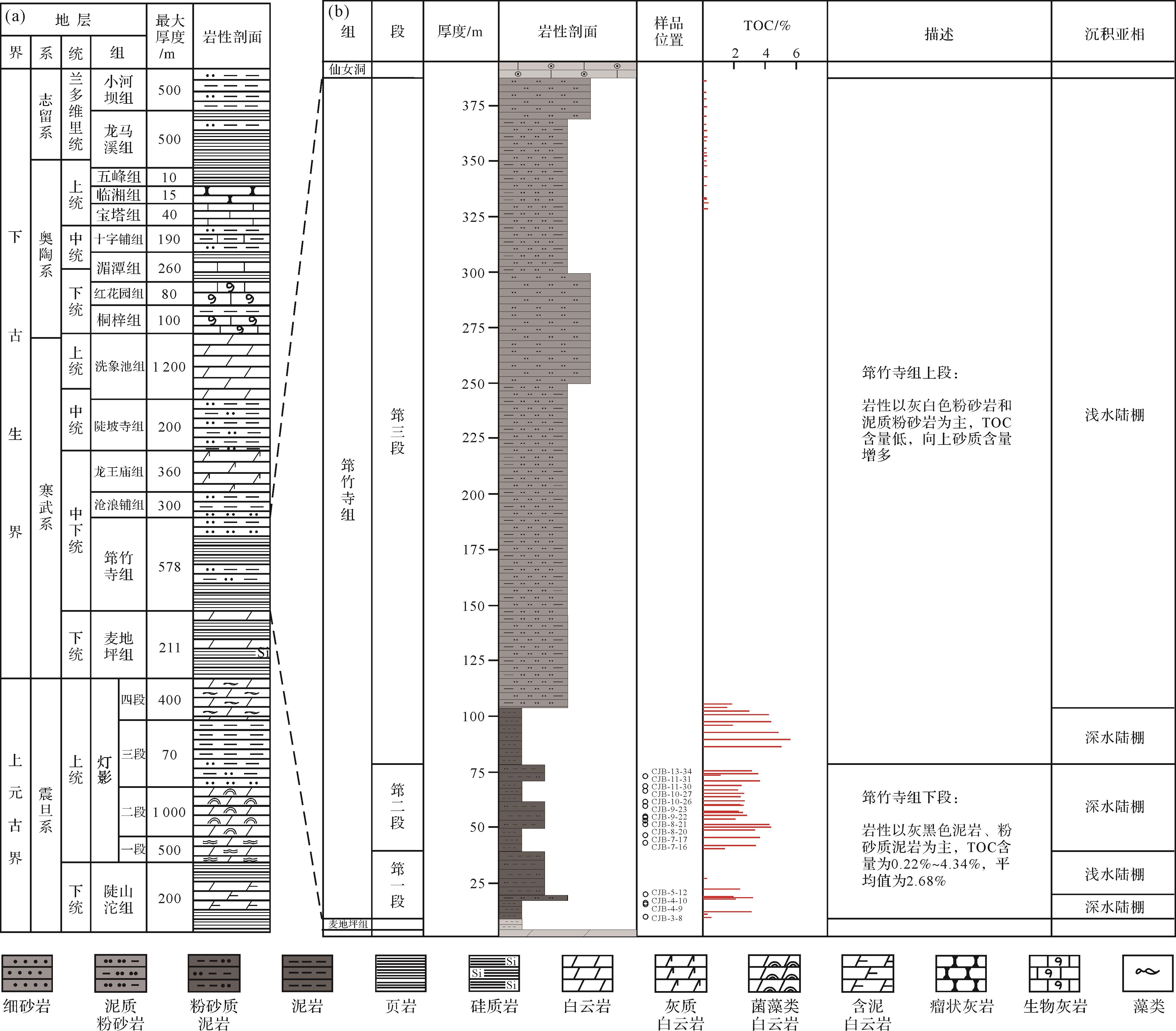
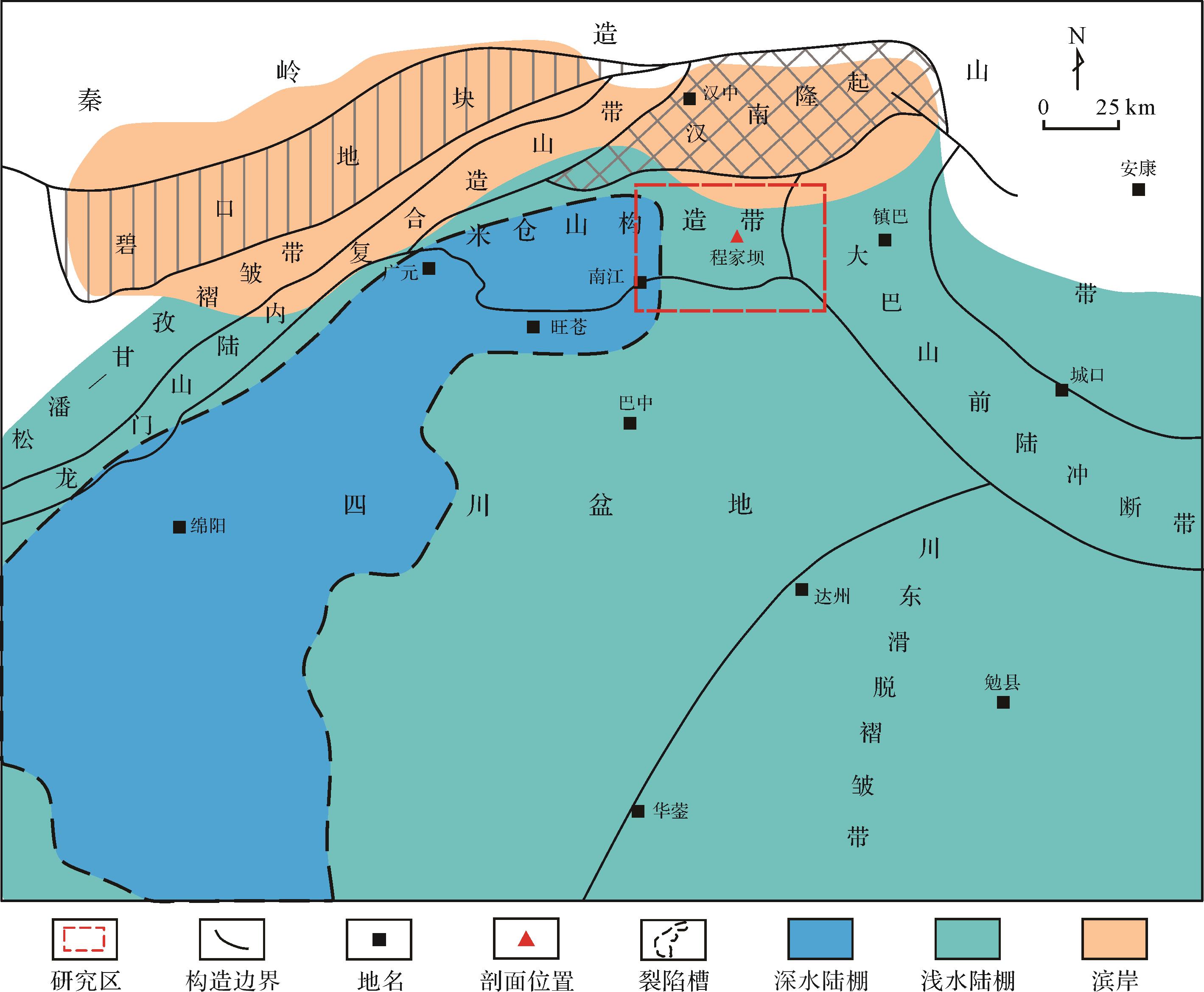
  • 研究区位于四川盆地北缘的米仓山构造带东部。米仓山构造带地处扬子板块北缘,北部与汉南隆起及东西向展布的秦岭造山带相接,南部毗邻四川盆地低缓变形区,东西两侧分别与大巴山前陆冲断带和龙门山陆内复合造山带相接(图1),是扬子板块与华北板块碰撞、拼接时形成的挤压推覆构造带(孙东,2011),构造走向整体呈EW向,并叠加NE向和NW向构造。川北地层发育较为齐全,仅缺失泥盆系与石炭系(鲁国,2021),且寒武系分布广泛、发育完整(图2a)。受中元古代末期岩浆活动以及新元古代末期裂陷槽形成的影响,四川地区在早寒武世时期继承了高低起伏的地貌(赵建华等,2019),与此同时,区域内发生大规模的海侵,开始了梅树村阶(麦地坪组)和筇竹寺阶(筇竹寺组)的沉积。另外,在晚震旦世一早寒武世发生的桐湾运动造成区域内寒武系筇竹寺组与下覆灯影组或麦地坪组呈不整合接触。川北地区筇竹寺组沉积厚度变化较大,厚度一般在200 m左右,部分地区可达500 m,岩性以深灰色泥页岩、灰色粉砂质泥岩及泥质粉砂岩为主。四川绵阳—长宁地区在晚震旦世—早寒武世发育大型拉张裂陷槽(杜金虎等,2016刘树根等,2016),研究区处于拉张槽边缘(燕继红等,2016),筇竹寺组沉积早期,海侵范围不断加大,广泛发育深水陆棚沉积;筇竹寺组沉积晚期,受海退和古陆影响,广泛发育浅水陆棚沉积。

    Figure 1.  Early Cambrian sedimentary facies and tectonic belt locations in the northern Sichuan Basin (modified from Gao, 2014; Li et al., 2022)

    Figure 2.  (a) Regional stratigraphic column of northern Sichuan Basin (modified from Zou et al., 2014; Zhu et al., 2019); (b) stratigraphic column of Chengjiaba section

    程家坝剖面位于陕西省汉中市南郑区大营村程家坝附近,起点坐标为107°14′26.41″ E,32°30′6.27″ N,见寒武系筇竹寺组顶、底,底部与寒武系麦地坪组泥岩呈不整合接触,顶部与寒武系仙女洞组鲕粒灰岩呈整合接触。该剖面筇竹寺组厚约371 m(图2b)。根据岩性变化、显微薄片观察和富有机质页岩分布等特征,可将筇竹寺组划分为三段:筇一段、筇二段、筇三段。筇一段形成于海侵阶段,地层厚度28 m,岩性以灰黑色粉砂质泥岩为主,硅质含量高,发育块状构造,总有机碳(Total Organic Carbon,TOC)含量较高,主要为深水陆棚沉积;筇二段形成时期海侵作用减弱,地层厚度40 m,岩性以灰黑色泥岩为主,粉砂质含量相对减少,发育水平层理,TOC含量高,为深水陆棚沉积;筇三段主要形成于海退阶段,地层厚度为303 m,以灰白色粉砂岩和泥质粉砂岩为主,TOC含量低,相较底部砂质成分增加,主要为浅水陆棚沉积。本文针对富有机质页岩段(筇一段、筇二段)展开研究。

  • 本次研究中筇竹寺组样品均采自川北地区程家坝剖面,共64块,采样间隔1~2 m,其中筇一段、筇二段27块,筇三段37块。将采集到的64块样品磨成粒径小于75 μm装入样品袋,送至成都达伟科技有限公司,进行TOC含量测定,另外,再选取筇一段、筇二段品质较好的15块样品,进行全岩矿物X射线衍射分析,主量、微量和稀土元素测试以及薄片鉴定。总有机碳含量测定,使用LECOCS-744碳硫分析仪,测试流程遵循国标GB/T 19145—2003《沉积岩中总有机碳的测定》,测试精度优于3%。全岩分析在中国石化石油勘探开发研究院无锡石油地质研究所实验研究中心完成,遵循标准《沉积岩中黏土矿物和常见非黏土矿物X射线衍射分析方法》(SY/T 5163—2018),使用D8 A25,X射线衍射仪(YQ2-20-05)。主量、微量和稀土元素分析在成都达伟科技有限公司完成,主量元素含量测定借助X射线荧光光谱仪(Axios-mAX),测试流程遵循国标《硅酸盐岩石化学分析方法第28部分:16个主次成分量测定》(GB/T 14506.28—2010),测试精度优于3%;微量和稀土含量测试使用电感耦合等离子体原子发射质谱仪(ICP-MS),测试流程遵循国标GB/T 14506.30—2010《硅酸盐岩石化学分析方法第30部分:44个元素量测定》,测试精度优于5%。岩石薄片鉴定在成都达伟科技有限公司完成,使用Axio偏光显微镜,标准为SY/T 5368—2016《岩石薄片鉴定》。

    为排除陆源碎屑组分对岩石自生组分的影响,常利用在成岩过程中稳定的Al元素对微量元素进行标准化,本文利用富集系数(EF)表示,公式为EFX=(X/Al)样品/(X/Al)UCC,式中EFX代表元素X的富集系数;UCC代表上地壳元素的标准值(McLennan,2001Tribovillard et al.,2006)。稀土元素数据采用后太古宙澳大利亚平均页岩(PAAS)进行标准化,异常值δCe、δEu和δPr分别通过δCe=CeN/(LaN×PrN1/2δEu=EuN/(SmN×GdN1/2δPr=PrN/(CeN×NdN1/2计算(McLennan,1989),式中下标N表示经PAAS标准化后的值。通常,利用化学蚀变指数(CIA)判断源岩风化程度和古气候特征(Nesbitt and Young,1982Panahi and Young,1997),公式为:

    CIA=100×n(Al2O3)/[n(Al2O3)+n(CaO*)+n(Na2O)+n(K2O)CIA] (1)

    式中:n代表摩尔分数;CaO*指硅酸盐中的CaO含量,CaO*=min[n(CaO)-10/3×n(P2O5),n(Na2O)];n(K2O)CIA为校正了成岩过程中K交代作用的K2O摩尔分数值,n(K2O)CIA=(K2O/Na2O)×n(Na2O)。

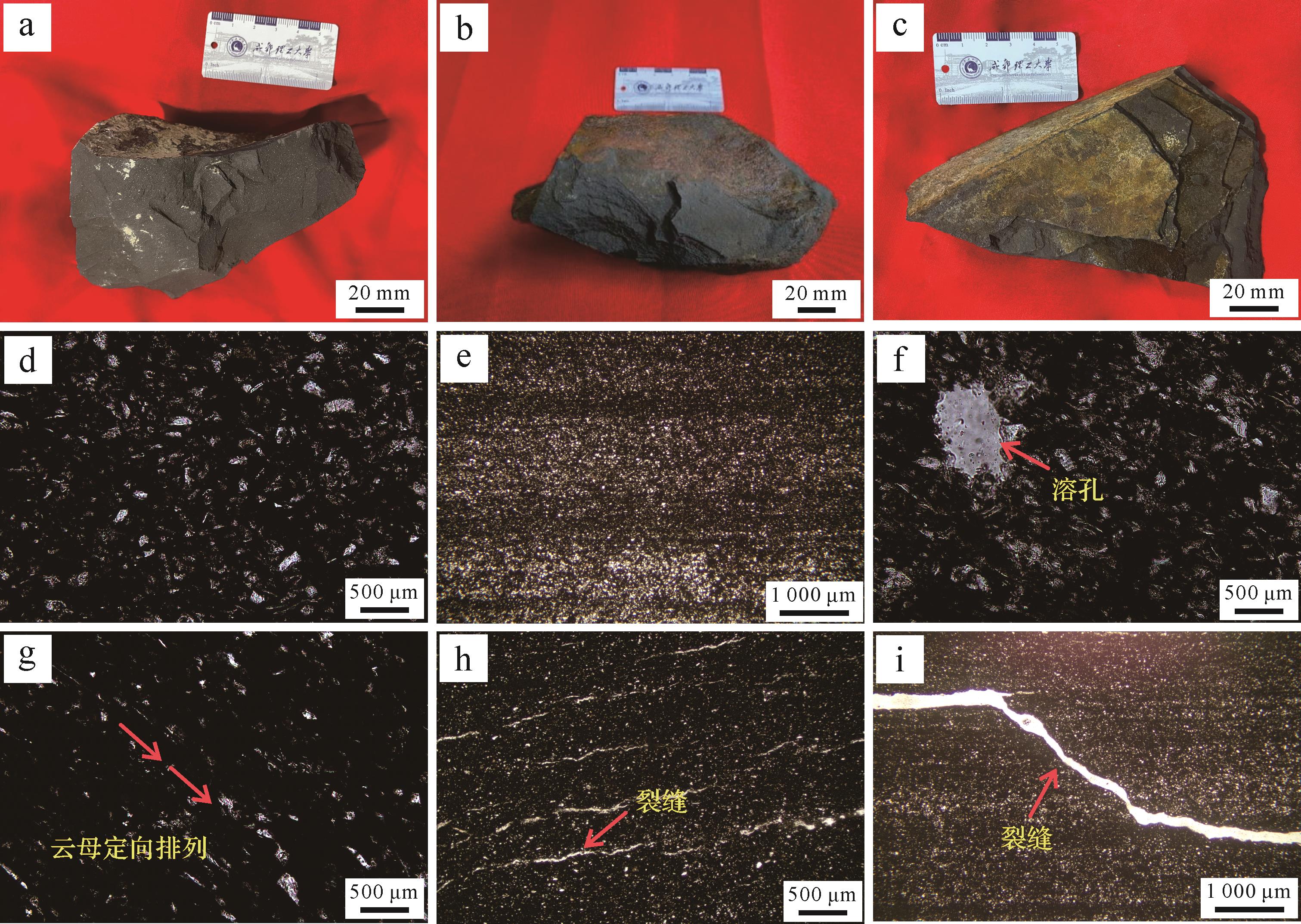
  • 川北地区寒武系筇竹寺组岩性以黑色和灰黑色页岩为主,碳质含量高,见块状构造和水平纹层构造(图3a~c)。镜下显微薄片观察显示,筇竹寺组页岩泥质含量高,主要包括泥级大小的脆性矿物和黏土矿物,砂质主要由石英和长石组成,呈均匀状分布(图3d),并且富有机质,具页理(图3e),还见溶孔、云母定向排列,断续裂缝和不规则裂缝(图3f~i)。

    Figure 3.  Shale hand specimens and photomicrographs of the Qiongzhusi Formation, Chingjiaba section

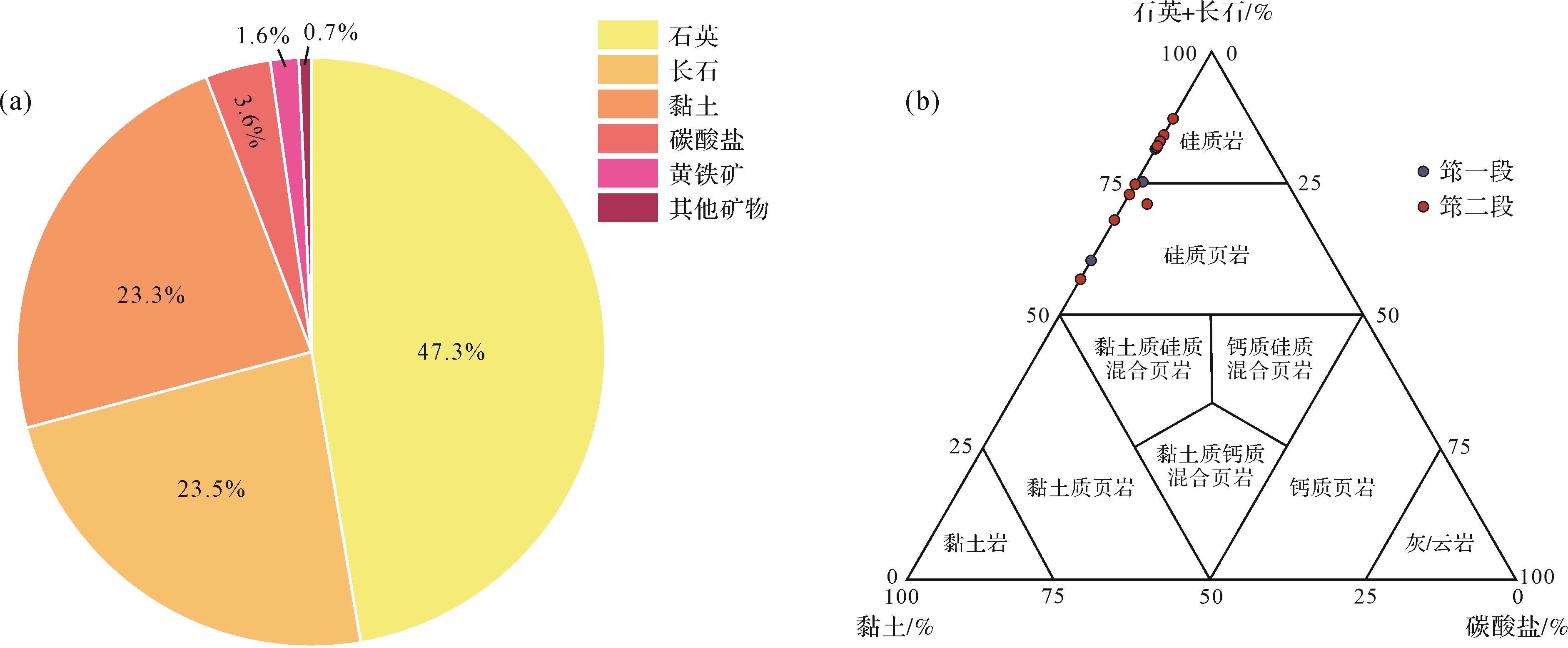
    全岩矿物X射线衍射分析表明,川北地区筇竹寺组页岩的矿物组分以石英、长石、黏土矿物为主,其次还有少量碳酸盐矿物、黄铁矿以及其他矿物(图4a)。石英含量介于41.0%~59.9%,平均为49.3%;长石含量介于11.7%~32.7%,平均为25.1%,主要成分为钾长石和斜长石;黏土矿物含量介于12.4%~43.0%,平均为23.3%;碳酸盐矿物含量介于1.0%~3.6%,平均为0.33%,主要成分为方解石和白云石;黄铁矿含量介于1.0%~5.8%,平均为1.5%。同时,根据硅质矿物(石英、长石)—碳酸盐矿物—黏土矿物三端元图对研究区页岩进行分类(图4b),发现筇竹寺组主要发育硅质岩相和硅质页岩相。

    Figure 4.  Plots of shale mineral composition ratio (a) and rock type division (b) in the Qiongzhusi Formation, Chengjiaba section(modified from Wang et al., 2016)

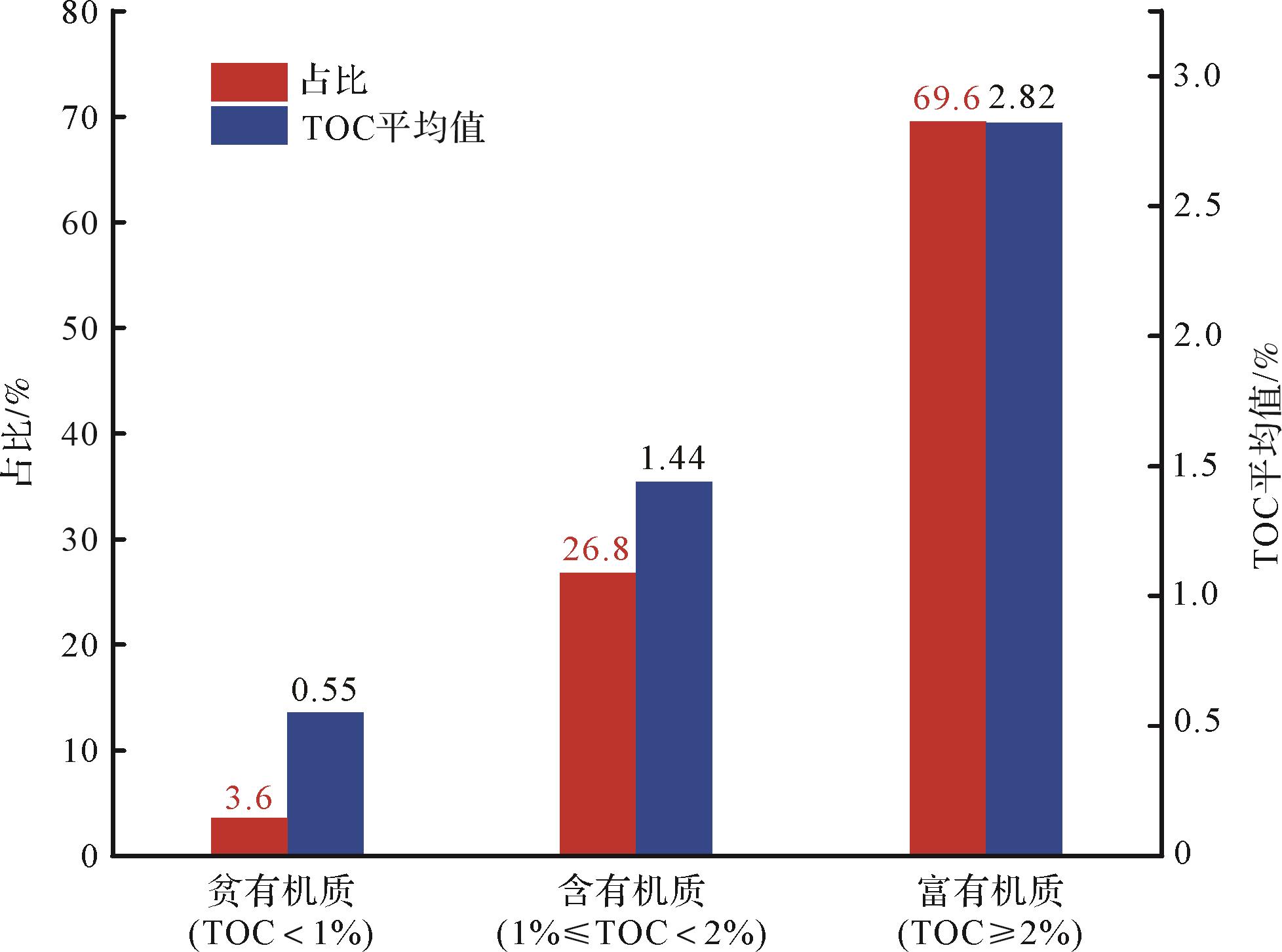
  • 总有机碳测试结果表明,川北地区筇竹寺组筇一段、筇二段页岩的TOC含量介于0.22%~4.34%,平均为2.68%。TOC含量小于1.0%的频数占比为3.6%,平均为0.55%;1.0%~2.0%的频数占比为26.8%,平均为1.44%;大于2.0%的频数占比为69.6%,平均为2.82%(图5)。因此,川北地区寒武系筇竹寺组页岩具有优质的烃源岩条件。

    Figure 5.  Shale TOC frequency distribution histogram of the Qiongzhusi Formation, Chengjiaba section

  • 川北地区筇竹寺组样品的主量元素主要由SiO2、Al2O3、Fe2O3和K2O组成。SiO2平均值为65.31%,Al2O3平均值为16.32%,TFe2O3平均值为3.50%,K2O平均值为3.62%,其他主量元素的平均含量由高到低依次为:Na2O、MgO、CaO、TiO2、P2O5、MnO,其平均值分别为2.11%,1.33%,1.05%,0.77%,0.15%,0.02%(表1)。

    样品号厚度/mTOC/%氧化物含量/%CIASibio/%元素含量比
    SiO2TFe2O3Al2O3CaOK2OMgONa2OTiO2P2O5MnOFe/Ti(Fe+Mn)/Ti
    CJB-3-89.73.0861.010.7414.220.764.210.821.0940.7260.0100.00584.8813.801.021.03
    CJB-4-915.42.0565.610.9417.310.834.321.031.7570.7790.0090.00781.678.141.211.22
    CJB-4-1016.03.1861.860.9016.220.674.070.991.6700.7410.0190.00681.928.011.211.22
    CJB-5-1219.92.3468.691.2517.870.774.211.031.9830.8180.0220.00780.839.361.531.54
    CJB-7-1643.13.6166.264.4217.641.043.841.532.3380.8600.1990.02277.267.705.145.17
    CJB-7-1746.53.3064.405.2418.271.183.821.832.5230.8650.2060.02976.433.746.066.09
    CJB-8-2051.42.0468.992.9514.860.973.170.862.4950.7830.2150.02273.1219.653.773.80
    CJB-8-2153.12.7861.114.9117.411.283.451.32.5510.8280.2420.02875.193.315.935.96
    CJB-9-2254.42.5265.012.8517.541.003.790.992.8210.9220.1910.01274.126.783.093.10
    CJB-9-2354.92.2465.514.5516.281.113.411.362.4420.8140.2300.01974.9711.465.595.61
    CJB-10-2659.62.6264.815.7215.601.123.261.372.2690.7140.2110.02375.3713.028.018.04
    CJB-10-2761.52.3772.343.9313.741.182.821.262.2050.6510.1630.02473.3026.726.046.07
    CJB-11-3066.52.4263.694.6016.021.163.351.881.7410.6510.1830.03379.7110.507.077.12
    CJB-11-3168.63.6162.664.9616.351.573.431.82.0580.7320.1970.02776.838.386.786.81
    CJB-13-3473.13.0967.714.6015.531.153.171.831.7430.6580.1850.02779.2116.156.997.03
    平均值/2.7565.313.5016.321.053.621.332.1100.7700.1500.01977.6511.114.634.65

    Table 1.  Major elements in Qiongzhusi Formation shale, Chengjiaba section

    沉积物中的Al、Ti元素主要赋存于陆源碎屑的黏土矿物或重矿物中,且受后期成岩作用影响较小(Tribovillard et al.,2006)。研究区页岩层系样品中Al2O3与Ti2O3呈较好的正相关性(R2=0.75),此外,Al2O3、Ti2O3的平均含量接近于上地壳(UCC)的Al2O3(18.9%)、Ti2O3(1.0%)和后太古宙澳大利亚平均页岩(PAAS)的Al2O3(15.2%)、Ti2O3(0.5%),说明陆源碎屑为研究区的主要沉积来源。

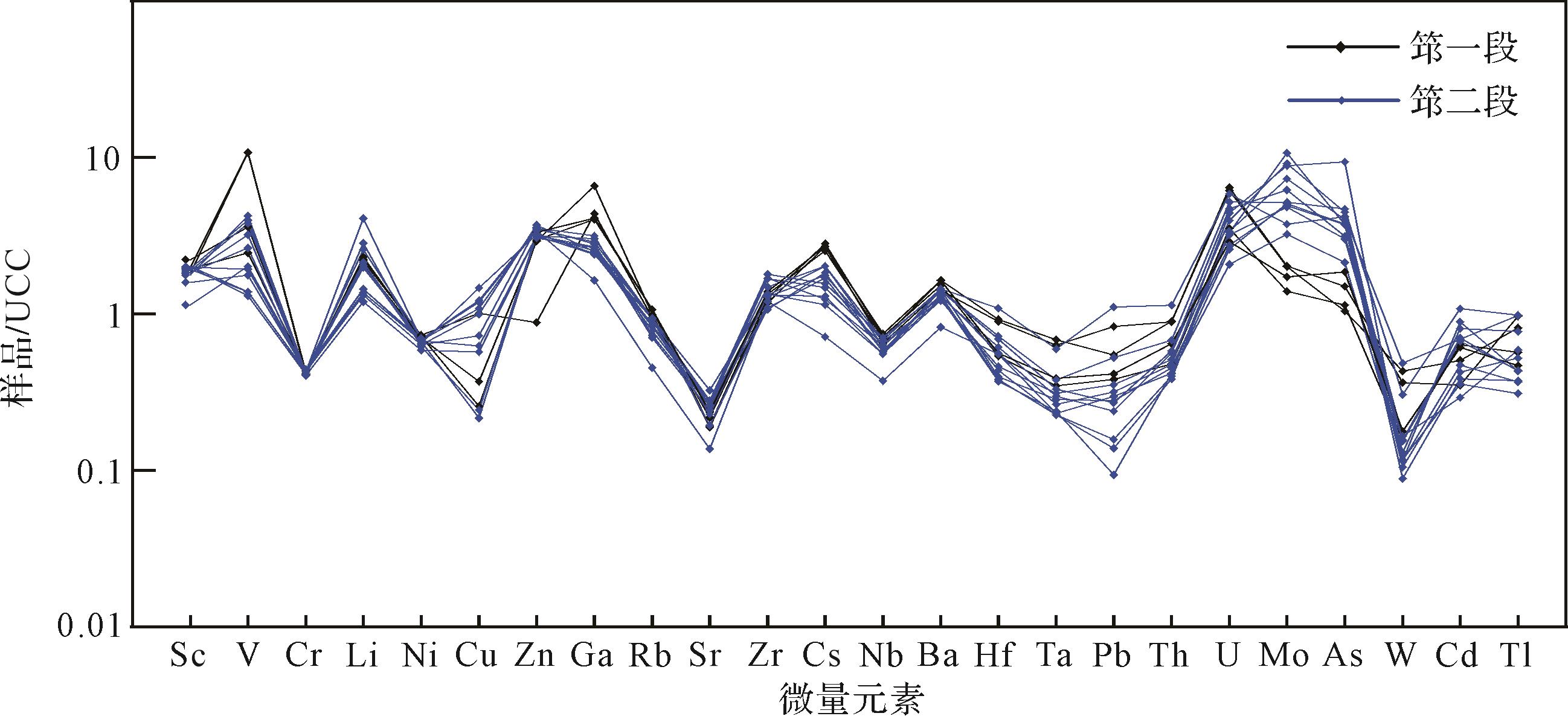
  • 富集系数可以反映沉积岩中元素的富集程度,结果显示(图6),研究区筇一段页岩中的元素V(EF=6.92)、U(EF=4.75)、Zn(EF=2.53)、Sc(EF=2.00)、Mo(EF=1.79)、Ba(EF=1.56)呈现相对富集,元素Th(EF=0.73)、Ni(EF=0.72)、Cr(EF=0.42)、Cu(EF=0.41)、Sr(EF=0.19)呈不同程度的亏损。筇二段页岩中的元素Mo(EF=6.30)、U(EF=3.77)、Zn(EF=3.34)、V(EF=2.52)、Sc(EF=1.82)、Ba(EF=1.29)呈现相对富集,元素Cu(EF=0.76)、Ni(EF=0.66)、Th(EF=0.55)、Cr(EF=0.42)、(EF=0.22)呈不同程度的亏损。整体上,筇竹寺组U、V、Mo、Ba、Zn、Sc呈富集,可能与有机质或黏土矿物伴生,Th、Ni、Cr、Cu、Sr呈亏损。

    Figure 6.  Shale trace elements spider diagram of the Qiongzhusi Formation, Chengjiaba section

  • 稀土元素测试结果显示(表2),研究区筇竹寺组页岩∑REE含量介于53.61~120.45 μg/g(平均为74.67 μg/g),远低于太古宙澳大利亚平均页岩(183.0 μg/g)、上地壳(146.4 μg/g)以及北美页岩(173.2 μg/g)中的∑REE。筇一段、筇二段∑LREE含量分别介于64.8~86.24 μg/g(平均为76.69 μg/g)和47.59~107.92 μg/g(平均为64.92 μg/g),∑HREE含量分别介于5.16~8.73 μg/g(平均为7.07 μg/g)和4.61~12.53 μg/g(平均为6.45 μg/g),∑LREE/∑HREE的平均值分别为11.04和10.35,指示轻稀土富集。

    样品号稀土元素含量/ μg/g∑LREE/∑HREEδCeδPrδEu(La/Yb)N
    LaCePrNdSmEuGdTbDyHoErTmYbLu∑REE∑LREE∑HREE
    CJB-3-827.8833.923.9913.521.800.502.170.281.820.401.390.201.470.1889.5281.617.9110.320.741.101.191.40
    CJB-4-930.3221.242.508.921.460.361.450.191.200.280.880.140.880.1469.9664.805.1612.560.561.071.172.54
    CJB-4-1027.3336.044.2415.452.460.722.520.332.040.441.470.241.440.2594.9786.248.739.880.771.061.361.40
    CJB-5-1234.0824.042.9410.711.920.411.840.251.630.351.040.161.040.1880.5974.106.4911.420.551.081.032.42
    CJB-7-1629.5215.121.796.921.230.261.420.201.220.260.750.120.780.1159.7054.844.8611.280.481.030.932.79
    CJB-7-1733.4844.405.2820.283.680.803.910.513.000.691.890.291.940.30120.45107.9212.538.610.771.040.991.27
    CJB-8-2019.0016.682.008.001.580.331.890.261.490.320.950.130.860.1253.6147.596.027.910.621.021.901.63
    CJB-8-2129.0218.782.248.431.650.371.730.251.500.320.950.150.970.1466.5060.496.0110.060.541.051.032.21
    CJB-9-2232.4423.42.7910.161.700.361.760.251.540.351.030.171.120.1677.2370.856.3811.110.571.060.982.14
    CJB-9-2331.2521.612.589.841.770.381.840.241.490.310.960.150.940.1573.5167.436.0811.090.561.040.992.45
    CJB-10-2625.5615.961.907.001.140.271.280.181.060.250.780.130.810.1256.4451.834.6111.240.531.061.052.33
    CJB-10-2724.6425.203.0411.322.130.482.420.311.980.421.230.211.360.2174.9566.818.148.210.671.061.001.34
    CJB-11-3028.4616.961.967.421.320.281.440.201.270.280.800.130.800.1261.4456.405.0411.190.521.030.962.63
    CJB-11-3132.0021.602.479.361.580.331.700.221.370.310.920.151.030.1673.2067.345.8611.490.561.020.952.29
    CJB-13-3430.1619.922.348.481.360.351.540.201.320.280.860.130.920.1468.0062.615.3911.620.551.061.142.42
    平均值29.0123.662.8010.391.790.411.930.261.600.351.060.171.090.1774.6768.066.6110.530.601.051.042.08
    注:∑REE=La+Ce+Pr+Nd+Sm+Eu+Gd+Tb+Dy+Ho+Er+Tm+Yb+Lu;∑LREE=La+Ce+Pr+Nd+Sm+Eu;∑HREE= Gd+Tb+Dy+Ho+Er+Tm+Yb+Lu;下标N表示经PAAS标准化后的值。

    Table 2.  Rare earth elements analysis for the Qiongzhusi Formation shale, Chengjiaba section

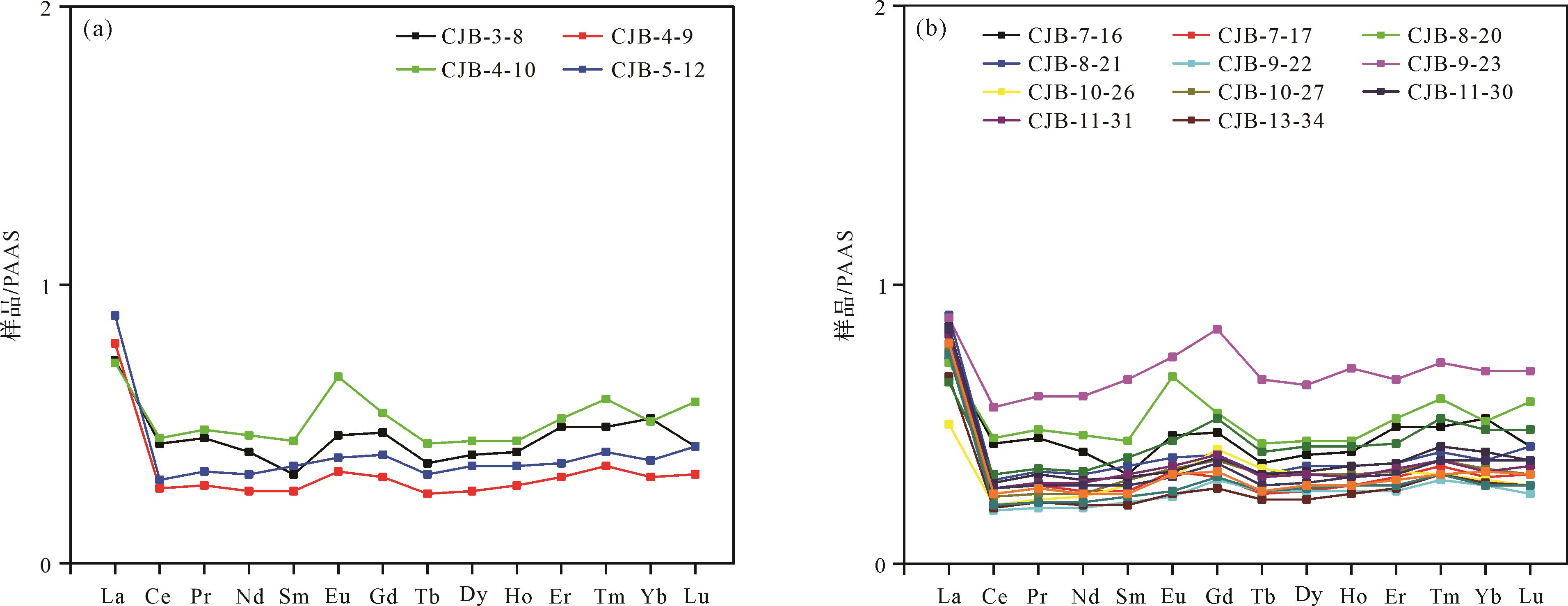
    (La/Yb)N是稀土元素标准化图解中分布的曲线斜率,当(La/Yb)N>1时,表示曲线右倾,轻稀土元素富集。(La/Sm)N、(Gd/Yb)N分别反映轻重稀土元素的分馏程度,该值越大,表示分馏程度越高。稀土元素特征值计算结果表明,筇一段、筇二段(La/Yb)N值分别为1.40~2.54(平均为1.94)和1.27~2.79(平均为2.14),(La/Sm)N值分别为1.61~3.02(平均为2.37)和1.32~3.49(平均为2.61),(Gd/Yb)N值分别为0.89~1.07(平均为1.01)和0.95~1.33(平均为1.09)。结合稀土元素配分模式图(图7),轻稀土段元素明显右倾,重稀土段元素较为平坦,可以看出筇竹寺组页岩轻稀土富集,且轻稀土元素之间分馏程度高,重稀土元素之间分馏程度低。筇一段、筇二段δCe的值分别为0.55~0.77(平均为0.66)、0.48~0.77(平均为0.58),δEu平均值分别为1.03~1.36(平均为1.19)、0.93~1.14(平均为0.99),表明Ce筇一段、筇二段呈现明显负异常,Eu在筇一段存在微弱的正异常,在筇二段无明显异常。

    Figure 7.  Rare earth elements distribution of shale in the Qiongzhusi Formation, Chengjiaba section

  • 研究表明,沉积速率与TOC具有一定关系,当沉积速率过低时,有机质与氧气接触时间变长,易被氧化分解,从而导致TOC含量降低。但沉积速率也并不是越高越有利,这是因为过快的沉积速率会带来大量的碎屑颗粒,有机质遭受强烈的稀释作用同样会导致TOC含量降低(Ibach,1982Ding et al.,2018)。因此,适当的沉积速率是有机质富集的关键因素之一。

    稀土元素的配分模式和分异程度指标(La/Yb)N可用于反映沉积速率(Cao et al.,2018),当沉积速率较高时,稀土元素与悬浮颗粒接触时间短,导致分异程度弱,表现为(La/Yb)N值接近1.0;当沉积速率较低时,悬浮颗粒在水体中停留时间长,轻稀土元素被有机质和黏土矿物吸附,导致稀土元素分异程度强,表现为(La/Yb)N值远离1.0(Murray et al.,1991Doner et al.,2019)。研究区筇竹寺组页岩稀土元素配分曲线呈右倾状,(La/Yb)N介于1.27~2.79,平均为2.08,说明沉积速率整体较高,有利于页岩有机质的富集。

  • 古气候条件对母岩风化、沉积物组成以及海洋活动和生物种群等有着重要影响(张水昌等,2005)。古气候条件的变化带来不同的母岩风化程度,进而影响沉积物中的矿物组分,岩石的化学成分呈现出不同的特征,因此,常通过沉积岩中化学成分的变化判断沉积时期的古气候条件。在地表强烈的风化条件下,Al和Ti等移动性较小的元素相对富集,而K、Ca和Na等不稳定元素往往缺乏,这些元素的组合反映出化学风化作用的强弱,对此,Nesbitt and Young(1982)提出了CIA指数(公式见上文)。古气候属于温暖潮湿型时,大气水循环加速,进而母岩风化强度增加,营养物质流向海洋、湖泊。陆源输入会促进沉积水体中微生物的繁殖,减少底层水体氧分含量,使有机质更好地富集和保存。前人研究表明,CIA指数在介于50~65、65~85、85~100时,分别指示微弱、中等、强烈的化学风化作用,对应的古气候分别为寒冷干燥型、温暖湿润型、高温潮湿型。根据研究区样品测试数据,筇竹寺组校正后的CIA值介于73.12~84.88(平均为77.65),表明研究区筇竹寺组沉积时期母岩受温暖湿润条件下的中等化学风化作用。

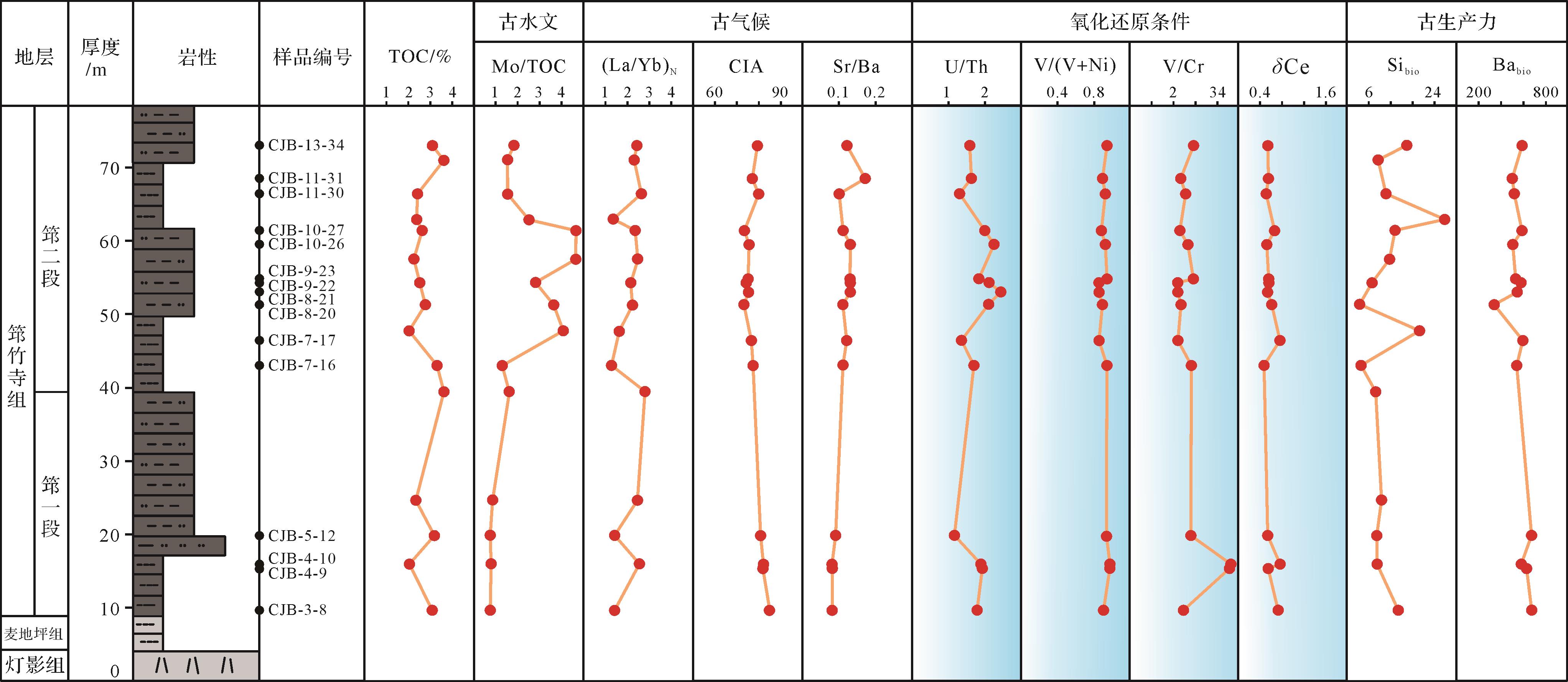
    元素Sr和元素Ba化学性质相似,可以形成硫酸盐和碳酸盐等溶解于水体中。当陆源物质输入海水,Sr2+和Ba2+与SO42-结合形成SrSO4和BaSO4,由于BaSO4溶解度小,故而首先沉淀,SrSO4则继续迁移,随着海水盐度的增高逐渐沉淀(张美洲等,2023)。因此,沉积物中Sr/Ba比值可以很好地判别沉积水体盐度,前人研究表明,Sr/Ba值小于0.5指示沉积水体为淡水环境,介于0.5~1.0指示半咸水环境,大于1.0指示咸水环境(于乐丹等,2024)。研究区筇一段、筇二段Sr/Ba的值分别为0.08~0.09(平均为0.09)和0.09~0.17(平均为0.12),远小于半咸水的临界值,表明筇竹寺组整体发育于淡水沉积环境。从柱状图上看(图8),筇竹寺组Sr/Ba值、CIA值波动较小,表明筇竹寺组沉积时期的古气候较为稳定,有利于有机质的富集。

    Figure 8.  Redox indices and sedimentary environment in the Qiongzhusi Formation, Chengjiaba section

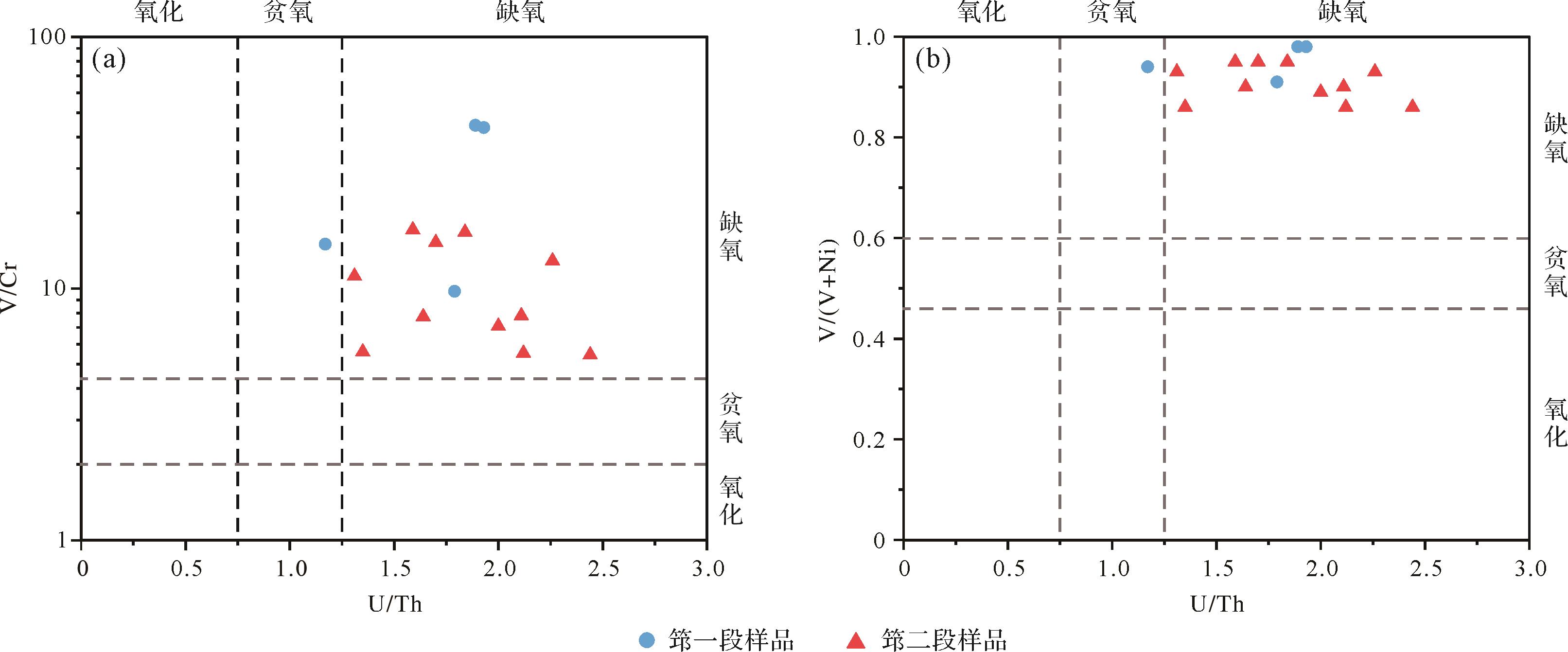
  • 元素U、V、Mo、Ni、Cr、Th以及元素Ce随水体中氧含量的变化呈现不同的富集程度,因此,这些敏感元素常用来指示沉积水体的氧化还原条件(Algeo and Maynard,2004)。相比于单独元素含量,元素比值反映沉积水体的氧化还原条件更为准确,其中,U/Th、V/(V+Ni)、V/Cr等特征值被广泛应用(曾雄伟等,2014何庆等,2021刘慧萍等,2024)。前人研究表明,缺氧环境下U/Th>1.25、V/(V+Ni)>0.6、V/Cr>4.25;还原程度较弱的贫氧环境下0.75<U/Th<1.25、0.46<V/(V+Ni)<0.6、2.00<V/Cr<4.25;氧含量较高的氧化环境下U/Th<0.75、V/(V+Ni)<0.46、V/Cr<2.00。研究区筇一段U/Th、V/(V+Ni)、V/Cr比值分别为1.17~1.93,0.91~0.98,9.75~44.52,平均值分别为1.69,0.95,28.22;筇二段U/Th、V/(V+Ni)、V/Cr比值分别为1.31~2.44,0.86~0.95,5.45~17.11,平均值分别为1.85,0.9,10.22,指示筇一段、筇二段的沉积水体均处于缺氧环境(图9)。

    Figure 9.  Intersection diagrams of shale trace elements values in the Qiongzhusi Formation, Chengjiaba section(modified from Ding et al., 2021)

    为降低氧化还原敏感元素比值的判别误差,应通过多项地球化学指标进行综合分析,元素Ce的异常值(δCe)通常用于氧化还原条件和海平面升降的判别(Cao et al.,2012)。沉积水体中较高的氧含量,会促使Ce3+转变为Ce4+,不同价态的Ce在水中的溶解度有所差别,一般Ce4+溶解度小,从而导致沉积物中Ce的富集。因此,当沉积水体为缺氧环境时,元素Ce主要以Ce3+形式存在,富集于水体中,导致沉积物中Ce的亏损(Shields and Stille,2001)。沉积物中Ce正异常(δCe>1)反映沉积水体富氧的氧化环境,Ce负异常(δCe<1)反映沉积水体厌氧的还原环境。值得注意的是,La元素的异常富集也会在一定程度上造成海水Ce的异常,进而影响Ce的过度计算(Bau and Dulski,1996)。基于Pr、Nd在地球化学行为上无明显相关性的前提下,δPr值(公式见上文)表明,真实的Ce负异常必然会使δPr>1,Ce正异常必然会使δPr<1。研究区筇竹寺组筇一段、筇二段δPr的平均值分别为1.07、1.04,δCe的平均值分别为0.66、0.58,表明研究区Ce异常值可以真实反映原始海洋的沉积特征,筇竹寺组的沉积水体属于厌氧的还原环境。

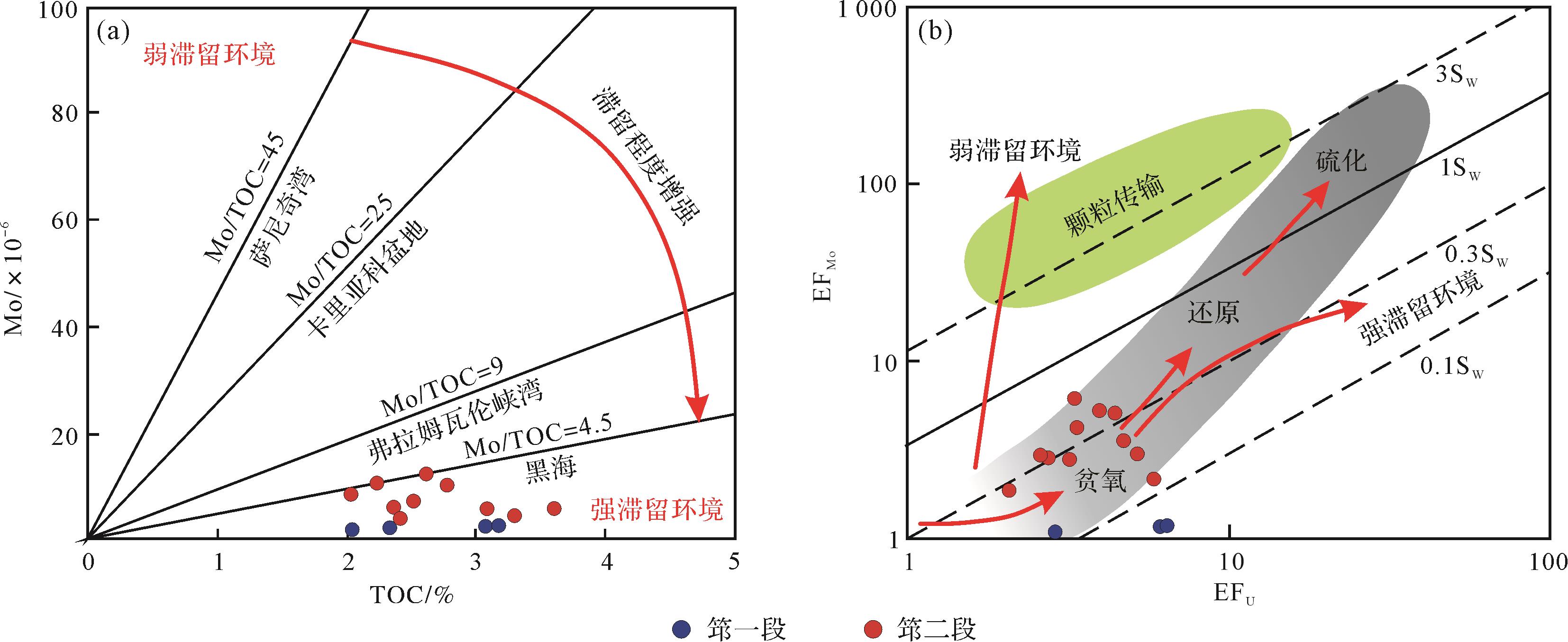
    滞留程度与构造运动密切相关,进而影响有机质的富集,氧化还原条件反映沉积水体对有机质分解作用的强弱,从而影响有机质的保存,一般局限水体(强滞留环境)和还原环境更有利于有机质的富集和保存(Algeo and Lyons,2006)。元素Mo一般仅在缺氧水体中富集,并可与TOC含量协同反映沉积水体的滞留程度,用Mo-TOC协变模式判别(Algeo and Lyons,2006)。通常,滞留程度越弱的沉积水体中元素Mo的补充越充足,沉积物中的Mo/TOC比值就越高(Algeo and Lyons,2006何龙,2020),在Mo-TOC协变模式中表现为,滞留程度随着Mo/TOC比值的减小而增强。通过氧化还原敏感元素比值以及Ce异常值,已判断研究区筇竹寺组在缺氧环境中沉积,计算Mo/TOC的值介于0.72~4.61,平均为2.19,指示研究区整体处于强滞留环境(图10a)。其中,筇一段平均值为0.77,筇二段平均值为2.71,表明筇一段水体的滞留程度强于筇二段。另外,在缺氧水体中,元素Mo与U均易富集,沉积物中Mo与U的富集关系不仅可以反映水体滞留程度,还可以反映缺氧水体的还原程度,常用EFMo-EFU协变模式判别(Algeo and Tribovillard,2009黄正清等,2020)。在缺氧的弱滞留环境,元素Mo比U富集速率更高,表现为EFMo/EFU为正常海水(1Sw)的3~10倍;在缺氧的强滞留环境,元素Mo与U的富集速率相对较低,且水体中Mo的消耗速率大于U,表现为EFMo/EFU为正常海水的1倍以下(何龙,2020)。研究区筇竹寺组页岩EFMo/EFU的比值主要落于贫氧—还原区域,且筇一段集中在0.1倍Sw左右,筇二段均匀分布于0.1倍Sw和1倍Sw之间(图10b),表明筇竹寺组沉积于缺氧的强滞留环境,筇一段滞留程度强于筇二段,与Mo-TOC协变模式判别结果一致。

    Figure 10.  Covariation models of shale samples in the Qiongzhusi Formation, Chengjiaba section (modified from Algeo and Tribovillard, 2009)

    综上所述,研究区筇竹寺组页岩沉积水体滞留程度强,且属于缺氧的还原环境,是有机质富集和保存的理想场所。

  • 较高的海洋生产力是沉积物中有机质富集的首要条件。海洋的生产力水平与生物活动息息相关,当水体中营养供给充足时,动植物大量繁殖,生物活动旺盛,光合作用强烈,生物生产力较高。Ba、P、Si等元素与生物化学作用密切相关,是指示海洋生产力常用的地球化学指标,不过沉积物中的Ba和Si有多种来源,只有生物钡(Babio)、生物硅(Sibio)才能反映古生产力的大小(Schoepfer et al.,2015)。一般认为,Babio介于200~1 000 μg/g时,沉积环境中具有较高的生产力;Sibio的含量与海洋生产力呈正相关,Sibio含量越高,古生产力越高(刘慧萍等,2024熊亮等,2024)。

    非生物成因的Ba元素主要来源于陆源碎屑,以及Fe、Mn氧化物或氢氧化物中,一般只占沉积物中Ba含量的一小部分,而生物成因的Ba元素主要来源于生物成因的重晶石,包括腐烂的浮游植物有机质和生物骨架(Eagle et al.,2003)。沉积物中Babio含量的计算公式为:Babio=Ba样品-Al样品×(Ba/Al)PAASDong et al.,2018),其中“样品”表示该元素在样品中的总含量,PAAS为澳大利亚后太古宙平均页岩的元素值。计算结果显示研究区筇竹寺组筇一段Babio含量介于586.22~679.95 μg/g(平均为644.12 μg/g),筇二段Babio含量介于341.28~599.94 μg/g(平均为532.93 μg/g),指示筇竹寺组沉积时期的古海洋具有较高的初级生产力,且筇一段的古生产力高于筇二段。

    Si元素来源较为广泛,主要包括陆源输入、海底热液硅质输入以及生物硅(Sibio),Sibio来源于硅藻、放射虫等海洋生物。通常判别沉积物是否受海底热液流体活动的影响的指标为元素Fe/Ti和(Fe+Mn)/Ti值,前人研究表明,当Fe/Ti>20±5或(Fe+Mn)/Ti>20±5时,认为沉积物受热液流体的影响(储呈林等,2016)。研究区筇竹寺组筇一段Fe/Ti和(Fe+Mn)/Ti平均值分别为1.24、1.25,筇二段Fe/Ti和(Fe+Mn)/Ti平均值分别为5.86、5.90,指示筇竹寺组页岩的硅质并非来自热液活动。在排除热液活动的影响之后,沉积物中Sibio含量的计算公式为:Sibio=Si样品-Al样品×(Si/Al)PAASDong et al.,2018),其中“样品”表示该元素在样品中的总含量,PAAS为澳大利亚后太古宙平均页岩的元素值。结果显示,研究区筇竹寺组筇一段Sibio含量介于8.01%~13.80%(平均为9.8%),筇二段Sibio含量介于3.31%~26.72%(平均为11.58%)。总体而言,川北地区筇竹寺组页岩沉积时期具有较高的古生产力。

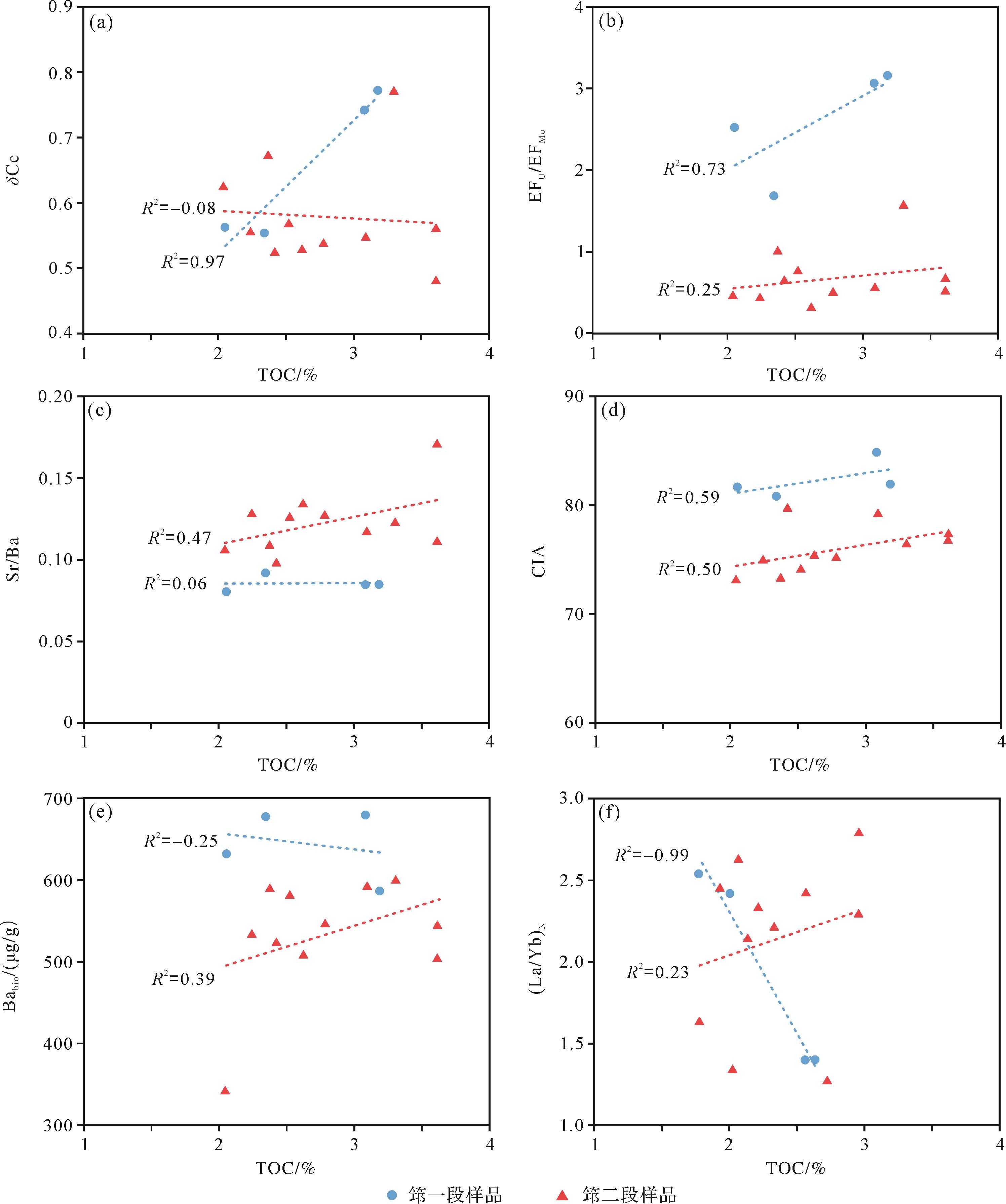
  • 海相页岩的有机质富集受控于古海洋沉积环境,一般古海洋生产力水平控制着沉积物中有机质的富集,水体的氧化还原条件控制着沉积物中有机质的保存,对此,前人提出两种有机质富集模式,即生产力模式和保存模式(丁江辉等,2019)。在实际的有机质富集过程中,陆源输入、沉积速率、水体盐度等因素也或多或少地影响有机质的富集。结合前文古气候、氧化还原、沉积速率、古生产力等判别指标,利用TOC含量代表有机质富集程度,以相关性程度判断影响川北地区筇竹寺组页岩有机质富集的因素。结果显示(图11),筇一段页岩样品,TOC与δCe和EFU/EFMo具有很好的相关性(R2=0.97和R2=0.73),与(La/Yb)N具有很强的负相关性(R2=-0.99),与CIA和Sr/Ba呈中等相关性(R2=0.59和R2=0.47),表明氧化还原条件和沉积速率对筇一段有机质的富集具有较强的控制作用;筇二段页岩样品,TOC与CIA和Sr/Ba呈中等相关性(R2=0.50和R2=0.47),与Babio、EFU/EFMo和(La/Yb)N呈较弱相关性(R2=0.39、R2=0.25和R2=0.23),表明筇二段有机质的富集与多种因素相关。由此认为,川北地区筇竹寺组富有机质页岩的形成,在筇一段沉积期主要受控于缺氧的沉积环境和较高沉积速率的水体条件,属于有机质富集的保存模式;在筇二段沉积期受控于古气候、古海洋生产力、水体沉积速率和氧化还原条件等多种因素,属于有机质富集的“综合模式”。

    Figure 11.  Correlation between TOC and paleomarine environmental indicators in shale samples from the Qiongzhusi Formation, Chengjiaba section

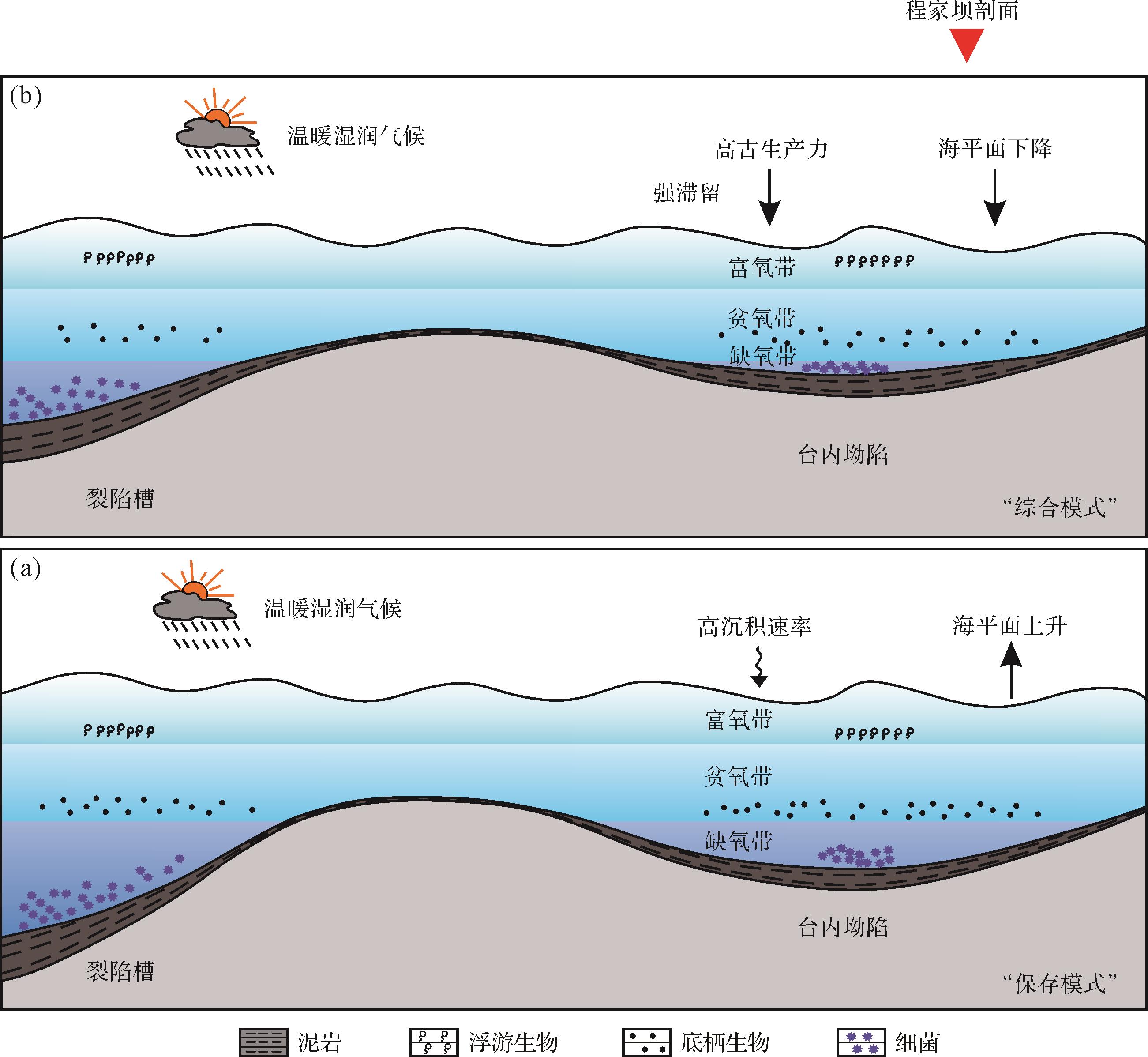
    川北地区筇竹寺组筇一段、筇二段沉积时期主要为海侵阶段,气候温暖湿润,沉积水体处于封闭缺氧的强滞留环境,沉积速率较高,生物活动频繁,有利于有机质的富集和保存。筇一段沉积时期,受拉张槽裂陷作用和海侵影响,海平面持续上升促使营养物质上升至表层水体,沉积水体生物生产力较高且处于厌氧的还原环境,有机质很好地富集并保存下来(图12a)。筇二段沉积时期,拉张槽裂陷作用减弱,沉积水体相对稳定,深度和滞留程度有所下降,研究区处于台内坳陷区域(张明何等,2024),仍然发育深水陆棚沉积,有着较高的生物生产力以及缺氧的沉积水体环境,有机质同样得到有效的富集和保存(图12b)。

    Figure 12.  Organic matter enrichment model for shale in the Qiongzhusi Formation, Chengjiaba section

  • (1) 程家坝剖面寒武系筇竹寺组筇一段、筇二段岩性主要为灰黑色—黑色泥岩和粉砂质泥岩,发育硅质岩相和硅质页岩相,发育水平纹层构造。主要为深水陆棚沉积,有机质含量高,TOC含量介于0.22%~4.34%,平均为2.68%,并且TOC大于2.0%的页岩占69.6%。

    (2) 川北地区筇竹寺组沉积时期气候温暖湿润且稳定,风化作用中等,沉积水体盐度低,沉积速率较高。筇一段沉积期,受海侵作用影响,盆地水体内生物活动频繁,古海洋生产力较高,沉积水体滞留程度强且处于厌氧的还原环境。筇二段沉积期,海平面有所下降,沉积水体滞留程度减弱,但研究区地处台内凹陷,发育深水陆棚沉积,仍然处于缺氧环境。

    (3) 研究区筇一段富有机质页岩的形成。主要受控于氧化还原条件和沉积速率因素,即有机质富集属于保存模式;筇二段是由古气候、古海洋生产力、水体沉积速率和氧化还原条件等多种因素协同控制,即有机质富集属于“综合模式”。

Reference (59)

Catalog

    /

    DownLoad:  Full-Size Img  PowerPoint
    Return
    Return