
Advanced Search
Volume 43 Issue 6
Dec.  2025
Turn off MathJax
Article Contents

PEI ZiXuan, HU YuZhao, XU SaiHua, ZHANG QiMeng. Evaluation and Sedimentary Environment Analysis of Ore-forming Elements in Wufeng Formation-Longmaxi Formation in Eastern Dianqianbei Depression: Evidence from kerogen trace elements[J]. Acta Sedimentologica Sinica, 2025, 43(6): 2264-2281. doi: 10.14027/j.issn.1000-0550.2023.127
Citation: PEI ZiXuan, HU YuZhao, XU SaiHua, ZHANG QiMeng. Evaluation and Sedimentary Environment Analysis of Ore-forming Elements in Wufeng Formation-Longmaxi Formation in Eastern Dianqianbei Depression: Evidence from kerogen trace elements[J]. Acta Sedimentologica Sinica, 2025, 43(6): 2264-2281. doi: 10.14027/j.issn.1000-0550.2023.127

Evaluation and Sedimentary Environment Analysis of Ore-forming Elements in Wufeng Formation-Longmaxi Formation in Eastern Dianqianbei Depression: Evidence from kerogen trace elements

doi: 10.14027/j.issn.1000-0550.2023.127
  • Received Date: 2023-09-20
  • Accepted Date: 2024-01-03
  • Rev Recd Date: 2023-11-21
  • Available Online: 2024-01-03
  • Publish Date: 2025-12-10
  • Objective The Dianqianbei Depression is not only an important exploration and producing area of marine shale gas in southern China, but also an important large-super large Mississippi Valley (MVT) type lead-zinc metallogenic area associated with key metals in China. Asphalt or ancient reservoirs with high Pb and Zn contents are constantly found in lead-zinc deposits. It is of great significance to explore the distribution characteristics of trace elements in black shale kerogen in the study area for lead-zinc prospecting. Methods Taking the black shale outcrops in Dashiban, Liangfengao and Maoba areas in the eastern part of the Dianqianbei Depression as the research object, the kerogen in black shale was pretreated by microwave digestion method, and the trace elements in black shale and kerogen were analyzed and tested in combination with petrographic and mineralographic observation. The material contribution of mineralization and the sedimentary environment of black shale were studied by the geochemical characteristics of elements in black shale kerogen. Results The whole rock Pb, Zn, Cd, Bi, Sb, V, Cr, and Ni contents are higher than those in kerogen, and the contents of Ag, Ge, U and Th in kerogen are higher than those in whole rock. The light rare earth is relatively enriched and the heavy rare earth is relatively depleted in the whole rock and kerogen. Eu and part of Ce in the whole rock show weak negative anomalies. The kerogen shows strong Ce and Eu weak negative anomalies, and the total rare earth content is higher than that of the whole rock.Three redox indicators (U/Th, Ni/Co, and V/Cr ) in the kerogen of the Wufeng Formation-Longmaxi Formation showed that the Wufeng Formation was oxygen-poor-anoxic, and the Longmaxi Formation was oxygen-rich-oxygen-poor; the ancient water depth calculated by Co element in the study area is 6.85-54.37 m. The paleoclimate reflected by Sr/Cu is warm and humid, and the Sr/Ba value is less than 0.5, representing the sedimentary environment of brackish water. Furthermore, the Wufeng Formation has greater paleoproductivity than the Longmaxi Formation. Conclusions Wufeng Formation-Longmaxi Formation in the study area are an oxygen-rich-oxygen-poor turbulent sedimentary environment, with a warm and humid climate of brackish water shallow shelf facies sedimentary characteristics. The trace elements in the black shale kerogen can provide a basis for the evaluation of regional prospecting areas.
  • [1] Fan J X, Peng P A, Melchin M J. Carbon isotopes and event stratigraphy near the Ordovician–Silurian boundary, Yichang, South China[J]. Palaeogeography, Palaeoclimatology, Palaeoecology, 2009, 276(1/2/3/4): 160-169.
    [2] Delabroye A, Vecoli M. The end-Ordovician glaciation and the Hirnantian Stage: A global review and questions about Late Ordovician event stratigraphy[J]. Earth-Science Reviews, 2010, 98(3/4): 269-282.
    [3] Melchin M J, Mitchell C E, Holmden C, et al. Environmental changes in the Late Ordovician-Early Silurian: Review and new insights from black shales and nitrogen isotopes[J]. GSA Bulletin, 2013, 125(11/12): 1635-1670.
    [4] Li Y F, Zhang T W, Ellis G S, et al. Depositional environment and organic matter accumulation of Upper Ordovician–Lower Silurian marine shale in the Upper Yangtze Platform, South China[J]. Palaeogeography, Palaeoclimatology, Palaeoecology, 2017, 466: 252-264.
    [5] Men X, Mou C L, Ge X Y. Changes in palaeoclimate and palaeoenvironment in the Upper Yangtze area (South China) during the Ordovician–Silurian transition[J]. Scientific Reports, 2022, 12(1): 13186.
    [6] Yan D T, Chen D Z, Wang Q C, et al. Large-scale climatic fluctuations in the Latest Ordovician on the Yangtze Block, South China[J]. Geology, 2010, 38(7): 599-602.
    [7] Algeo T J, Marenco P J, Saltzman M R. Co-evolution of oceans, climate, and the biosphere during the ‘Ordovician Revolution’: A review[J]. Palaeogeography, Palaeoclimatology, Palaeoecology, 2016, 458: 1-11.
    [8] Zou C N, Qiu Z, Poulton S W, et al. Ocean euxinia and climate change “double whammy” drove the Late Ordovician mass extinction[J]. Geology, 2018, 46(6): 535-538.
    [9] Xiao B, Liu S G, Ran B, et al. Geochemistry and sedimentology of the Upper Ordovician–Lower Silurian black shale in the northern margin of the Upper Yangtze Platform, South China: Implications for depositional controls on organic-matter accumulation[J]. Australian Journal of Earth Sciences, 2020, 67(1): 129-150.
    [10] Armstrong H A, Abbott G D, Turner B R, et al. Black shale deposition in an Upper Ordovician–Silurian permanently stratified, Peri-glacial Basin, southern Jordan[J]. Palaeogeography, Palaeoclimatology, Palaeoecology, 2009, 273(3/4): 368-377.
    [11] Hao F, Zou H Y, Lu Y C. Mechanisms of shale gas storage: Implications for shale gas exploration in China[J]. AAPG Bulletin, 2013, 97(8): 1325-1346.
    [12] Camp W K, Egenhoff S, Schieber J, et al. A compositional classification for grain assemblages in fine-grained sediments and sedimentary rocks:Discussion[J]. Journal of Sedimentary Research, 2016, 86(1): 1-5.
    [13] Ma Y Q, Fan M J, Lu Y C, et al. Geochemistry and sedimentology of the Lower Silurian Longmaxi mudstone in southwestern China: Implications for depositional controls on organic matter accumulation[J]. Marine and Petroleum Geology, 2016, 75: 291-309.
    [14] Cheng Y, Liu W Q, Wu W, et al. Geochemical characteristics of the lower Cambrian Qiongzhusi Formation in Huize area, east Yunnan: Implications for paleo-ocean environment and the origin of black rock series[J]. Arabian Journal of Geosciences, 2021, 14(20): 2081.
    [15] 苏文博,李志明, Ettensohn F R,等. 华南五峰组—龙马溪组黑色岩系时空展布的主控因素及其启示[J]. 地球科学:中国地质大学学报,2007,32(6):819-827.

    Su Wenbo, Li Zhiming, Ettensohn F R, et al. Distribution of black shale in the Wufeng-Longmaxi Formations (Ordovician-Silurian), South China: Major controlling factors and implications[J]. Earth Science: Journal of China University of Geosciences, 2007, 32(6): 819-827.
    [16] 杨剑. 黔北地区下寒武统黑色岩系形成环境与地球化学研究[D]. 西安:长安大学,2009.

    Yang Jian. Study on the formation environment and geochemistry of lower Cambrian black shale series, northern Guizhou province, China[D]. Xi’an: Chang'an University, 2009.
    [17] 何金先,段毅,张晓丽,等. 贵州地区下寒武统牛蹄塘组黑色页岩地质特征及其油气资源意义[J]. 西安石油大学学报(自然科学版),2011,26(3):37-42.

    He Jinxian, Duan Yi, Zhang Xiaoli, et al. Geologic characteristics and hydrocarbon resource implication of the black shale in Niutitang Formation of the lower Cambrian, Guizhou province[J]. Journal of Xi'an Shiyou University (Natural Science Edition), 2011, 26(3): 37-42.
    [18] 刘树根,王世玉,孙玮,等. 四川盆地及其周缘五峰组—龙马溪组黑色页岩特征[J]. 成都理工大学学报(自然科学版),2013,40(6):621-639.

    Liu Shugen, Wang Shiyu, Sun Wei, et al. Characteristics of black shale in Wufeng Formation and Longmaxi in Sichuan Basin and its peripheral areas[J]. Journal of Chengdu University of Technology (Science & Technology Edition), 2013, 40(6): 621-639.
    [19] 王世玉. 黔北地区上奥陶统五峰组—下志留统龙马溪组黑色页岩(气)特征研究[D]. 成都:成都理工大学,2013.

    Wang Shiyu. The study of the shale (gas) features in Upper Ordovician-Lower Silurian, uplift in the northern of Guizhou [D]. Chengdu: Chengdu University of Technology, 2013.
    [20] 包建平,斯春松,蒋兴超,等. 黔北坳陷小草坝古油藏储层沥青来源与成因研究[J]. 地球化学,2016,45(3):315-328.

    Bao Jianping, Si Chunsong, Jiang Xingchao, et al. Study on origin and source of solid bitumen from the Xiaocaoba paleo-reservoir in the northern Guizhou Depression[J]. Geochemistry, 2016, 45(3): 315-328.
    [21] Xu S H, Hu Y Z, Cheng Y, et al. Genetic relationship between the Maoping Pb-Zn deposit and paleo-oil reservoir in the northern Yunnan-Guizhou Depression: Evidence from bitumen trace elements and the in-situ sulfur isotope of pyrite associated with bitumen[J]. Frontiers in Earth Science, 2023, 10: 1109112.
    [22] 王鹏万,张磊,李昌,等. 黑色页岩氧化还原条件与有机质富集机制:以昭通页岩气示范区A井五峰组—龙马溪组下段为例[J]. 石油与天然气地质,2017,38(5):933-943.

    Wang Pengwan, Zhang Lei, Li Chang, et al. Redox conditions and organic enrichment mechanisms of black shale: A case from the Wufeng-lower Longmaxi Formations in well A in Zhaotong Shale Gas Demonstration Area[J]. Oil & Gas Geology, 2017, 38(5): 933-943.
    [23] 梁兴,叶熙,张介辉,等. 滇黔北坳陷威信凹陷页岩气成藏条件分析与有利区优选[J]. 石油勘探与开发,2011,38(6):693-699.

    Liang Xing, Ye Xi, Zhang Jiehui, et al. Reservoir forming conditions and favorable exploration zones of shale gas in the Weixin Sag, Dianqianbei Depression[J]. Petroleum Exploration and Development, 2011, 38(6): 693-699.
    [24] 陈科洛,张廷山,梁兴,等. 滇黔北坳陷五峰组—龙马溪组下段页岩岩相与沉积环境[J]. 沉积学报,2018,36(4):743-755.

    Chen Keluo, Zhang Tingshan, Liang Xing, et al. Analysis of shale lithofacies and sedimentary environment on Wufeng Formation-Lower Longmaxi Formation in Dianqianbei Depression[J]. Acta Sedimentologica Sinica, 2018, 36(4): 743-755.
    [25] 梁兴,徐政语,张朝,等. 昭通太阳背斜区浅层页岩气勘探突破及其资源开发意义[J]. 石油勘探与开发,2020,47(1):11-28.

    Liang Xing, Xu Zhengyu, Zhang Chao, et al. Breakthrough of shallow shale gas exploration in Taiyang anticline area and its significance for resource development in Zhaotong, Yunnan province, China[J]. Petroleum Exploration and Development, 2020, 47(1): 11-28.
    [26] 梁兴,张廷山,舒红林,等. 滇黔北昭通示范区龙马溪组页岩气资源潜力评价[J]. 中国地质,2020,47(1):72-87.

    Liang Xing, Zhang Tingshan, Shu Honglin, et al. Evaluation of shale gas resource potential of Longmaxi Formation in Zhaotong National Shale Gas Demonstration Area in the northern Yunnan-Guizhou[J]. Geology in China, 2020, 47(1): 72-87.
    [27] 谢庆宾,王佳,宋姝豫,等. 昭通示范区龙马溪组页岩气高产储层微观孔隙结构定量表征[J]. 新疆石油天然气,2021,17(3):7-17.

    Xie Qingbin, Wang Jia, Song Shuyu, et al. Quantitative characterization of microscopic pore structures for the high-yielding shale gas reservoir of Longmaxi Formation in Zhaotong Demonstration Zone[J]. Xinjiang Oil & Gas, 2021, 17(3): 7-17.
    [28] 李明隆,谭秀成,李延钧,等. 页岩岩相划分及含气性评价:以滇黔北地区五峰组—龙马溪组为例[J]. 断块油气田,2021,28(6):727-732.

    Li Minglong, Tan Xiucheng, Li Yanjun, et al. Shale lithofacies classification and evaluation of gas-bearing property: A case study of the Wufeng-Longmaxi Formation in northern Yunnan and Guizhou[J]. Fault Block Oil & Gas Field, 2021, 28(6): 727-732.
    [29] Pi D H, Liu C Q, Shields-Zhou G A, et al. Trace and rare earth element geochemistry of black shale and kerogen in the early Cambrian Niutitang Formation in Guizhou province, South China: Constraints for redox environments and origin of metal enrichments[J]. Precambrian Research, 2013, 225: 218-229.
    [30] 邓义楠,郭庆军,朱茂炎,等. 湘西寒武纪早期黑色岩系中干酪根的稀土元素地球化学特征[J]. 地球科学:中国地质大学学报,2014,39(3):283-292.

    Deng Yinan, Guo Qingjun, Zhu Maoyan, et al. REE geochemistry of kerogen from early Cambrian black rock series in western Hunan[J]. Earth Science: Journal of China University of Geosciences, 2014, 39(3): 283-292.
    [31] Xu J B, Cheng B, Deng Q, et al. Distribution and geochemical significance of trace elements in shale rocks and their residual kerogens[J]. Acta Geochimica, 2018, 37(6): 886-900.
    [32] Deng Q, Zhao G Y, Wang H Z, et al. Distribution and geochemical significance of trace elements in kerogens from Ediacaran–lower Cambrian strata in South China[J]. Acta Geochimica, 2023, 42(1): 50-62.
    [33] 皮道会,刘丛强,邓海琳,等. 贵州遵义牛蹄塘组黑色岩系有机质的稀土元素地球化学研究[J]. 矿物学报,2008,28(3):303-310.

    Pi Daohui, Liu Congqiang, Deng Hailin, et al. REE geochemistry of organic matter from black shales of the Niutitang Formation, Zunyi, Guizhou province[J]. Acta Mineralogica Sinica, 2008, 28(3): 303-310.
    [34] 杨剑,易发成,钱壮志. 黔北黑色岩系干酪根特征与碳同位素指示意义[J]. 矿物岩石,2005,25(1):99-103.

    Yang Jian, Yi Facheng, Qian Zhuangzhi. Characters of lower Cambrian black shale series' kerogen and their carbon isotope implications in northern Guizhou province[J]. Journal of Mineralogy and Petrology, 2005, 25(1): 99-103.
    [35] Akinlua A, Torto N, Ajayi T R, et al. Trace metals characterisation of Niger delta kerogens[J]. Fuel, 2007, 86(10/11): 1358-1364.
    [36] 李靖,周世新,巩书华,等. 川东北地区烃源岩与沥青生物标志物特征及古油藏油源辨识[J]. 岩性油气藏,2013,25(4):54-62.

    Li Jing, Zhou Shixin, Gong Shuhua, et al. Biomarker characteristics of source rock and bitumen and oil-source correlation of paleo-reservoir in northeastern Sichuan[J]. Lithologic Reservoirs, 2013, 25(4): 54-62.
    [37] 杨珊,廖泽文,刘虎,等. 渝东漆辽剖面五峰组—龙马溪组页岩及残余干酪根中微量元素地球化学特征[J]. 矿物岩石地球化学通报,2015,34(6):1231-1237.

    Yang Shan, Liao Zewen, Liu Hu, et al. Geochemical characteristics of trace elements of shales and their residual kerogens from Wufeng-Longmaxi Formations in the Qiliao section, eastern Chongqing, China[J]. Bulletin of Mineralogy, Petrology and Geochemistry, 2015, 34(6): 1231-1237.
    [38] 王瑶琳,徐胜林,侯明才,等. 云南保山地区下仁和桥组页岩特征、有机质富集因素及富集模型[J]. 大庆石油地质与开发,2022,41(5):37-46.

    Wang Yaolin, Xu Shenglin, Hou Mingcai, et al. Shale characteristics, organic matter enrichment factors and enrichment model of Xiarenheqiao Formation in Baoshan area, in Yunnan[J]. Petroleum Geology & Oilfield Development in Daqing, 2022, 41(5): 37-46.
    [39] 邓义楠,郭庆军,朱茂炎,等. 湘西下寒武统牛蹄塘组黑色岩系的微量元素地球化学特征[J]. 矿物岩石地球化学通报,2015,34(2):410-418.

    Deng Yinan, Guo Qingjun, Zhu Mao-yan, et al. Trace element geochemistry characteristics of Niutitang Formation from lower Cambrian black rock series in western Hunan[J]. Bulletin of Mineralogy, Petrology and Geo-chemistry, 2015, 34(2): 410-418.
    [40] 段文刚,吝文,田继军,等. 川南罗布向斜五峰组—龙马溪组页岩孔隙分形特征与主控因素[J]. 新疆石油地质,2022,43(2):153-159.

    Duan Wengang, Lin Wen, Tian Jijun, et al. Fractal characteristics and main controlling factors of Wufeng-Longmaxi Formation shale in Luobu syncline, southern Sichuan Basin[J]. Xinjiang Petroleum Geology, 2022, 43(2): 153-159.
    [41] 徐传正. 滇黔北坳陷五峰组—龙马溪组下段页岩储层特征研究[D]. 乌鲁木齐:新疆大学,2020.

    Xu Chuanzheng. Research on shale reservoir characteristics of Wufeng-Lower Longmaxi Formation in Dianqianbei Depression[D]. Urumqi: Xinjiang University, 2020.
    [42] 郭旭升. 上扬子地区五峰组—龙马溪组页岩层序地层及演化模式[J]. 地球科学,2017,42(7):1069-1082.

    Guo Xusheng. Sequence stratigraphy and evolution model of the Wufeng-Longmaxi shale in the Upper Yangtze area[J]. Earth Science, 2017, 42(7): 1069-1082.
    [43] 陈超,牟传龙,梁薇,等. 川南—黔北地区晚奥陶世凯迪期早期与凯迪期晚期岩相古地理[J]. 古地理学报,2014,16(5):641-654.

    Chen Chao, Mou Chuanlong, Liang Wei, et al. Lithofacies palaeogeography of the Early Katian and Late Katian of Late Ordovician in southern Sichuan-northern Guizhou provinces[J]. Journal of Palaeogeography, 2014, 16(5): 641-654.
    [44] 闫剑飞. 黔北地区上奥陶统五峰组—下志留统龙马溪组黑色岩系页岩气富集条件与分布特征[D]. 成都:成都理工大学,2018.

    Yan Jianfei. The shale gas accumulation conditions and distribution characteristics of black shales in the Upper Ordovician Wufeng Formation-Lower Silurian Longmaxi Formation of northern Guizhou[D]. Chengdu: Chengdu University of Technology, 2018.
    [45] 熊绍云,王鹏万,黄羚,等. 中、上扬子龙马溪组层序划分及对页岩储层发育的控制[J]. 地质学报,2020,94(11):3471-3487.

    Xiong Shaoyun, Wang Pengwan, Huang Ling, et al. Sequence division of the Longmaxi Formation and their control on shale reservoir development in Middle-Upper Yangtze[J]. Acta Geologica Sinica, 2020, 94(11): 3471-3487.
    [46] 张志诚. 滇黔北地区龙马溪组页岩气有利区评价[D]. 成都:西南石油大学,2017.

    Zhang Zhicheng. Evaluation of shale gas favorable areas of Longmaxi Formation in northern Yunnan and Guizhou[D]. Chengdu: Southwest Petroleum University, 2017.
    [47] 中华人民共和国国家质量监督检验检疫总局,中国国家标准化管理委员会. GB/T 19144—2010 沉积岩中干酪根分离方法 [S]. 北京:中国标准出版社,2010.

    General Administration of Quality Supervision, Inspection and Quarantine of the People's Republic of China, Standardization Administration of the People's Republic of China. GB/T 19144-2010 Isolation method for kerogen from sedimentary rock [S]. Beijing: China Standard Press, 2010.
    [48] 马亮帮,葛颖. 微波消解—电感耦合等离子体发射光谱法测定固体沥青中微量金属元素[J]. 岩矿测试,2013,32(3):441-444.

    Ma Liangbang, Ge Ying. Determination of trace metal elements in solid bitumen with microwave digestion by inductively coupled plasma-atomic emission spectrometry[J]. Rock and Mineral Analysis, 2013, 32(3): 441-444.
    [49] 程涌,蹇龙,唐果,等. 滇东会泽地区下寒武统筇竹寺组黑色岩系微量元素异常特征及成矿意义[J]. 有色金属工程,2020,10(12):90-98.

    Cheng Yong, Jian Long, Tang Guo, et al. Trace element anomaly characteristics and metallogenic significance of the lower Cambrian Qiongzhusi Formation from Huize area, eastern Yunnan province[J]. Nonferrous Metal Engineering, 2020, 10(12): 90-98.
    [50] Jones B, Manning D A C. Comparison of geochemical indices used for the interpretation of palaeoredox conditions in ancient mudstones[J]. Chemical Geology, 1994, 111(1/2/3/4): 111-129.
    [51] 林治家,陈多福,刘芊. 海相沉积氧化还原环境的地球化学识别指标[J]. 矿物岩石地球化学通报,2008,27(1):72-80.

    Lin Zhijia, Chen Duofu, Liu Qian. Geochemical indices for redox conditions of marine sediments[J]. Bulletin of Mineralogy, Petrology and Geochemistry, 2008, 27(1): 72-80.
    [52] 何洪茜,肖加飞,兰青,等. 黔北下志留统龙马溪组黑色泥岩沉积环境及页岩气成藏条件[J]. 地球与环境,2022,50(6):898-908.

    He Hongxi, Xiao Jiafei, Lan Qing, et al. Black mudstone sedimentary environment and shale gas accumulation conditions of Lower Silurian Longmaxi Formation in northern Guizhou province[J]. Earth and Environment, 2022, 50(6): 898-908.
    [53] Pan J Y, Ma D S, Cao S L. Trace element geochemistry of the lower Cambrian black rock series from northwestern Hunan, South China[J]. Progress in Natural Science, 2004, 14(1): 64-70.
    [54] Abanda P A, Hannigan R E. Effect of diagenesis on trace element partitioning in Shales[J]. Chemical Geology, 2006, 230(1/2): 42-59.
    [55] 邓义楠,郭庆军,朱茂炎,等. 有机质中稀土元素的地球化学特征对恢复古海洋环境的指示意义[J]. 地质论评,2015,61(增刊1):622-623.

    Deng Yinan, Guo Qingjun, Zhu Maoyan, et al. Geochemical characteristics of rare earth elements in organic matter are indicative of the restoration of ancient marine environment[J]. Geological Review, 2015, 61(Suppl.1): 622-623.
    [56] Hu D P, Li M H, Zhang X L, et al. Large mass-independent sulphur isotope anomalies link stratospheric volcanism to the Late Ordovician mass extinction[J]. Nature Communications, 2020, 11(1): 2297.
    [57] 潘松圻,邹才能,李勇,等. 重大生物事件与化石能源形成演化:兼论地球系统框架下能源学发展[J]. 石油勘探与开发,2021,48(3):498-509.

    Pan Songqi, Zou Caineng, Li Yong, et al. Major biological events and fossil energy formation: On the development of energy science under the earth system framework[J]. Petroleum Exploration and Development, 2021, 48(3): 498-509.
    [58] 唐友军. 咸化湖盆优质烃源岩与成藏:以东濮凹陷为例[D]. 荆州:长江大学,2022.

    Tang Youjun. Characteristic investigation of high-quality sourcerocks and hydrocarbon accumulation in the saline lake basin: A case study of Dongpu Depression[D]. Jingzhou: Yangtze University, 2022.
    [59] 连梦利,刘达东,林瑞钦,等. 黔北地区五峰组—龙马溪组页岩沉积环境及有机质富集机理[J]. 中南大学学报(自然科学版),2022,53(9):3756-3772.

    Lian Mengli, Liu Dadong, Lin Ruiqin, et al. Sedimentary environment and organic matter enrichment mechanism of Wufeng-Longmaxi shale in the northern Guizhou area[J]. Journal of Central South University (Science and Technology), 2022, 53(9): 3756-3772.
    [60] 李丹龙,伏美燕,邓虎成,等. 上扬子地区下寒武统牛蹄塘组富有机质页岩岩相及沉积环境分析:以贵州温水村剖面为例[J]. 天然气地球科学,2023,34(3):445-459.

    Li Danlong, Fu Meiyan, Deng Hucheng, et al. Analysis of lithofacies and sedimentary environment of shale deposited in shelf facies: A case study of the Wenshuicun section in Guizhou province, South China[J]. Natural Gas Geoscience, 2023, 34(3): 445-459.
    [61] 韦恒叶. 古海洋生产力与氧化还原指标:元素地球化学综述[J]. 沉积与特提斯地质,2012,32(2):76-88.

    Wei Hengye. Productivity and redox proxies of palaeo-oceans: An overview of elementary geochemistry[J]. Sedimentary Geology and Tethyan Geology, 2012, 32(2): 76-88.
    [62] 蔡全升,胡明毅,杨智,等. 湘西前陆坳陷区五峰—龙马溪组黑色岩系沉积环境与有机质富集机制:以TD2井为例[J]. 地球科学,2024,49(7):2330-2345.

    Cai Quansheng, Hu Mingyi, Yang Zhi, et al. Sedimentary environment and organic matter accumulation of the black rock series of Wufeng-Longmaxi Formations in foreland depression, western Hunan province: An example from well TD2 in Changde area[J]. Geoscience, 2024, 49(7): 2330-2345.
    [63] 拜文华,王强,孙莎莎,等. 五峰组—龙马溪组页岩地化特征及沉积环境:以四川盆地西南缘为例[J]. 中国矿业大学学报,2019,48(6):1276-1289.

    Bai Wenhua, Wang Qiang, Sun Shasha, et al. Geochemical characteristics and sedimentary environment of the Wufeng-Longmaxi shales: A case study from southwestern margin of the Sichuan Basin[J]. Journal of China University of Mining & Technology, 2019, 48(6): 1276-1289.
    [64] 郑荣才,柳梅青. 鄂尔多斯盆地长6油层组古盐度研究[J]. 石油与天然气地质,1999,20(1):22-27.

    Zheng Rongcai, Liu Meiqing. Study on palaeosalinity of Chang-6 oil reservoir set in Ordos Basin[J]. Oil & Gas Geology, 1999, 20(1): 22-27.
    [65] 徐建兵. 高过成熟页岩中烃类降解对页岩气组成及储集的影响[D]. 广州:中国科学院大学(中国科学院广州地球化学研究所),2019.

    Xu Jianbing. Effect of hydrocarbon degradation on the composition and enrichment of shale gas in high maturity shale rocks[D]. Guangzhou: University of Chinese Academy of Sciences (Guangzhou Institute of Geochemistry, Chinese Academy of Sciences), 2019.
    [66] Awan R S, Liu C L, Yang S F, et al. The occurrence of vanadium in nature: Its biogeochemical cycling and relationship with organic matter: A case study of the early Cambrian black rocks of the Niutitang Formation, western Hunan, China[J]. Acta Geochimica, 2021, 40(6): 973-997.
    [67] Algeo T J, Maynard J B. Trace-element behavior and redox facies in core shales of Upper Pennsylvanian Kansas-type cyclothems[J]. Chemical Geology, 2004, 206(3/4): 289-318.
    [68] Tribovillard N, Algeo T J, Lyons T, et al. Trace metals as paleoredox and paleoproductivity proxies: An update[J]. Chemical Geology, 2006, 232(1/2): 12-32.
    [69] Liu Y J, Zhang J R, Qiao E G, et al. Geochemistry of gold deposits in west Hunan and east Guangxi, China[J]. Geochemistry, 1984, 3(4): 307-321.
    [70] 谢依婷. 湘中黑色页岩风化元素活动性的续级提取实验分析[D]. 长沙:湖南师范大学,2019.

    Xie Yiting. Sequential chemical extraction study on mobility of elements during weathering of black shales in central Hunan, China[D]. Changsha: Hunan Normal University, 2019.
    [71] Hu K, Xiao J X, Zhai J P, et al. Minerogenetic mechanism of the Songxi silver-antimony deposit of northeastern Guangdong-ore-controlling role of organic matter[J]. Chinese Journal of Geochemistry, 1999, 18(4): 305-313.
    [72] 李荣西,毛景文,赵帮胜,等. 烃类流体在MVT型铅锌矿成矿中角色与作用:研究进展与展望[J]. 地球科学进展,2021,36(4):335-345.

    Li Rongxi, Mao Jingwen, Zhao Bangsheng, et al. A review of the role of hydrocarbon fluid in the ore formation of the MVT Pb-Zn deposit[J]. Advances in Earth Science, 2021, 36(4): 335-345.
    [73] 杨弘忠,易点文,周庆磊,等. 重庆渝东南地区铅锌矿矿床成因浅析[J]. 四川地质学报,2008,28(3):190-196.

    Yang Hongzhong, Yi Dianwen, Zhou Qinglei, et al. Simple explanation of genesis of Pb-Zn deposits in southeast Chongqing[J]. Acta Geologica Sichuan, 2008, 28(3): 190-196.
    [74] Gao P, Liu G D, Jia C Z, et al. Trace and rare earth element partitions in organic fractions of mudstones during the oil formation[C]//AAPG annual convention and exhibition. Denver: AAPG, 2015: 1-18.
    [75] Adegoke A K, Abdullah W H, Hakimi M H, et al. Trace elements geochemistry of kerogen in Upper Cretaceous sediments, Chad (Bornu) Basin, northeastern Nigeria: Origin and paleo-redox conditions[J]. Journal of African Earth Sciences, 2014, 100: 675-683.
    [76] Alberdi-Genolet M, Tocco R. Trace metals and organic geochemistry of the Machiques member (Aptian–Albian) and La Luna Formation (Cenomanian–Campanian), Venezuela[J]. Chemical Geology, 1999, 160(1/2): 19-38.
    [77] 段玮,曾翔,蔡进功,等. 渤海湾盆地东营凹陷沉积环境和古生产力对优质烃源岩形成的控制:以牛庄洼陷沙河街组为例[J]. 天然气地球科学,2022,33(11):1754-1767.

    Duan Wei, Zeng Xiang, Cai Jingong, et al. Control of sedimentary environment and paleoproductivity on the formation of high-quality hydrocarbon source rocks in Dongying Sag, Bohai Bay Basin: Case study of the Shahejie Formation in Niuzhuang Sag[J]. Natural Gas Geoscience, 2022, 33(11): 1754-1767.
  • 加载中
通讯作者: 陈斌, bchen63@163.com
  • 1. 

    沈阳化工大学材料科学与工程学院 沈阳 110142

  1. 本站搜索
  2. 百度学术搜索
  3. 万方数据库搜索
  4. CNKI搜索

Figures(8)  / Tables(4)

Article Metrics

Article views(569) PDF downloads(34) Cited by()

Proportional views
Related
Publishing history
  • Received:  2023-09-20
  • Revised:  2023-11-21
  • Accepted:  2024-01-03
  • Published:  2025-12-10

Evaluation and Sedimentary Environment Analysis of Ore-forming Elements in Wufeng Formation-Longmaxi Formation in Eastern Dianqianbei Depression: Evidence from kerogen trace elements

doi: 10.14027/j.issn.1000-0550.2023.127

Abstract: Objective The Dianqianbei Depression is not only an important exploration and producing area of marine shale gas in southern China, but also an important large-super large Mississippi Valley (MVT) type lead-zinc metallogenic area associated with key metals in China. Asphalt or ancient reservoirs with high Pb and Zn contents are constantly found in lead-zinc deposits. It is of great significance to explore the distribution characteristics of trace elements in black shale kerogen in the study area for lead-zinc prospecting. Methods Taking the black shale outcrops in Dashiban, Liangfengao and Maoba areas in the eastern part of the Dianqianbei Depression as the research object, the kerogen in black shale was pretreated by microwave digestion method, and the trace elements in black shale and kerogen were analyzed and tested in combination with petrographic and mineralographic observation. The material contribution of mineralization and the sedimentary environment of black shale were studied by the geochemical characteristics of elements in black shale kerogen. Results The whole rock Pb, Zn, Cd, Bi, Sb, V, Cr, and Ni contents are higher than those in kerogen, and the contents of Ag, Ge, U and Th in kerogen are higher than those in whole rock. The light rare earth is relatively enriched and the heavy rare earth is relatively depleted in the whole rock and kerogen. Eu and part of Ce in the whole rock show weak negative anomalies. The kerogen shows strong Ce and Eu weak negative anomalies, and the total rare earth content is higher than that of the whole rock.Three redox indicators (U/Th, Ni/Co, and V/Cr ) in the kerogen of the Wufeng Formation-Longmaxi Formation showed that the Wufeng Formation was oxygen-poor-anoxic, and the Longmaxi Formation was oxygen-rich-oxygen-poor; the ancient water depth calculated by Co element in the study area is 6.85-54.37 m. The paleoclimate reflected by Sr/Cu is warm and humid, and the Sr/Ba value is less than 0.5, representing the sedimentary environment of brackish water. Furthermore, the Wufeng Formation has greater paleoproductivity than the Longmaxi Formation. Conclusions Wufeng Formation-Longmaxi Formation in the study area are an oxygen-rich-oxygen-poor turbulent sedimentary environment, with a warm and humid climate of brackish water shallow shelf facies sedimentary characteristics. The trace elements in the black shale kerogen can provide a basis for the evaluation of regional prospecting areas.

PEI ZiXuan, HU YuZhao, XU SaiHua, ZHANG QiMeng. Evaluation and Sedimentary Environment Analysis of Ore-forming Elements in Wufeng Formation-Longmaxi Formation in Eastern Dianqianbei Depression: Evidence from kerogen trace elements[J]. Acta Sedimentologica Sinica, 2025, 43(6): 2264-2281. doi: 10.14027/j.issn.1000-0550.2023.127
Citation: PEI ZiXuan, HU YuZhao, XU SaiHua, ZHANG QiMeng. Evaluation and Sedimentary Environment Analysis of Ore-forming Elements in Wufeng Formation-Longmaxi Formation in Eastern Dianqianbei Depression: Evidence from kerogen trace elements[J]. Acta Sedimentologica Sinica, 2025, 43(6): 2264-2281. doi: 10.14027/j.issn.1000-0550.2023.127
  • 奥陶纪末至志留纪初的过渡是地质历史上的一个重要时期[15],在此期间发生了气候、生物和海洋条件的深刻变化,其标志是海洋生物大规模灭绝、大规模冰川作用、海平面变化、广泛的火山作用、海洋缺氧事件和海相黑色页岩的广泛沉积[4,69]。黑色页岩具有巨大的经济价值和研究意义,是Pb、Zn、Ag、Ge、Cd、Bi、Sb、U、Mo、V、Ni、和Au等金属矿产的重要来源。世界各地发现了与黑色页岩有关的工业矿床和潜在金属富集,并已在许多国家得到了广泛开发,如美国、加拿大、澳大利亚、中国、德国、俄罗斯等[913]。中国南方古生代富有机质的黑色页岩分布广泛,发育层位较多,如下寒武统牛蹄塘组、奥陶系五峰组、志留系龙马溪组等[1419]

    滇黔北坳陷西部以奥陶系五峰组—志留系龙马溪组黑色页岩为生油岩,泥盆系和石炭系碳酸盐岩为储层的生储组合中,既有毛坪、徐家寨和小草坝等常规的古油藏[2021],生油岩中更赋存经济利益巨大的页岩气。同时在该组合中,油气储层中也赋存高品位铅锌矿床(如毛坪、会泽铅锌矿床)。因此,研究滇黔北坳陷东部五峰组—龙马溪组微量元素逐渐受到石油地质和矿床地质工作者的关注。在黑色页岩微量元素研究领域,干酪根元素研究既是对全岩元素研究的补充,也是其创新方向之一。前人利用全岩主、微量已对该地区页岩矿物成分、岩相划分、有机地球化学特征、沉积古环境、含气性评价等方面开展了一定的工作[2228]。目前,已有不少研究者逐渐将研究对象从传统的黑色页岩本身转移到其原生有机质组分——干酪根[2932],由此开辟了利用干酪根元素地球化学展开黑色页岩相关研究的新领域。此外,干酪根作为生油母质,主要来源于长期生存于海水氧化带的生物,其中也蕴含了丰富的微量元素,尤其富集Pb、Zn、Ag、V、Ni、Co、Mo、U等微量元素及稀土元素,包含了丰富的元素地球化学信息。目前,干酪根中部分微量元素及稀土元素的富集机制已取得了一定成果[3339],但干酪根中微量元素对成矿的贡献有待进一步研究。由此来看,一方面,探讨干酪根中微量元素的富集机制具有重要意义;另一方面,在前人利用全岩微量恢复沉积古环境的基础上,采用新方法对研究区的沉积演化特征进行再限定同样具有创新性和重要意义。因此,本文通过分析滇黔北坳陷东部黑色泥页岩及干酪根中微量稀土元素特征,旨在探讨:(1)滇黔北坳陷东部五峰组—龙马溪组沉积古环境;(2)奥陶纪末至志留纪初海洋上层水体的REE组合特征;(3)干酪根中微量元素分布特征及对铅锌找矿选区评价的启示。

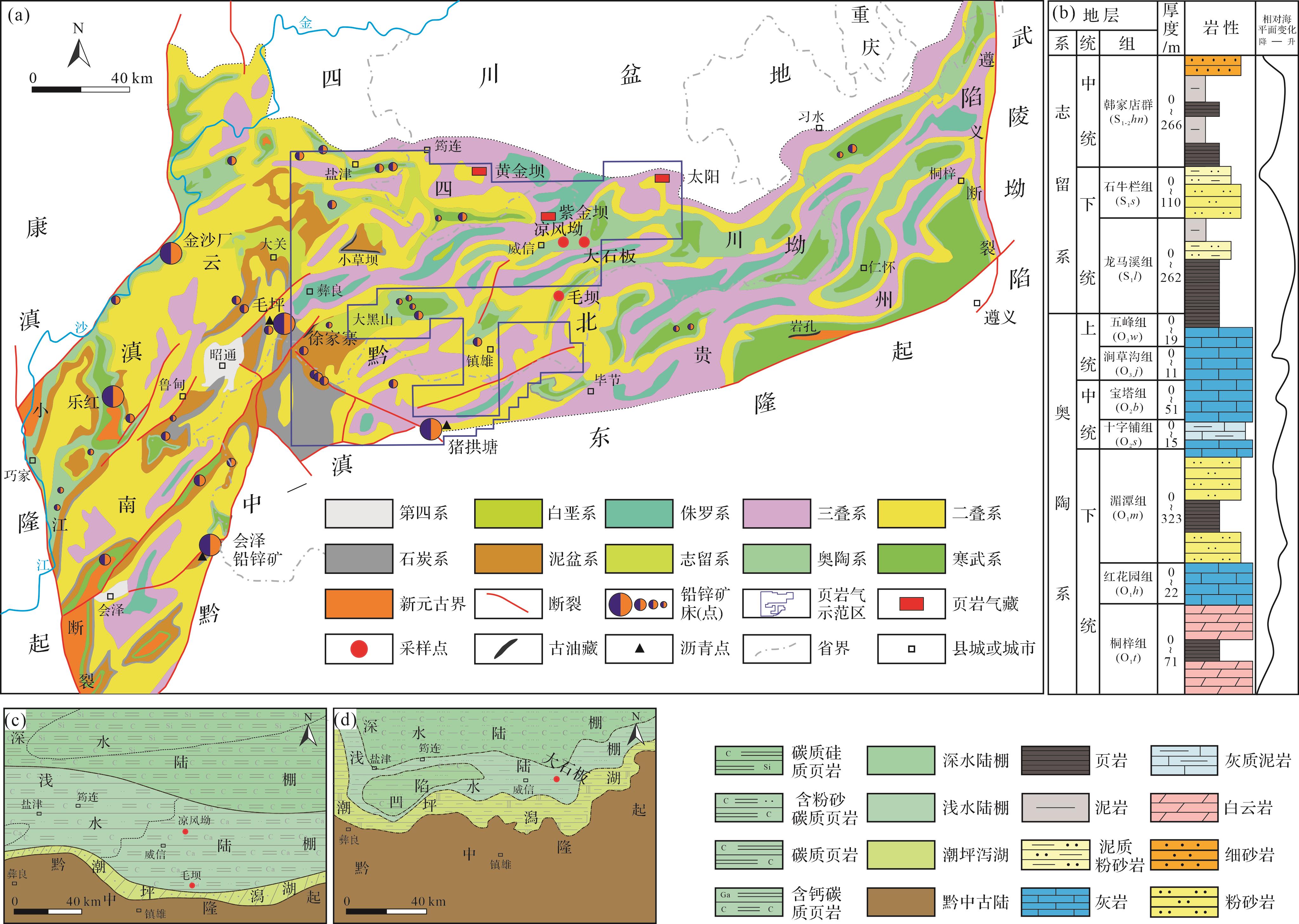
  • 滇黔北坳陷位于上扬子板块西南部,北边与四川盆地川南低陡褶皱带相望,南边与黔中—滇东隆起相接,西边与康滇隆起相毗,东边与武陵坳陷相邻(图1a)[21]。滇黔北坳陷为多旋回叠合盆地,主体在加里东早期开始形成,现今的研究区是古上扬子克拉通盆地的残留,构造变形强度具有南强北弱、西强东弱的特点[28,40]。根据构造演化特征及组合形式,滇黔北坳陷包括东、西两个凹陷,其中西部凹陷为昭通凹陷,东部凹陷为威信凹陷,本研究区以东部威信凹陷为主(图1a)。研究区内地层发育较全,寒武系—白垩系均有出露,其中,上奥陶统五峰组和下志留统龙马溪组是该研究区页岩气勘探的主要地层[41]。大型、超大型铅锌矿床主要分布在滇黔北坳陷西部[21]

    Figure 1.  (a) Regional geological map of Dianqianbei Depression (modified from reference [21]); (b) Ordovician-Silurian stratigraphic column section for the eastern part of the Dianqianbei Depression (modified from reference [42]) ; (c) lithofacies paleogeographic map of the Wufeng Formation in the study area (modified from reference [43]); (d) lithofacies paleogeographic map of the Longmaxi Formation in the study area (modified from reference [45])

    滇黔北坳陷东部出露下古生界奥陶系—志留系地层,从下到上依次为:桐梓组、红花园组、湄潭组、十字铺组、宝塔组、涧草沟组、五峰组、龙马溪组、石牛栏组、韩家店群,其中上奥陶统五峰组和下志留统龙马溪组为两套富有机质泥页岩层系(图1b)[42]。奥陶纪时期,随着海平面持续上升,扬子板块形成广泛的浅海台地,沉积了五峰组黑色泥(页)岩。奥陶纪末期,位于南极的冈瓦纳大陆古生代冰盖的扩张引发了广泛海退,形成了奥陶系顶部的石灰岩。随后,在早志留世,研究区由于冈瓦纳大陆冰期的结束,发生了广泛海侵,在志留系底部形成了一套黑色泥(页)岩[28]。前人对滇黔北坳陷岩相古地理平面展布特征的研究表明,晚奥陶世五峰期凉风坳和毛坝两个地区应均处于浅水陆棚区(图1c)[43],但略有不同,凉风坳地区更偏向于深水陆棚相一侧,而毛坝地区更接近于潮坪—潟湖相一侧[4344];早志留世龙马溪期则在不同时段表现不同的沉积特征,研究区大石板龙马溪组下段为砂质深水陆棚,中上段则为灰质浅水陆棚相(图1d)[4546]。按区域沉积特征,龙马溪组可以分为上中下三段:下段是龙马溪早期沉积,以黑色碳质泥(页)岩为主,中段沉积于龙马溪中期,以泥质粉砂岩和灰黑色含钙泥(页)岩组合为主,上段沉积于龙马溪晚期,以灰黄色泥(页)岩和粉砂岩为主。

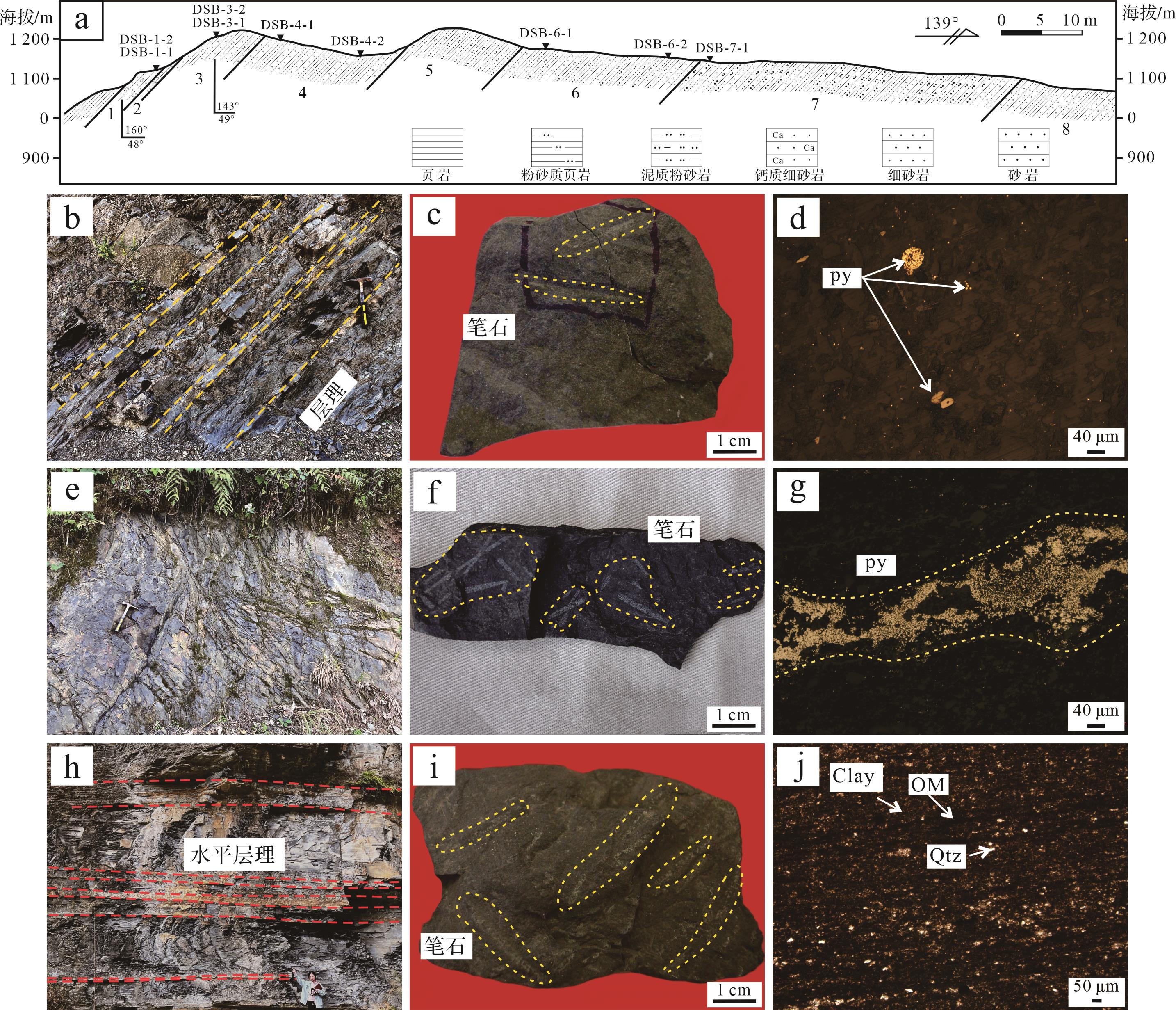
  • 研究区内五峰组—龙马溪组出露良好,尤以威信地区为主(图1a)。本研究共采集新鲜岩样19件。其中,龙马溪组包含大石板剖面样品8件(泥页岩样品6件,砂岩2件);五峰组样品包含凉风坳露头泥页岩样品6件,毛坝露头泥页岩样品5件,其中露头处均按照从下至上的顺序进行采样并编号。露头新鲜(图2b,e,h),主要有灰黑色含钙泥质粉砂岩(图2c)、黑色钙质页岩(图2f)、黑色含钙碳质页岩(图2i)、灰黑色钙质页岩(图2j),多为薄层至中层状、可见笔石化石(图2c,f,i)、泥页岩水平层理发育(图2h),含有丰富的黄铁矿、黏土矿物以及有机质(图2d,g,j)。

    Figure 2.  Characteristics of black shale from the Wufeng Formation⁃Longmaxi Formation in the study area

    本研究共分析全岩样品10件,其中五峰组5件(凉风坳3件,毛坝2件),龙马溪组大石板5件。分析干酪根样品18件,其中五峰组11件(凉风坳6件,毛坝5件),龙马溪组大石板7件。

  • 干酪根制备:于武汉莲荷检测科技有限公司完成。干酪根提取采用酸溶解与重液悬浮相结合的方法,分别利用盐酸、氢氟酸除去全岩中的碳酸盐、硅酸盐组分,后用重液浮选的方法除去硫化物组分,最后得到较纯净的干酪根组分[47]

    干酪根微波消解及微量元素测试:于广州市拓岩检测技术有限公司完成。与传统消解方法相比,微波消解法具有分解快速、完全、挥发性元素(如Ge)损失小、试剂消耗少、操作简单、处理效率高、污染小、空白低的优势。因此,本研究采用微波消解法对干酪根样品进行前处理,以确保实验的准确性。所用微波消解仪型号为ETHOS TOUCH CONTROL,消解过程参考文献[48]。经过消解后的18件干酪根样品,采用电感耦合等离子体发射质谱仪(ICP-MS)进行微量元素测试,型号为塞默飞iCAP RQ。其工作条件为:射频发生器频率40.68 MHz,波长范围175~785 nm,波长连续覆盖,完全无断点,等离子体输出功率700~1 700 W,等离子体冷却气0~22.5 L/min可调,快泵进样、延时、清洗。重复测量3次。测试过程中以OU-6、BCR-1、GBPG-1为标准样品,以监测数据结果的准确性,数据结果RSD优于5%。

    全岩微量元素测试:于广州澳实分析检测有限公司完成。采用四酸消解法电感耦合等离子体发射质谱检测微量元素和稀土元素含量,并结合熔融法电感耦合等离子体质谱测定稀土元素的含量;测试仪器为美国Agilent 7900,实验方法执行代码分别为ME-MS61r、ME-MS81g。

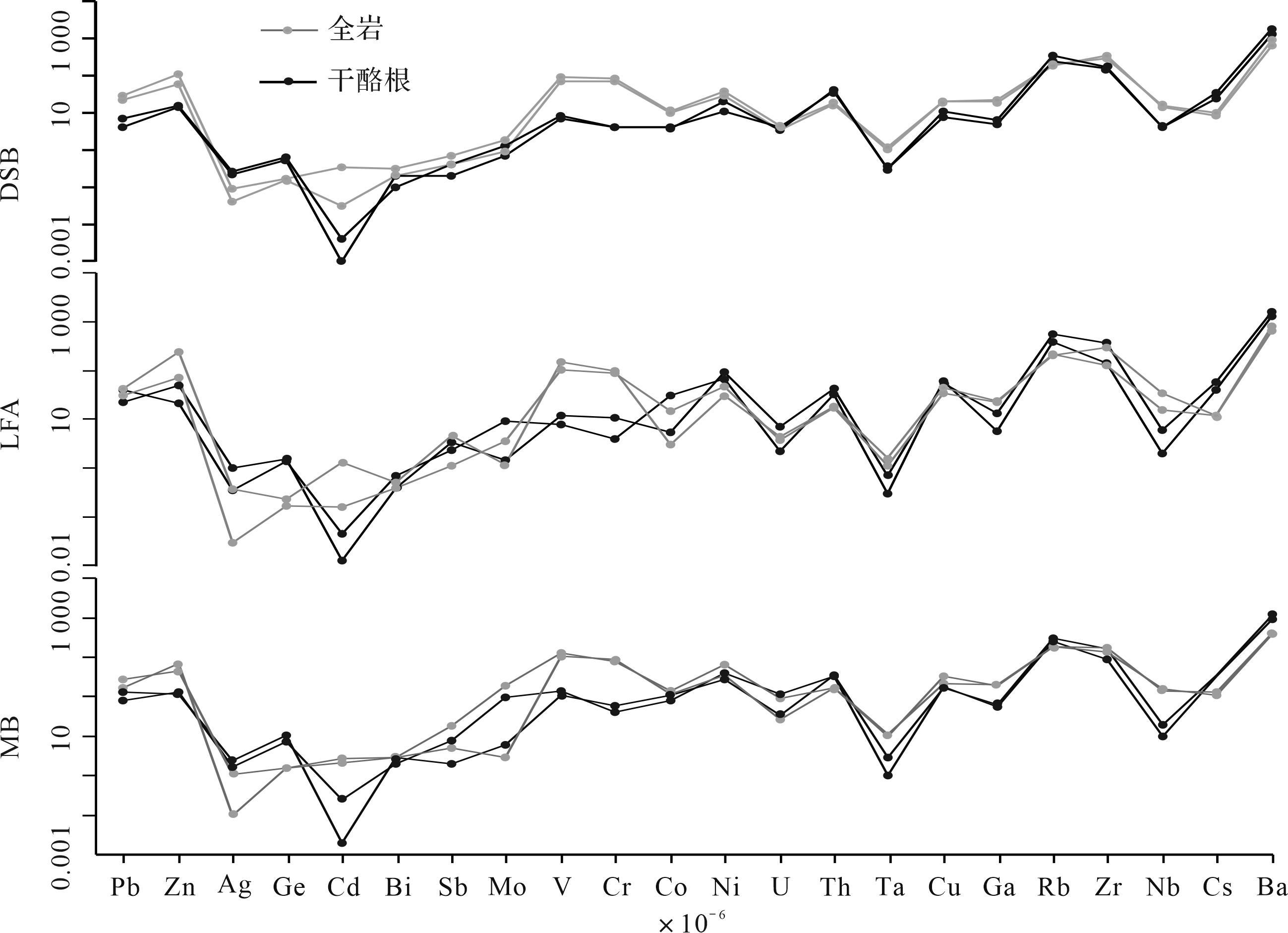
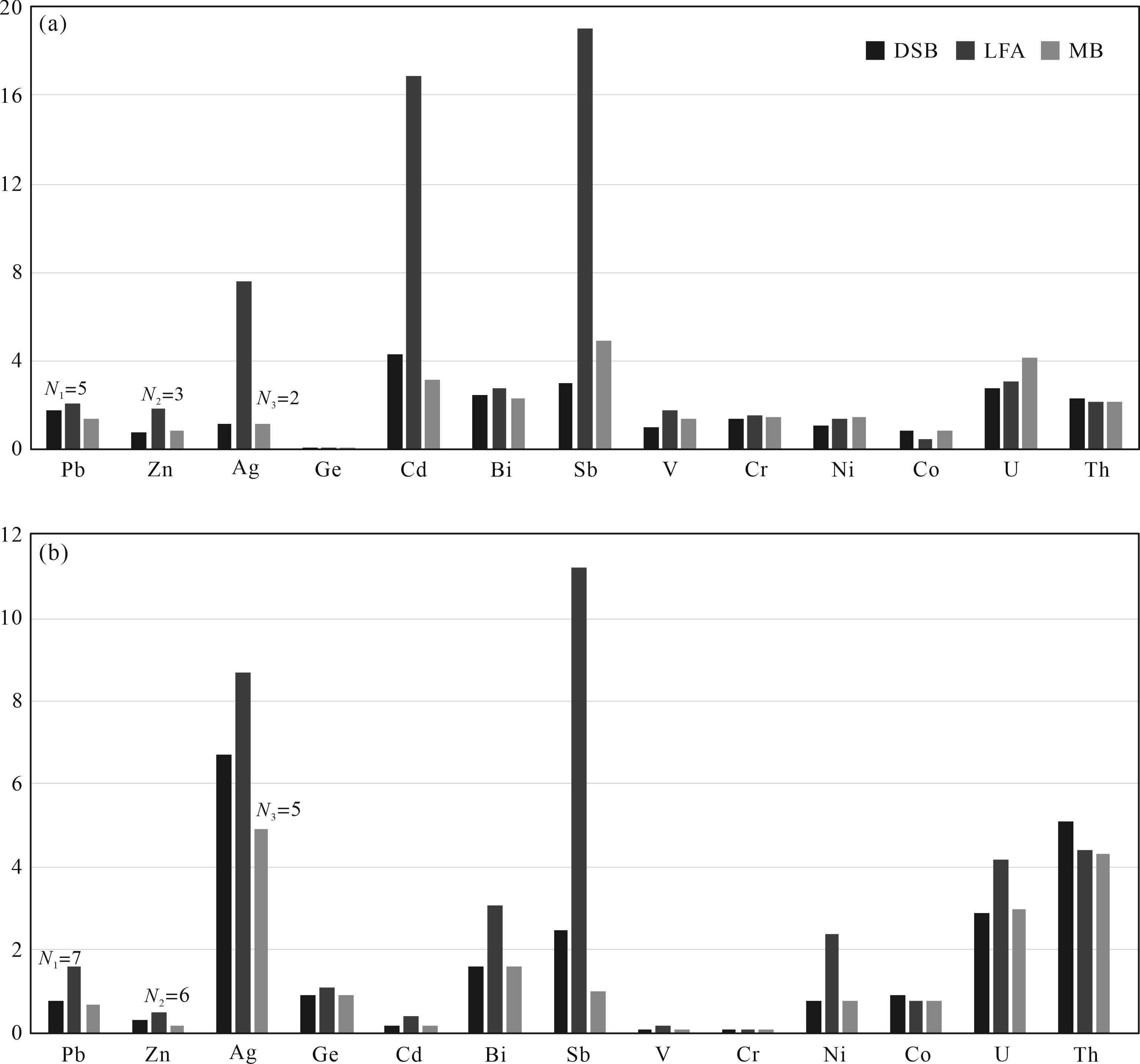
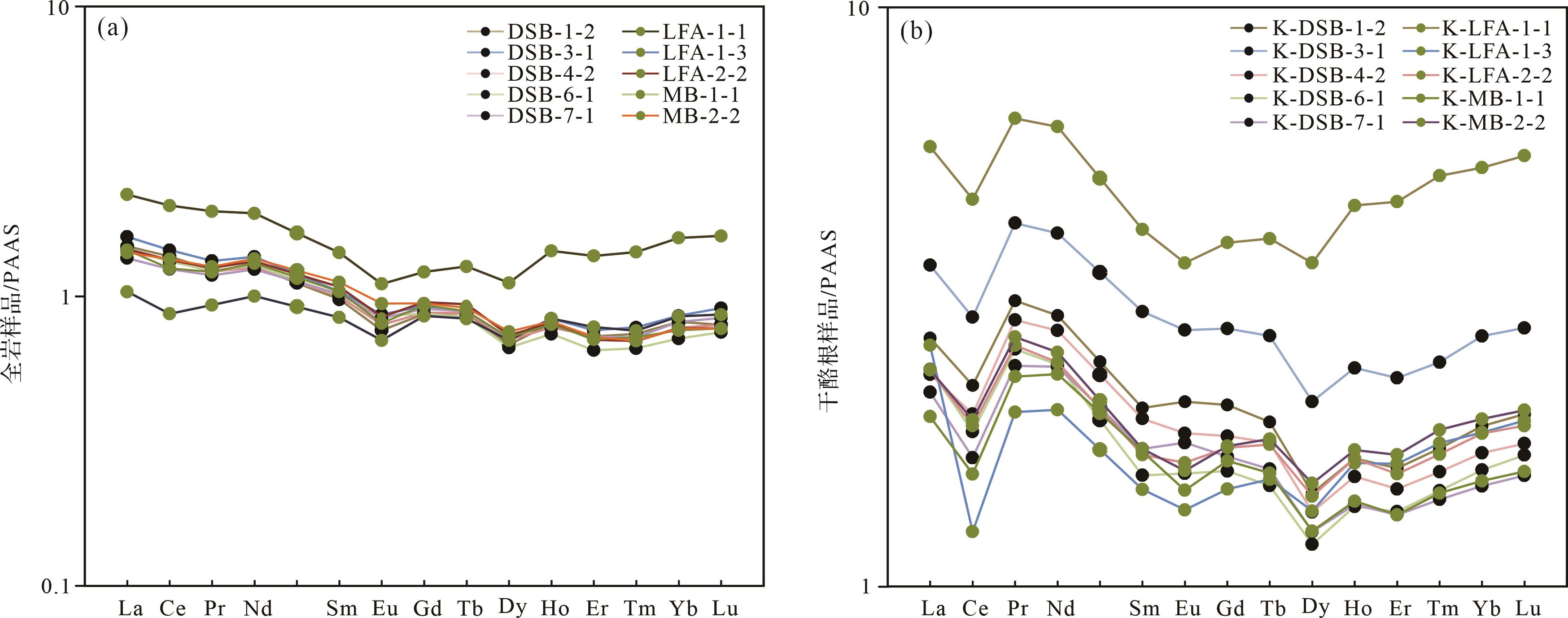
  • 研究区样品分析结果见表1。微量元素总含量方面,全岩中表现为五峰组凉风坳(LFA)最高(平均值为1 742.3×10⁻⁶)、龙马溪组大石板(DSB)次之(平均值为1 623.3×10⁻⁶),五峰组毛坝(MB)则最低。干酪根与全岩元素含量具有相似的变化特点,元素总含量高于全岩,最高可达2 965.2×10⁻⁶表1图3)。计算所得全岩及干酪根中元素富集系数差异较明显(图4)。干酪根总稀土元素含量(ΣREE)均高于对应全岩样品。轻、重稀土元素分馏程度较全岩更低(表2图5)。

    样品编号PbZnAgGeCdBiSbMoVCrCoNiUThTaCuGaRbZrNbCsBaTotalV/CrNi/CoU/Th
    全岩
    DSB-1-2291080.090.170.330.30.71.9908010.436.24.318.21.220.122.520828216108901 829.11.133.480.23
    DSB-3-130440.350.200.050.30.61.8859013.041.84.520.51.323.423.621032017117991 737.40.943.220.22
    DSB-4-229470.050.160.400.41.02.2848014.441.94.018.11.224.322.420422716117491 577.01.052.910.22
    DSB-6-132510.060.200.350.41.00.8738014.136.53.317.81.129.721.320824415116601 499.70.912.590.18
    DSB-7-122560.040.160.030.20.40.970709.929.43.517.51.019.418.21773361486201 473.31.002.970.2
    LFA-1-1432450.370.231.300.54.61.21461003.130.54.417.91.643.923.920730234126551 877.01.469.840.25
    LFA-1-3341160.700.152.370.35.414.0516806.368.89.611.50.787.312.71271661174451 720.96.4510.920.84
    LFA-2-231700.030.170.160.41.13.61059015.046.93.816.91.134.022.721212716128211 629.01.173.130.22
    MB-1-127440.110.160.280.31.819.61288014.266.99.116.91.032.619.419017014134111 258.41.64.710.54
    MB-2-217690.010.160.210.30.50.31059012.034.62.616.81.121.620.218613316113911 127.91.172.880.16
    干酪根
    KDSB-1-27160.260.630.0040.10.41.3843.920.43.539.80.310.86.633471664351 9302 605.11.795.280.09
    KDSB-3-110210.331.030.0030.20.62.410710.026.64.947.80.418.39.094103036472 0302 965.21.292.670.10
    KDSB-4-124200.331.200.0260.41.03.810518.740.94.556.80.233.67.665381922631 4302 452.32.002.190.08
    KDSB-4-213180.220.870.0050.20.62.28512.626.14.037.10.318.86.272851623311 3501 985.21.552.070.11
    KDSB-6-141210.421.330.0370.50.81.49419.930.52.632.30.346.96.543451442341 4002 143.32.151.530.08
    KDSB-6-231660.391.330.0350.50.92.310517.736.73.749.50.3116.07.584302173431 3702 412.71.862.070.08
    KDSB-7-14140.220.520.20.20.7744.110.84.035.90.37.925.072391614241 3101 836.81.682.620.11
    KLFA-1-123501.011.580.0130.43.41.512115.594.87.043.10.755.813.305473676581 6002 901.61.1817.360.16
    KLFA-1-219420.771.280.0340.33.00.91484.896.44.741.40.754.112.205183277551 3202 531.31.7119.960.11
    KLFA-1-38310.500.530.0240.22.95.25153.390.515.327.70.342.64.101561242189551 542.610.2027.760.55
    KLFA-2-128250.331.270.0520.52.59.813518.065.67.634.60.249.16.502591572291 9102 624.42.443.640.22
    KLFA-2-240210.351.390.0450.72.39.18430.468.32.233.10.362.85.903771402411 2602 110.21.892.250.07
    KLFA-2-328140.241.040.0240.51.14.98324.045.12.829.90.241.65.302701012281 1601 769.82.611.880.09
    KMB-1-18130.170.720.0250.20.89.81447.940.112.033.30.117.85.50248871338901 426.63.895.060.36
    KMB-2-19120.211.030.10.20.710512.426.93.132.80.213.36.102851472341 0301 630.51.932.170.09
    KMB-2-213120.241.040.0020.30.20.611611.1273.536.10.316.56.303041682361 1401 794.41.862.430.10
    KMB-2-31599.670.880.0010.30.30.76411.526.64.431.30.219.24.902351262288951 428.91.582.310.14
    KMB-2-411100.260.980.0230.20.20.71049.223.94.234.60.213.06.102791182339391 499.22.202.600.12
    注:“—”表示低于检测限。

    Table 1.  Trace element analysis for whole rocks and kerogen in the study area (10-6)

    Figure 3.  Comparison of trace element contents in whole rock and kerogen

    Figure 4.  Enrichment coefficient of the whole rock and kerogen elements

    Figure 5.  PAAS normalized rare earth element (REE) partition curves of whole rock and kerogen

  • 不同采样点之间全岩微量元素组成差异较大。毛坝地区微量元素含量整体偏低,其中Ba元素含量最高(391×10-6~411×10-6),其次是Rb、Zr、V等元素(100×10-6~190×10-6)。大石板中Ba元素含量最高(620×10-6~820×10-6),Zr、Rb等元素含量介于180×10-6~340×10-6,出现研究区Zn的高值(108×10-6),其余微量元素均低于90×10-6。凉风坳地区微量元素总量均较高,Ba、Zr、Rb、V、Zn含量最高,平均含量介于100×10-6~830×10-6,其余微量元素均低于100×10-6表1)。

    干酪根微量元素不同采样点之间的含量组成特征同样差异明显。毛坝地区整体上微量元素含量相对较低,Ba元素含量最高(890×10-6~1 140×10-6)。大石板Ba元素含量最高(1 310×10-6~2 030×10-6),其次为Rb、Zr等元素平均含量介于150×10-6~540×10-6,其余元素含量均低于70×10-6。凉风坳和大石板具有相似的微量元素组成,均以Ba含量最高,其次为Rb、Zr等元素,其余元素均低于100×10-6表1)。

    为评价研究区各元素成矿潜力,进一步计算了微量元素富集系数(K),采用某元素测试值的中位数代表其原始地层丰度(富集系数=中位数/扬子上地壳元素丰富值),当元素富集系数K<1时,代表该元素在地层中相对亏损,不利于成矿;当1≤K<1.5时,表明该元素相对富集,具有成矿潜力但不明显;当K>1.5时,指示地层中某元素富集程度高,有一定的成矿潜力[49]。计算得出,在全岩中,五峰组凉风坳和毛坝地区Cd、Sb、V、Cr等元素相对富集,龙马溪组与五峰组具有相似的元素富集特征。在干酪根中,五峰组凉风坳地区Pb、Ag、Bi、Sb、Mo、Ni、U、Th等元素富集程度高,有一定的成矿潜力;五峰组毛坝地区Ag、Bi、U、Th等元素富集程度高,有一定的成矿潜力,Sb、Mo相对富集,具有成矿潜力但不明显;龙马溪组大石板Ag、Bi、Sb、Mo、U、Th等元素富集程度高,有一定的成矿潜力(图4表1)。

  • 全岩和干酪根稀土元素特征见表2。数据显示,全岩稀土元素总量(ΣREE)为146.6×10⁻⁶~310.4×10⁻⁶,均低于干酪根(276.64×10⁻⁶~824.15×10⁻⁶),轻稀土元素(LREE)高于重稀土元素(HREE),轻重稀土元素比值(LREE/HREE)介于8.2~12.5,均高于干酪根(7.88~10.34)。全岩及干酪根稀土元素经过澳大利亚后太古宙平均页岩(PAAS)标准化后显示,轻稀土略显右倾,重稀土相对平坦,整体表现为轻稀土元素相对富集、重稀土元素相对亏损的轻微右倾型,全岩中Eu、部分Ce呈弱负异常(图5a),干酪根表现出较强的Ce负异常(0.53~0.75),Eu弱负异常(0.87~1.03)(图5b)。全岩中LaN/YbN比值在1.0和1.6之间变化,干酪根LaN/YbN值介于0.80~1.52(表2)。

    样品编号LaCePrNdSmEuGdTbDyHoErTmYbLuYΣREELREEHREEL/HLaN/YbNδEuδCe
    全岩
    DSB-1-246.891.19.7034.15.750.904.510.693.940.842.470.372.420.3524.4203.9188.415.612.11.40.81.0
    DSB-3-150.595.910.4536.96.121.024.810.704.150.872.590.392.540.4024.3217.3200.916.512.21.50.91.0
    DSB-4-245.588.39.6133.95.880.944.560.694.100.812.480.352.310.3523.0199.8184.115.711.81.50.91.0
    DSB-6-145.787.69.6734.55.931.014.520.673.850.772.210.332.120.3322.0199.2184.414.812.51.60.91.0
    DSB-7-142.682.49.3233.46.000.994.700.704.150.842.460.362.420.3725.0190.7174.716.010.91.30.91.0
    LFA-1-170.6136.515.5052.18.331.306.301.006.441.494.680.714.720.7145.7310.4284.326.110.91.10.81.0
    LFA-1-332.657.87.3627.04.980.834.440.664.080.872.660.382.530.3829.8146.6130.616.08.21.00.80.9
    LFA-2-245.888.59.8935.66.341.004.950.744.250.842.400.352.300.3425.0203.3187.116.211.61.50.81.0
    MB-1-145.482.89.5635.06.110.954.830.704.170.832.410.362.260.3424.5195.7179.815.911.31.50.80.9
    MB-2-244.589.19.9736.36.581.114.900.724.370.852.450.352.290.3425.8203.8187.616.311.51.40.91.0
    干酪根
    KDSB-1-284.614824.679.312.002.4610.701.528.411.735.440.8665.620.87349.0386.12350.9635.169.981.111.010.75
    KDSB-3-1113.019433.5110.017.603.2714.502.1412.102.487.791.2208.041.23069.5520.87471.3749.509.521.040.950.72
    KDSB-4-1100.016526.078.911.502.3511.001.619.742.106.641.1207.261.15068.6424.37383.7540.629.451.010.970.74
    KDSB-4-273.213222.874.711.502.179.461.407.801.615.010.7895.050.77744.9348.27316.3731.909.921.070.970.74
    KDSB-6-174.712320.365.39.181.858.231.186.861.434.580.7324.720.74242.2322.80294.3328.4710.341.170.990.73
    KDSB-6-292.114923.574.510.902.1910.101.468.431.745.560.9165.820.94356.8387.16352.1934.9710.071.170.970.74
    KDSB-7-168.211119.064.710.202.098.721.267.211.444.520.7074.430.68441.5304.16275.1928.979.501.131.030.71
    KLFA-1-1181.031050.8168.024.404.2720.403.1521.004.7315.702.56015.702.44085.2824.15738.4785.688.620.850.890.74
    KLFA-1-2161.027144.4145.022.104.0319.803.0720.104.5514.802.41014.802.30085.3729.36647.5381.837.910.800.900.74
    KLFA-1-382.282.715.854.58.681.607.661.217.831.705.540.8845.480.85154.2276.64245.4831.167.881.110.920.53
    KLFA-2-170.612522.074.011.301.989.641.367.991.635.030.8145.010.76648.3337.12304.8832.249.461.040.880.73
    KLFA-2-274.612620.665.89.961.939.031.398.311.735.320.8465.460.83455.0331.81298.8932.929.081.010.950.74
    KLFA-2-387.810317.656.78.591.707.701.136.761.364.240.6694.270.64840.5302.17275.3926.7810.281.520.980.60
    KMB-1-161.910418.262.810.101.738.571.247.231.464.520.7254.520.69542.5287.69258.7328.968.931.010.870.71
    KMB-2-191.111919.862.99.481.718.651.318.031.665.290.8565.310.81750.4335.91303.9931.929.521.260.880.64
    KMB-2-274.512921.368.510.201.879.091.428.741.795.740.9325.780.88754.7339.75305.3734.388.880.950.910.74
    KMB-2-371.810518.359.89.491.778.511.297.691.584.920.7864.780.72745.5296.44266.1630.288.791.110.920.67
    KMB-2-470.212320.766.710.001.838.651.388.141.765.400.8575.400.80049.6324.82292.4332.399.030.960.920.74

    Table 2.  REE characteristics in whole rocks and kerogen (10-6)

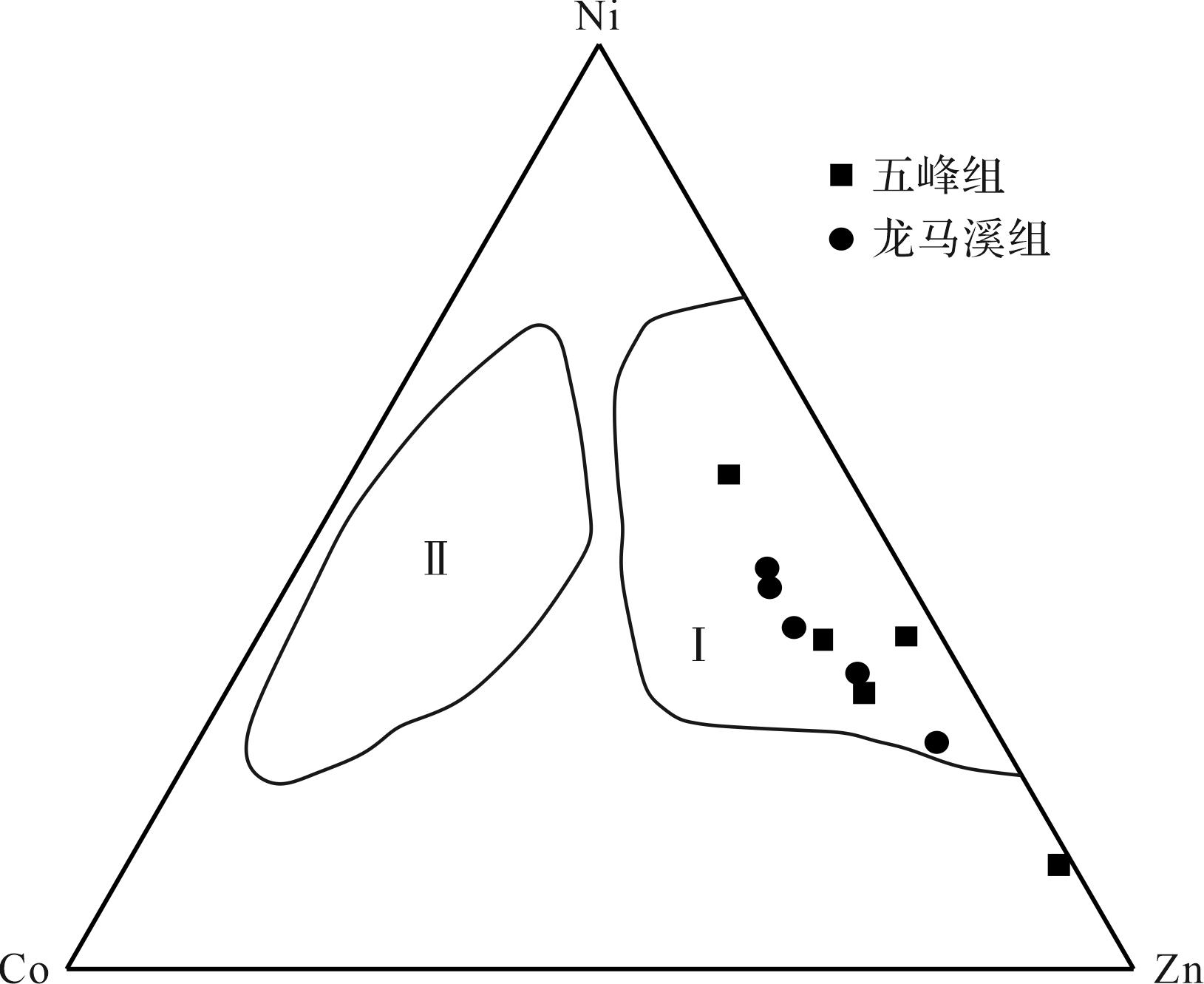
  • V/Cr、Ni/Co、U/Th等指标被认为是判别黑色页岩氧化还原环境的有效手段[22,5052]。例如,V/Cr=2,U/Th=0.75,Ni/Co=5等可以作为判断氧化还原条件的界限,当V/Cr、Ni/Co、U/Th的值降低说明沉积古环境趋于氧化,反之则趋于还原环境。研究区黑色页岩可能受到陆源碎屑物质干扰,加之Zn-Ni-Co三角图解显示研究区还受到一定的热水活动影响(图6),这可能导致全岩中指示古氧化还原条件的临界元素V、Ni、Cr、U等不能准确地反映氧化还原环境特征,因此若用某一种定量的地球化学指标重建沉积古环境可能会出现误差,不能准确地反演沉积古环境特征[5154]。为排除碎屑和热液的影响,选取岩石中一种特殊的原生组分——干酪根,作为恢复古环境的介质。其主要来源于海洋上层水体的浮游动物、藻类以及菌类,由于它们长期生存于海水中,生物体与周边环境通过呼吸作用和新陈代谢作用充分发生物质交换已保持平衡状态,这种物质交换使得生物体中的微量元素充分具备水体组成特征。此外,干酪根作为沉积有机质的主体,性质稳定,结构复杂且难溶,在记录过去的生物地球化学循环方面及有机质形成演化环境方面具有很好的潜力,干酪根中的微量元素变化也许可以有效地恢复水体的氧化还原趋势[29,3233]。与全岩分析不同的是,不能直接用干酪根中氧化还原敏感元素的比值来确定氧化还原条件的界限,但是可以根据其比值的变化规律很好地反映沉积古环境的氧化还原变化趋势[55]。与此同时,本文结合全岩氧化还原敏感元素的比值来反演古氧化还原条件,将更加精准地重建沉积古环境。

    Figure 6.  Zn⁃Ni⁃Co diagram of the black rock series and kerogen of the Wufeng Formation⁃Longmaxi Formation in the study area

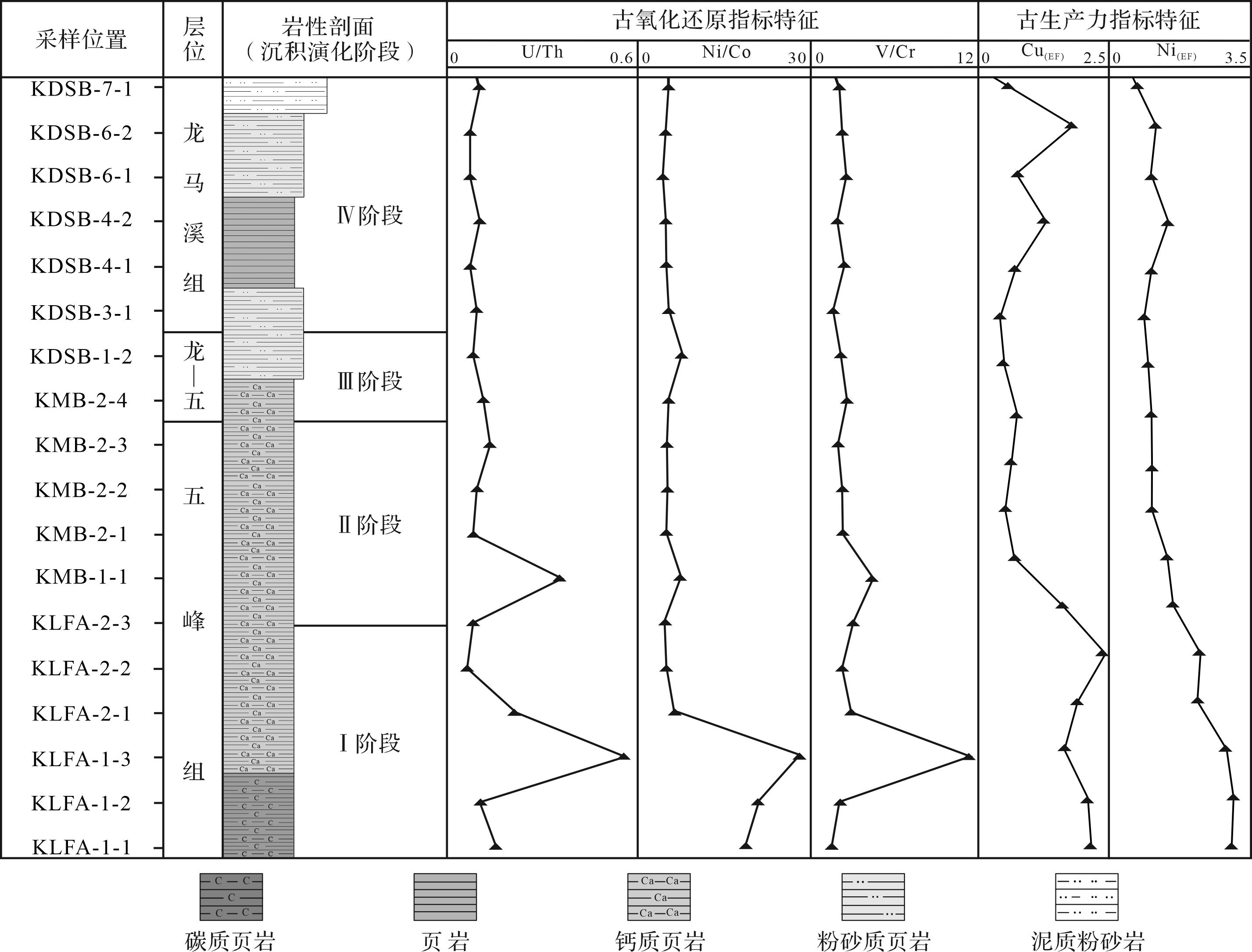
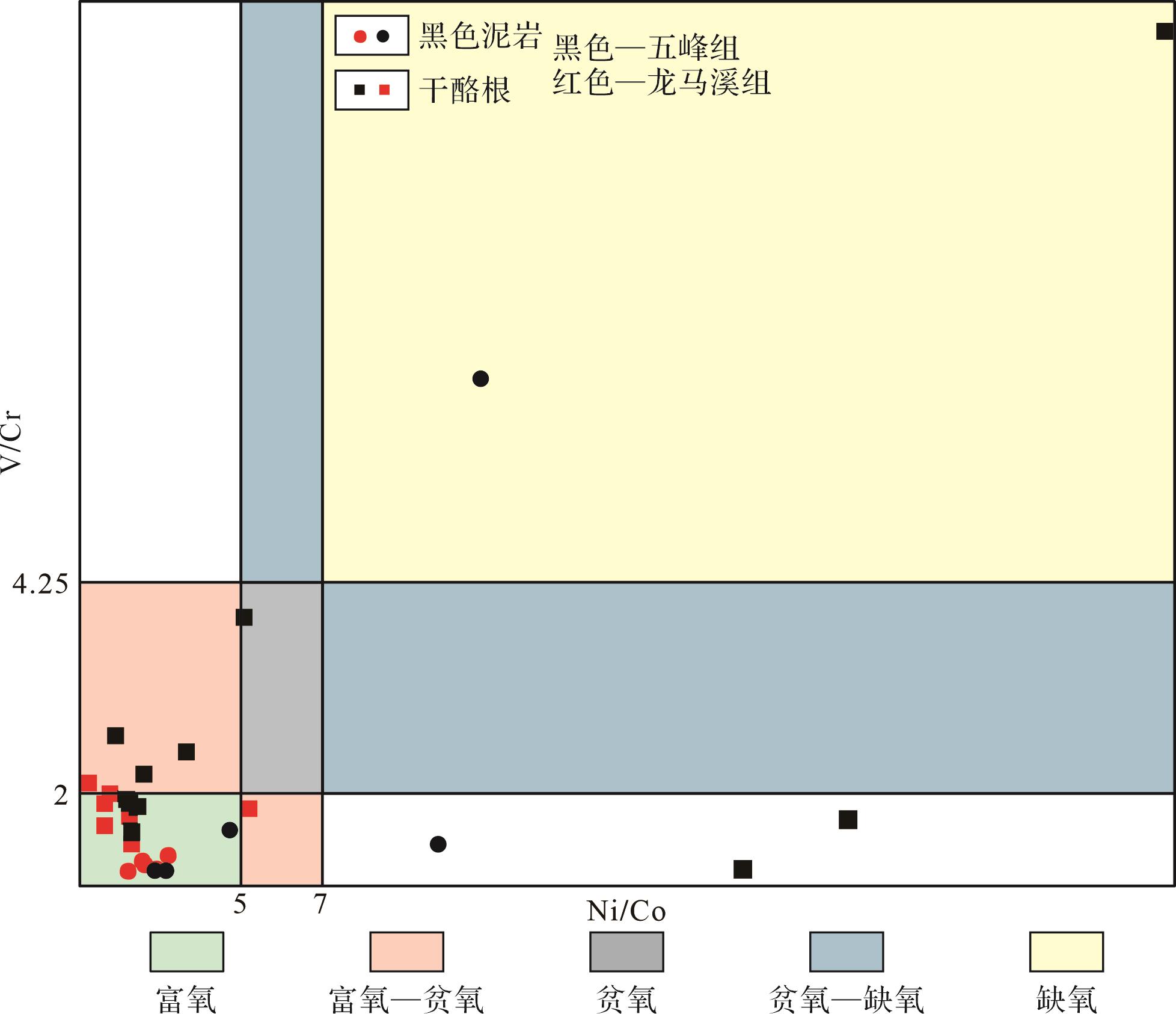
    研究区五峰组底部到顶部干酪根中U/Th、Ni/Co、V/Cr值变化明显(图7),其比值出现两次高值(表1),分别是凉风坳(KLFA-1-3)和毛坝(KMB-1-1),表明研究区五峰组在地质历史时期上可能经历了缺氧事件且环境变化十分动荡。进入志留纪,研究区龙马溪组干酪根中U/Th等值逐渐降低,曲线逐渐趋于平坦,暗示着含氧量不断增加,环境逐渐趋于氧化(图7)。这表明,在奥陶纪、志留纪之交发生的气候突变、冰川发育、海平面变化等与奥陶纪末经历的生物大灭绝以及短暂的海退紧密相关,导致这一时期内古水体含氧量动荡变化[5657]。通过建立氧化还原指标图发现,五峰组全岩及干酪根数据点大部分落在了富氧—贫氧以及缺氧的过渡区域,龙马溪组大部分点处于富氧区域(图8)。其中,五峰组凉风坳(KLFA-1-3)全岩及干酪根均出现了V/Cr的异常高值6.45和10.20;Ni/Co全岩及干酪根的异常高值10.92和27.76,其点均落在了缺氧区域(图8),表明五峰组这一时期处于缺氧的还原环境。加之凉风坳地区氧化还原指标变化明显,且计算得到的古水深变化显著,指示黑色页岩形成的古氧化还原环境变化更频繁,表明研究区五峰组凉风坳地区沉积水体的缺氧程度要强于其他沉积时期。此外,从图中可以看出,有三个数据点(干酪根KLFA-1-1、KLFA-1-2和全岩LFA-1-1)落在了白色区域,属于异常指标值,Ni/Co表明为缺氧的沉积环境,V/Cr却指示氧化的信号。这一矛盾的解释为:一方面是不同的氧化还原指标所反映的古沉积环境范围存在差异性,如V/Cr、U/Th更多地反映氧化和缺氧,而Ni/Co却可以指示氧化、贫氧以及缺氧的沉积环境;另一方面可能是不同的指标对混合古氧化还原状态的差异性响应,如在氧化还原界面附近,氧化、贫氧、缺氧的水体易混合在一起,易使贫氧以及缺氧的水体脉冲到氧化的水体中,亦或使氧化的水体脉冲到贫氧甚至缺氧的水体中,导致不同的氧化还原指标反映了不同的古沉积环境状态[58]。因此,这三个异常数据点均为以贫氧—缺氧为主的古沉积环境,但可能伴随氧化的水体涌入。

    Figure 7.  Evolution characteristics of paleoredox and paleoproductivity in kerogen

    Figure 8.  Redox index diagram of the black rock series and kerogen of the Wufeng Formation⁃Longmaxi Formation in the study area

  • 古生产力指海洋的初始生产力,即地质历史时期海洋单位面积、单位时间内所生产的有机质的总质量分数[59],其最直接的反映指标是TOC值。五峰组TOC整体高于龙马溪组,指示五峰组黑色页岩的初级生产力相比龙马溪组较高,且凉风坳地区相对于毛坝地区具有更高的初级生产力水平(表3)。古生产力高低主要受太阳辐射产生的真光层深度、沉积水体温度、水体中富营养化程度等因素影响,研究中可以用生物Ba含量(Babio)估算海洋初始生产力[60]。通过计算得出研究区Babio的含量较低且与样品中测试的Ba含量相差较大(表3),推测研究区Ba元素含量可能受到陆源碎屑铝硅酸盐中的钡的影响。然而不能直接认为研究区五峰组—龙马溪组古生产力较低,因为在贫氧或者缺氧的环境下,沉积物表面或底部水体会发生硫酸盐还原反应,硫酸钡是硫酸盐的潜在来源,当硫酸盐供应不足时,硫酸钡会发生部分溶解,进而造成Ba含量的减少,引起Babio的值偏小,导致估算的古生产力偏低[61]。此外,前人研究表明Cu-EF和Ni-EF与TOC具有正相关性,在一定程度上可以用来恢复沉积时期的古生产力[62]。因此,通过建立干酪根中Cu-EF和Ni-EF的纵向演化特征图发现,研究区五峰组—龙马溪组Cu-EF和Ni-EF从底部到顶部逐渐减小,表明古生产力逐渐降低(图7)。综合来看,五峰组古生产力水平整体高于龙马溪组,与TOC分析结果相一致。

    样品DSB-1-2DSB-3-1DSB-4-2DSB-6-1DSB-7-1LFA-1-1LFA-1-3LFA-2-2MB-1-1MB-2-2
    Babio296.75151.00138.5069.00107.75108.2594.75217.25-127.50-143.00
    Sr/Cu4.643.564.243.576.110.801.662.583.345.83
    Sr/Ba0.100.100.140.160.190.050.320.110.270.32
    h/m19.4133.9249.6046.9319.446.8554.3748.0531.89
    TOC/%0.590.40/0.610.212.55/0.801.420.38
    注:“—”表示无准确数据;/表示该项数据未测。

    Table 3.  Paleoenvironment analysis of the Wufeng Formation⁃Longmaxi Formation in the study area

    黑色泥页岩中常用喜干型元素Sr和喜湿型元素Cu的质量分数比值来指示古气候环境。Sr/Cu质量分数比值越大,代表气候越干热,比值变小,说明气候越温湿。一般认为,Sr/Cu质量分数比值介于1.3~5.0代表温湿气候,Sr/Cu>5.0指示干热气候[63]。研究区五峰组—龙马溪组Sr/Cu质量分数比值介于0.80~6.11,五峰组平均值为2.84,龙马溪组平均值为4.42,总体处于温湿气候。值得注意的是,龙马溪组顶部和五峰组中上部出现Sr/Cu>5的情况,反映出干热气候的特征,这与当时全球气候变暖,海平面上升以及生物绝后大泛滥的环境有密切关系。

    Sr/Ba比值可以较为准确地判别介质古盐度,一般认为,Sr/Ba>1.0为咸水,介于0.5~1.0为半咸水,小于0.5为微咸水[64]。研究区五峰组—龙马溪组Sr/Ba值均小于0.5,反映古水体整体为微咸水环境。此外,利用Co元素含量定量计算了古水体深度,具体计算方法参考文献[61]。计算结果显示,古水深范围为6.85~54.37 m,认为研究区古水体为浅水陆棚环境。

  • 综上所述,利用黑色页岩及干酪根氧化还原敏感元素指标用于恢复古环境时具有一致性。滇黔北坳陷东部五峰组—龙马溪组黑色页岩为一套总体上受陆源碎屑及低温热水沉积影响,且从下至上含氧量增加、古生产力逐渐降低的烃源层。奥陶系五峰组到志留系龙马溪组沉积古环境经历了四个阶段(图7)。阶段Ⅰ:五峰组沉积早期(LFA-1-1到LFA-2-2),沉积水体属于贫氧—缺氧环境,其中LFA-1-3出现氧化还原指标高值,表明在沉积早期水体环境动荡变化,古生产力相对较高。阶段Ⅱ:到五峰组中期(LFA-2-3到MB-2-3),含氧量增加,水体逐渐氧化,在MB-1-1出现氧化还原指标高值,同样暗示环境较为动荡,古生产力中等。阶段Ⅲ:随着时间推移到五峰组—龙马溪组的交界时期(MB-2-4到DSB-1-2),沉积水体由还原条件变为氧化条件,古生产力降低。阶段Ⅳ:龙马溪组沉积期(DSB-3-1到DSB-7-1),还原性逐渐减弱且变为富氧的氧化环境,沉积水体相对稳定,此时古生产力水平较低。

  • 氧化还原敏感元素V、Cr、Ni、Co、U、Th等在水体及沉积物中的分布、循环、分异,均受其化学性质和水体氧化还原条件控制[31]。一般来说,V、Ni等微量营养元素,被大量生物摄食进入生物体,使得这些营养元素含量在水体中大幅度降低,并在一定条件下随着有机质一起沉积,从而导致V、Ni等在干酪根中较全岩中更富集[65],然而在本研究区中营养元素V在全岩中更富集(图3)。笔者推测,虽然V可以生物富集并以有机金属化合物的形式输送到沉积物中,但当干酪根中营养元素表现为低含量时,与有机质相关的V是有限的[32]。一方面,V更倾向于富集在黏土和黄铁矿中[66],使得V在成岩过程中大量进入黏土和金属硫化物中;另一方面,随着地层埋藏加深,V容易在干酪根降解或热解过程中再活化,导致干酪根中的元素部分活化转移[67]。Ni属于亲硫元素,常以二价离子的形式溶解在氧化的水体中。研究区大石板和毛坝Ni含量更富集于全岩中,通过显微镜观察到该地区发育草莓状黄铁矿,证实在H2S加入的环境下,Ni不会发生价态变化而形成硫化物直接沉淀[52,62],使得在全岩中更为富集。而在凉风坳地区,干酪根中的Ni均高于全岩,这可能与当时水体缺氧及古生产力相对较高有很大的关系。研究认为高含量的Ni指示高的有机质输入,反映一定时期较高的古生产力,由于在该地区古生产力优于其他地区,使得该地区营养元素更为富集。

    Cr在含氧海水中,主要以铬酸盐离子(CrO42-)的形式存在,研究区主要为富氧—贫氧环境且环境动荡变化,使得Cr元素较难以有机结合态赋存于有机质中,使得研究区Cr元素在全岩中的含量均高于干酪根(表1图3)。而在贫氧环境中,Cr(Ⅳ)被还原成Cr(Ⅲ),形成水合羟基阳离子和羟基阳离子(Cr(OH)2+、Cr(OH)3、(Cr,Fe)(OH)3),这些离子很容易被腐殖酸络合或被Fe和Mn的氢氧化物吸附以进入沉积物中[68],这与凉风坳相对缺氧的沉积环境中Cr元素较其他地区高的情况相符合。整体来说,研究区干酪根中Cr元素丰度较低,是因为在有机质丰富的介质中,由于腐殖酸作用,Cr亦可以从含铬的硅酸盐矿物中被溶解出来,经胶体搬运并由离子吸附而富集在细粒的黏土里,进而Cr更富集在全岩中[69]

    在各类沉积岩中,U元素的主要地球化学特征与有机质密不可分。研究区U元素在干酪根中与在全岩中含量相当,这可能与硫化物的加入有关,镜下观察发现,研究区黄铁矿较发育,因此推测一部分U元素可能从硫化物矿物中被分解出来,并吸附在有机质上[70]。Th在低温环境下是不易发生迁移的元素,一般富集在黏土矿物中[52],但研究区Th元素更富集于干酪根中(图3),这是由于研究区存在低温热水沉积作用,当温度升高时,Th元素更易被干酪根所吸附。

  • 目前,关于黑色页岩中干酪根聚矿作用的研究愈发引起重视。前人通过对华南不同时代三个重要含金建造的相关研究中发现,金主要富集在干酪根中,主要通过干酪根中有机官能团的表面吸附、离子交换络合作用和螯合作用的方式来富集和携带[71]。李荣西等[72]研究烃类流体在MVT型铅锌矿成矿中的角色与作用时提出,目前MVT型铅锌矿中Pb、Zn元素的主要来源之一是富有机质的黑色页岩,而干酪根作为沉积有机质的主体(占沉积有机质的90%以上),且干酪根具有吸附作用,推测MVT型铅锌矿成矿元素可能来自干酪根[34,72]。此外,与MVT型铅锌矿共生的沥青具有较高的成矿元素含量,暗示干酪根也可能为其提供了丰富的成矿物质,杨珊等[37]在研究渝东南铅锌矿区五峰组—龙马溪组页岩及残余干酪根中微量元素地球化学特征中发现,干酪根中多数微量元素含量较全岩中更高,尤其Pb、Zn元素其平均值均高于全岩约10倍,这就说明是干酪根而不是无机矿物吸附了大量金属元素[37,73]

    在滇黔北坳陷东部五峰组—龙马溪组所测的干酪根中铅锌元素以及伴生关键金属元素含量分别为:Pb介于4×10-6~41×10-6,平均值为18.44×10-6;Zn介于9×10-6~66×10-6,平均值为23.06×10-6;Ag介于0.17~9.67×10-6,平均值为0.88×10-6;Ge介于0.52~1.58×10-6,平均值为1.04×10-6;Cd介于0.001×10-6~0.052×10-6,平均值为0.02×10-6;Bi介于0.1×10-6~0.7×10-6,平均值为0.32×10-6;Sb介于0.2×10-6~3.4×10-6,平均值为1.19×10-6。而在滇黔北坳陷西部大关县悦乐镇营盘剖面五峰组—龙马溪组干酪根中测得的铅锌元素以及伴生关键金属元素含量分别为:Pb介于252×10-6~373×10-6,平均值为323.75×10-6;Zn介于103×10-6~368×10-6,平均值为263.50×10-6;Ag介于1.16×10-6~2.56×10-6,平均值为1.53×10-6;Ge介于7.05×10-6~11.6×10⁻⁶,平均值为8.65×10⁻⁶;Cd介于0.26×10⁻⁶~0.96×10-6,平均值为0.40×10-6;Bi介于4.2×10-6~6.3×10-6,平均值为5.28×10-6;Sb介于14.5×10-6~19.1×10-6,平均值为16.75×10-6表4)。其中,在西部Pb元素高于扬子上地壳20倍左右,Zn元素约为扬子上地壳的4倍,除富集Pb、Zn外,干酪根中还高度富集Ag、Ge、Gd、Bi、Sb等金属元素,这些元素是MVT铅锌矿床矿石选冶过程中的可回收金属元素,常作为伴生金属矿产被利用(云南驰宏锌锗股份有限公司2022年年报),此外,伴生金属元素亦表现为西高东低的含量特征。就铅锌矿床分布特征而言,滇黔北坳陷奥陶系—志留系之上地层中铅锌矿床表现为西多东少的分布特征,西部发育多个大型—超大型铅锌矿床(如毛坪、会泽、乐红、猪拱塘等),而在东部具工业规模的铅锌矿床很少(图1a)。通过对比,建立了干酪根中铅锌元素含量与铅锌矿床分布之间的联系,即存在西高东低的含量差异对应铅锌矿床西多东少的分布特征。笔者将从以下两个方面进行探讨引起滇黔北坳陷东西部干酪根中元素含量差异的原因。

    一是古氧化还原条件方面,前人研究表明,干酪根中Eu的强烈负异常代表了有机质沉降期及早期成岩作用中的还原环境[74]。滇黔北坳陷东部δEu介于0.87~1.03,平均值为0.94;西部δEu介于0.74~0.78,平均值为0.76。数据表明,滇黔北坳陷东部δEu平均值高于西部,说明东部沉积环境更趋于氧化,且东部δEu变化范围更大,表明其沉积环境更为动荡。此外,干酪根作为沉积有机质的主体,其微量元素Mo的含量亦能反映古氧化还原条件,因为在强的还原条件下,有机质可以更好地被保存,Mo被吸附在有机质上,Alberdi-Genolet et al.[76]认为Mo的浓度会随着缺氧程度的增加而增加,高含量的Mo(5×10⁻⁶~40×10-6)可以作为缺氧的还原条件指标[7576]。研究数据显示,滇黔北坳陷东部和西部Mo含量相差较大,东部Mo含量为0.6×10⁻⁶~9.8×10⁻⁶,平均值为3.22×10⁻⁶;而西部钼含量均高于40×10-6,平均值为56.01×10⁻⁶。这暗示其沉积古环境的差异显著。东部为富氧—贫氧的动荡沉积环境,而西部为缺氧的还原环境。二是古生产力方面,古生产力在一定程度上可以代表水体中古生物的丰度。这是因为生物与水体之间存在营养元素的交换和平衡,其中Zn即为营养元素之一。也就是说,通过计算干酪根中Cu-EF和Ni-EF来反映古生产力水平将可以体现沉积有机质(干酪根)中的营养元素含量水平[58,77]。滇黔北坳陷东部Cu-EF范围0.26~2.03,Ni-EF值为0.33~2.87;西部Cu-EF为12.16~16.35,Ni-EF在13.24和24.91之间变化(表4),这表明滇黔北坳陷东西部古生产水平的巨大差距,可能是引起东西部干酪根中锌元素含量差异的原因之一。

    样品编号成矿元素沉积环境指标元素指标
    PbZnGeAgCdSbBiMoCuNiCu-EFNi-EFδEu
    S11-13011917.332.560.25714.54.6659.444343714.2913.240.75
    S11-23733048.091.250.28317.46.0368.049952816.1016.000.75
    S11-33392617.052.060.29716.96.3066.746245814.9013.880.74
    S11-4-13223689.721.460.38317.14.7451.350757816.3517.520.78
    S11-4-23053638.901.180.95615.84.8650.048656915.6817.240.76
    S11-53422718.131.240.28517.05.2058.347352815.2616.000.75
    S11-625210311.601.160.28219.14.2045.837782212.1624.910.75
    S11-73562478.341.340.41816.26.2848.649349415.9014.970.77
    平均值323.75263.508.651.530.4016.755.2856.01467.50551.7515.0816.720.76

    Table 4.  Trace element analysis in kerogen of the Wufeng Formation⁃Longmaxi Formation in the western Dianqianbei Depression

    综上所述,滇黔北坳陷东部相对低的古生产力,加之动荡的偏氧化沉积环境不利于有机质的保存,导致东西部干酪根中铅锌元素含量巨大差异。从而推断,干酪根中铅锌元素含量西高东低的显著特征,是造成滇黔北坳陷东西部奥陶系—志留系之上地层中铅锌矿床分布呈西多东少的原因之一,即黑色页岩干酪根中的铅锌元素可能是区域上MVT铅锌矿床的成矿物质来源之一。滇黔北坳陷西部五峰组—龙马溪组铅锌及相关伴生金属成矿能力远大于东部,但值得注意的是,东部干酪根中Ag元素相对富集,可作为今后的找矿方向。

  • (1) 滇黔北坳陷东部五峰组—龙马溪组黑色页岩为一套总体上受陆源碎屑及低温热水沉积影响、具有初级生产力(五峰组>龙马溪组),且从下至上含氧量增加的烃源层,总体呈富氧—贫氧的动荡沉积环境,具有温湿的微咸水浅水陆棚相沉积特征。

    (2) 研究区五峰组—龙马溪组黑色泥页岩及干酪根中微量元素含量变化上具有较好的一致性,但干酪根中微量元素总含量更高,且干酪根中Ag元素富集程度高,有一定的成矿潜力;全岩及干酪根中轻稀土略显右倾,重稀土相对平坦,整体表现为轻稀土元素相对富集、重稀土元素相对亏损的轻微右倾型;干酪根中总稀土含量均高于全岩,表现为以La、Ce、Pr等轻稀土元素为主。

    (3) 滇黔北坳陷五峰组—龙马溪组地层中,干酪根中铅锌及关键金属(Ag、Ge、Cd、Bi、Sb等)均表现为西高东低,奥陶系—志留系以上地层中铅锌矿床分布亦为西部发育而东部较为匮乏。因此,干酪根中富集成矿元素可以作为MVT铅锌找矿选区的指标之一。

Reference (77)

Catalog

    /

    DownLoad:  Full-Size Img  PowerPoint
    Return
    Return