





-
在岩石学中细粒沉积物是指粒径小于62.5 μm的泥级和粉砂级沉积物(Aplin and Macquaker,2011;朱筱敏等,2016),成分主要包括黏土矿物、长英质矿物、碳酸盐矿物、有机质等(姜在兴等,2013)。Schieber et al.(2007b)利用水槽实验,证明了黏土矿物能够在高能水体中搬运沉积,颠覆了人们在细粒沉积方面的传统认识,标志着细粒沉积学研究进入了新阶段。之后,研究人员又利用水槽实验,证明了细粉砂和细粒碳酸盐矿物能够像砂粒一样被搬运并沉积(Schieber et al.,2013;Yawar and Schieber,2017)。随着研究不断深入,细粒沉积物通过底流、异轻流、风暴流、异重流、波浪增强重力流(Curran et al.,2002;Mulder et al.,2003;Macquaker et al.,2010;Plint et al.,2012;Schieber et al.,2013;Plint,2014)等流体搬运的证据不断被发现,印证了细粒沉积岩能够在高能水动力环境中形成的观点。此外,众多学者(Håkanson and Jansson,1983;Quintana et al.,2007;姜在兴等,2022;陆加敏等,2026)也指出,化学作用和生物作用在细粒沉积物的搬运过程中同样扮演着重要角色,这些认识极大地促进了细粒沉积学的发展。尽管对细粒沉积物搬运方式的研究已取得了显著进展,但相较于细粒沉积学其他领域进展仍然缓慢,目前国内外学者尚未对细粒沉积物的不同搬运方式开展系统性总结。基于此,本文收集和整理了前人的研究成果,结合东营凹陷沙河街组三段—四段细粒沉积岩、川北及川东北侏罗系千佛崖组(凉高山组)二段泥页岩的研究成果,对细粒沉积物搬运方式的特征、触发条件以及形成的沉积构造等特征进行了系统性的梳理和总结,以期为细粒沉积物搬运机理的后续深入研究和细粒沉积物沉积机理的研究提供参考,从而促进细粒沉积学理论的发展,同时为非常规油气资源分布预测提供理论支撑。
-
细粒沉积物有多种物理搬运方式,包括河水搬运、风力搬运、底流搬运、异轻流搬运和重力流搬运(Tsoar and Pye,1987;Middleton and Goudie,2001;Falcieri et al.,2014;Schieber,2016)。
-
黏土和粉砂级的长英质矿物能够以悬浮载荷方式在河水中搬运(Church,2006),水流速度、粒径大小(Eder et al.,2014;Ma et al.,2017)等是影响河流中沉积物悬浮载荷的关键因素,例如河床底部的细粒沉积物能够被强烈的水流冲刷,重新悬浮起来(Eder et al.,2014);较小的粒径需要较低的流速来克服重力,因此更易在水流中悬浮,从而搬运更远的距离(Ma et al.,2017)。Lamb et al.(2020)通过研究8条低洼沙质河道中180个沉积物浓度剖面,认为河水中的细粒沉积物多以絮凝体形式进行悬浮搬运。Maroulis and Nanson(1996)研究发现,土壤中粉—细砂长英质矿物和富含蒙脱石的黏土物质,在干旱和潮湿交替的环境中能够形成细砂大小、密度低于石英颗粒的絮凝体。土壤成因的絮凝体主要以类似石英颗粒的滚动或跳跃形式底载荷搬运(Maroulis and Nanson,1996),絮凝体的底载荷搬运在现代和古代的河流记录中是一个普遍现象(Rust and Nanson,1989)。水槽实验表明,这些絮凝体处于不同流速下,在床底能够形成低、过渡和高流态的不同床面形态(Maroulis and Nanson,1996)。由于黏土片层之间存在静电作用,絮凝体具有良好的稳定性(Norrish and Tiller,1976)。一般情况下,当水流条件发生变化时,絮凝体能保持其形态,尺寸不会明显减小(Norrish and Tiller,1976;Rust and Nanson,1989;Müller et al.,2004),不过,在持续的洪水事件中,这些絮凝体会发生解聚(Grangeon et al.,2014),解聚后的物质呈悬浮态,在床底形成具有黏性、抗搬运的表面,这种表面在之后的干旱和潮湿周期中可以再次形成泥质絮凝体(Maroulis and Nanson,1996)。
水体碳库中包括颗粒无机碳(PIC)、溶解无机碳(DIC)、颗粒有机碳(POC)和溶解有机碳(DOC)(张兴亮,2022)。研究表明,河水将POC和DOC从陆地搬运到水体是全球碳循环中的重要环节(Dosch et al.,2024),其中每年全球河水向海洋物理搬运的POC达110~230亿吨(Galy et al.,2015)。水体中的POC是不能通过亚微米级孔径过滤器的有机物,主要由河水中的陆源输入物、水体中的自生浮游植物和大型水生植物碎片组成(Zigah et al.,2011;Adam et al.,2015;Chen et al.,2018),河水中的陆源输入物主要是陆地植物碎片和土壤有机物混合物(Chen et al.,2018)。季节变化、洪水、风暴等是影响河水向盆地水体搬运POC的重要因素(Alam et al.,2007;Kim et al.,2007;Zigah et al.,2011;Liu et al.,2013;Tesi et al.,2013;Chen et al.,2018;Dosch et al.,2024)。通常认为,河水中的POC随着细粒悬浮沉积物一起悬浮搬运(Liu et al.,2013),但最近的研究表明,粒径较大或密度较高的植物碎屑、木屑等粗颗粒有机物能够在(近)河床表面被搬运(Dosch et al.,2024),颗粒有机质所占比例受颗粒大小和形状、难降解性、沉积物负荷、湍流程度(Dosch et al.,2024)、靠近河床的流速及二次流运动等条件的控制(Nichols et al.,2000;Turowski et al.,2016;Schwab et al.,2022)。搬运过程中,(近)河床表面的颗粒有机质与其他碎屑颗粒之间的相互作用会导致有机质的磨损(Turowski et al.,2016;Scheingross et al.,2019;Dosch et al.,2024),磨损后的颗粒有机质在河水中将转变为悬浮搬运(Dosch et al.,2024)。在川北地区千二段和东营凹陷沙四上亚段的部分细粒沉积岩中,近圆形、长条形或不规则形状的黑色炭屑与长英质或碳酸盐矿物颗粒均匀分布,利用扫描电镜分析,川北地区千二段细粒沉积岩中破碎的镜屑体、惰屑体等陆源有机质碎屑较为发育,夹杂于石英、黏土等陆源碎屑矿物之间(图1a),反映了颗粒有机质在河流的输运作用下,与其他物质组分相互磨损、破碎,共同搬运入湖悬浮沉降的特征。

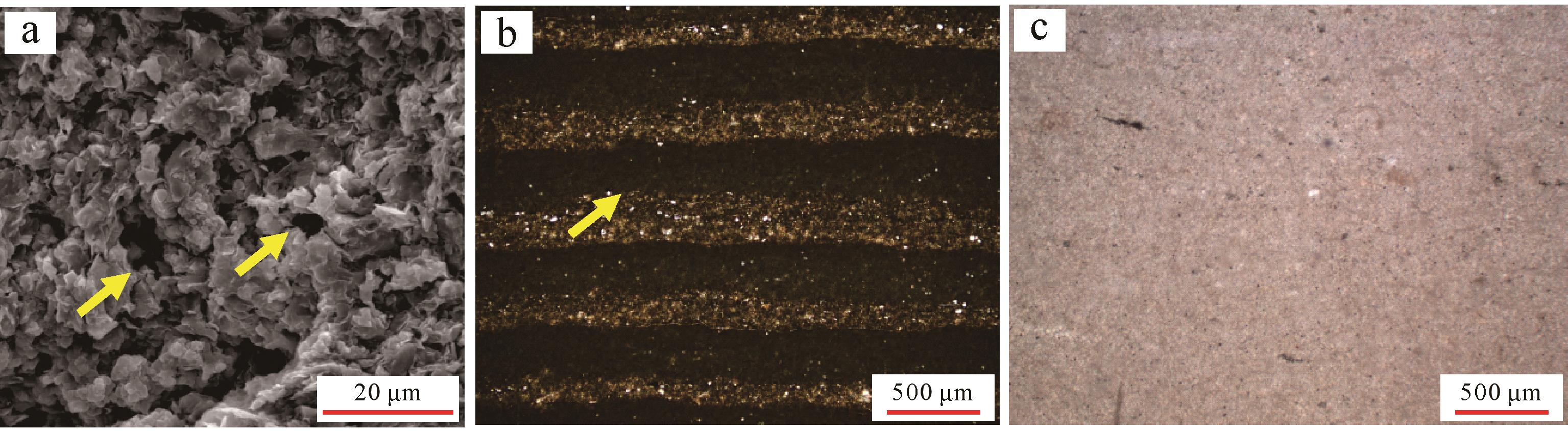
图 1 不同物理搬运机制形成的沉积特征
Figure 1. Deposition structures formed by different physical transport mechanisms
-
大气搬运的细粒沉积物主要为沙尘和火山灰(Tsoar and Pye,1987;Middleton and Goudie,2001;杜学斌等,2022;姜在兴等,2022)。现代沙尘暴观测结果表明,粒径在0.1~0.5 mm的颗粒以跳跃方式运动,0.5~2.0 mm的颗粒通过蠕动方式前进,小于0.1 mm的颗粒以悬浮方式运移(Folk,1971),沙尘主要由粉砂粒径的石英构成,这些细粒物质借助风力可以输送到距离源区数千千米的位置沉积下来(Huang et al.,2008),例如撒哈拉沙漠产生的沙尘影响范围远至美国东南部、加勒比海等地区(Prospero,1996;Smith et al.,1996),O’Brien(1996)认为风力搬运到盆地中的粉砂和黏土悬浮沉降,是形成细粒沉积岩中水平连续、层内无粒度分级、界面突变接触的粉砂和黏土薄层的机制之一(图1b)。火山喷发时产生的大量细小火山灰(粒径小于2 mm)可通过风力等自然作用进行长距离搬运,研究表明粒径小于10 μm的火山灰颗粒在大气中停留时间可能超过10天(Rose and Durant,2009),甚至数月(Cooper et al.,2018),例如7万年前印尼的多巴超级火山喷发,3 000 km³的火山灰迅速扩散,3天后遮蔽了半个地球,距离火山口2 000 km外的印度沉积了5 m厚的火山灰(顾朝林等,2023)。
-
底流通常指深水沉积环境中长期或持续作用于水体底部,能够造成搬运、侵蚀和沉积的半永久性水流(Rebesco et al.,2008,2014;王振,2023),等深积岩是底流活动直接作用的沉积产物(Rebesco,2005;Stow and Smillie,2020;Shanmugam,2022)。底流的形成与温盐驱动、风、潮汐、上升流和下降流等多种因素有关(王振,2023)。根据底流的驱动机制,底流分为风驱底流、温盐底流、深水潮汐底流和内波/内潮汐驱动的斜压流四类(Shanmugam,2008,2022)。
研究表明,底流是水体中细粒沉积物的重要搬运机制(李一凡等,2021)。Smith et al.(2019)分析了美国东部阿巴拉契亚盆地中—上泥盆统富有机质黑色页岩后,认为底流的搬运作用是形成该套细粒沉积地层的重要因素,证明了富有机质页岩可以形成于具有一定水动力的含氧环境;Schieber et al.(2019)研究了罗马尼亚的沥青质灰泥岩地层后,提出其中的细粒复合颗粒是由同时期的海底底流侵蚀,之后以底床载荷方式运输后沉积而成,丰富了人们对细粒沉积物搬运机制的认识;Paz et al.(2022)在阿根廷Neuquén盆地侏罗纪晚期—白垩纪早期的细粒沉积地层中,发现了大量底流搬运形成的平行层理、波状交错层理等牵引构造,扩展了学界对细粒沉积物运输过程的理解。
牵引构造是底流搬运最常见的沉积构造(Shanmugam,2008,2017)(图1c),平行层理、波状层理、压扁层理、透镜状层理、双黏土层、羽状交错层理、低角度交错层理、双向交错层理、爬升波痕交错层理、波状交错层理、脉状层理、逆粒序层理等沉积构造能够在底流沉积物中识别出来(宋博等,2016;Shanmugam,2017;龚承林等,2024),这些沉积构造往往单独出现,并非形成一个完整递变的序列,从而可以与浊流等流体类型进行区分(龚承林等,2024),但四类底流均能形成类似的牵引构造,如何利用这些沉积构造区分不同类型的底流是目前面临的挑战(Shanmugam,2017)。东营凹陷沙河街组三段—四段的灰质泥岩或泥质灰岩中,常见泥晶方解石颗粒构成的透镜体(图1d),透镜体长轴多水平排列,成层性较好,附近沉积物未见风暴作用造成的扰动构造,说明搬运流体为水平运动的层流,且沉积时水体能量较低。透镜体纵向上不具有粒序特征,可能为多期流体运动所致。综合上述推断,东营凹陷沙河街组三段—四段灰质泥岩或泥质灰岩中的透镜体主要为多期底流成因,底流冲刷破碎均质灰质泥纹层,破碎后的泥晶方解石纹层被底流搬运沉积,在压实作用下形成泥晶方解石透镜体。川北地区千二段的粉砂质泥岩或泥质粉砂岩中,纹层之间的接触面常为不平整冲刷面,内部偶见反映底流牵引作用的微波状断续纹层,部分上覆沉积构造中可见下覆沉积构造的撕裂碎片,部分纹层可组成交错层理等多样的沉积构造类型(图1e),指示了沉积时期底流频繁发育。
-
异轻流是河水流入湖(海)盆后,由于盐度和密度差异,漂浮在湖(海)面的浮力水体(施振生和周天琪,2024),风力是主要驱动力(Warrick et al.,2007),常形成水平层理、块状层理等沉积构造,其中常见植物碎屑(吴雨农,2023)。Kineke et al.(2000)通过分析Sepik河口附近水体中的悬浮沉积物和盐度的分布,结合地震剖面观测等技术,证明了河水形成的异轻流可以将细粒沉积物搬运到大陆架和斜坡上沉积。随后,Curran et al.(2002)提出异轻流中的悬浮沉积物的聚集和沉降速率与风速、风向以及潮汐有关,证实了黏土絮凝体与长英质颗粒是河水异轻流的重要组成部分,这些沉积物能够被搬运到湖盆水体较深的位置沉积。实验研究表明,异轻流中的沉积物通量主要受湍流产生的对流过程控制,而与沉积物的颗粒特性关系较小(Mccool and Parsons,2004)。最近研究发现,河流携带的细粒沉积物入海形成的异轻流,在大潮混合作用下,是造成深水重力流的重要机制(Hage et al.,2019;杨田等,2021)。盐度差异是两者发生转化的关键因素,盐度差越小,越容易发生转化(Parsons et al.,2001;Davarpanah and Wells,2020),沉积物常形成云雾状构造、砂质团块和液化构造(Shanmugam,2013)(图1f)。
-
重力流作为一种高效的搬运机制,对细粒沉积物的分布具有深远意义。细粒沉积物中的重力流搬运有多种类型,包括滑动—滑塌、浊流、异重流、泥质碎屑流、风暴流和波浪增强重力流等(Mulder,2003;Plint,2012;Baas et al.,2014;宋明水等,2017;Boulesteix et al.,2019;Mutti,2019;李森等,2020;杨田等,2023)。
-
滑动—滑塌沉积是在一定触发机制下,由于自身重力作用,沉积物上的重力沿斜面向下的分力不足以克服沉积物内部的内聚力,斜坡高部位先存的沉积物发生再搬运,沿斜坡以连续或不连续块体(刚性固体)形式向斜坡底部运动,在斜坡下部平缓地带堆积形成的沉积体(操应长等,2017a;Xu et al.,2023)。
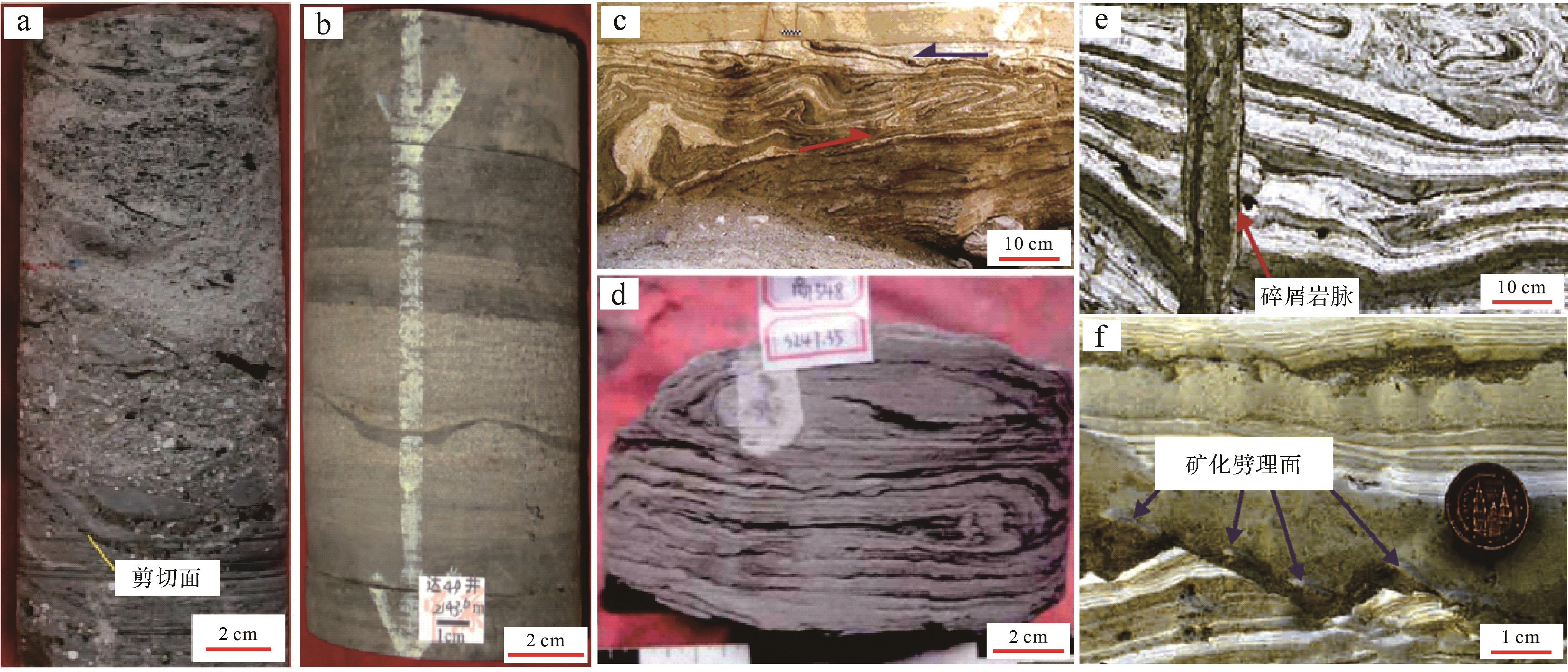
滑动—滑塌触发机制多样,包括沉积颗粒自重、波浪震荡、地震、火山、海啸等多种成因(Mutti,2019;钟建华等,2019;崔明明等,2023),常形成底部剪切面、逆冲断层、褶皱、包卷层理、交叉切割的碎屑岩脉、矿化劈理面、不规则塑性变形泥砾等构造(Waldron and Gagnon,2011;Alsop and Marco,2012;操应长等,2017a;高红灿等,2017;陈广坡等,2018;Alsop et al.,2019,2021;Mutti,2019)(图2)。根据滑动—滑塌中变形构造,能够判断沉积物的受力情况和移动方向(王龙樟等,2018),从而有助于认识当时的沉积环境、古地形和古地震事件(钟宁等,2021),并对现今的地质灾害研究和油气勘探具有重要的指导意义(李相博等,2009;邹才能等,2009;Hage et al.,2019)。而变形构造种类较多,成因和触发机制复杂,特别是在滑塌褶皱形成时的沉积环境、构造背景、变形机理等方面(邵珠福等,2014;Yang and van Loon,2016;李守军等,2017;Liang et al.,2018;孟元库和李日辉,2019;钟建华等,2020),众多学者还存在较大争议,使得滑塌褶皱研究成为目前变形构造研究中最具争议的课题(崔明明等,2023)。

图 2 滑动—滑塌沉积特征
Figure 2. Sliding and slumping sedimentary characteristics
国内外学者在西班牙东南部Prebetic地区、加拿大西北部Bowser盆地、鄂尔多斯盆地镇原地区、渤海湾盆地东营凹陷、海拉尔盆地东明凹陷、滦平盆地、共和盆地等地区的细粒沉积地层中识别出了大量滑动—滑塌构造(Rodrı́guez-Pascua et al.,2000;Gagnon and Waldron,2011;陈广坡等,2018;何维领等,2020;刘炳强等,2020;刘建平等,2022;王成等,2022;Xu et al.,2023),表明滑动—滑塌在细粒沉积物的搬运中起到了重要作用。东营凹陷沙四上亚段滑动—滑塌较为常见,在FY1井、NY1井、G17-X10井、NX55井等取心井中发育较多包卷层理、纹层强烈变形等滑动—滑塌作用形成的变形构造。
-
浊流是一种在水体底部形成的高速紊流状态的混浊流体,由水和大量自悬浮物质混合而成,是重力流的一种(姜辉,2010;徐景平,2014)。研究表明,浊流是将陆地上的陆源碎屑物质及其他颗粒类型,搬运至深海或者深湖地区的最重要搬运方式(Shanmugam,2000;徐景平,2014;马瑶等,2024),浊流能够将大量泥砂带入海洋或湖泊深处,形成浊积岩。季节性洪水、地震、海啸、风暴、火山喷发等地质事件都能够触发浊流(Arai et al.,2013;Normandeau et al.,2020;Heerema et al.,2022;Bigham et al.,2023;Williams and Rowley,2023)。
浊流内部的颗粒主要受流体扰动支撑,当浊流速度降低,能量逐渐衰减而不足以搬运沉积物时,浊流中的沉积物按其颗粒的大小依次沉降,从而形成了具有递变沉积特征的正粒序层理(Bouma,1962;Dott,1963;高红灿等,2017)。需要注意的是,一次浊流形成的单层总是呈向上变细的正粒序(吴崇筠,1986;李文厚等,2001),即正粒序的概念只是针对单一浊流事件沉积(Bouma,1962;Kuenen,1967;Bates and Jackson,1980),将正粒序应用于由多个层组成的、代表多个沉积事件的混合单元是错误的(Shanmugam,2002,2006)。浊流搬运机制表现为沉积物重力流—牵引搬运—悬浮沉积的变化特征(Paz et al.,2022),能够形成包含5个纹层组的垂向变化序列(Lazar et al.,2015)(图3a),所以浊积岩不仅发育鲍马序列,在搬运过程中,浊流可能会侵蚀下覆沉积物,形成冲刷面、印模和槽模(尚婷等,2013;高红灿等,2017;Xu et al.,2023)(图3b~d),随着较粗颗粒的卸载,流体的密度和悬浮物的沉降速度降低,水流的牵引作用增加(李文厚等,2001),其沉积物就会发育主要由上覆流体牵引驱动形成的纹层构造(李存磊等,2012)。在东营凹陷FY1井、LY1井、NY1井和T41井等取心井的沙三下—沙四上亚段地层和川北地区YY2井、YY3井和CS60井等取心井的千二段地层中识别出了正粒序构造、重荷模构造等浊流搬运的证据。

图 3 浊流沉积特征
Figure 3. Turbidity current sedimentary characteristics
-
异重流作为一种近年来提出的沉积物输送机制(谈明轩等,2015),是携带沉积物颗粒导致流体密度大于稳定环境水体的密度,流体受浮力影响小,沿盆地底部流动的高密度流体(Mulder and Syvitski,1995)。大量研究表明,异重流由洪水期河口直接注入,不需要沉积物的早期积累、再搬运及地震、火山、风暴、海啸等触发机制,由大范围降雨、冰雪融水、火山泥流等事件形成的包含大量沉积物的洪水是异重流形成的主要触发机制(Mulder et al.,2001b,2003;Plink-Björklund and Steel,2004;孙福宁等,2016;栾国强等,2018)。
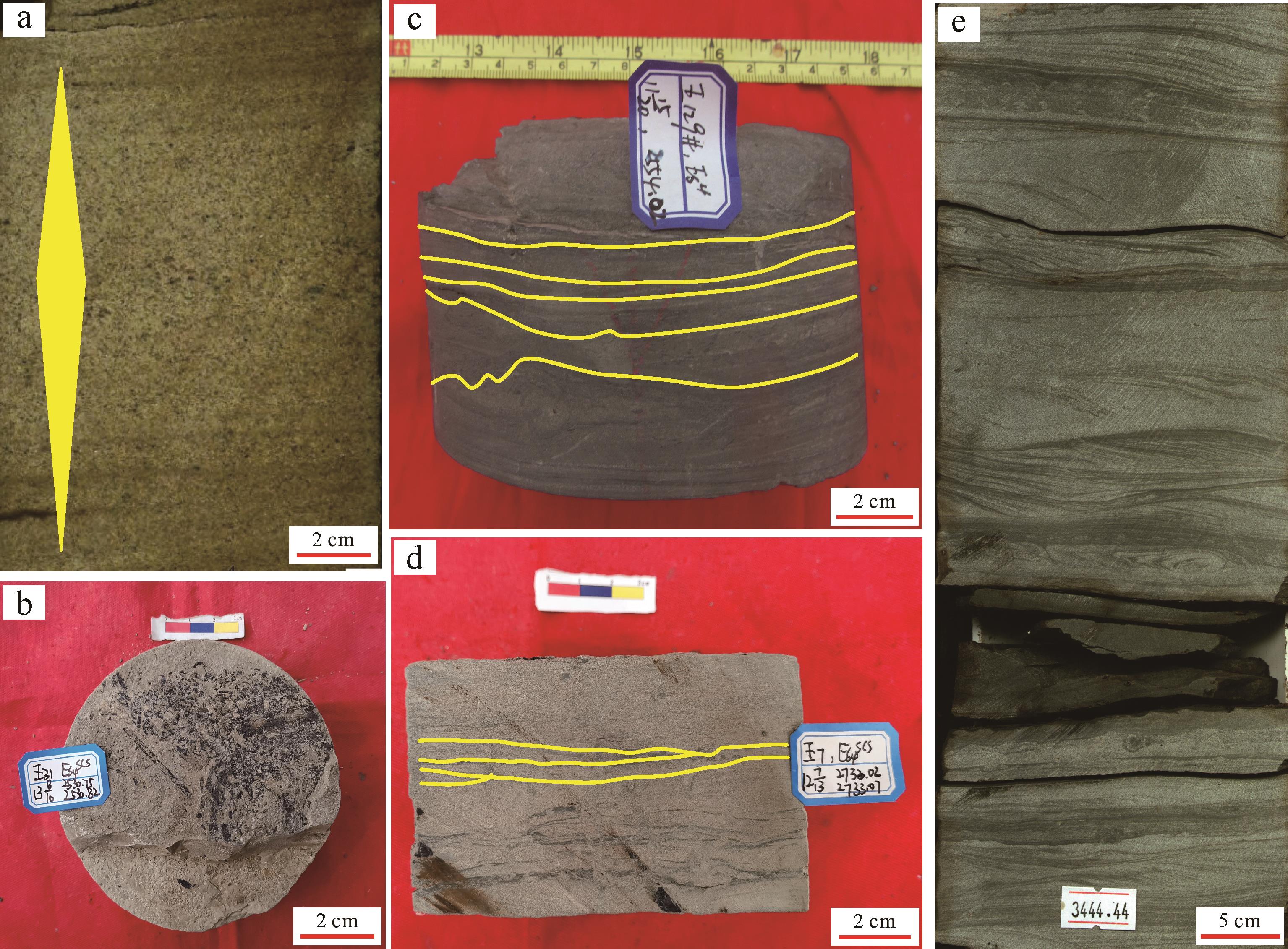
异重流颗粒间的支撑机制为流体湍动支撑(Mulder et al.,2001a),近端多为中—细砂岩,中部以细砂岩、粉砂岩为主,远端则主要为粉砂岩、泥质粉砂岩和泥岩等细粒沉积岩(孙福宁等,2016),因此异重流被认为是将大量细粒沉积物搬运至深水盆地的重要流体类型(宋明水等,2017)。异重流由近源到远源流动过程中,能量亏损,流速降低,单期异重岩沉积过程与异重流能量演化过程密切相关,因此异重岩垂向上形成了记录异重流能量增强和减弱的逆—正粒序(Mulder et al.,2001a)。由于异重流存在悬浮载荷、底床载荷和漂浮载荷(Plink-Björklund and Steel,2004;Zavala et al.,2006;Hüneke and Mulder,2011;Mulder and Chapron,2012;杨仁超等,2023),异重岩中还可能发育爬升沙纹层理、平行层理、波状层理、交错层理、层内微侵蚀面、植物碎片等沉积特征(杨田等,2015;金杰华等,2019;Xu et al.,2023)。异重流在川北地区千二段较少发育,但在东营凹陷沙四上亚段较多,例如东营凹陷FY1井、T29井、W7井、W31井、W129井等取心井中存在大量异重流搬运的证据(图4)。

图 4 异重流沉积特征
Figure 4. Gravity flow sedimentary characteristics
-
风暴流沉积作为一种较特殊的沉积体,一般发育在正常浪基面与风暴浪基面之间,风暴浪破坏了原始的水温和水动力条件,并冲击和改造了异地和原地沉积,同时将浅水的粗粒碎屑带到深水,形成低能条件下的高能沉积(钟建华等,2020)。风暴流的产生与风暴息息相关,气温、水温、湿度、地形、气压、季节等因素控制着风暴的形成(Nance and Colman,2000;Woods,2005;Chen et al.,2008;Saunders and Lea,2008;王秀明等,2013;Yang et al.,2019;黄程等,2021;沈晓玲等,2023;郑淋淋等,2023;柳龙生等,2024)。Xu et al.(2023)利用天文旋回研究了东营凹陷沙四段细粒沉积地层中的风暴事件后,发现长偏心率较大时期,水体和陆地之间较大的热力差与暖湿的气候促进了季风的形成,进而为风暴流的发生创造了良好条件。
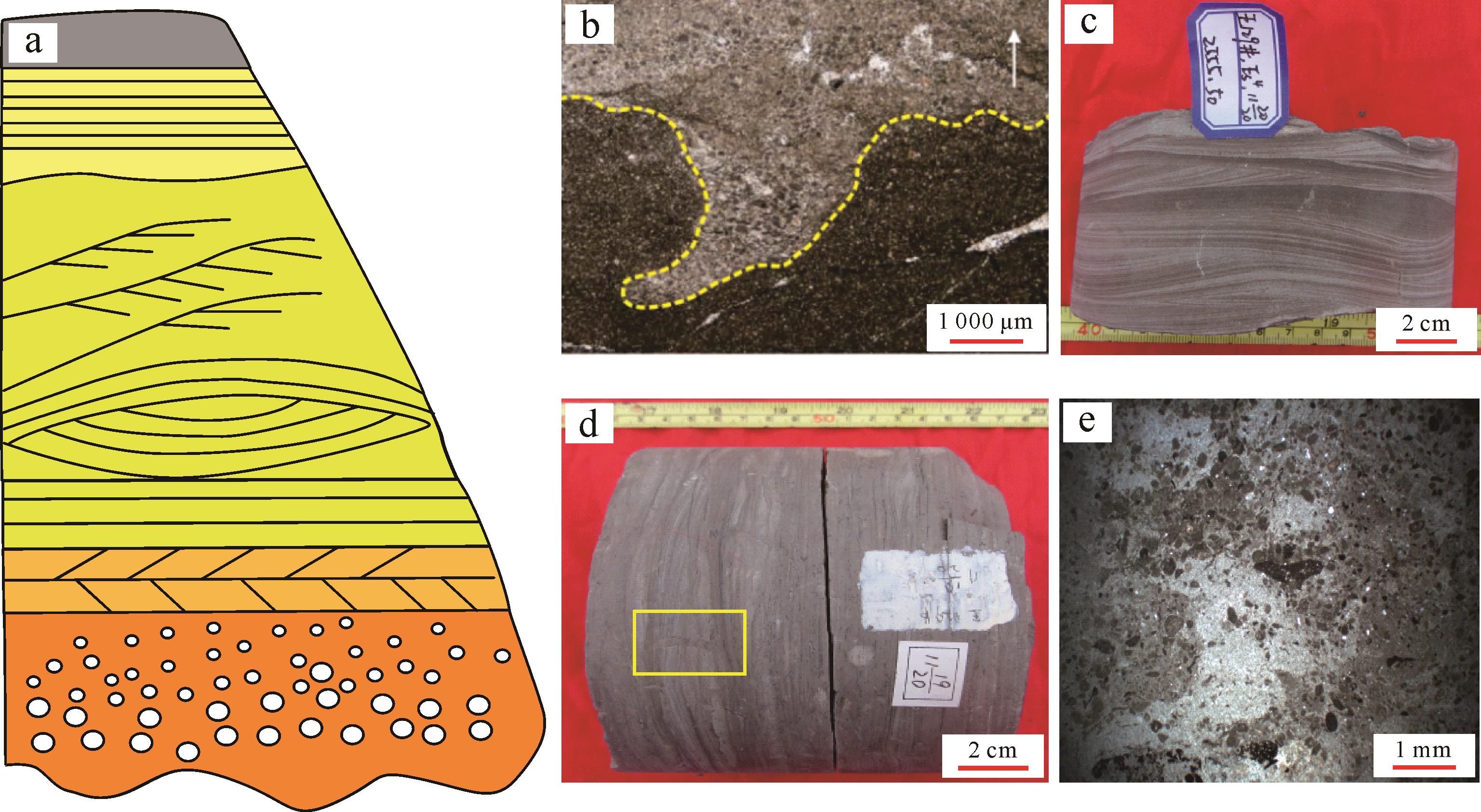
风暴事件可划分为风暴高峰期、风暴晚期和风暴后期三个阶段(Kreisa and Bambach,1982)。在风暴流作用初期,水底沉积物开始受到扰动,随着风暴高峰到来,风暴流能量骤增,大量沉积物冲刷水底沉积物,形成风暴侵蚀面等构造。当风暴高峰期过后,能量逐渐衰减,水体由高流态向低流态过渡,风暴流搬运的物质依次堆积,沉积物粒度逐渐变细,显示了水动力由弱突然变强,再逐渐减弱的沉积过程。一次风暴流形成的完整风暴岩沉积序列,自下而上包括粒序层理段(砾岩—含砾砂岩)、块状层理段(粉砂岩—含砾砂岩)、丘状交错层理与平行层理段(粉砂岩—细砂岩)、波状纹层段(粉砂岩—泥岩)和泥岩段(田景春,2014)(图5a)。此外,底面侵蚀构造(图5b)、粗粒滞流沉积、生物逃逸迹、浪成交错层理等构造也是风暴岩的识别标志(郑荣才等,2010;王瀚等,2019;何玉平,2020;Xu et al.,2023;宋慧波等,2024)。上述风暴流搬运形成的沉积构造在东营凹陷沙四上亚段的细粒沉积岩中广泛发育(图5c~e)。

图 5 风暴沉积特征
Figure 5. Storm deposition characteristics
-
Shanmugam(1996)提出了泥质碎屑流的术语,泥质碎屑流是一种以泥质沉积为主的塑性流体,以层流态方式运移,其沉积物支撑机制包括基质强度、分散压力和浮力,内部混杂少量砂质颗粒和砂质团块,黏土含量高,黏结性强。该流体在一定的触发机制下,通过自身重力驱动沿斜坡向下运动,由于基质内聚力较强,环境水体难以对流体稀释,并且被限制在流体底部,产生滑水现象,使得流体能够在水体中搬运较长距离,最后由于能量逐渐降低而沉积在斜坡下部和湖盆的平坦部位(廖纪佳等,2013;杨仁超等,2023)。
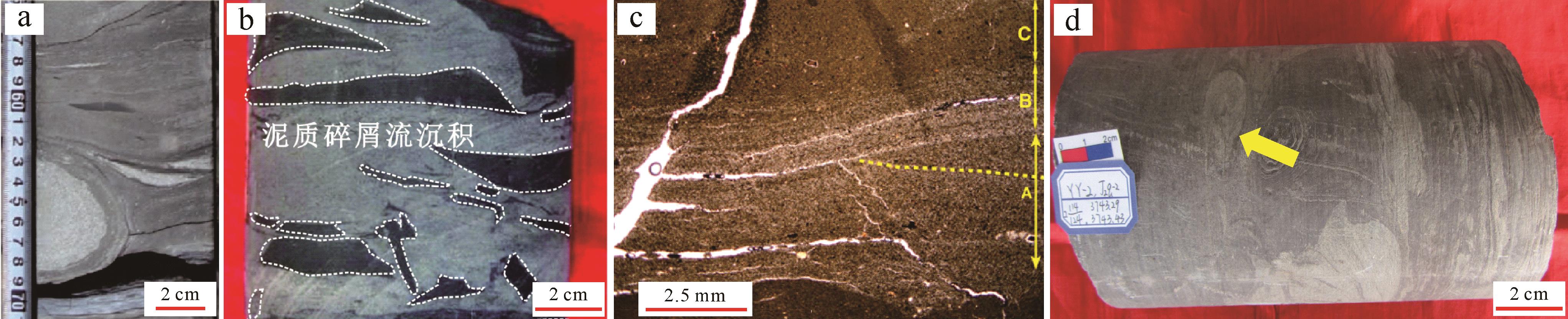
洪水和滑塌作用均能够形成泥质碎屑流(李振鹏等,2019;杨仁超等,2023),沉积物以块状为主,与底部和顶部泥岩呈突变接触,反映了块状冻结的特征,内部常见砂质团块以及平行排列、两端拉长变细的漂浮状泥岩撕裂屑(张青青等,2017;周新平等,2021;余烨等,2022)(图6a,b),反映了层流流动特征,表明其经过了较长的搬运和调整。

图 6 泥质碎屑流和波浪增强重力流沉积特征
Figure 6. Muddy debris flow and wave⁃enhanced gravity current sedimentary characteristics
泥质碎屑流在搬运过程中,常伴随着流体类型之间的转化(操应长等,2017b;李相博等,2019;余和雨等,2019),这主要与流体在流动时,沉积物中黏土矿物、有机质等颗粒含量的变化有关(Boulesteix et al.,2019;Craig et al.,2020)。研究发现,泥质碎屑流与浊流、砂质碎屑流之间的演变是常见的转化形式(Talling et al.,2013;操应长等,2017b;王启明等,2023;杨田等,2023;于吉星等,2023;王冠民等,2024)。李聪等(2023)研究了南堡凹陷陆相重力流沉积岩后,认为内部具有大量泥岩撕裂屑和砂岩透镜体的泥质碎屑流沉积,是由后端的浊流转化而成;王冠民等(2024)分析了辽中凹陷东三段重力流沉积,认为砂质碎屑流转化成泥质碎屑流后,泥质含量升高,会导致形成的储层物性变差。
泥质碎屑流搬运在川北地区千二段少量发育,本次分别在YY2井、YY3井、LY1井和CS60井等取心井的块状泥质粉砂岩或粉砂质泥岩岩心上,识别出少量泥质碎屑流形成的沉积构造,例如在YY2井3 743.36 m和YY3井3 548.17 m附近识别出大小约4 cm的孤立粉砂质团块(图6d)。
-
波浪增强重力流的概念由Macquaker et al.(2010)提出,这是一种在波浪作用下,将沉积物以流体泥的形式沿低角度大陆架向坡下运输的流体。国内外学者在现代陆架泥质沉积物、英国克利夫兰铁矿组、美国Mowry页岩、加拿大阿尔伯塔省Smoky河附近的白垩纪泥岩、中国雅布赖盆地新河组和渤海湾盆地古近系等细粒沉积岩地层中识别出了该类流体(Macquaker et al.,2010;Plint,2014;张少敏等,2016;王伟庆等,2022)。
波浪增强重力流形成的沉积构造由三部分构成(图6c):(1)由粉砂或细砂粒级的石英和黏土聚合体形成的底层,内部可能发育波状纹层和内碎屑,表明沉积物是在波浪影响的湍流条件下,受到牵引分量形成(Macquake et al.,2010);(2)当流体中悬浮泥质含量逐渐升高,流体流动结构发生改变(Friedrichs and Wright,2004;Macquake et al.,2010;Baas et al.,2011),湍流逐渐转变为过渡性流体(Plint,2014),形成了平行互层的粉砂和泥质纹层,向上泥质比例增加;(3)晚期流体能量减弱,流速降低,泥质含量增高,湍流受阻,颗粒凝聚发生凝胶化作用,整体快速沉积形成泥质层(Baas et al.,2011;Talling et al.,2012)。
-
细粒沉积物中的溶解物质,可以呈胶体溶液或真溶液被搬运。当环境的pH值、Eh值、温度、压力、离子浓度或电荷等发生改变时,溶解物质就可能从溶液中絮凝或沉淀出来(姜在兴等,2022)。
黏土矿物在水体中能够以胶体质点形式搬运(董万百等,2024;陆加敏等,2026)。带同种电荷的胶体质点之间存在的相互排斥力,是引起胶体质点搬运的主要因素,也是胶体质点在重力作用下难以沉积的根本原因(朱筱敏,2008)。研究人员利用高岭石、蒙脱石胶体溶液,探讨了黏土矿物在水溶液中的电化学行为,发现改变无机盐种类、浓度、pH值等环境条件,能够影响黏土矿物的双电层特性,进而影响颗粒间的相互作用,最后控制胶体悬浮液的稳定性(Secor and Radke,1985;Chang and Sposito,1996;Aurell and Wistrom,2000)。
研究显示,当溶液中Na+浓度增加到一定程度时,黏土颗粒间产生静电排斥力的扩散离子层厚度被压缩,范德华力开始占据主导地位,黏土颗粒之间的相互作用力变为引力,导致颗粒聚集,形成絮凝体沉降(Lagaly,1989),随着无机盐浓度的增加,颗粒间碰撞频率增加,絮凝速率加快,絮凝体尺寸逐渐变小(Lick et al.,1993),也有学者通过探讨不同盐度条件下高岭石的絮凝沉积作用,认为盐度不是决定高岭石临界沉积速度的主要因素,但是能够促进絮凝效率(Schieber et al.,2023)。不同无机盐含有价态各异的离子,在黏土絮凝过程中会造成不同的影响,有研究指出,二价阳离子(如Ca2+和Mg2+)相较于单价阳离子(Na+和K+)电荷更高,能够更加有效地中和黏土颗粒表面的负电荷,减少颗粒间排斥力,从而促进黏土颗粒的絮凝(Ahmed et al.,1969)。相同价态的不同阳离子对黏土颗粒的絮凝作用也有所差异,例如,相同条件下Ca2+比Mg2+能够更加有效地促进黏土颗粒的絮凝(Heil and Sposito,1993)。Xu et al.(2015)利用NaNO3和KNO3溶液探究了蒙脱石的絮凝作用,结果显示,K+更有助于黏土颗粒的絮凝,K+在黏土颗粒表面发生的强烈非经典极化现象是造成这一差异的原因。有机化合物也能够促进黏土颗粒的絮凝(Furukawa et al.,2014),与无机盐离子略有不同,有机化合物除了可以通过影响黏土矿物表面的电荷,影响黏土矿物的絮凝沉积,还可以通过桥接作用使黏土物质结合到一起,形成絮凝物(Lagaly and Dékány,2013;Lamb et al.,2020)。众多研究表明,pH值对黏土矿物的絮凝作用有重要影响,pH值较小时,有利于黏土矿物的絮凝(Krizek et al.,1975;Thellier et al.,1992;Mietta et al.,2009;Lagaly and Dékány,2013),其原因是质子(H+)与黏土矿物边缘的羟基(OH-)反应,影响黏土矿物边缘电荷密度,进而影响絮凝行为(Thellier et al.,1992)。Mietta et al.(2009)运用多种实验手段研究了蒙脱石和高岭石的絮凝行为后,发现pH值为4时,蒙脱石和高岭石颗粒边缘带正电荷,导致其快速絮凝并形成较大絮凝体,而pH值为8时,黏土颗粒边缘带负电荷,不利于发生絮凝。此外,颗粒大小、颗粒浓度、水动力条件和沉降速度同样影响着黏土矿物的絮凝(Sherman,1953;O'Brien et al.,1980;Lick et al.,1993),进而影响黏土矿物在水体中的搬运。不过,颗粒预处理的影响、颗粒尺寸对表面性质的影响,以及天然矿物与实验室纯矿物之间表面性质的差异,使得实验室得出的结果,能否用来解释自然水体中黏土胶体质点的电化学行为还存在很大的不确定性(Filella,2006)。
自然环境中,河流将带负电荷的黏土矿物以胶体形式搬运至河口时,湖(海)水中Ca2+和Mg2+等带正电的离子能够与黏土矿物表面的负电荷中和,消除黏土矿物之间的相互排斥力,从而使得黏土胶体质点发生凝聚,下沉形成胶体沉积物(董万百等,2024)。本次对川北地区千二段和东营凹陷沙三下亚段—沙四上亚段细粒沉积岩进行扫描电镜观察,发现两地区黏土矿物粒径较小,普遍小于10 μm,有利于黏土矿物间发生絮凝作用。在CS60井、LY1井、YY2井、NY1井、LY1井等多口取心井的部分深度段可见黏土矿物絮凝作用形成的絮凝孔(图7a),指示化学作用促进了两地区黏土矿物的搬运和沉积。

图 7 细粒沉积岩中黏土矿物絮凝孔及泥晶碳酸盐矿物特征
Figure 7. Characteristics of micritic carbonate minerals in fine⁃grained sedimentary rocks
前文提到,水体碳库中包括颗粒无机碳、溶解无机碳、颗粒有机碳和溶解有机碳(张兴亮,2022),其中DOC是水生系统中重要碳源,也是水体中微生物生命活动的重要物质来源(Raymond and Bauer,2000;潘艳喜,2022)。河水是将DOC输入到海洋碳库的主要途径(Meybeck,1982),当海平面快速上升或远洋深层水上涌时,深水中的DOC能够被运输到浅水区域(张兴亮,2022)。由于黏土矿物粒径小,比表面积大,层间域有较大胀缩性,且表面裸露化学官能团,因此黏土矿物具有吸附水中DOC的特性(Kennedy et al.,2002;Churchman et al.,2020)。水体中的DOC通过离子交换、阳离子桥、水桥和离子偶极力等多种机制,被吸附在黏土矿物的外表面和层间域中(Grotzinger et al.,2011),形成结构复杂的有机碳—黏土絮凝体,所吸附有机碳按赋存空间分为表面与絮凝孔隙吸附的有机碳、结构边缘孔隙吸附的有机碳和内部层间域吸附的有机碳(卢龙飞等,2013),被黏土矿物吸附的DOC,特别是吸附在黏土矿物层间域的有机碳很难被降解或被微生物利用(Saggar et al.,1996;Kennedy et al.,2002;Grotzinger et al.,2011;卢龙飞等,2013;Churchman et al.,2020)。因此,认为有机碳—黏土絮凝体的形成促进了有机碳的富集,有利于DOC在水体中保存,增加了DOC向盆地更远位置运输的可能性。
碳酸盐类矿物是细粒沉积物中的重要组分。很多湖泊中的碳酸盐矿物是由湖泊周围地区岩石风化剥蚀,输送到水体中沉积形成的(Håkanson and Jansson,1983)。但是在钙质基岩区,水、CO2和含钙矿物之间发生反应,大量Ca2+、HCO
铁是湖相细粒沉积物中的常见元素,有时也可以呈离子状态在水中被搬运。影响铁搬运的主要因素是Eh和pH值。Fe3+只有在pH小于2~3的水体环境中,才能被长距离搬运,当Eh值降至200 mV以下,pH值显中性特征时,Fe3+转化为Fe2+,Fe2+可以聚集在沉积物孔隙水中或以离子形式作长距离搬运,因此Fe2+远较Fe3+易于搬运,若Eh值继续降低,Fe2+则会以难溶解的硫化铁化合物形式沉淀下来(Håkanson and Jansson,1983;朱筱敏,2008)。
-
一般认为,生物搬运有两种方式(朱筱敏,2008):一种是生物在生活过程中,不断从周围介质吸收物质成分,从而将一些元素富集起来,当生物死亡后,其遗体堆积物就可以形成特定的岩石或矿产;另一种是生物通过生命活动引起周围环境改变,影响物质的搬运。
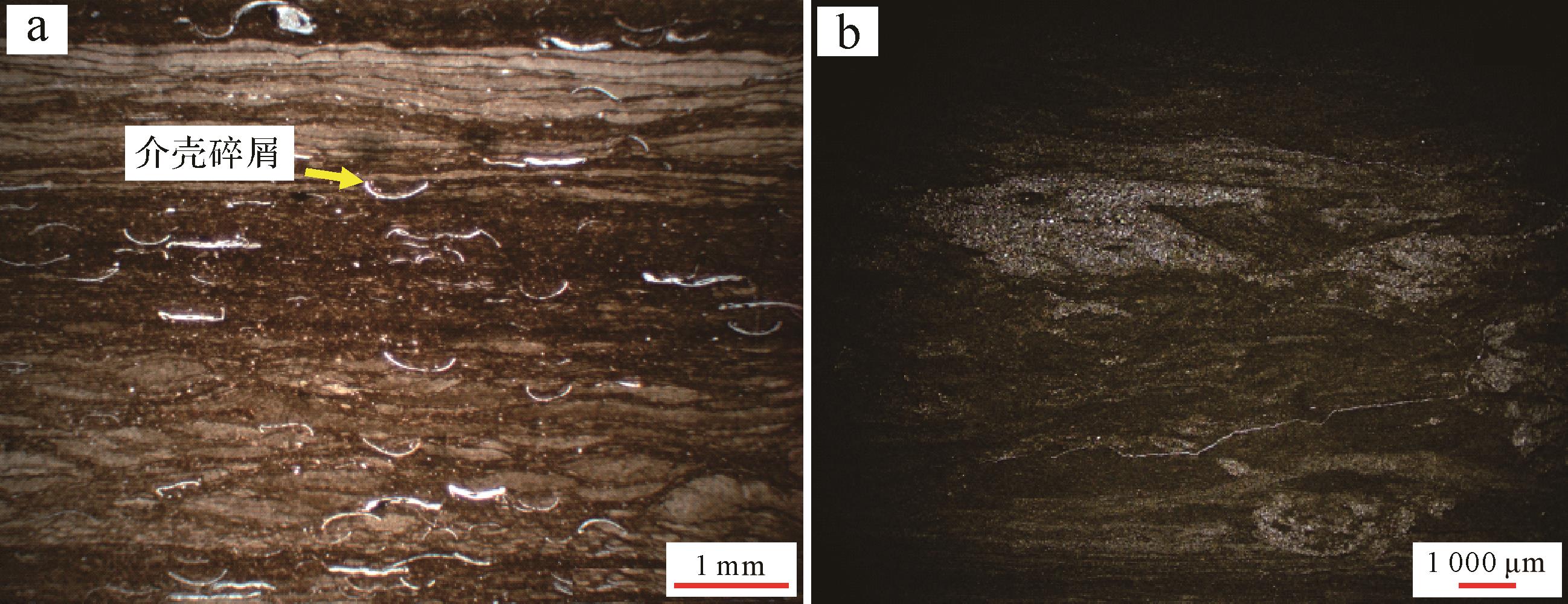
细粒沉积物中,钙质矿物、硅质矿物、有机质等物质成分可以通过上述第一种方式进行生物搬运,其中钙质矿物和硅质矿物受生物矿化作用控制。碳酸钙是自然界中最丰富的生物成因矿物,存在方解石、文石、球文石等多种变体(Aizenberg et al.,2003;Becker et al.,2003;汪玉瑛,2015),其中方解石和文石最为稳定且常见(杜津柘,2021)。碳酸钙矿物能够形成轮藻、颗石藻、软体动物贝壳以及珊瑚等众多生物的壳体。研究人员在巴西Araripe盆地Romualdo组、美国堪萨斯州下二叠统、中国四川盆地千佛崖组、渤海湾盆地沙河街组、准噶尔盆地芦草沟组、松辽盆地青山口组等地区及层位中的海相或陆相细粒沉积岩中识别出广泛发育的钙质有孔虫、介形虫、轮藻及其他钙藻等钙质生物化石(刘传联等,2001;Watabe and Kaesler,2004;刘长海等,2011;Araripe et al.,2021;刘金等,2021;朱如凯等,2022;焦悦等,2023;吕丹等,2023;彭军等,2024)。例如,在东营凹陷沙四段(图8a)和川北地区千二段细粒沉积岩中,发育较多成层或零散分布的介壳碎屑。生物体内的硅多以微小的非晶态二氧化硅形式存在,具有良好的塑性和强度(Lowenstam and Weiner,1989)。细粒沉积物中常见的硅质生物包括放射虫、海绵骨针和硅藻(Schimmelmann et al.,2016;Gao et al.,2021;管全中等,2021;王拔秀等,2024)。放射虫和海绵对海洋硅循环至关重要,它们的生活和保存受海洋上升流和火山活动影响(黄志诚等,1991;Ma et al.,2016),生物死亡后,骨骼沉积形成硅质软泥(黄志诚等,1991;童金南和殷鸿福,2007)。硅藻在自然水体中广泛分布(李东和汉景泰,2010),晚冬早春时,随着水温上升和营养物质上移,小型硅藻大量繁殖,夏季被绿藻或蓝藻取代(Kemp et al.,2000;Zolitschka et al.,2015;熊志方和李铁刚,2017),大型硅藻则从早夏生长至晚秋,秋末冬初时大量死亡并沉降到海底(Kemp et al.,2000;Smetacek,2000)。硅质外壳因难以降解,得以在沉积物中保存(Smol and Stoermer,2010)。藻类勃发不仅可以搬运沉积大量钙质或硅质骨骼,而且藻类死亡后可以分解产生大量有机质,形成有机质纹层,这是优质烃源岩形成的重要机制(刘传联等,2001,2020;王冠民,2005)。例如,鄂尔多斯盆地中元古界、松辽盆地青山口组、济阳拗陷古近系、准噶尔盆地芦草沟组等地区及层位中的烃源岩成烃母质,皆主要来源于藻类等低等水生生物(刘传联和徐金鲤,2000;冯子辉等,2009;焦鑫等,2021;潘星,2021)。气候、季节变化、火山喷发、热液活动等均能够导致藻类勃发,提高古生产力,促进有机质纹层形成(Kemp et al.,2000;邹才能等,2019;李耀华等,2022;刘显阳等,2023;周家全等,2023;刘全有等,2024;谢环宇等,2024)。微生物及其分泌的微生物细胞外聚合物(EPS)形成生物膜,这些生物膜在有利环境下,进一步发展成有机质厚层,称为微生物席(Noffke et al.,2001)。微生物死亡残体、释放的代谢产物及其捕获的有机质颗粒是微生物席向沉积物贡献的有机质类型(蔡进功等,2019)。

图 8 细粒沉积岩中介壳及生物扰动构造特征
Figure 8. Characteristics of shell debris and bioturbation structures in fine⁃grained sedimentary rocks
第二种生物搬运方式中,生物作用能够改变沉积物的稳定性,从而控制物质的搬运。微生物席上的EPS通常具有黏性,在吸附水体中碎屑物质的同时(Mount,1984;Schieber et al.,1999,2007a;Gerdes et al.,2000;Decho and Gutierrez,2017),能够增强沉积物的稳定性及抗侵蚀能力(Schieber et al.,1999;Underwood and Paterson,2003;Hanlon et al.,2006),进而影响沉积物的搬运。Malarkey et al.(2015)利用水槽实验研究发现,非常少量但广泛分布的EPS,足以显著影响底形的形成,这是由于EPS的黏性远比细粒沉积物中各物质之间的物理黏性强,极大抑制了细粒物质的移动。之后,Parsons et al.(2016)同样利用水槽实验,量化了EPS对底形形态的影响,证明了EPS通过增强细粒沉积物颗粒之间的黏合力,控制了底形的形态。另外,生物能够通过生命活动引起周围微环境(如pH、离子浓度等)改变、为矿物提供结晶位点、进行还原作用等方式,促进细粒沉积物中碳酸盐矿物、黏土矿物、石英、黄铁矿、有机质等物质的形成和搬运。例如,藻类能促使湖水中碳酸盐矿物的形成和搬运:夏季水温升高,日照较强,使藻类勃发,同时光合作用增强,不断消耗水体中的CO2,促使表层水中碳酸盐矿物形成(Kelts and Hsü,1978;王慧中和梅洪明,1998),最终在湖底形成浅色钙质泥晶纹层;水体中微生物细胞(即细菌、古菌和微型真核生物)分泌的EPS有助于微生物附着于表面,形成“生物膜群落”(Decho and Gutierrez,2017),并能够通过影响周围环境条件(Perri et al.,2018)、提供成核点(Krause et al.,2012)、物理吸附(Schieber et al.,2007a)等方式控制碳酸盐矿物、硅酸盐矿物、长英质矿物、有机质等物质的形成和搬运(Schieber,1986;O'Brien,1990;Konhauser,1997;Schieber,1999;Krause et al.,2012;Perri et al.,2018;Suosaari et al.,2022);细菌硫酸盐还原作用(BSR)是细粒沉积物中黄铁矿形成的重要途径,该作用由细菌介导,硫酸盐还原细菌将SO42-还原成H2S(公式1),再与Fe2+结合形成铁硫化物,形成粒度较小的草莓状黄铁矿(Machel,2001;Rickard,2019)。
(1) 此外,生物扰动对沉积物搬运也有重要作用(Shull,2009)。生物扰动是指充氧环境下,鱼类或其他动物群对湖(海)底沉积物造成的机械混合作用(Håkanson and Jansson,1983)。底栖生物通过摄食、掘穴和建造钻孔,扰动水底沉积物,影响颗粒物质的运输(Aller,1982;Kristensen,1988;Quintana et al.,2007;Mermillod,2011)。与物理搬运不同,生物扰动引起的沉积物运输,在极低或极高能量的水体环境中不复存在,而在中等能量的水体环境中最为活跃(Cadée,2001)。
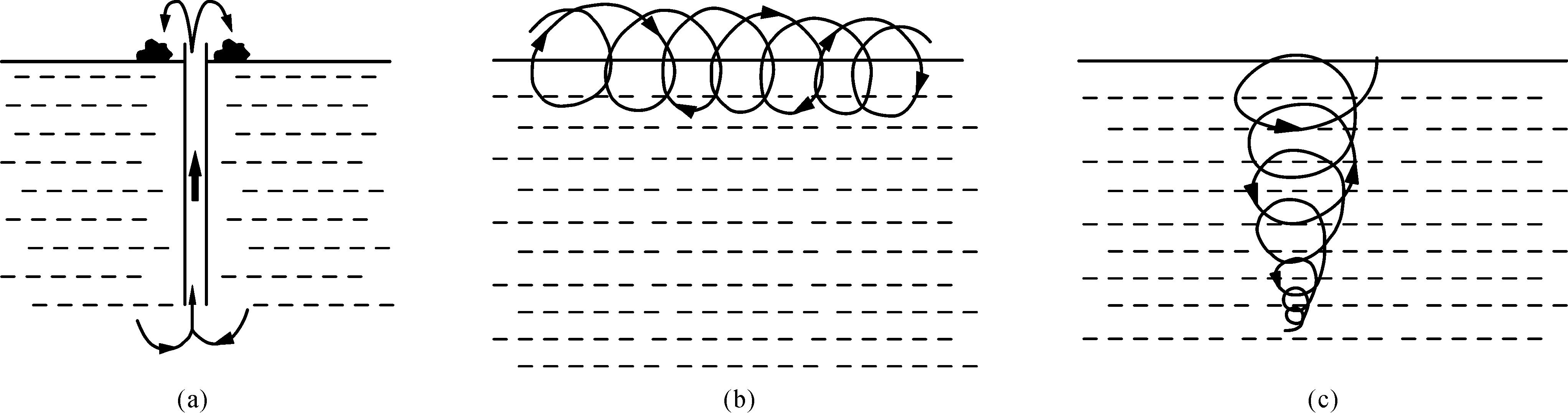
生物扰动会在细粒沉积岩中形成丰富的遗迹化石,Lobza and Schieber(1999)利用模拟实验还原了美国田纳西州中部上泥盆统页岩中生物扰动构造的形成过程,认为基质黏度、生物形态以及生物运动类型是控制不同形态生物扰动遗迹发展的关键因素。川北地区千二段细粒沉积岩中,发育大量生物扰动构造,这些生物扰动构造在沉积过程中显示出较好的持续性和普遍性,最常见的是发育在沉积物—水界面附近的斑驳状、边界模糊的生物扰动构造,将原始沉积构造搅混、破坏(图8b)。不同类型的生物在扰动过程中,会造成不同类型的生物搬运,Håkanson and Jansson(1983)根据生物种类的不同,将湖泊沉积物中生物对物质的搬运作用分为垂直向上搬运(图9a)、沉积物—水界面附近的搬运(图9b)和多类型生物综合搬运(图9c)三种类型,同时指出生物搬运作用会随着季节变化而变化。不同生物的摄食模式不同,可能是影响沉积物内颗粒或溶解质运输的关键。例如,头朝下进食的Heteromastus蠕虫将作为粪便团的颗粒从深部沉积物搬运到表层沉积物,表面底栖生物Marenzelleria蠕虫通过在沉积物表面附近挖掘寻找食物,搬运、混合了沉积物颗粒,研究人员利用发光体作为示踪剂,评估了二者对颗粒物质运输的影响后,发现Marenzelleria的颗粒混合率较Heteromastus高出1.5~2.2倍,说明不同类型生物对沉积物的运输条件与摄食模式紧密相关(Quintana et al.,2007)。为了满足氧气的代谢,洞穴中的底栖生物通常会进行灌溉作用,这一过程是孔隙水运输最重要的生物机制(Aller,1982)。

图 9 三种不同的生物搬运方式示意图(据Håkanson and Jansson,1983修改)
Figure 9. Schematic diagram of three different types of biological transport mechanisms (modified from Håkanson and Jansson, 1983)
生物扰动可以改变沉积物的粒径、稳定性、孔隙度、渗透率等性质,并显著影响水—沉积界面处营养物质的通量。研究人员利用示踪剂,在东太平洋圣卡塔利娜盆地探究了不同颗粒大小与生物扰动之间的关系,发现细颗粒比粗颗粒更易深入地渗透到沉积物中,细颗粒的生物扩散速率是粗颗粒生物扩散速率的10倍,原因可能是生物优先摄食细颗粒,并将其向下运输(Wheatcroft,1992)。生活在潟湖潮间带泥滩中的多毛类蠕虫通过摄食和排泄,对底层沉积物进行搬运,它们的搬运活动使得表层沉积物具有更好的颗粒分选性,排出的粪便富含有机质,增加了沉积物的凝聚力,有助于沉积物的稳定(Palomo and Iribarne,2000)。但底栖生物的掘穴、爬行等活动能够将沉积物混合,避免细粒物质在沉积物表面形成保护层(Singer and Anderson,1984),同时使沉积物表面处于松散或未压实状态,从而降低沉积物的抗侵蚀能力(Young and Southard,1978)。研究显示,生物搬运到水—沉积界面处富含有机质的粪便,能够在沉积物中创造还原条件(Nizzoli et al.,2005;Lindqvist et al.,2009),促进微生物在沉积物表面吸收氧气(Herringshaw and Mcilroy,2013),并增加水—沉积物界面处的营养物质通量(Gibbs et al.,2005;Giles and Pilditch,2006;Shull,2009)。有研究表明,生物灌溉作用能够将黏土大小的颗粒运输到生物洞穴周围的孔隙空间中,降低原始孔隙度和渗透率,从而影响沉积物的性质(Herringshaw and Mcilroy,2013)。然而,另外的关于潮间带蠕虫生物活动的实验发现,蠕虫更倾向吞食沉积物中较小的泥质颗粒,并通过排泄将其搬运到沉积物表面,之后这些细颗粒会在波浪作用下重新悬浮,并从沉积物中移除,这一过程使潮间带沉积物颗粒变粗,渗透率升高,同时也为沉积物中蠕虫的生命活动提供了足够的氧气(Volkenborn et al.,2007a,2007b)。生物搬运对生态系统也有一定的影响,有研究认为,底栖生物通过在泥质沉积物中摄食沉积物的搬运作用,减少了浮游生物的密度(Aller,1982)。
-
与传统搬运理论更侧重于单一的搬运方式不同,本文将细粒沉积物的搬运方式分为物理搬运、化学搬运和生物搬运三大类(表1),并将传统搬运理论中分析较为薄弱的化学搬运和生物搬运进行了更加深入的探讨。
表 1 细粒沉积物搬运机理类型及特征总结
Table 1. Summary of fine⁃grained sediment transport mechanism types and characteristics
搬运方式 搬运沉积特征 触发机制或影响因素 物理搬运 河水 低、过渡和高流态的不同床面形态 水流速度、粒径大小等 大气 水平连续、层内无粒度分级、界面突变接触的粉砂和黏土薄层 粒径大小 底流 平行层理、波状层理、压扁层理、透镜状层理、羽状交错层理、低角度交错层理等牵引构造 温盐驱动、风、潮汐、上升流和下降流等 异轻流 水平纹层、块状构造、植物碎屑等 盐度和密度差异 滑动—滑塌 底部剪切面、逆冲断层、包卷层理、不规则塑性变形泥砾等 沉积颗粒自重、波浪震荡、地震、火山、海啸等 浊流 冲刷面、印模、槽模、正粒序等 洪水、地震、海啸、风暴、火山喷发 异重流 逆—正粒序、爬升沙纹层理、平行层理、波状层理、交错层理、层内微侵蚀面、植物碎片等 洪水 风暴流 底面侵蚀构造、粗粒滞流沉积、生物逃逸迹、浪成交错层理等 气温、水温、湿度、地形、气压、季节 泥质碎屑流 块状构造、砂质团块、漂浮状泥岩撕裂屑等 洪水、滑塌作用 波浪增强重力流 波状纹层、内碎屑、平行互层的粉砂和泥质纹层等 波浪作用 化学搬运 块状构造、纹层状构造 pH值、Eh值、温度、压力、离子浓度、电荷等 生物搬运 纹层状构造、硅质或钙质生物化石、遗迹化石 含氧量、气候、季节、火山、热液等 (1) 物理搬运方式多样,包括河水搬运、大气搬运、底流搬运、异轻流搬运和重力流搬运,重力流搬运又分为滑动—滑塌、浊流、异重流、泥质碎屑流、风暴流和波浪增强重力流六种类型。推移力、载荷力和重力是物理搬运方式的驱动力,风力、潮汐、地震、洪水、风暴、火山喷发等是不同物理搬运方式的触发机制,这些搬运方式能够形成平行层理、交错层理、透镜状层理、粒序层理、褶皱构造、底面侵蚀构造、砂质团块等丰富的沉积构造。(2)化学搬运主要涉及呈胶体溶液或真溶液被搬运的溶解物质,例如黏土矿物、溶解有机碳、碳酸盐类矿物、铁质矿物等,这些物质受环境的pH值、Eh值、温度、压力、离子浓度或电荷等影响,能够从水体中絮凝或沉淀形成细粒沉积物。(3)生物能够通过吸收富集、生物活动引起环境改变和生物扰动影响物质的搬运。钙质矿物、硅质矿物、有机质等物质成分可以通过生物吸收富集的方式形成和搬运;生物活动引起环境改变可以影响沉积物的稳定性,进而控制细粒沉积物的搬运,同时可以结合为矿物提供结晶位点、进行还原作用等方式,促进细粒沉积物中碳酸盐矿物、石英、黄铁矿等物质的形成和搬运;生物扰动主要是底栖生物通过摄食、掘穴等活动对细粒物质进行运输,搬运作用分为垂直向上搬运、沉积物—水界面附近的搬运和多类型生物综合搬运。生物搬运可以改变沉积物的性质,显著影响水—沉积界面处营养物质的通量,并对生态系统也有一定的影响。
细粒沉积物搬运方式的研究近年来已取得显著进展,但由于细粒沉积物难以直观观测、搬运方式间相互作用与转换具有复杂性、搬运介质和沉积环境具有多样性,以及化学和生物搬运过程存在多重影响因素,并且在实际沉积环境中,多种搬运机制可能会同时发生,导致当前对细粒沉积物搬运方式的识别仍具有多解性和不确定性。例如,生物活动过程中可能会改变沉积物的物理特性,从而影响其化学稳定性和物理搬运能力;化学沉积过程可能会为生物提供附着基质,进而影响生物搬运;浊流等物理搬运机制运输黏土矿物时,可能会促进黏土矿物的絮凝等化学沉积过程;风暴流、底流等物理搬运机制运输沉积物时,引起的生物搬运会进一步混合沉积物,两种搬运机制共同决定了沉积产物的性质。
未来的研究应集中于以下几个方面:首先,深入探究不同细粒沉积物搬运机制之间的相互作用和转换规律,进一步重视和加强水槽实验、数值模拟在细粒沉积物搬运机理研究中的作用,采用多学科交叉的方法,全面分析不同搬运机制之间的相互作用和转换规律;其次,利用先进的技术手段,提高对沉积构造的识别精度和分析深度,例如,研究经历了成岩作用改造后的细粒沉积岩时,能否利用先进技术手段,判断岩石中代表不同搬运机制的沉积构造是否受到了成岩作用改造等;最后,加强化学作用和生物活动对细粒沉积物物理化学性质影响的定量研究,揭示其在搬运过程中的具体作用机理。上述研究的深入探索,有助于厘清不同类型搬运机制如何共同影响细粒沉积物的搬运和沉积,有望进一步减少细粒沉积物搬运方式研究中的不确定性,推动该领域的理论发展和实际应用。
-
摘要: 意义 细粒沉积物搬运机理研究是细粒沉积物“源—汇”系统理论中的重要一环,对恢复沉积环境、理解细粒沉积物分布和预测非常规油气资源等方面具有重要意义。由于细粒沉积物粒度细小,不便观察,且搬运方式多样,不同搬运方式对应多种沉积构造,因此,细粒沉积物搬运机理的研究进展缓慢。纵观国内外现有的研究成果,目前尚缺乏针对细粒沉积物搬运机理研究成果的梳理和总结。 【进展 】综合当前的研究成果,系统梳理了细粒沉积物的搬运方式及沉积特征,将细粒沉积物搬运方式分为物理搬运、化学搬运和生物搬运三大类。物理搬运包括河水、大气、底流、异轻流和六种重力流搬运,河水和大气搬运依靠流水或风的动力,克服细粒物质的重力作用,实现对细粒物质的搬运,搬运的驱动力主要是推移力和载荷力;底流、异轻流和重力流搬运由潮汐、风力、地震、洪水、风暴、火山喷发等方式触发,搬运的驱动力主要是重力。黏土矿物、溶解有机碳、碳酸盐类矿物、铁质矿物等呈胶体溶液或真溶液被搬运;溶解物质受环境的pH值、Eh值、温度、压力、离子浓度或电荷等影响,能够通过化学方式搬运。生物吸收富集、生物活动引起环境改变和生物扰动均能影响细粒物质的形成和搬运。 【结论与展望】 物理搬运方式以推移力、载荷力和重力等作用为驱动力,可形成丰富的沉积构造;化学搬运主要涉及溶解物质,受pH值、温度等环境因素影响;生物搬运通过吸收富集、改变环境和生物扰动等方式影响细粒物质搬运。未来应聚焦于细粒沉积物搬运机制间的相互作用,提高沉积构造识别精度,重视模拟实验研究,加强化学作用和生物作用定量化分析,以提升对细粒沉积物搬运过程的认识,推动细粒沉积学理论向前发展。Abstract: Significance The study of fine-grained sediment transport mechanisms is an important part of the “source-to-sink” system theory of fine-grained sediments, and it is significant for the restoration of sedimentary environments, understanding the distribution of fine-grained sediments and predicting the distribution of unconventional oil and gas resources. Due to the fine grain size, which makes them difficult to observe, and the diversity of transport modes, each transport mode corresponds to particular sedimentary structures. Therefore, research on the transport mechanisms of fine-grained sediments has progressed slowly. From a review of the existing research reported in China and elsewhere, it is evident that there is still a lack of sorting and summarizing research findings regarding the transport mechanisms of fine-grained sediments. Progress This study synthesizes current research, systematically sorts the transport modes and sedimentary characteristics of fine-grained sediments and classifies the transport modes of fine-grained sediments into three major categories: physical transport, chemical transport, and biological transport. Physical transport includes river water, atmosphere, bottom current, density underflow, and six types of gravity-flow transport. River water and atmospheric transport rely on the forces exerted by water flow and/or wind to overcome the gravitational force on fine-grained materials. These are mainly traction force and load force. Bottom current, density underflow, and gravity flow transport are triggered by tides, wind, earthquakes, floods, storms, volcanic eruptions and other means, with gravity being the main driving force. Clay minerals, dissolved organic carbon, carbonate minerals, iron minerals and others are transported as colloids or as true solutions. Dissolved substances are affected by environmental factors such as pH, Eh, temperature, pressure, and ion concentration or charge, and are transported by chemical means. Biological absorption and enrichment, environmental changes caused by biological activities and bioturbation all affect the formation and transport of fine-grained materials. [Conclusion and Prospect] Physical transport has diverse modes. With driving forces such as traction force, carrying capacity, and gravity, it can form a rich variety of sedimentary structures. Chemical transport mainly involves dissolved substances and is affected by environmental factors such as pH values and temperature. Biological transport influences the transport of fine-grained substances through absorption and enrichment, alteration of the environment, and bioturbation. In the future, attention should be focused on the interactions among the transport mechanisms of fine-grained sediments, the accuracy of identifying sedimentary structures should be improved, importance should be attached to simulation experiment research, and the quantitative analysis of chemical and biological effects should be strengthened, so as to enhance the understanding of the transport processes of fine-grained sediments and promote the development of the theory of fine-grained sedimentology.
-
图 1 不同物理搬运机制形成的沉积特征
(a) terrestrial organic detritus, well YY2, Jq2, 3 725.64 m, 3000 x; (b) horizontally continuous silt laminations and clay laminations interbedded in shale, Appalachian Basin, Devonian (O'Brien, 1996); (c) double clay layers, Edop oil field offshore Nigeria, Pliocene (Shanmugam, 2017); (d) lens made of micrite calcite grains, well FY1, Es3, 3 127.90 m, 1 x (-); (e) cross-bedding, well YY3, Jq2, 3 554.10 m, 1 x (-); (f) deposition structures formed by plumes, Cameroon, Cretaceous (Mutti, 2019)
Figure 1. Deposition structures formed by different physical transport mechanisms
Fig.1
图 2 滑动—滑塌沉积特征
(a) bottom shear surface, well MD2, Cretaceous, 522.13 m (Chen et al., 2018); (b) dark gray elongated irregular mud clasts, well D41, Cretaceous, 2 143.60 m (Gao et al., 2017); (c) reverse faults and folds, Dead Sea Basin, Upper Pleistocene (Alsop and Marco, 2012); (d) convergent bedding, well S548, Es3, 3 247.35 m(Cao et al., 2017a); (e) clastic dykes, Dead Sea Basin, Upper Pleistocene (Alsop et al.,2019); (f) mineralized cleavage surfaces, Dead Sea Basin, Upper Pleistocene (Alsop et al., 2019)
Figure 2. Sliding and slumping sedimentary characteristics
Fig.2
图 3 浊流沉积特征
(a) schematic diagram of turbidity current sedimentary sequence (modified from Lazar et al., 2015),base: erosional surface: I. homogenous laminae set, with coarsest grain size; II. continuous parallel laminae set, with relatively coarse grain size; III. discontinuous, curved, non-parallel laminae set, with relatively coarse grain size; IV. continuous-discontinuous parallel laminae set; V. gradational laminae set with indistinct bedding, with finest grain size; (b) multiple normal grading sequences, well NY1, Es4, 3 438.58 m, 1x(-); (c) erosional surface, well T41, Es4, 1 240.50-1 240.62 m; (d) cast, well FY1, Es4, 3 277.35 m
Figure 3. Turbidity current sedimentary characteristics
Fig.3
图 4 异重流沉积特征
(a) reverse grading structure, well W1, Paleogene (Jin et al., 2019); (b) carbonaceous detritus, well W31, Es4, 2 530.80 m; (c) wavy laminations, well W129, Es4, 2 554.02 m; (d) low-angle cross-stratification, well W7, Es4, 2 733.50 m; (e) climbing ripple lamination, well FY1, Es4, 3 444.24-3 444.44 m
Figure 4. Gravity flow sedimentary characteristics
Fig.4
图 5 风暴沉积特征
(a) storm rock sedimentary sequence; (b) erosional surface, Chengkou section, upper Cambrian series (Wang et al., 2019); (c) wave-formed cross-stratification, well W129, Es4, 2 555.50 m; (d) bioturbation traces, well W129, Es4, 2 555.40 m; (e) coarse-grained lags, well FY1, Es4, 3 436.94 m, 1x(-)
Figure 5. Storm deposition characteristics
Fig.5
图 6 泥质碎屑流和波浪增强重力流沉积特征
(a) sandy clasts, well X4, Cretaceous, 1 130.66 m (Yu et al., 2022); (b) muddy rip-up clasts, well L57, Chang 7 section, 2 356.49 m (Lü et al., 2020); (c) three-layered sedimentary structures of wave-enhanced gravity flows in modern sediments, Eel Shelf (Macquaker et al., 2010); (d) silty clumps, well YY2, 3 743.36 m
Figure 6. Muddy debris flow and wave⁃enhanced gravity current sedimentary characteristics
Fig.6
图 7 细粒沉积岩中黏土矿物絮凝孔及泥晶碳酸盐矿物特征
(a) flocculated pores in clay minerals, well NY1, Es4, 3 473.96 m; (b) micritic calcite laminae, well FY1, Es4, 3 326.00 m, 5 x (-); (c) massive micritic limestone, well FY1, Es4, 3 437.54 m, 5 x (-)
Figure 7. Characteristics of micritic carbonate minerals in fine⁃grained sedimentary rocks
Fig.7
图 8 细粒沉积岩中介壳及生物扰动构造特征
(a) scattered shell debris, well FY1, Es4, 3 425.70 m, 1 x (-); (b) bioturbation structures, well YY2, Jq2, 3 739.55 m, 1 x (-)
Figure 8. Characteristics of shell debris and bioturbation structures in fine⁃grained sedimentary rocks
Fig.8
图 9 三种不同的生物搬运方式示意图(据Håkanson and Jansson,1983修改)
Figure 9. Schematic diagram of three different types of biological transport mechanisms (modified from Håkanson and Jansson, 1983)
表 1 细粒沉积物搬运机理类型及特征总结
Table 1. Summary of fine⁃grained sediment transport mechanism types and characteristics
搬运方式 搬运沉积特征 触发机制或影响因素 物理搬运 河水 低、过渡和高流态的不同床面形态 水流速度、粒径大小等 大气 水平连续、层内无粒度分级、界面突变接触的粉砂和黏土薄层 粒径大小 底流 平行层理、波状层理、压扁层理、透镜状层理、羽状交错层理、低角度交错层理等牵引构造 温盐驱动、风、潮汐、上升流和下降流等 异轻流 水平纹层、块状构造、植物碎屑等 盐度和密度差异 滑动—滑塌 底部剪切面、逆冲断层、包卷层理、不规则塑性变形泥砾等 沉积颗粒自重、波浪震荡、地震、火山、海啸等 浊流 冲刷面、印模、槽模、正粒序等 洪水、地震、海啸、风暴、火山喷发 异重流 逆—正粒序、爬升沙纹层理、平行层理、波状层理、交错层理、层内微侵蚀面、植物碎片等 洪水 风暴流 底面侵蚀构造、粗粒滞流沉积、生物逃逸迹、浪成交错层理等 气温、水温、湿度、地形、气压、季节 泥质碎屑流 块状构造、砂质团块、漂浮状泥岩撕裂屑等 洪水、滑塌作用 波浪增强重力流 波状纹层、内碎屑、平行互层的粉砂和泥质纹层等 波浪作用 化学搬运 块状构造、纹层状构造 pH值、Eh值、温度、压力、离子浓度、电荷等 生物搬运 纹层状构造、硅质或钙质生物化石、遗迹化石 含氧量、气候、季节、火山、热液等  下载: 导出CSV
-
[1] 蔡进功,曾翔,韦海伦,等. 2019. 从水体到沉积物:探寻有机质的沉积过程及其意义[J]. 古地理学报,21(1):49-66. Cai Jingong, Zeng Xiang, Wei Hailun, et al. 2019. From water body to sediments: Exploring the depositional processes of organic matter and their implications[J]. Journal of Palaeogeography, 21(1): 49-66. [2] 操应长,王思佳,王艳忠,等. 2017a. 滑塌型深水重力流沉积特征及沉积模式:以渤海湾盆地临南洼陷古近系沙三中亚段为例[J]. 古地理学报,19(3):419-432. Cao Yingchang, Wang Sijia, Wang Yanzhong, et al. 2017a. Sedimentary characteristics and depositional model of slumping deep-water gravity flow deposits: A case study from the middle member 3 of Paleogene Shahejie Formation in Linnan subsag, Bohai Bay Basin[J]. Journal of Palaeogeography, 19(3): 419-432. [3] 操应长,杨田,王艳忠,等. 2017b. 深水碎屑流与浊流混合事件层类型及成因机制[J]. 地学前缘,24(3):234-248. Cao Yingchang, Yang Tian, Wang Yanzhong, et al. 2017b. Types and genesis of deep-water hybrid event beds comprising debris flow and turbidity current[J]. Earth Science Frontiers, 24(3): 234-248. [4] 陈广坡,李娟,吴海波,等. 2018. 陆相断陷湖盆滑塌型深水重力流沉积特征、识别标志及形成机制:来自海拉尔盆地东明凹陷明D2井全井段连续取心的证据[J]. 石油学报,39(10):1119-1129. Chen Guangpo, Li Juan, Wu Haibo, et al. 2018. Sedimentary characteristics, identification mark and formation mechanism of the slumping deepwater gravity flow in fault lacustrine basin: A case study on the consecutive coring well of Ming D2 in Dongming Sag, Hailaer Basin[J]. Acta Petrolei Sinica, 39(10): 1119-1129. [5] 崔明明,彭楠,柳永清,等. 2023. 陆相湖盆沉积物滑塌变形研究进展[J]. 地质论评,69(2):701-718. Cui Mingming, Peng Nan, Liu Yongqing, et al. 2023. Research progress on deformation structures of slump deposits in continental lacustrine basin[J]. Geological Review, 69(2): 701-718. [6] 董万百,张祥国,钟建华,等. 2024. 松辽盆地古龙凹陷青山口组页岩油储层中的重力坠落砂脉的发现及其意义[J]. 地质科学,59(1):180-198. Dong Wanbai, Zhang Xiangguo, Zhong Jianhua, et al. 2024. Discovery and significances of gravity fall sand dikes in shale oil reservoirs of Qingshankou Formation in Gulong Sag, Songliao Basin[J]. Chinese Journal of Geology, 59(1): 180-198. [7] 杜津柘. 2021. 贝壳基质蛋白及其磷酸化对生物矿化的调控研究[D]. 北京:清华大学:1-41. Du Jinzhe. 2021. Regulation of shell matrix protein and its phosphorylation on biomineralization[D]. Beijing: Tsinghua University: 1-41. [8] 杜学斌,贾冀新,赵珂,等. 2022. 扬子地区奥陶纪一志留纪过渡期深时火山灰层发育特征及其对富有机质页岩沉积的影响[J]. 中南大学学报(自然科学版),53(9):3509-3521. Du Xuebin, Jia Jixin, Zhao Ke, et al. 2022. Development characteristics of deep-time volcanic ash layers and its influence on deposition of organic-rich shale across Ordovician-Silurian transition in Yangtze area, South China[J]. Journal of Central South University(Science and Technology), 53(9): 3509-3521. [9] 冯子辉,霍秋立,王雪,等. 2009. 松辽盆地松科1井晚白垩世沉积地层有机地球化学研究[J]. 地学前缘,16(5):181-191. Feng Zihui, Huo Qiuli, Wang Xue, et al. 2009. Geochemical research on the Late Cretaceous strata of well SK1 in Songliao Basin[J]. Earth Science Frontiers, 16(5): 181-191. [10] 高红灿,郑荣才,肖斌,等. 2017. 二连盆地白音查干凹陷下白垩统腾格尔组滑塌—浊流沉积特征:以达49井为例[J]. 石油学报,38(7):777-792. Gao Hongcan, Zheng Rongcai, Xiao Bin, et al. 2017. Slump-turbidite sedimentary characteristics of the Lower Cretaceous Tenggeer Formation in Baiyinchagan Sag of Erlian Basin: A case study of well Da 49[J]. Acta Petrolei Sinica, 38(7): 777-792. [11] 龚承林,徐长贵,尤丽,等. 2024. 深海重力流与底流交互作用的沉积响应及其勘探意义[J]. 矿物岩石地球化学通报,43(4):721-733,687. Gong Chenglin, Xu Changgui, You Li, et al. 2024. Depositional responses of the interaction between deep-marine gravity and bottom currents and their exploration significance[J]. Bulletin of Mineralogy, Petrology and Geochemistry, 43(4): 721-733, 687. [12] 顾朝林,苏鹤放,顾江,等. 2023. 论地球科学的新时代[J]. 干旱区地理,46(7):1176-1195. Gu Chaolin, Su Hefang, Gu Jiang, et al. 2023. On the new era of Earth science[J]. Arid Land Geography, 46(7): 1176-1195. [13] 管全中,董大忠,张华玲,等. 2021. 富有机质页岩生物成因石英的类型及其耦合成储机制:以四川盆地上奥陶统五峰组—下志留统龙马溪组为例[J]. 石油勘探与开发,48(4):700-709. Quanzhong Gaun, Dong Dazhong, Zhang Hualing, et al. 2021. Types of biogenic quartz and its coupling storage mechanism in organic-rich shales: A case study of the Upper Ordovician Wufeng Formation to Lower Silurian Longmaxi Formation in the Sichuan Basin, SW China[J]. Petroleum Exploration and Development, 48(4): 700-709. [14] 何维领,罗顺社,李昱东,等. 2020. 斜坡背景下沉积物变形构造时空展布规律:以鄂尔多斯盆地镇原地区长7油层组为例[J]. 岩性油气藏,32(6):62-72. He Weiling, Luo Shunshe, Li Yudong, et al. 2020. Spatio-temporal distribution of soft-sediment deformation structures on slope: A case study of Chang 7 oil reservoir in Zhenyuan area, Ordos Basin[J]. Lithologic Reservoirs, 32(6): 62-72. [15] 何玉平. 2020. 东海盆地西湖凹陷天台区始新世平湖组风暴岩的发现及其地质意义[J]. 吉林大学学报(地球科学版),50(2):500-508. He Yuping. 2020. Discovery and geological significance of Eocene Pinghu Formation tempestites in Tiantai area, Xihu Sag, East China Sea Basin[J]. Journal of Jilin University (Earth Science Edition), 50(2): 500-508. [16] 黄程,沈宇葳,文馨. 2021. 四川广元清风峡剖面上泥盆统风暴沉积特征及其古环境意义[J]. 古地理学报,23(6):1094-1109. Huang Cheng, Shen Yuwei, Wen Xin. 2021. Sedimentary characteristics and its palaeoenvironmental significance of the Upper Devonian storm deposits at Qingfengxia section in Guangyuan city, Sichuan province[J]. Journal of Palaeogeography, 23(6): 1094-1109. [17] 黄志诚,黄钟瑾,陈智娜. 1991. 下扬子区五峰组火山碎屑岩与放射虫硅质岩[J]. 沉积学报,9(2):1-15. Huang Zhicheng, Huang Zhongjin, Chen Zhina. 1991. Volcanic rock and radiolarian silicilith of Wufeng Formation in Lower Yangtze region[J]. Acta Sedimentologica Sinica, 9(2): 1-15. [18] 姜辉. 2010. 浊流沉积的动力学机制与响应[J]. 石油与天然气地质,31(4):428-435. Jiang Hui. 2010. Dynamical mechanism and depositional responses of turbidity current sedimentation[J]. Oil & Gas Geology, 31(4): 428-435. [19] 姜在兴,梁超,吴靖,等. 2013. 含油气细粒沉积岩研究的几个问题[J]. 石油学报,34(6):1031-1039. Jiang Zaixing, Liang Chao, Wu Jing, et al. 2013. Several issues in sedimentological studies on hydrocarbon-bearing fine-grained sedimentary rocks[J]. Acta Petrolei Sinica, 34(6): 1031-1039. [20] 姜在兴,王运增,王力,等. 2022. 陆相细粒沉积岩物质来源、搬运—沉积机制及多源油气甜点[J]. 石油与天然气地质,43(5):1039-1048. Jiang Zaixing, Wang Yunzeng, Wang Li, et al. 2022. Review on provenance, transport-sedimentation dynamics and multi-source hydrocarbon sweet spots of continental fine-grained sedimentary rocks[J]. Oil & Gas Geology, 43(5): 1039-1048. [21] 焦鑫,柳益群,周鼎武,等. 2021. 湖相烃源岩中的火山—热液深源物质与油气生成耦合关系研究进展[J]. 古地理学报,23(4):789-809. Jiao Xin, Liu Yiqun, Zhou Dingwu, et al. 2021. Progress on coupling relationship between volcanic and hydrothermal-originated sediments and hydrocarbon generation in lacustrine source rocks[J]. Journal of Palaeogeography, 23(4): 789-809. [22] 焦悦,吴朝东,王家林,等. 2023. 天山东段地区二叠系芦草沟组沉积特征与古环境对比[J]. 古地理学报,25(2):277-293. Jiao Yue, Wu Chaodong, Wang Jialin, et al. 2023. Comparative study on sedimentary characteristics and palaeoenvironment of the Permian Lucaogou Formation in eastern Tianshan Mountains[J]. Journal of Palaeogeography, 25(2): 277-293. [23] 金杰华,操应长,王健,等. 2019. 涠西南凹陷陡坡带流一段上亚段异重流沉积新发现[J]. 地学前缘,26(4):250-258. Jin Jiehua, Cao Yingchang, Wang Jian, et al. 2019. New discovery of hyperpycnal flow deposits in the El1 x section of the steep slope belt in the Weixinan Sag[J]. Earth Science Frontiers, 26(4): 250-258. [24] 李聪,鲜本忠,王鹏宇,等. 2023. 南堡凹陷东北部东二段重力流砂岩储层发育规律[J]. 地质科技通报,42(2):159-169. Li Cong, Xian Benzhong, Wang Pengyu, et al. 2023. Development law of gravity flow sandstone reservoir in the Second member of the Dongying Formation in the northeastern Nanpu Depression[J]. Bulletin of Geological Science and Technology, 42(2): 159-169. [25] 李存磊,任伟伟,唐明明. 2012. 流体性质转换机制在重力流沉积体系分析中应用初探[J]. 地质论评,58(2):285-296. Li Cunlei, Ren Weiwei, Tang Mingming. 2012. Preliminary study on gravity flow depositional system based on fluid properties conversion theory[J]. Geological Review, 58(2): 285-296. [26] 李东,汉景泰. 2010. 东北四龙湾玛珥湖现代硅藻氧同位素组成与水体温度的热力学分馏特征[J]. 科学通报,55(27/28):2728-2734. Li dong, Han Jingtai. 2010. Temperature-induced fractionation of oxygen isotopes between diatom frustules and growth water in Lake Sihailongwan in Northeast China[J]. Chinese Science Bulletin, 55(27/28): 2728-2734. [27] 李森,朱如凯,崔景伟,等. 2020. 鄂尔多斯盆地长7段细粒沉积岩特征与古环境:以铜川地区瑶页1井为例[J]. 沉积学报,38(3):554-570. Li Sen, Zhu Rukai, Cui Jingwei, et al. 2020. Sedimentary characteristies of fine-grained sedimentary rock and paleo-environment of Chang 7 member in the Ordos Basin: A case study from well Yaoye 1 in Tongchuan[J]. Acta Sedimentologica Sinica, 38(3):554-570. [28] 李守军,张祥玉,赵秀丽,等. 2017. 山东省青岛市灵山岛下白垩统中发现鱼类和叶肢介化石[J]. 地质论评,63(1):1-6. Li Shoujun, Zhang Xiangyu, Zhao Xiuli, et al. 2017. Discovery of fish and conchostracan fossils in Lower Cretaceous in Lingshan Island, Qingdao, Shandong[J]. Geological Review, 63(1): 1-6. [29] 李文厚,邵磊,魏红红,等. 2001. 西北地区湖相浊流沉积[J]. 西北大学学报(自然科学版),31(1):57-62. Li Wenhou, Shao Lei, Wei Honghong, et al. 2001. Turbidity current deposits of lake facies in northwestern China[J]. Journal of Northwest University (Natural Science Edition), 31(1): 57-62. [30] 李相博,刘化清,潘树新,等. 2019. 中国湖相沉积物重力流研究的过去、现在与未来[J]. 沉积学报,37(5):904-921. Li Xiangbo, Liu Huaqing, Pan Shuxin, et al. 2019. The past, present and future of research on deep-water sedimentary gravity flow in lake basins of China[J]. Acta Sedimentologica Sinica, 37(5): 904-921. [31] 李相博,刘化清,完颜容,等. 2009. 鄂尔多斯盆地三叠系延长组砂质碎屑流储集体的首次发现[J]. 岩性油气藏,21(4):19-21. Li Xiangbo, Liu Huaqing, Rong Wanyan, et al. 2009. First discovery of the sandy debris flow from the Triassic Yanchang Formation, Ordos Basin[J]. Lithologic Reservoirs, 21(4): 19-21. [32] 李耀华,徐兴友,张君峰,等. 2022. 火山活动期断陷湖盆富有机质混积页岩形成条件:以松辽盆地南部梨树断陷沙河子组富有机质页岩为例[J]. 地球科学,47(5):1728-1747. Li Yaohua, Xu Xingyou, Zhang Junfeng, et al. 2022. Hybrid sedimentary conditions of organic-rich shales in faulted lacustrine basin during volcanic eruption episode: A case study of Shahezi Formation (K1 sh Fm.), Lishu faulted depression, south Songliao Basin[J]. Earth Science, 47(5): 1728-1747. [33] 李一凡,魏小洁,樊太亮. 2021. 海相泥页岩沉积过程研究进展[J]. 沉积学报,39(1):73-87. Li Yifan, Wei Xiaojie, Fan Tailiang. 2021. A review on sedimentary processes of marine mudstones and shales[J]. Acta Sedimentologica Sinica, 39(1): 73-87. [34] 李振鹏,王航,常涛,等. 2019. 歧南断阶带沙一段重力流类型及勘探潜力分析[J]. 断块油气田,26(1):7-11. Li Zhenpeng, Wang Hang, Chang Tao, et al. 2019. Gravity flow identification characteristics and exploration potential in Es1 of Qinan fault step belt[J]. Fault-Block Oil & Gas Field, 26(1): 7-11. [35] 廖纪佳,朱筱敏,邓秀芹,等. 2013. 鄂尔多斯盆地陇东地区延长组重力流沉积特征及其模式[J]. 地学前缘,20(2):29-39. Liao Jijia, Zhu Xiaomin, Deng Xiuqin, et al. 2013. Sedimentary characteristics and model of gravity flow in Triassic Yanchang Formation of Longdong area in Ordos Basin[J]. Earth Science Frontiers, 20(2): 29-39. [36] 刘炳强,邵龙义,王伟超,等. 2020. 重力流主导的深水沉积特征及其模式:以共和盆地下三叠统为例[J]. 地质学报,94(4):1106-1127. Liu Bingqiang, Shao Longyi, Wang Weichao, et al. 2020. Sedimentary characteristics and depositional model of deep-water deposits dominated by gravity flow: A case study from the Lower Triassic in the Gonghe Basin[J]. Acta Geologica Sinica, 94(4): 1106-1127. [37] 刘长海,魏文艳,任志勇,等. 2011. 渤海海域渤东凹陷沙河街组四段古生物组合的发现及其意义[J]. 微体古生物学报,28(3):67-74. Liu Changhai, Wei Wenyan, Ren Zhiyong, et al. 2011. The palaeontological assemblage from the Es4 of the bodong deprfssion in the Bohai Sea and its significance[J]. Acta Micropalaeontologica Sinica, 28(3): 67-74. [38] 刘传联,陈莹,龚瑞雪,等. 2020. 南海IODP U1501站始新统—渐新统有机地球化学特征及烃源条件分析[J]. 中国海上油气,32(5):19-25. Liu Chuanlian, Chen Ying, Gong Ruixue, et al. 2020. Organic geochemical characteristics and hydrocarbon source conditions analysis of Eocene-Oligocene at IODP Site U1501 in the South China Sea[J]. China Offshore Oil and Gas, 32(5): 19-25. [39] 刘传联,徐金鲤. 2000. 济阳坳陷下第三系颗石藻类化石的分布及与油气的关系[J]. 海洋地质与第四纪地质,20(3):73-77. Liu Chuanlian, Xu Jinli. 2000. Distribution of Paleogene coccolithophorids in Jiyang Depression and their relationship with oil and gas[J]. Marine Geology & Quaternary Geology, 20(3): 73-77. [40] 刘传联,赵泉鸿,汪品先. 2001. 东营凹陷生油岩中介形虫氧、碳同位素的古湖泊学意义[J]. 地球科学:中国地质大学学报,26(5):441-445. Liu Chuanlian, Zhao Quanhong, Wang Pinxian. 2001. Paleolimnological significance of carbon and oxygen isotopic ratios of ostracoda from oil source rocks in Dongying Depression[J]. Earth Science: Journal of China University of Geosciences, 26(5): 441-445. [41] 刘建平,鲜本忠,张莉,等. 2022. 渤海湾盆地东营凹陷碎屑流主控型深水体系沉积过程及模式[J]. 中国地质,49(6):1951-1969. Liu Jianping, Xian Benzhong, Zhang Li, et al. 2022. Depositional process and model of debrite dominated deep-water system in the Dongying Depression, Bohai Bay Basin[J]. Geology in China, 49(6): 1951-1969. [42] 刘金,王剑,张晓刚,等. 2021. 准噶尔盆地东部芦草沟组介形类化石生油特征的扫描电镜研究[J]. 电子显微学报,40(6):679-686. Liu Jin, Wang Jian, Zhang Xiaogang, et al. 2021. Scanning electron microscope study on oil generation characteristics of ostracod fossils from the Lucaogou Formation in eastern Junggar Basin[J]. Journal of Chinese Electron Microscopy Society, 40(6): 679-686. [43] 柳龙生,刘莲,高拴柱. 2024. 阿拉伯海超级气旋风暴“查帕拉”(2015)快速加强过程中环境场特征[J]. 热带气象学报,40(1):40-51. Liu Longsheng, Liu Lian, Gao Shuanzhu. 2024. Environmental characteristics during the rapid intensification of super cyclonic storm Chapala (2015) over the Arabian Sea[J]. Journal of Tropical Meteorology, 40(1): 40-51. [44] 刘全有,朱东亚,孟庆强,等. 2024. 地球多层圈有机—无机相互作用的资源效应[J]. 天然气地球科学,35(5):741-762. Liu Quanyou, Zhu Dongya, Meng Qingqiang, et al. 2024. Organic-inorganic interactions in the Earth′s multi-spheres and resources effects[J]. Natural Gas Geoscience, 35(5): 741-762. [45] 刘显阳,李士祥,周新平,等. 2023. 鄂尔多斯盆地石油勘探新领域、新类型及资源潜力[J]. 石油学报,44(12):2070-2090. Liu Xianyang, Li Shixiang, Zhou Xinping, et al. 2023. New fields, new types and resource potentials of petroleum exploration in Ordos Basin[J]. Acta Petrolei Sinica, 44(12): 2070-2090. [46] 卢龙飞,蔡进功,刘文汇,等. 2013. 泥岩与沉积物中粘土矿物吸附有机质的三种赋存状态及其热稳定性[J]. 石油与天然气地质,34(1):16-26. Lu Longfei, Cai Jingong, Liu Wenhui, et al. 2013. Occurrence and thermostability of absorbed organic matter on clay minerals in mudstones and muddy sediments[J]. Oil & Gas Ge-ology, 34(1): 16-26. [47] 陆加敏,林铁峰,李军辉,等. 2026.古龙凹陷青山口组页岩中黄铁矿脉与凝灰岩脉特征及成因机制[J]. 沉积学报, 44(2):481-495. Lu Jiamin, Lin Tiefeng, Li Junhui, et al. 2026.Characteristics and genetic mechanism of pyrite dikes and tuff dikes in shale oil reservoir of Qingshankou Formation, Gulong Sag[J]. Acta Sedimentologica Sinica, 44(2): 481-495. [48] 栾国强,董春梅,林承焰,等. 2018. 异重流发育条件、演化过程及沉积特征[J]. 石油与天然气地质,39(3):438-453. Luan Guoqiang, Dong Chunmei, Lin Chengyan, et al. 2018. Development conditions, evolution process and depositional features of hyperpycnal flow[J]. Oil & Gas Geology, 39(3): 438-453. [49] 吕丹,王华建,李罡,等. 2023. 松辽盆地青山口组页岩沉积水体环境演变的古生物学证据[J]. 石油与天然气地质,44(4):857-868. Dan Lü, Wang Huajian, Li Gang, et al. 2023. Paleobiological evidence of the paleowater environment evolution during deposition of the Qingshankou shale in the Songliao Basin[J]. Oil & Gas Geology, 44(4): 857-868. [50] 吕奇奇,罗顺社,李梦杰,等. 2020. 深水碎屑流与浊流混合事件层沉积特征及分布:以鄂尔多斯盆地西南长7油层组为例[J]. 东北石油大学学报,44(2):69-78. Qiqi Lü, Luo Shunshe, Li Mengjie, et al. 2020. Sedimentary characteristics and distribution of deep-water hybrid event beds comprising debris and turbidites: A case study of Chang7 oil formation in the southwest of Ordos Basin[J]. Journal of Northeast Petroleum University, 44(2): 69-78. [51] 马瑶,雷迅,李嘉玮,等. 2024. 鄂尔多斯盆地西南部下三叠统刘家沟组重力流沉积特征及其成因分析[J]. 西北大学学报(自然科学版),54(6)1065-1077. Ma Yao, Lei Xun, Li Jiawei, et al. 2024. Characterization of gravity flow deposition of the Lower Triassic Liujiagou Formation in the southwestern Ordos Basin andanalysis of its genesis[J]. Journal of Northwest University( Natural Scienee Edition ), 54(6): 1065-1077. [52] 孟元库,李日辉. 2019. 青岛灵山岛及邻区早白垩世大地构造演化[J]. 地质论评,65(2):385-388. Meng Yuanku, Li Rihui. 2019.Early Cretaceous tectonic evolution on Lingshan Island, Qingdao, and adjacent regions[J]. Geological Review, 65(2): 385-388. [53] 潘星. 2021. 鄂尔多斯盆地南缘中—新元古代成源环境与有机质富集机制[D]. 西安:西北大学:75-94. Pan Xing. 2021. Sedimentary environments and mechanism of organic matter enrichment of the Meso-Neoproterozoic era in the southern margin of Ordos Basin[D]. Xian: Northwest University: 75-94. [54] 潘艳喜. 2022. 冻土水文过程对高寒山区河流溶解性有机碳输出的作用[D]. 武汉:中国地质大学:1-16. Pan Yanxi. 2022. Effect of hydrological processes under the influence of permafrost on riverine dissolved organic carbon output in alpine region[D]. Wuhan: China University of Geosciences: 1-16 . [55] 彭军,张新怡,许天宇,等. 2024. 四川盆地元坝地区千佛崖组二段细粒沉积岩岩相特征及储集性分析[J]. 石油实验地质,46(2):247-262. Peng Jun, Zhang Xinyi, Xu Tianyu, et al. 2024. Lithofacies characteristics and reservoir capacity of fine-grained sedimentary rocks of Second member of Qianfoya Formation in Yuanba area, Sichuan Basin[J]. Petroleum Geology & Experiment, 46(2): 247-262. [56] 尚婷,陈刚,李文厚,等. 2013. 鄂尔多斯盆地富黄探区延长组浊流沉积与油气聚集关系[J]. 西北大学学报(自然科学版),43(1):81-88. Shang Ting, Chen Gang, Li Wenhou, et al. 2013. Turbidity current deposit and its relation to the hydrocarbon accumulation of Yanchang Formation in Fuhuang exploration area, Ordos Basin[J]. Journal of Northwest University (Natural Science Edition), 43(1): 81-88. [57] Shanmugam G. 2017. 等深流沉积:物理海洋学、过程沉积学和石油地质学[J]. 石油勘探与开发,44(2):177-195. Shanmugam G. 2017. Contourites: Physical oceanography, process sedimentology, and petroleum geology[J]. Petroleum Exploration and Development, 44(2): 177-195. [58] 邵珠福,钟建华,李勇,等. 2014. 青岛灵山岛纹层控制的砂级颗粒支撑叠瓦构造的发现及其意义[J]. 中国科学:地球科学,44(8):1761-1776. Shao Zhufu, Zhong Jianhua, Li Yong, et al. 2014. Characteristics and sedimentary processes of lamina-controlled sand-particle imbricate structure in deposits on Lingshan Island, Qingdao, China[J]. Science China Earth Sciences, 44(8): 1761-1776. [59] 沈晓玲,章丽娜,桑明慧,等. 2023. 浙江夏季弱天气尺度强迫背景下午后局地热对流特征分析[J]. 热带气象学报,39(4):443-452. Shen Xiaoling, Zhang Li’na, Sang Minghui, et al. 2023. Characteristics of local thermal convection in summer afternoon under weak synoptic-scale forcing in Zhejiang[J]. Journal of Tropical Meteorology, 39(4): 443-452. [60] 施振生,周天琪. 2024. 海相细粒沉积成因机制与有机质富集模式研究进展[J]. 石油与天然气地质,45(4):910-928. Shi Zhensheng, Zhou Tianqi. 2024. Advances and perspectives in the study of the genetic mechanism and organic matter enrichment models of marine fine-grained sediment[J]. Oil & Gas Geology, 45(4): 910-928. [61] 宋博,闫全人,向忠金,等. 2016. 广西凭祥盆地深水底流沉积类型及其研究意义[J]. 沉积学报,34(1):58-69. Song Bo, Yan Quanren, Xiang Zhongjin, et al. 2016. Sedimentary types and significance of deep-water bottom currents deposit in the Pingxiang Basin, Guangxi[J]. Acta Sedimentologica Sinica, 34(1): 58-69. [62] 宋慧波,张彬,于振锋,等. 2024. 鄂尔多斯盆地东缘太原组风暴沉积特征及环境模式[J]. 沉积学报,42(4):1370-1383. Song Huibo, Zhang Bin, Yu Zhenfeng, et al. 2024. Storm deposit characteristics and their environmental model in the Taiyuan Formation on the eastern margin of the Ordos Basin[J]. Acta Sedimentologica Sinica, 42(4): 1370-1383. [63] 宋明水,向奎,张宇,等. 2017. 泥质重力流沉积研究进展及其页岩油气地质意义:以东营凹陷古近系沙河街组三段为例[J]. 沉积学报,35(4):740-751. Song Mingshui, Xiang Kui, Zhang Yu, et al. 2017. Research progresses on muddy gravity flow deposits and their significances on shale oil and gas: A case study from the 3rd oil-member of the Paleogene Shahejie Formation in the Dongying Sag[J]. Acta Sedimentologica Sinica, 35(4): 740-751. [64] 孙福宁,杨仁超,李冬月. 2016. 异重流沉积研究进展[J]. 沉积学报,34(3):452-462. Sun Funing, Yang Renchao, Li Dongyue. 2016. Research progresses on hyperpycnal flow deposits[J]. Acta Sedimentologica Sinica, 34(3): 452-462. [65] 谈明轩,朱筱敏,朱世发. 2015. 异重流沉积过程和沉积特征研究[J]. 高校地质学报,21(1):94-104. Tan Mingxuan, Zhu Xiaomin, Zhu Shifa. 2015. Research on sedimentary process and characteristics of hyperpycnal flows[J]. Geological Journal of China Universities, 21(1): 94-104. [66] 田景春. 2014. 事件沉积学[M]. 北京:地质出版社:1-247. Tian Jingchun. 2014. Event sedimentology[M]. Beijing: Geological Publishing House: 1-247. [67] 童金南,殷鸿福. 2007. 古生物学[M]. 北京:高等教育出版社:1-394. Tong Jinnan, Yin Hongfu. 2007. Palaeontology[M]. Beijing: Higher Education Press: 1-394. [68] 王拔秀,张鹏辉,梁杰,等. 2024. 生物成因微晶石英特征及其对海相页岩储层孔隙发育的影响[J]. 沉积学报,42(5):1738-1752. Wang Baxiu, Zhang Penghui, Liang Jie, et al. 2024. Biogenic microcrystalline quartz and its influence on pore development in marine shale reservoirs[J]. Acta Sedimentologica Sinica, 42(5): 1738-1752. [69] 王成,姜在兴,孔祥鑫,等. 2022. 滦平盆地西瓜园组中段厚层砾岩沉积特征及成因机制研究:来自滦页1井全井段连续取心的证据[J]. 地学前缘,29(3):340-355. Wang Cheng, Jiang Zaixing, Kong Xiangxin, et al. 2022. Sedimentary characteristics and genesis of thick conglomerate in the middle section of Xiguayuan Formation, Luanping Basin: Insight from a consecutive coring study of well LY1[J]. Earth Science Frontiers, 29(3): 340-355. [70] 王冠民. 2005. 古气候变化对湖相高频旋回泥岩和页岩的沉积控制:以济阳坳陷古近系为例[D]. 广州:中国科学院研究生院(广州地球化学研究所):1-17. Wang Guanmin. 2005. The sedimentary control to mudstone and shale of high-frequency cycle by paleo-climate change: Taking the Eogene in Jiyang Depression as an example[D]. Guangzhou: Guangzhou Institute of Geochemistry, Chinese Academy of Sciences: 1-17. [71] 王冠民,庞小军,黄晓波,等. 2024. 渤海海域辽中凹陷南部古近系东营组三段重力流砂岩优质储层特征及成因[J]. 石油与天然气地质,45(1):81-95. Wang Guanmin, Pang Xiaojun, Huang Xiaobo, et al. 2024. Characteristics and origin of high-quality gravity-flow sandstone reservoirs in the 3rd member of the Dongying Formation, southern Liaozhong Sag, Bohai Sea[J]. Oil & Gas Geology, 45(1): 81-95. [72] 王瀚,李智武,刘树根,等. 2019. 扬子地台北缘城口地区上寒武统洗象池组风暴沉积特征及其地质意义[J]. 石油实验地质,41(2):176-184. Wang Han, Li Zhiwu, Liu Shugen, et al. 2019. Sedimentary characteristics and geological significance of tempestites in the upper Cambrian Xixiangchi Formation, Chengkou area, northern margin of the Yangtze Platform[J]. Petroleum Geology & Experiment, 41(2): 176-184. [73] 王慧中,梅洪明. 1998. 东营凹陷沙三下亚段油页岩中古湖泊学信息[J]. 同济大学学报,26(3):315-319. Wang Huizhong, MEI Hongming. 1998. Paleolimnological information from the oil shale in the lower part of Sha 3 formation, in Dongying Depression[J]. Journal of Tongji University, 26(3): 315-319. [74] 王龙樟,姚永坚,林卫兵,等. 2018. 南海南部沉积物波:软变形及其触发机制[J]. 地球科学,43(10):3462-3470. Wang Longzhang, Yao Yongjian, Lin Weibing, et al. 2018. Sediment waves in the south of South China Sea: Soft sediment deformation and its triggering mechanism[J]. Earth Science, 43(10): 3462-3470. [75] 王启明,杜晓峰,官大勇,等. 2023. 辽中凹陷中南部西斜坡东三段湖底扇沉积特征与发育模式[J]. 地球科学,48(8):2979-2992. Wang Qiming, Du Xiaofeng, Guan Dayong, et al. 2023. Sedimentary characteristics and development pattern of sublacustrine fan in the Third member of Dongying Formation in the south-central western slope of Liaozhong Sag[J]. Earth Science, 48(8): 2979-2992. [76] 王伟庆,刘惠民,刘雅利,等. 2022. 东营凹陷古近系页岩碳酸盐纹层内部结构与成因[J]. 油气地质与采收率,29(3):11-19. Wang Weiqing, Liu Huimin, Liu Yali, et al. 2022. Texture and genesis of Paleogene lacustrine shale carbonate laminae in Dongying Sag, Jiyang Depresion, Bohai Bay Basin[J]. Petroleum Geology and Recovery Efficiency, 29(3): 11-19. [77] 王秀明,周小刚,俞小鼎. 2013. 雷暴大风环境特征及其对风暴结构影响的对比研究[J]. 气象学报,71(5):839-852. Wang Xiuming, Zhou Xiaogang, Yu Xiaoding. 2013. Comparative study of environmental characteristics of a windstorm and their impacts on storm structures[J]. Acta Meteorologica Sinica, 71(5): 839-852. [78] 汪玉瑛. 2015. 生物成因碳酸钙矿化机制的仿生实验研究[D]. 合肥:中国科学技术大学:1-31. Wang Yuying. 2015. Biomimetic experimental study of mineralization mechanisum of biogenetic calcium carbonate[D]. Hefei: University of Science and Technology of China: 1-31. [79] 王振. 2023. 华北克拉通西部中—晚奥陶世深水底流沉积体系及其演化[D]. 武汉:中国地质大学:31-49. Wang Zhen. 2023. Middle-Late Ordovician deep-water bottom current sedimentary system and its evolution in the western North China Craton[D]. Wuhan: China University of Geosciences: 31-49. [80] 吴崇筠. 1986. 湖盆砂体类型[J]. 沉积学报,4(4):1-27. Wu Chongyun. 1986. Sandbodies in lake basin[J]. Acta Sedimentologica Sinica, 4(4): 1-27. [81] 吴雨农. 2023. 巴音都兰凹陷南洼槽致密砂砾岩储层特征及优质储层控制因素研究[D]. 大庆:东北石油大学:25-28. Wu Yunong. 2023. Characteristics of tight glutenite reservoirs and controlling factors of quality reservoirs in the southern trough slope of Bayindulan Sag[D]. Daqing: Northeast Petroleum University: 25-28. [82] 谢环宇,姜在兴,王力,等. 2024. 火山断陷型湖盆细粒沉积岩有机质富集模式:以松辽盆地梨树断陷下白垩统沙河子组二段下亚段为例[J]. 石油勘探与开发,51(5):1067-1079. Xie Huanyu, Jiang Zaixing, Wang Li, et al. 2024. Organic matter enrichment model of fine-grained rocks in volcanic rift lacustrine basin: Acase study of lower submember of Second member of Lower Cretaceous Shahezi Formation in Lishu rift depression of Songliao Basin, NE China[J]. Petroleum Exploration and Development, 51(5): 1067-1079. [83] 熊志方,李铁刚. 2017. 海洋纹层硅藻席古海洋学与生物地球化学研究进展[J]. 海洋与湖沼,48(6):1244-1256. Xiong Zhifang, Li Tiegang. 2017. Marine laminated diatom mats in palaeoceanography and biogeochemistry: Retrospective and prospective[J]. Oceanologia et Limnologia Sinica, 48(6): 1244-1256. [84] 徐景平. 2014. 海底浊流研究百年回顾[J]. 中国海洋大学学报(自然科学版),44(10):98-105. Xu Jingping. 2014. Turbidity current research in the past century: An overview[J]. Periodical of Ocean University of China, 44(10): 98-105. [85] 杨仁超,李作福,张学才,等. 2023. 异重流沉积研究进展与展望[J]. 沉积学报,41(6):1917-1933. Yang Renchao, Li Zuofu, Zhang Xuecai, et al. 2023. Advances and perspectives in the study of hyperpycnal flow deposition[J]. Acta Sedimentologica Sinica, 41(6): 1917-1933. [86] 杨田,操应长,田景春. 2021. 浅谈陆相湖盆深水重力流沉积研究中的几点认识[J]. 沉积学报,39(1):88-111. Yang Tian, Cao Yingchang, Tian Jingchun. 2021. Discussion on research of deep-water gravity flow deposition in lacustrine basin[J]. Acta Sedimentologica Sinica, 39(1): 88-111. [87] 杨田,操应长,王健,等. 2023. 陆相湖盆深水浊流与泥质碎屑流间过渡流沉积与沉积学意义[J]. 沉积学报,41(5):1295-1310. Yang Tian, Cao Yingchang, Wang Jian, et al. 2023. Deep-water deposition for transitional flow from turbidity current to muddy debris flow in lacustrine basins and its sedimentological significance[J]. Acta Sedimentologica Sinica, 41(5): 1295-1310. [88] 杨田,操应长,王艳忠,等. 2015. 深水重力流类型、沉积特征及成因机制:以济阳坳陷沙河街组三段中亚段为例[J]. 石油学报,36(9):1048-1059. Yang Tian, Cao Yingchang, Wang Yanzhong, et al. 2015. Types, sedimentary characteristics and genetic mechanisms of deep-water gravity flows: A case study of the middle submember in member 3 of Shahejie Formation in Jiyang Depression[J]. Acta Petrolei Sinica, 36(9): 1048-1059. [89] 余和雨,刘晓磊,陆杨. 2019. 海底碎屑流运动特性研究的若干进展[J]. 地质科技通报,38(6):25-32. Yu Heyu, Liu Xiaolei, Lu Yang. 2019. Advances in motion characteristics of submarine debris flow[J]. Bulletin of Geological Science and Technology, 38(6): 25-32. [90] 于吉星,杨田,田景春,等. 2023. 深水重力流沉积油气勘探中的几个基础沉积学问题与研究展望[J]. 古地理学报,25(6):1299-1314. Yu Jixing, Yang Tian, Tian Jingchun, et al. 2023. Some basic sedimentological problems and research prospects of deep-water gravity-flow sedimentary in oil and gas exploration[J]. Journal of Palaeogeography, 25(6): 1299-1314. [91] 余烨,蔡灵慧,尹太举,等. 2022. 湖相重力流沉积特征及沉积模式:以下刚果盆地A区块白垩系Pointe Indienne组为例[J]. 沉积学报,40(1):34-46. Yu Ye, Cai Linghui, Yin Taiju, et al. 2022. Sedimentary characteristics and depositional model of lacustrine gravity flow deposits: A case study of the Cretaceous Pointe Indienne Formation of block A, Lower Congo Basin[J]. Acta Sedimentologica Sinica, 40(1): 34-46. [92] 张青青,操应长,刘可禹,等. 2017. 东营凹陷滑塌型重力流沉积分布特征及三角洲沉积对其影响[J]. 地球科学,42(11):2025-2039. Zhang Qingqing, Cao Yingchang, Liu Keyu, et al. 2017. Sedimentary characteristics of re-transported gravity flow deposits and their distribution: Influence of deltaic sedimentation in the Dong-ying Sag[J]. Earth Science, 42(11): 2025-2039. [93] 张少敏,操应长,朱如凯,等. 2016. 雅布赖盆地小湖次凹细粒沉积岩岩相特征与沉积环境探讨[J]. 天然气地球科学,27(2):309-319. Zhang Shaomin, Cao Yingchang, Zhu Rukai, et al. 2016. The lithofacies and depositional environment of fine-grained sedimentary rocks of Xiaohu subsag in Yabulai Basin[J]. Natural Gas Geoscience, 27(2): 309-319. [94] 张兴亮. 2022. 海洋惰性溶解有机碳库与海侵黑色页岩[J]. 科学通报,67(15):1607-1613. Zhang Xingliang. 2022. Marine refractory dissolved organic carbon and transgressive black shales[J]. Chinese Science Bulletin, 67(15): 1607-1613. [95] 郑淋淋,张申䶮,邱学兴,等. 2023. 大别山对一次冷涡对流的作用分析[J]. 大气科学,47(6):2001-2019. Zheng Linlin, Zhang Shenyan, Qiu Xuexing, et al. 2023. Impacts of the Dabie Mountains on a mesoscale convective system that occurred in the background of the northeast cold vortex[J]. Chinese Journal of Atmospheric Sciences, 47(6): 2001-2019. [96] 郑荣才,周刚,董霞,等. 2010. 龙门山甘溪组谢家湾段混积相和混积层序地层学特征[J]. 沉积学报,28(1):33-41. Zheng Rongcai, Zhou Gang, Dong Xia, et al. 2010. The characteristics of hybrid facies and hybrid sequence of Xiejiawan member of Ganxi Formation in the Longmenshan area[J]. Acta Sedimentologica Sinica, 28(1): 33-41. [97] 钟建华,倪良田,孙宁亮,等. 2020. 青岛灵山岛下白垩统湖泊风暴沉积与风暴作用[J]. 地质学报,94(10):3036-3061. Zhong Jianhua, Ni Liangtian, Sun Ningliang, et al. 2020. Lacustrine storm and tempestite of Lower Cretaceous in the Lingshan Island, Qingdao, Shandong[J]. Acta Geologica Sinica, 94(10): 3036-3061. [98] 钟建华,宋冠先,倪良田,等. 2019. 黄河下游与黄河三角洲现代非地震变形层理的研究[J]. 沉积学报,37(2):239-253. Zhong Jianhua, Song Guanxian, Ni Liangtian, et al. 2019. Modern non-seismically induced deformation bedding in the lower reaches of the Yellow River and Yellow River Delta[J]. Acta Sedimentologica Sinica, 37(2): 239-253. [99] 钟宁,蒋汉朝,李海兵,等. 2021. 地震成因软沉积物变形记录的地震强度研究进展[J]. 地质论评,67(6):1785-1802. Zhong Ning, Jiang Hanchao, Li Haibing, et al. 2021. The use of soft-sediment deformation structures as proxies for paleoseismic activity and shaking: A review[J]. Geological Review, 67(6): 1785-1802. [100] 周家全,王越,宋子怡,等. 2023. 准噶尔盆地博格达地区中二叠统芦草沟组热液硅质结核特征及页岩油意义[J]. 石油与天然气地质,44(3):789-800. Zhou Jiaquan, Wang Yue, Song Ziyi, et al. 2023. Characterizing hydrothermal siliceous nodules to guide shale oil exploration in the Middle Permian Lucaogou Formation, Bogda area, Junggar Basin[J]. Oil & Gas Geology, 44(3): 789-800. [101] 周新平,何青,刘江艳,等. 2021. 鄂尔多斯盆地三叠系延长组7段深水碎屑流沉积特征及成因[J]. 石油与天然气地质,42(5):1063-1077. Zhou Xinping, He Qing, Liu Jiangyan, et al. 2021. Features and origin of deep-water debris flow deposits in the Triassic Chang 7 member, Ordos Basin[J]. Oil & Gas Geology, 42(5): 1063-1077. [102] 朱如凯,李梦莹,杨静儒,等. 2022. 细粒沉积学研究进展与发展方向[J]. 石油与天然气地质,43(2):251-264. Zhu Rukai, Li Meng-ying, Yang Jingru, et al. 2022. Advances and trends of fine-grained sedimentology[J]. Oil & Gas Geology, 43(2): 251-264. [103] 朱筱敏. 2008. 沉积岩石学[M]. 4版. 北京:石油工业出版社:1-484. Zhu Xiaomin. 2008.Sedimentary petrology[M]. 4th ed. Beijing: Petroleum Industry Press: 1-484. [104] 朱筱敏,钟大康,袁选俊,等. 2016. 中国含油气盆地沉积地质学进展[J]. 石油勘探与开发,43(5):820-829. Zhu Xiaomin, Zhong Dakang, Yuan Xuanjun, et al. 2016. Development of sedimentary geology of petroliferous basins in China[J]. Petroleum Exploration and Development, 43(5): 820-829. [105] 邹才能,杨智,张国生,等. 2019. 非常规油气地质学建立及实践[J]. 地质学报,93(1):12-23. Zou Caineng, Yang Zhi, Zhang Guo-sheng, et al. 2019. Establishment and practice of unconventional oil and gas geology[J]. Acta Geologica Sinica, 93(1): 12-23. [106] 邹才能,赵政璋,杨华,等. 2009. 陆相湖盆深水砂质碎屑流成因机制与分布特征:以鄂尔多斯盆地为例[J]. 沉积学报,27(6):1065-1075. Zou Caineng, Zhao Zhengzhang, Yang Hua, et al. 2009. Genetic mechanism and distribution of sandy debris flows in terrestrial lacustrine basin[J]. Acta Sedimentologica Sinica, 27(6): 1065-1075. [107] Adams J L, Tipping E, Bryant C L, et al. 2015. Aged riverine particulate organic carbon in four UK catchments[J]. Science of the Total Environment, 536: 648-654. [108] Ahmed S, Swindale L D, El-Swaify S A. 1969. Effects of adsorbed cations on physical properties of tropical red earths and tropical black earths[J]. European Journal of Soil Science, 20(2): 255-268. [109] Aizenberg J, Weiner S, Addadi L. 2003. Coexistence of amorphous and crystalline calcium carbonate in skeletal tissues[J]. Connective Tissue Research, 44(Suppl.1): 20-25. [110] Alam M J, Nagao S, Aramaki T, et al. 2007. Transport of particulate organic matter in the Ishikari River, Japan during spring and summer[J]. Nuclear Instruments and Methods in Physics Research Section B: Beam Interactions with Materials and Atoms, 259(1): 513-517. [111] Aller R C. 1982. The effects of macrobenthos on chemical properties of marine sediment and overlying water[M]//McCall P L, Tevesz M J S. Animal-sediment relations: The biogenic alteration of sediments. New York: Springer: 53-102. [112] Alsop G I, Marco S. 2012. Tsunami and seiche-triggered deformation within offshore sediments[J]. Sedimentary Geology, 261/262: 90-107. [113] Alsop G I, Weinberger R, Marco S, et al. 2019. Identifying soft-sediment deformation in rocks[J]. Journal of Structural Geology, 125: 248-255. [114] Alsop G I, Weinberger R, Marco S, et al. 2021. Detachment fold duplexes within gravity-driven fold and thrust systems[J]. Journal of Structural Geology, 142: 104207. [115] Aplin A C, Macquaker J H S. 2011. Mudstone diversity: Origin and implications for source, seal, and reservoir properties in petroleum systems[J]. AAPG Bulletin, 95(12): 2031-2059. [116] Arai K, Naruse H, Miura R, et al. 2013. Tsunami-generated turbidity current of the 2011 Tohoku-Oki earthquake[J]. Geology, 41(11): 1195-1198. [117] Araripe R C, Oliveira D H, Tomé M E, et al. 2021. Foraminifera and ostracoda from the Lower Cretaceous (Aptian–Lower Albian) Romualdo Formation, Araripe Basin, northeast Brazil: Paleoenvironmental inferences[J]. Cretaceous Research, 122: 104766. [118] Aurell C A, Wistrom A O. 2000. Coagulation of kaolinite colloids in high carbonate strength water[J]. Colloids and Surfaces A: Physicochemical and Engineering Aspects, 168(3): 277-285. [119] Baas J H, Best J L, Peakall J. 2011. Depositional processes, bedform development and hybrid bed formation in rapidly decelerated cohesive (mud–sand) sediment flows[J]. Sedimentology, 58(7): 1953-1987. [120] Baas J H, Manica R, Puhl E, et al. 2014. Processes and products of turbidity currents entering soft muddy substrates[J]. Geology, 42(5): 371-374. [121] Bates R L, Jackson J A. 1980. Glossary of geology[M]. Falls Church: American Geological Institute: 1-788. [122] Becker A, Bismayer U, Epple M, et al. 2003. Structural characterisation of X-ray amorphous calcium carbonate (ACC) in sternal deposits of the crustacea Porcellio scaber [J]. Dalton Transactions(4): 551-555. [123] Bigham K T, Rowden A A, Leduc D, et al. 2023. Deep-sea macrofauna community recovery in Kaikōura Canyon following an earthquake-triggered turbidity flow[J]. Deep Sea Research Part I: Oceanographic Research Papers, 202: 104192. [124] Boulesteix K, Poyatos-Moré M, Flint S S, et al. 2019. Transport and deposition of mud in deep-water environments: Processes and stratigraphic implications[J]. Sedimentology, 66(7): 2894-2925. [125] Bouma A H. 1962. Sedimentology of some flysch deposits: A graphic approach to facies interpretation[M]. Amsterdam: Elsevier: 1-168. [126] Cadée G C. 2001. Sediment dynamics by bioturbating organisms[M]//Reise K. Ecological comparisons of sedimentary shores. Berlin: Springer: 127-148. [127] Chang F R C, Sposito G. 1996. The electrical double layer of a disk-shaped clay mineral particle: Effects of electrolyte properties and surface charge density[J]. Journal of Colloid and Interface Science, 178(2): 555-564. [128] Chen F H, Yu Z C, Yang M L, et al. 2008. Holocene moisture evolution in arid Central Asia and its out-of-phase relationship with Asian monsoon history[J]. Quaternary Science Reviews, 27(3/4): 351-364. [129] Chen J G, Yang H Q, Zeng Y, et al. 2018. Combined use of radiocarbon and stable carbon isotope to constrain the sources and cycling of particulate organic carbon in a large freshwater lake, China[J]. Science of the Total Environment, 625: 27-38. [130] Church M. 2006. Bed material transport and the morphology of alluvial river channels[J]. Annual Review of Earth and Planetary Sciences, 34: 325-354. [131] Churchman G J, Singh M, Schapel A, et al. 2020. Clay minerals as the key to the sequestration of carbon in soils[J]. Clays and Clay Minerals, 68(2): 135-143. [132] Cooper C L, Swindles G T, Savov I P, et al. 2018. Evaluating the relationship between climate change and volcanism[J]. Earth-Science Reviews, 177: 238-247. [133] Craig M J, Baas J H, Amos K J, et al. 2020. Biomediation of submarine sediment gravity flow dynamics[J]. Geology, 48(1): 72-76. [134] Curran K J, Hill P S, Milligan T G. 2002. Fine-grained suspended sediment dynamics in the Eel River flood plume[J]. Continental Shelf Research, 22(17): 2537-2550. [135] Davarpanah Jazi S, Wells M G. 2020. Dynamics of settling-driven convection beneath a sediment-laden buoyant overflow: Implications for the length-scale of deposition in lakes and the coastal ocean[J]. Sedimentology, 67(1): 699-720. [136] Decho A W, Gutierrez T. 2017. Microbial extracellular polymeric substances (EPSs) in ocean systems[J]. Frontiers in Microbiology, 8: 922. [137] Dosch S, Hovius N, Repasch M, et al. 2024. Sourcing and long-range transport of particulate organic matter in river bedload: Rio Bermejo, Argentina[J]. Earth Surface Dynamics, 12(4): 907-927. [138] Dott R H. 1963. Dynamics of subaqueous gravity depositional processes[J]. AAPG Bulletin, 47(1): 104-128. [139] Eder A, Exner-kittridge M, Strauss P, et al. 2014. Re-suspension of bed sediment in a small stream-results from two flushing experiments[J]. Hydrology and Earth System Sciences, 18(3): 1043-1052. [140] Falcieri F M, Benetazzo A, Sclavo M, et al. 2014. Po River plume pattern variability investigated from model data[J]. Continental Shelf Research, 87: 84-95. [141] Filella M. 2006. Colloidal properties of submicron particles in natural waters[M]//Wilkinson K J, Lead J R. Environmental colloids and particles: Behaviour, separation and characterisation. Chichester: John Wiley & Sons Ltd: 17-93. [142] Folk R L. 1971. Longitudinal dunes of the northwestern edge of the Simpson Desert, northern Territory, Australia, 1. Geomorphology and grain size relationships[J]. Sedimentology, 16(1/2): 5-54. [143] Friedrichs C T, Wright L D. 2004. Gravity-driven sediment transport on the continental shelf: Implications for equilibrium profiles near river mouths[J]. Coastal Engineering, 51(8/9): 795-811. [144] Furukawa Y, Reed A H, Zhang G P. 2014. Effect of organic matter on estuarine flocculation: A laboratory study using montmorillonite, humic acid, xanthan gum, guar gum and natural estuarine flocs[J]. Geochemical Transactions, 15(1): 1. [145] Gagnon J F, Waldron J W F. 2011. Sedimentation styles and depositional processes in a Middle to Late Jurassic slope environment, Bowser Basin, northwestern British Columbia, Canada[J]. Marine and Petroleum Geology, 28(3): 698-715. [146] Galy V, Peucker-Ehrenbrink B, Eglinton T. 2015. Global carbon export from the terrestrial biosphere controlled by erosion[J]. Nature, 521(7551): 204-207. [147] Gao P, He Z L, Lash G G, et al. 2021. Controls on silica enrichment of lower Cambrian organic-rich shale deposits[J]. Marine and Petroleum Geology, 130: 105126. [148] Gerdes G, Klenke T, Noffke N. 2000. Microbial signatures in peritidal siliciclastic sediments: A catalogue[J]. Sedimentology, 47(2): 279-308. [149] Gibbs M, Funnell G, Pickmere S, et al. 2005. Benthic nutrient fluxes along an estuarinegradient: Influence of the pinnid bivalve Atrina zelandica in summer[J]. Marine Ecology Progress Series, 288: 151-164. [150] Giles H, Pilditch C A. 2006. Effects of mussel (Perna canaliculus) biodeposit decomposition on benthic respiration and nutrient fluxes[J]. Marine Biology, 150(2): 261-271. [151] Grangeon T, Droppo I G, Legout C, et al. 2014. From soil aggregates to riverine flocs: A laboratory experiment assessing the respective effects of soil type and flow shear stress on particles characteristics[J]. Hydrological Processes, 28(13): 4141-4155. [152] Grotzinger J P, Fike D A, Fischer W W. 2011. Enigmatic origin of the largest-known carbon isotope excursion in Earth's history[J]. Nature Geoscience, 4(5): 285-292. [153] Hage S, Cartigny M J B, Sumner E J, et al. 2019. Direct monitoring reveals initiation of turbidity currents from extremely Dilute River plumes[J]. Geophysical Research Letters, 46(20): 11310-11320. [154] Håkanson L, Jansson M. 1983. Principles of lake sedimentology[M]. Berlin: Springer: 1-316. [155] Hanlon A R M, Bellinger B, Haynes K, et al. 2006. Dynamics of extracellular polymeric substance (EPS) production and loss in an estuarine, diatom-dominated, microalgal biofilm over a tidal emersion-immersion period[J]. Limnology and Oceanography, 51(1): 79-93. [156] Heerema C J, Cartigny M J B, Jacinto R S, et al. 2022. How distinctive are flood-triggered turbidity currents?[J]. Journal of Sedimentary Research, 92(1): 1-11. [157] Heil D, Sposito G. 1993. Organic matter role in illitic soil colloids flocculation: II. Surface charge[J]. Soil Science Society of America Journal, 57(5): 1246-1253. [158] Herringshaw L G, Mcilroy D. 2013. Bioinfiltration: Irrigation-driven transport of clay particles through bioturbated sediments[J]. Journal of Sedimentary Research, 83(6): 443-450. [159] Huang J P, Minnis P, Chen B, et al. 2008. Long-range transport and vertical structure of Asian dust from CALIPSO and surface measurements during PACDEX[J]. Journal of Geophysical Research: Atmospheres, 113(D23): D23212. [160] Hüneke H, Mulder T. 2011. Deep-sea sediments[M]. Amsterdam: Elsevier: 1-750. [161] Kelts K, Hsü K J. 1978. Freshwater carbonate sedimentation[M]//Lerman A. Lakes: Chemistry, geology, physics. New York: Springer: 295-323. [162] Kemp A E S, Pike J, Pearce R B, et al. 2000. The “fall dump”: A new perspective on the role of a “shade flora” in the annual cycle of diatom production and export flux[J]. Deep Sea Research Part II: Topical Studies in Oceanography, 47(9/10/11): 2129-2154. [163] Kennedy M J, Pevear D R, Hill R J. 2002. Mineral surface control of organic carbon in black shale[J]. Science, 295(5555): 657-660. [164] Kim J H, Ludwig W, Schouten S, et al. 2007. Impact of flood events on the transport of terrestrial organic matter to the ocean: A study of the Têt River (SW France) using the BIT index[J]. Organic Geochemistry, 38(10): 1593-1606. [165] Kineke G C, Woolfe K J, Kuehl S A, et al. 2000. Sediment export from the Sepik River, Papua New Guinea: Evidence for a divergent sediment plume[J]. Continental Shelf Research, 20(16): 2239-2266. [166] Konhauser K O. 1997. Bacterial iron biomineralisation in nature[J]. FEMS Microbiology Reviews, 20(3/4): 315-326. [167] Krause S, Liebetrau V, Gorb S, et al. 2012. Microbial nucleation of Mg-rich dolomite in exopolymeric substances under anoxic modern seawater salinity: New insight into an old enigma[J]. Geology, 40(7): 587-590. [168] Kreisa R D, Bambach R K. 1982. The role of storm processes in generating shell beds in Paleozoic shelf environments[M]//Einsele G, Seilacher A. Cyclic and event stratification. Berlin: Springer: 200-207. [169] Kristensen E. 1988. Benthic fauna and biogeochemical processes in marine sediments: Microbial activities and fluxes[M]//Blackburn T H, Sørensen J. Nitrogen cycling in coastal marine environments. Chichester: John Wiley & Sons Ltd: 275-299. [170] Krizek R J, Edil T B, Ozaydin I K. 1975. Preparation and identification of clay samples with controlled fabric[J]. Engineering Geology, 9(1): 13-38. [171] Kuenen P H. 1967. Emplacement of flysch-type sand beds[J]. Sedimentology, 9(3): 203-243. [172] Lagaly G. 1989. Principles of flow of kaolin and bentonite dispersions[J]. Applied Clay Science, 4(2): 105-123. [173] Lagaly G, Dékány I. 2013. Colloid clay science[J]. Developments in Clay Science, 5: 243-345. [174] Lamb M P, de Leeuw J, Fischer W W, et al. 2020. Mud in rivers transported as flocculated and suspended bed material[J]. Nature Geoscience, 13(8): 566-570. [175] Lazar O R, Bohacs K M, Macquaker J H S, et al. 2015. Capturing key attributes of fine-grained sedimentary rocks in outcrops, cores, and thin sections: Nomenclature and description guidelines[J]. Journal of Sedimentary Research, 85(3): 230-246. [176] Liang Z, Zhou Y Q, van Loon A J. 2018. Soft-sediment deformation structures induced by rapid sedimentation in Early Cretaceous turbidites, Lingshan Island, eastern China[J]. Canadian Journal of Earth Sciences, 55(2): 118-129. [177] Lick W, Huang H N, Jepsen R. 1993. Flocculation of fine-grained sediments due to differential settling[J]. Journal of Geophysical Research: Oceans, 98(C6): 10279-10288. [178] Lindqvist S, Norling K, Hulth S. 2009. Biogeochemistry in highly reduced mussel farm sediments during macrofaunal recolonization by Amphiura filiformis and Nephtys sp.[J]. Marine Environmental, 67(3): 136-145. [179] Liu J T, Kao S J, Huh C A, et al. 2013. Gravity flows associated with flood events and carbon burial: Taiwan as instructional source area[J]. Annual Review of Marine Science, 5: 47-68. [180] Lobza V, Schieber J. 1999. Biogenic sedimentary structures produced by worms in soupy, soft muds: Observations from the Chattanooga Shale (Upper Devonian) and experiments[J]. Journal of Sedimentary Research, 69(5): 1041-1049. [181] Lowenstam H A, Weiner S. 1989. On biomineralization[M]. New York: Oxford University Press: 1-251. [182] Ma H B, Nittrouer J A, Naito K, et al. 2017. The exceptional sediment load of fine-grained dispersal systems: Example of the Yellow River, China[J]. Science Advances, 3(5): e1603114. [183] Ma Y Q, Fan M J, Lu Y C, et al. 2016. Geochemistry and sedimentology of the Lower Silurian Longmaxi mudstone in southwestern China: Implications for depositional controls on organic matter accumulation[J]. Marine and Petroleum Geology, 75: 291-309. [184] Machel H G. 2001. Bacterial and thermochemical sulfate reduction in diagenetic settings: Old and new insights[J]. Sedimentary Ge-ology, 140(1/2): 143-175. [185] Macquaker J H S, Bentley S J, Bohacs K M. 2010. Wave-enhanced sediment-gravity flows and mud dispersal across continental shelves: Reappraising sediment transport processes operating in ancient mudstone successions[J]. Geology, 38(10): 947-950. [186] Malarkey J, Baas J H, Hope J A, et al. 2015. The pervasive role of biological cohesion in bedform development[J]. Nature Communications, 6: 6257. [187] Maroulis J C, Nanson G C. 1996. Bedload transport of aggregated muddy alluvium from Cooper Creek, central Australia: A flume study[J]. Sedimentology, 43(5): 771-790. [188] Mccool W W, Parsons J D. 2004. Sedimentation from buoyant fine-grained suspensions[J]. Continental Shelf Research, 24(10): 1129-1142. [189] Mermillod B F. 2011. The functional significance of bioturbation and biodeposition on biogeochemical processes at the water-sediment interface in freshwater and marine ecosystems[J]. Journal of the North American Benthological Society, 30(3): 770-778. [190] Meybeck M. 1982. Carbon, nitrogen, and phosphorus transport by world rivers[J]. American Journal of Science, 282(4): 401-450. [191] Middleton N J, Goudie A S. 2001. Saharan dust: Sources and trajectories[J]. Transactions of the Institute of British Geographers, 26(2): 165-181. [192] Mietta F, Chassagne C, Manning A J, et al. 2009. Influence of shear rate, organic matter content, pH and salinity on mud flocculation[J]. Ocean Dynamics, 59(5): 751-763. [193] Mount J F. 1984. Mixing of siliciclastic and carbonate sediments in shallow shelf environments[J]. Geology, 12(7): 432-435. [194] Mulder T, Chapron E. 2012. Flood deposits in continental and marine environments: Character and significance[M]//Slatt R M, Zavala C. Sediment transfer from shelf to deep water—revisiting the delivery system. Tulsa: American Association of Petroleum Geologists: 1-30. [195] Mulder T, Migeon S, Savoye B, et al. 2001a. Inversely graded turbidite sequences in the deep Mediterranean: A record of deposits from flood-generated turbidity currents?[J]. Geo-Marine Letters, 21(2): 86-93. [196] Mulder T, Migeon S, Savoye B, et al. 2001b. Twentieth century floods recorded in the deep Mediterranean sediments[J]. Geology, 29(11): 1011-1014. [197] Mulder T, Syvitski J P M. 1995. Turbidity currents generated at river mouths during exceptional discharges to the world oceans[J]. The Journal of Geology, 103(3): 285-299. [198] Mulder T, Syvitski J P M, Migeon S, et al. 2003. Marine hyperpycnal flows: Initiation, behavior and related deposits. A review[J]. Marine and Petroleum Geology, 20(6/7/8): 861-882. [199] Müller R, Nystuen J P, Wright V P. 2004. Pedogenic mud aggregates and paleosol development in ancient dryland river systems: Criteria for interpreting alluvial mudrock origin and floodplain dynamics[J]. Journal of Sedimentary Research, 74(4): 537-551. [200] Mutti E. 2019. Thin-bedded plumites: An overlooked deep-water deposit[J]. Journal of Mediterranean Earth Sciences, 11: 61-80. [201] Nance L B, Colman B R. 2000. Evaluating the use of a nonlinear two-dimensional model in downslope windstorm forecasts[J]. Weather and Forecasting, 15(6): 715-729. [202] Nichols G J, Cripps J A, Collinson M E, et al. 2000. Experiments in waterlogging and sedimentology of charcoal: Results and implications[J]. Palaeogeography, Palaeoclimatology, Palaeoecology, 164(1/2/3/4): 43-56. [203] Nizzoli D, Welsh D T, Bartoli M, et al. 2005. Impacts of mussel (Mytilus galloprovincialis) farming on oxygen consumption and nutrient recycling in a eutrophic coastal lagoon[J]. Hydrobiologia, 550: 183-198. [204] Noffke N, Gerdes G, Klenke T, et al. 2001. Microbially induced sedimentary structures: A new category within the classification of primary sedimentary structures[J]. Journal of Sedimentary Research, 71(5): 649-656. [205] Normandeau A, Bourgault D, Neumeier U, et al. 2020. Storm-induced turbidity currents on a sediment-starved shelf: Insight from direct monitoring and repeat seabed mapping of upslope migrating bedforms[J]. Sedimentology, 67(2): 1045-1068. [206] Norrish K, Tiller K G. 1976. Subplasticity in Australian soils. V. Factors involved and techniques of dispersion[J]. Australian Journal of Soil Research, 14(3): 273-289. [207] O'Brien N R. 1990. Significance of lamination in Toarcian (Lower Jurassic) shales from Yorkshire, Great Britain[J]. Sedimentary Ge-ology, 67(1/2): 25-34. [208] O'Brien N R. 1996. Shale lamination and sedimentary processes[J]. Geological Society, London, Special Publications, 116(1): 23-36. [209] O'Brien N R, Nakazawa K, Tokuhashi S. 1980. Use of clay fabric to distinguish turbiditic and hemipelagic siltstones and silts[J]. Sedimentology, 27(1): 47-61. [210] Palomo G, Iribarne O. 2000. Sediment bioturbation by polychaete feeding may promote sediment stability[J]. Bulletin of Marine Science, 67(1): 249-257. [211] Parsons D R, Schindler R J, Hope J A, et al. 2016. The role of biophysical cohesion on subaqueous bed form size[J]. Geophysical Research Letters, 43(4): 1566-1573. [212] Parsons J D, Bush J W M, Syvitski J P M. 2001. Hyperpycnal plume formation from riverine outflows with small sediment concentrations[J]. Sedimentology, 48(2): 465-478. [213] Paz M, Buatois L A, Mángano M G, et al. 2022. Organic-rich, fine-grained contourites in an epicontinental basin: The Upper Jurassic-Lower Cretaceous Vaca Muerta Formation, Argentina[J]. Marine and Petroleum Geology, 142: 105757. [214] Perri E, Tucker M E, Słowakiewicz M, et al. 2018. Carbonate and silicate biomineralization in a hypersaline microbial mat (Mesaieed Sabkha, Qatar): Roles of bacteria, extracellular polymeric substances and viruses[J]. Sedimentology, 65(4): 1213-1245. [215] Plink-Björklund P, Steel R J. 2004. Initiation of turbidity currents: Outcrop evidence for Eocene hyperpycnal flow turbidites[J]. Sedimentary Geology, 165(1/2): 29-52. [216] Plint A G. 2014. Mud dispersal across a Cretaceous prodelta: Storm-generated, wave-enhanced sediment gravity flows inferred from mudstone microtexture and microfacies[J]. Sedimentology, 61(3): 609-647. [217] Plint A G, Macquaker J H S, Varban B L. 2012. Bedload transport of mud across a wide, storm-influenced ramp: Cenomanian–Turonian Kaskapau Formation, western Canada foreland basin[J]. Journal of Sedimentary Research, 82(11): 801-822. [218] Prospero J M. 1996. Saharan dust transport over the north Atlantic ocean and mediterranean: An overview[M]//Guerzoni S, Chester R. The impact of desert dust across the mediterranean. Dordrecht: Springer: 133-151. [219] Quintana C O, Tang M, Kristensen E. 2007. Simultaneous study of particle reworking, irrigation transport and reaction rates in sediment bioturbated by the polychaetes Heteromastus and Marenzelleria [J]. Journal of Experimental Marine Biology and Ecology, 352(2): 392-406. [220] Raymond P, Bauer J. 2000. Bacterial consumption of DOC during transport through a temperate estuary[J]. Aquatic Microbial Ecology, 22(1): 1-12. [221] Rebesco M. 2005. Contourites[M]//Selley R C, Cocks L R M, Plimer I R. Encyclopedia of geology. Amsterdam: Elsevier: 513-527. [222] Rebesco M, Camerlenghi A, van Loon A J. 2008. Contourite research: A field in full development[J]. Developments in Sedimentology, 60: 3-10. [223] Rebesco M, Hernández-Molina F J, van Rooij D, et al. 2014. Contourites and associated sediments controlled by deep-water circulation processes: State-of-the-art and future considerations[J]. Marine Geology, 352: 111-154. [224] Rickard D. 2019. Sedimentary pyrite framboid size-frequency distributions: A meta-analysis[J]. Palaeogeography, Palaeoclimatology, Palaeoecology, 522: 62-75. [225] Rodrı́guez-Pascua M A, Calvo J P, de Vicente G, et al. 2000. Soft-sediment deformation structures interpreted as seismites in lacustrine sediments of the Prebetic Zone, SE Spain, and their potential use as indicators of earthquake magnitudes during the Late Miocene[J]. Sedimentary Geology, 135(1/2/3/4): 117-135. [226] Rose W I, Durant A J. 2009. Fine ash content of explosive eruptions[J]. Journal of Volcanology and Geothermal Research, 186(1/2): 32-39. [227] Rust B R, Nanson G C. 1989. Bedload transport of mud as pedogenic aggregates in modern and ancient rivers[J]. Sedimentology, 36(2): 291-306. [228] Saggar S, Parshotam A, Sparling G P, et al. 1996. 14C-labelled ryegrass turnover and residence times in soils varying in clay content and mineralogy[J]. Soil Biology and Biochemistry, 28(12): 1677-1686. [229] Saunders M A, Lea A S. 2008. Large contribution of sea surface warming to recent increase in Atlantic hurricane activity[J]. Nature, 451(7178): 557-560. [230] Scheingross J S, Hovius N, Dellinger M, et al. 2019. Preservation of organic carbon during active fluvial transport and particle abrasion[J]. Geology, 47(10): 958-962. [231] Schieber J. 1986. The possible role of benthic microbial mats during the formation of carbonaceous shales in shallow Mid-Proterozoic basins[J]. Sedimentology, 33(4): 521-536. [232] Schieber J. 1999. Microbial mats in terrigenous clastics: The challenge of identification in the rock record[J]. Palaios, 14(1): 3-12. [233] Schieber J. 2016. Mud re-distribution in epicontinental basins–exploring likely processes[J]. Marine and Petroleum Geology, 71: 119-133. [234] Schieber J, Bose P K, Eriksson P G, et al. 2007a. Atlas of microbial mat features preserved within the siliciclastic rock record[M]. Amsterdam: Elsevier: 1-324. [235] Schieber J, Li Z Y, Yawar Z, et al. 2023. Kaolinite deposition from moving suspensions: The roles of flocculation, salinity, suspended sediment concentration and flow velocity/bed shear[J]. Sedimentology, 70(1): 121-144. [236] Schieber J, Miclăuș C, Seserman A, et al. 2019. When a mudstone was actually a “sand”: Results of a sedimentological investigation of the bituminous marl formation (Oligocene), eastern Carpathians of Romania[J]. Sedimentary Geology, 384: 12-28. [237] Schieber J, Southard J B, Kissling P, et al. 2013. Experimental deposition of carbonate mud from moving suspensions: Importance of flocculation and implications for modern and ancient carbonate mud deposition[J]. Journal of Sedimentary Research, 83(11): 1026-1032. [238] Schieber J, Southard J, Thaisen K. 2007b. Accretion of mudstone beds from migrating floccule ripples[J]. Science, 318(5857): 1760-1763. [239] Schimmelmann A, Lange C B, Schieber J, et al. 2016. Varves in marine sediments: A review[J]. Earth-Science Reviews, 159: 215-246. [240] Schwab M S, Hilton R G, Haghipour N, et al. 2022. Vegetal undercurrents: Obscured riverine dynamics of plant debris[J]. Journal of Geophysical Research: Biogeosciences, 127(3): e2021JG006726. [241] Secor R B, Radke C J. 1985. Spillover of the diffuse double layer on montmorillonite particles[J]. Journal of Colloid and Interface Science, 103(1): 237-244. [242] Shanmugam G. 1996. High-density turbidity currents: Are they sandy debris flows?[J]. Journal of Sedimentary Research, 66(1): 2-10. [243] Shanmugam G. 2000. 50 years of the turbidite paradigm (1950s—1990s): Deep-water processes and facies models: A critical perspective[J]. Marine and Petroleum Geology, 17(2): 285-342. [244] Shanmugam G. 2002. Ten turbidite myths[J]. Earth-Science Reviews, 58(3/4): 311-341. [245] Shanmugam G. 2006. Deep-water processes and facies models: Implications for sandstone petroleum reservoirs[M]. Amsterdam: Elsevier: 1-476. [246] Shanmugam G. 2008. Chapter 5 deep-water bottom currents and their deposits[J]. Developments in Sedimentology, 60: 59-81. [247] Shanmugam G. 2013. New perspectives on deep-water sandstones: Implications[J]. Petroleum Exploration and Development, 40(3): 316-324. [248] Shanmugam G. 2022. 150 years (1872-2022) of research on deep-water processes, deposits, settings, triggers, and deformation: A difficult domain of progress, dichotomy, diversion, omission, and groupthink[J]. Journal of Palaeogeography, 11(4): 469-564. [249] Sherman I. 1953. Flocculent structure of sediment suspended in Lake Mead[J]. Eos, Transactions American Geophysical Union, 34(3): 394-406. [250] Shull D H. 2009. Bioturbation[M]//Steele J H. Encyclopedia of ocean sciences. 2nd ed. Amsterdam: Elsevier: 395-400. [251] Singer J K, Anderson J B. 1984. Use of total grain-size distributions to define bed erosion and transport for poorly sorted sediment undergoing simulated bioturbation[J]. Marine Geology, 57(1/2/3/4): 335-359. [252] Smetacek V. 2000. Oceanography: The giant diatom dump[J]. Nature, 406(6796): 574-575. [253] Smith G W, Ives L D, Nagelkerken I A, et al. 1996. Caribbean sea-fan mortalities[J]. Nature, 383(6600): 487. [254] Smith L B, Schieber J, Wilson R D. 2019. Shallow-water onlap model for the deposition of Devonian black shales in New York, USA[J]. Geology, 47(3): 279-283. [255] Smol J P, Stoermer E F. 2010. The diatoms: Applications for the environmental and Earth sciences[M]. 2nd ed. Cambridge: Cambridge University Press: 1-687. [256] Stow D, Smillie Z. 2020. Distinguishing between deep-water sediment facies: Turbidites, contourites and hemipelagites[J]. Geosciences, 10(2): 68. [257] Suosaari E P, Lascu I, Oehlert A M, et al. 2022. Authigenic clays as precursors to carbonate precipitation in saline lakes of Salar de Llamara, northern Chile[J]. Communications Earth & Environment, 3(1): 325. [258] Talling P J, Masson D G, Sumner E J, et al. 2012. Subaqueous sediment density flows: Depositional processes and deposit types[J]. Sedimentology, 59(7): 1937-2003. [259] Talling P J, Paull C K, Piper D J W. 2013. How are subaqueous sediment density flows triggered, what is their internal structure and how does it evolve? Direct observations from monitoring of active flows[J]. Earth-Science Reviews, 125: 244-287. [260] Tesi T, Miserocchi S, Acri F, et al. 2013. Flood-driven transport of sediment, particulate organic matter, and nutrients from the Po River watershed to the Mediterranean Sea[J]. Journal of Hydrology, 498: 144-152. [261] Thellier C, Sposito G, Holtzclaw K M. 1992. Proton effects on Quaternary cation exchange and flocculation of Silver Hill illite[J]. Soil Science Society of America Journal, 56(2): 427-433. [262] Tsoar H, Pye K. 1987. Dust transport and the question of desert loess formation[J]. Sedimentology, 34(1): 139-153. [263] Turowski J M, Hilton R G, Sparkes R. 2016. Decadal carbon discharge by a mountain stream is dominated by coarse organic matter[J]. Geology, 44(1): 27-30. [264] Underwood G J C, Paterson D M. 2003. The importance of extracellular carbohydrate production by marine epipelic diatoms[J]. Advances in Botanical Research, 40: 183-240. [265] Volkenborn N, Hedtkamp S I C, van Beusekom J E E, et al. 2007a. Effects of bioturbation and bioirrigation by lugworms (Arenicola marina) on physical and chemical sediment properties and implications for intertidal habitat succession[J]. Estuarine, Coastal and Shelf Science, 74(1/2): 331-343. [266] Volkenborn N, Polerecky L, Hedtkamp S I C, et al. 2007b. Bioturbation and bioirrigation extend the open exchange regions in permeable sediments[J]. Limnology and Oceanography, 52(5): 1898-1909. [267] Waldron J W F, Gagnon J F. 2011. Recognizing soft-sediment structures in deformed rocks of orogens[J]. Journal of Structural Ge-ology, 33(3): 271-279. [268] Warrick J A, Digiacomo P M, Weisberg S B, et al. 2007. River plume patterns and dynamics within the southern California Bight[J]. Continental Shelf Research, 27(19): 2427-2448. [269] Watabe K, Kaesler R L. 2004. Ontogeny of a new species of Paraparchites (Ostracoda) from the Lower Permian speiser shale in kansas[J]. Journal of Paleontology, 78(3): 603-611. [270] Wheatcroft R A. 1992. Experimental tests for particle size-dependent bioturbation in the deep ocean[J]. Limnology and Oceanography, 37(1): 90-104. [271] Williams R, Rowley P. 2023. Anatomy of a volcanic eruption undersea[J]. Science, 381(6662): 1046-1047. [272] Woods A D. 2005. Paleoceanographic and paleoclimatic context of Early Triassic time[J]. Comptes Rendus Palevol, 4(6/7): 463-472. [273] Xu C Y, Li H, Hu F N, et al. 2015. Non-classical polarization of cations increases the stability of clay aggregates: Specific ion effects on the stability of aggregates[J]. European Journal of Soil Science, 66(3): 615-623. [274] Xu T Y, Peng J, Yu L D, et al. 2023. The control of astronomical cycles on lacustrine fine-grained event sedimentation: A case study of the Chunshang sub-member of the upper Es4 in the Dongying Sag[J]. Petroleum Science, 20(3): 1395-1410. [275] Yang J, Li L L, Zhao K F, et al. 2019. A comparative study of typhoon Hato (2017) and typhoon Mangkhut (2018): Their impacts on coastal inundation in Macau[J]. Journal of Geophysical Research: Oceans, 124(12): 9590-9619. [276] Yang R C, van Loon A J. 2016. Early Cretaceous slumps and turbidites with peculiar soft-sediment deformation structures on Lingshan Island (Qingdao, China) indicating a tensional tectonic regime[J]. Journal of Asian Earth Sciences, 129: 206-219. [277] Yawar Z, Schieber J. 2017. On the origin of silt laminae in laminated shales[J]. Sedimentary Geology, 360: 22-34. [278] Young R N, Southard J B. 1978. Erosion of fine-grained marine sediments: Sea-floor and laboratory experiments[J]. GSA Bulletin, 89(5): 663-672. [279] Zavala C, Ponce J J, Arcuri M, et al. 2006. Ancient lacustrine hyperpycnites: A depositional model from a case study in the Rayoso Formation (Cretaceous) of west-central Argentina[J]. Journal of Sedimentary Research, 76(1): 41-59. [280] Zigah P K, Minor E C, Werne J P, et al. 2011. Radiocarbon and stable carbon isotopic insights into provenance and cycling of carbon in Lake Superior[J]. Limnology and Oceanography, 56(3): 867-886. [281] Zolitschka B, Francus P, Ojala A E K, et al. 2015. Varves in lake sediments: A review[J]. Quaternary Science Reviews, 117: 1-41. -

 点击查看大图
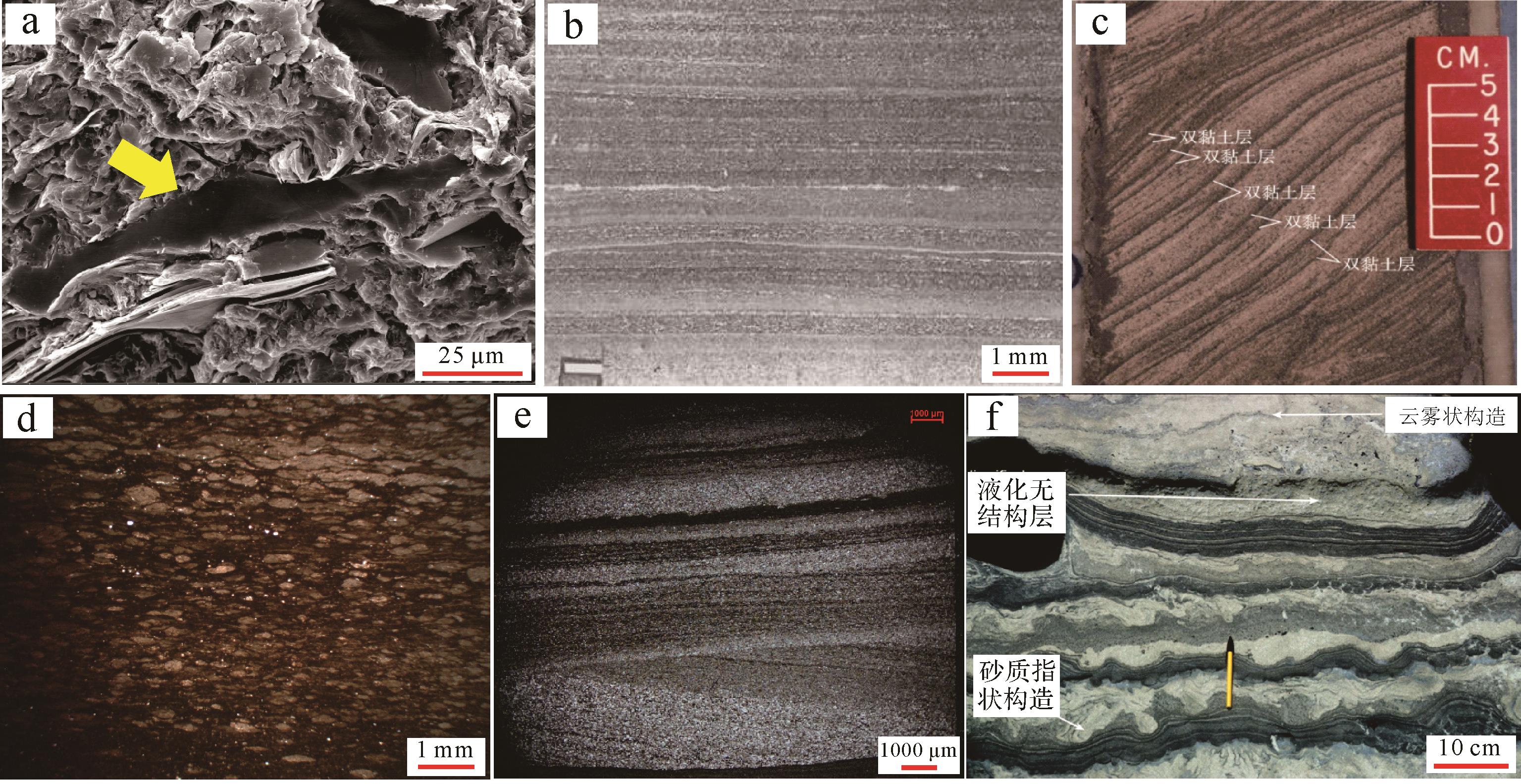
计量
- 文章访问数: 349
- HTML全文浏览量: 58
- PDF下载量: 194
- 被引次数: 0